Welcome to the Mindfulness Meditation Podcast presented by the Rubin Museum of Art.
We are a museum in Chelsea,
New York City that connects visitors to the art and ideas of the Himalayas and serves as a space for reflection and personal transformation.
I'm your host,
Tashi Chodron.
Every Monday we present a meditation session inspired by a different artwork from the Rubin Museum's collection and led by a prominent meditation teacher from the New York area.
This podcast is a recording of our weekly practice currently held virtually.
In the description for each episode,
You will find information about the theme for that week's session,
Including an image of the related artwork.
Our Mindfulness Meditation Podcast is presented in partnership with Sharon Salzberg and teachers from the New York Insight Meditation Center,
The Interdependence Project,
And Parabola Magazine and supported by the Frederick Lance Foundation for American Buddhism.
And now,
Please enjoy your practice.
Tashi Delek and Jule,
Jule from Ladakh.
I'm still here in Ladakh,
India.
People in Ladakh,
They greet with the word Jule.
So welcome.
Welcome to Mindfulness Meditation Online with the Rubin Museum of Art.
I'm Tashi Chodron,
And I'm so happy to be your host today.
We are a museum of Himalayan art and ideas in New York City,
And we are so glad to have all of you join us for our weekly program where we combine art and meditation online.
Inside from our collection,
We will take a look at a work of art.
We will hear a brief talk from our teacher,
And then we will have a short sit,
About 15 to 20 minutes for the meditation guided by our teacher.
So now let's take a look at today's theme and artwork.
And the theme is still Fineness.
In fact,
This month's theme is Fineness.
So this is the beautiful art connection for this month's theme of kindness.
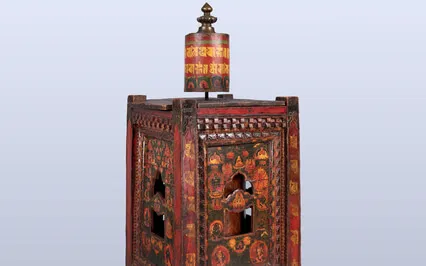
And what you're looking at is this tail wheel.
Tail wheels come in many different sizes.
And the one you're looking at here,
It's a 19th to 20th century,
Wood metals and metal mineral pigments.
The dimension of this is about 94 into 33 into 32 inches.
And it's in this beautiful Lotus mineral pigment where kind of typical.
So in Tibetan Buddhist culture,
Those who are unable to read,
They can spin this trail wheel.
And the wheel is filled with thousands of inscribed mantras.
In this particular trail wheel,
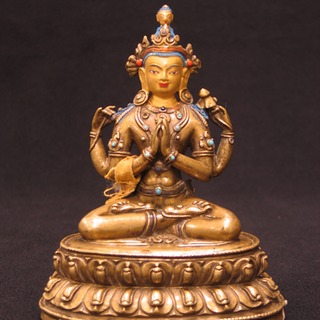
You actually see the deity Avalokiteshvara.
In Tibetan,
It's called Chenrek Sik.
And the mantra for Avalokiteshvara is the six syllable mantra for healing,
For purification of any negativity.
The mantra can be seen on top.
You see that smaller wheel on top.
And that scripture in Tibetan is called Len Tha,
Which is the Sanskrit scripture.
And this is the Om Mani Padme Hon,
The six syllable mantra.
And bottom of the smaller wheel under the scripture is the Lotus petal,
As you can see in orange sort of coral color and with the green leaf.
So this is the Avalokiteshvara mantra prayer.
And if you look at the bottom of this wheel,
There's actually a hole where a string goes through that.
And through that hole,
There's a string that ties to the metal stand where the wheel is on top.
And the wheel is filled with prayers,
The Avalokiteshvara mantra or the Medicine Buddha healing mantra for healing and Vajrasattva mantras for purifying any karmic obscuration.
So all,
There'll be thousands and thousands of these mantras.
And as you pull the string from that hole,
The prayer wheel spins.
It spins clockwise.
And the belief and the idea is that the prayer is read that many times and that much more blessing.
But one of the most important thing in this action is to dedicate,
Dedicate all the blessings and these positive energy for all essential beings benefit for the world peace.
So it's basically invoking the innate goodness that is in each of us,
That is the wisdom and compassion.
And through that,
Kindness arises.
And that is how we can connect to this theme.
So without further ado,
Let me bring our teacher for today,
Sharon Salzberg.
It's my great honor.
Thank you so much,
Sharon,
For being here.
And Sharon is co-founder of the Insight Meditation Society in Barre,
Massachusetts,
Has guided meditation retreats worldwide since 1974.
Her latest book is Real Change Mindfulness to Ourselves and the World.
Sharon is also the author of several publications,
Including the New York Times bestseller,
Real Happiness,
The Power of Meditation,
Faith,
Trusting Your Own Deepest Experience,
Loving Kindness,
The Revolution of Art of Happiness,
And The Real Love,
The Art of Mindful Connection.
While running our own podcast,
The Meta Hour,
And interviewing 100 plus influential voices in meditation and mindfulness movements,
Sharon has regularly contributed to many on stage conversations here at the Reuben Museum.
Thank you so much,
Sharon.
And Sharon's more information and most upcoming programs can be found on sharonsalzberg.
Org.
Thank you so much.
Hello,
Everybody.
It's wonderful to be here.
It's wonderful to be here around the world from around the world.
And it's wonderful to be here with this beautiful piece of art,
Which I found so moving in and this beautiful topic.
So just as we did a few weeks ago with another topic,
I want to spend a few moments with each of us just sitting being quiet and thinking about that word kindness and seeing what it brings up in us.
What kinds of imagery,
What kinds of emotion maybe,
What kinds of reaction.
Each of us has perhaps very different conditioning and background in thinking about kindness.
And we have all kinds of responses from disdain and dislike to admiration and awe.
Many cultures,
Kindness is kind of gendered.
Might be okay if you're a woman,
It might not be that okay if you're a man.
My first book that I wrote was called Loving Kindness.
And I remember some fair amount of negativity,
Meeting it,
And it was birthed into the world.
And there was some sense of,
Well,
That's just like feeling good or that's covering over.
They couldn't really have power because just covering over really conflicted feelings or difficult feelings.
And it took me a long time,
But years later,
I look back at that period and I thought,
Oh,
What they were really saying to those people was it's a kind of girly practice.
It's sweet,
It's sentimental.
But really,
What is our experience of it?
Just feel it in your body,
In your heart.
So thank you.
I sometimes say that kindness is love or loving kindness or compassion in action.
It's the living force.
It's the living embodiment.
Ideas like love or loving kindness can be ideas.
And they can exist as vague aspirations or abstract concepts or they can exist as the fulcrum around which we decide whether to chat with our neighbor or kind of rush them off and go inside.
Maybe only later to think,
I wonder if they were kind of lonely.
That was maybe a little hasty of me.
What if that recognition happened earlier?
Because that orientation towards something like kindness just infused our system and wasn't only for times when we were perfectly rested or had no stress in our lives.
It was for every time.
One of the things I've always enjoyed a lot about,
Particularly the Tibetan tradition,
Is that you hear these tremendous stories,
Almost like folk stories,
Which are so funny and so unexpected sometimes.
There's so many stories I've been told of the great master,
Learned,
Scholarly,
Impeccable in their scholarship and their reputation and just brilliant mind and can really see deeply and express things in a way that is so eloquent and so beautiful.
It's traveling around the countryside and traveling with a servant who's sort of like unkempt and maybe can't even read and has got lots of issues in terms of presentation,
But has the kindest heart you can imagine.
The story goes on and they meet whatever adventures and challenges on their journey.
And lo and behold,
Inevitably,
Who gets enlightened first?
That servant.
Because that openness of heart and that tenderness,
That vulnerability to recognizing,
Say,
The pain that others might be in,
It's so precious a quality that nothing else actually compares.
And it opens us,
It leaves us humble rather than with no identity.
Like,
I'm a great scholar,
Aren't I?
It leaves us able to connect much more purely with the person,
The people,
The peoples that are right in front of us.
And connection is what it's all about because that sense of connection is both going to guide our awareness and is guided by our awareness.
So it brings us to a much greater appreciation of who's there,
What's there.
When we do maybe walk by that supermarket checkout person,
For example,
And we do take a moment to either verbally,
Depending on the situation,
Verbally or non-verbally wish them well.
Instead of walking by them like they were another grocery cart,
Which they're not.
You know,
That is a person.
And that's why something like kindness as a practice is powerful because it's taking a truth,
It's an obvious truth.
It's not like a mysterious truth,
Hard to find,
Elusive.
The truth that our lives are all connected,
That we all have something to do with one another and it's putting it in center stage instead of saying,
Yeah,
That's a nice idea.
That's what we are really doing with a committed development of equality like kindness.
It doesn't mean being obsequious.
It doesn't mean only saying yes.
It doesn't mean never saying no.
It doesn't mean any of that,
Which is hard to believe.
I tend to pretty well try to divide between,
I mean some distinction anyway,
Between the inner state of connection,
Of caring,
Wishing well for someone and the outer manifestation,
Which is always contextual.
It's in the moment.
It's changing.
Depending on the moment changing,
It depends on circumstance.
It depends on our best guess is what I usually say.
It depends on our best guess of what might be the appropriate thing to say in this moment in time with this very person in front of me.
Because we fall into a big trap when we start feeling like there's only one way to respond.
That is kind.
We're just,
We're lost at that point because first of all,
It's not true.
And anytime we kind of prop up what isn't true,
We're going to hurt.
Second of all,
There's so many options available to us depending upon all those factors.
And sometimes I really literally just call it our best guess.
What seems the best thing to say in this moment to the best of my ability?
Yes or no?
Maybe it's no,
I'm not going to give you more money.
No,
I'm not going to lunge in the car one more time.
I'm sorry.
I can't do that.
I can't do this again.
Whatever you are moved to say.
Because that's the truth of the present moment and brings in kindness to ourselves,
Brings in wisdom or understanding like life's complicated.
You know,
You can't do everything for everybody and you have to be okay with that and have some measure of peace that is actually not going to weaken the force of kindness.
It's only going to strengthen it.
So let's sit together and we'll continue for a few minutes anyway.
In meditation practice,
The first huge,
Huge arena of kindness we come upon,
Of course,
Is to hurt ourselves.
So as we sit,
You can place your attention on the feeling of the breath,
Just the normal natural breath,
However it feels most at ease for you.
Maybe that is focusing on the nostrils or the chest or the abdomen.
Find that place,
Bring your attention there and just rest.
See if you can feel one breath.
Without concern for it's already gone by.
Start leaning forward for even the very next breath,
Just this one.
Find that place,
Bring your attention there and just rest.
See if you can feel one breath.
And as your attention wanders,
You get lost in thought,
Spun out in a fantasy or you fall asleep.
Notice how you speak to yourself right in that moment.
Can you be kind?
Can you be tender?
Maybe not.
Maybe you're pretty harsh,
Pretty intense.
Okay,
If you really feel like it's over the line,
It's mean,
It's punishing,
Relax.
Take a few breaths.
Remind yourself you can always,
Always begin again.
See if you can let go of whatever's taken your way and simply come back.
I've always found it just amazing that no matter how many times my attention might wander or wherever it might go for however long,
There is just that ability to let go gently,
To have some kindness toward myself and to begin again,
Just bringing my attention back to the feeling of the breath.
And when you feel ready,
You can open your eyes or lift your gaze and we'll end the meditation.
Thank you.
Thank you so much for that brilliant session,
Sharon.
Thank you for listening.
Have a mindful day.