Welcome to the mindfulness meditation podcast presented by the Rubin Museum of Art.
We are a museum in Chelsea,
New York City that connects visitors to the art and ideas of the Himalayas and serves as a space for reflection and personal transformation.
I'm your host,
Dawn Eshelman.
Every Monday we present a meditation session inspired by a different artwork from the Rubin Museum's collection and led by a prominent meditation teacher from the New York area.
This podcast is a recording of our weekly practice currently held virtually.
In the description for each episode,
You will find information about the theme for that week's session,
Including an image of the related artwork.
Our mindfulness meditation podcast is presented in partnership with Sharon Salzberg and teachers from the New York Insight Meditation Center,
The Interdependence Project,
And Parabola Magazine.
And now,
Please enjoy your practice.
Hi everyone.
Thanks for joining us.
This is Dawn Eshelman with the Rubin Museum of Art,
And you are here with us for our weekly mindfulness meditation,
Where we look at a work of art together and practice our weekly practice.
Oh wait,
This Friday,
It's going to be a real life event at the Rubin.
It is our opening of the Mandala Lab,
A brand new installation on the third floor for all ages.
Hope you can join us.
And it's because of the Mandala Lab that we're really focused on this theme of mandalas today.
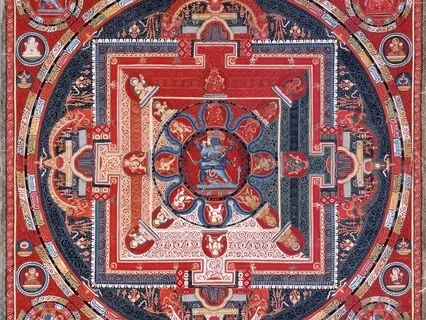
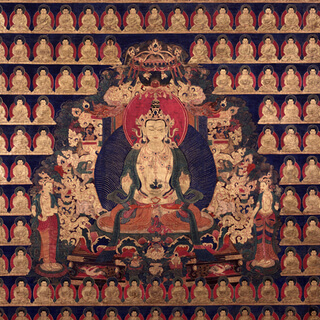
This is a beautiful mandala,
And mandalas with their elaborate patterns and geometry represent both celestial dwellings,
So kind of the universe,
Right,
And the celestial dwellings of the deities and Buddhist conception of cosmos.
And they are a symmetrical diagram oriented around this center figure here,
And composed of these concentric circles and squares.
And we talked last time about how they can sometimes be considered like a bird's eye view of an actual palace that a practitioner would then navigate themselves through.
The point to which is to really come to a clear understanding of the self and to transform.
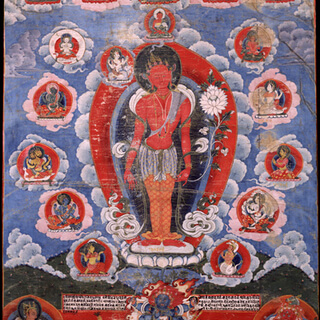
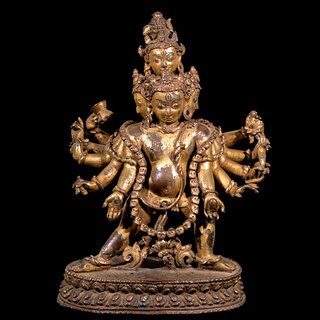
The deity in the center of this mandala is Krishna Yamari,
A wrathful form of Manjushri,
The bodhisattva of wisdom,
And Yamari has six faces and hands.
He holds a vajra and a bell.
And as we know through this iconography and our learnings about it,
The vajra and bell crossed at the heart represent the union of wisdom and method or compassionate action.
Now I would love to welcome the fabulous Sharon Salzberg,
Who is the co-founder of the Insight Meditation Society in Barre,
Massachusetts,
Where she's guided meditation retreats there and around the world,
Really,
For many years.
Her latest book is Real Change,
And it's great to have you here with us,
Sharon.
How are you today?
Thank you all for being here together.
It is a good time to meditate together.
I'm going to talk a little bit just about the idea of a mandala and the experience of it,
Then we'll get a chance to practice.
The mandala has always meant to me of the many things that can represent really a universe.
I think what it would be like if I were going to draw my universe,
My circle,
My beings,
The people I count on,
The people I feel grateful to,
The people I worry about,
Whatever it might be,
That that's the dimension of that particular universe.
Sometimes I think,
Oddly enough,
Most strikingly,
When I've gone to memorial services or I've gone to funerals and I realize,
Oh,
That person that I had a connection to,
They had a much bigger universe than me and the people we knew in common,
That they were the people they made music with and they were the people they visited museums with.
Maybe I was part of the group that they meditated with,
But we tend to have a significant universe.
If it's not people we encounter or meet up with in person,
It's people who've inspired us maybe,
Or those we've read about,
Or those who consume a lot of our mental energy.
That would be an interesting mandala.
Like who's taking up space in my day,
Each day in my mind.
And so I think that's an interesting exercise actually to decide the nature,
The flavor of the mandala you're going to be exploring and draw it out,
Paint it out.
Or visualize it,
You know,
Have that sense of your world in some dimension,
In some aspect.
And the really significant thing for me in terms of the idea of the mandala is that the core,
The center is the most important part,
That everything is radiating out.
So when I look at a mandala,
I don't think something wrong,
Something incomplete with it.
It feels like a holistic depiction of something.
I may not understand it,
You know,
But I can feel it in some way.
And that's because everything is radiating out from the center.
It all belongs.
And so that of course brings me to meditation practice where the foundational exercise is establishing some sense of center.
You know how we can,
Of course,
You know,
How we can be scattered or distracted and kind of feel like our energy is flying all over the place.
And so what we're doing in that aspect of practice is we're gathering,
We're landing,
We're having a place that is like a home base that has a sense of a feeling of a flavor of home.
We have a home and everything can come out from that.
Of course we leave home sometimes,
But there's a certain feeling when we get back there and it's not to exclude other experiences or deny them or make them go away.
But we have this vantage point or this basis where our energy is collected rather than all over the place where our attention is centered.
And I think the larger manifestation in life of that kind of scatteredness or dispersion or distractedness is a sense of fragmentation where still my favorite example of that when I was teaching once in New York city where,
Uh,
Someone raised their hand and said,
I can have loving kindness and compassion for all beings everywhere.
As long as I'm alone.
But once I'm with other people,
It's really rough and everyone left because we all knew what they were talking about.
And actually it can be the other way around as well.
We might feel a tremendous connection when we're with others,
But we have a very difficult time being alone.
So our lives tend to be fragmented.
They're compartmentalized.
It's the same way we can be so role identified.
You know,
I feel I'm one person at work,
I'm another person at home and whatever it might be.
And so this exercise in meditation here too,
In that larger,
More global sense of our life is helping establish a center.
Now remember,
You know,
Again,
The center does not mean pushing away other experiences,
But it's giving us a place to return to,
To settle,
To not be manipulating or strategizing.
How am I going to get more of that or less of that?
We can simply be,
And out of that will radiate connection to everything.
So let's sit together.
You can sit comfortably.
Close your eyes or not.
Let's start by listening to sound,
Whether the sound of my voice or other sounds.
It's a way of relaxing deep inside,
Allowing our experience to come and go.
Of course we like certain sounds and we don't like others,
But we don't have to chase after them to hold on or push away.
Just let the sound,
Unless you are responsible for responding to it,
Just let it wash through you.
Bring your attention to the front.
Bring your attention to the feeling of everybody's sitting or whatever sensations you discover.
See if you can feel the earth supporting you.
See if you can feel space touching you.
Allow yourself to receive the space which is already touching us.
It's always touching us.
Bring your attention to your hands and make the shift to picking up the world of direct sensation instead of thinking hands,
Fingers,
Feel,
Warmth,
Coolness,
Heaviness,
Pressure,
Whatever it might be.
You don't have to name these things,
But feel them.
And on that same level of picking up sensations,
Bring your attention to the feeling of the breath,
Just the normal natural breath.
Wherever you feel it most distinctly,
The nostrils,
The chest or the abdomen.
If it's the nostrils,
It may be tingling,
Vibration,
Warmth,
Coolness.
At the chest or the abdomen,
It may be movement,
Pressure,
Stretching,
Release.
Again,
You don't have to name these things,
But feel them.
This is where we rest our attention.
This is the center.
See if you can feel one breath.
Without concern for it to have gone by,
Without leaning forward for even the very next breath.
This is one.
You you you if you like you can use a quiet mental notation of in out or rising falling to help support the awareness of the breath but very quiet so your attention is really going to feeling the breath one breath at a time if you find your attention is wandered your energy has gone to the past to the future anywhere it's all right maybe fall asleep that's okay too you can realize that you've left home so to speak just very gently let go and bring your attention back to the feeling of the breath you if you have to do that many times it's perfectly all right you you you you you you you you it's very much got that kind of feeling or flavor I'm just heading back home no matter what has taken us away it's fine well however long it's been that's okay too when we notice we've been distracted we've been lost then we have the opportunity to let go gently and to begin again bringing our attention back to the feeling of the breath you you you you you you you you you you you you you you you and when you feel ready you can open your eyes or lift your gaze and we'll end the meditation you thank you Sharon thank you thank you all that concludes this week's practice if you'd like to support the Rubin and this meditation series we invite you to become a member if you're looking for more inspiring content please check out our new podcast awaken hosted by Laurie Anderson The 10-part series features personal stories that explore the dynamic path to enlightenment and what it means to wake up.
Now available wherever you listen to podcasts.
Thank you for listening and thank you for practicing with us.