Welcome to the mindfulness meditation podcast presented by the Rubin Museum of Art.
We are a museum in Chelsea,
New York City that connects visitors to the art and ideas of the Himalayas and serves as a space for reflection and personal transformation.
I'm your host,
Dawn Eshelman.
Every Monday we present a meditation session inspired by a different artwork from the Rubin Museum's collection and led by a prominent meditation teacher from the New York area.
This podcast is a recording of our weekly practice currently held virtually.
In the description for each episode,
You will find information about the theme for that week's session,
Including an image of the related artwork.
Our mindfulness meditation podcast is presented in partnership with Sharon Salzberg and teachers from the New York Insight Meditation Center,
The Interdependence Project,
And Parabola Magazine.
And now,
Please enjoy your practice.
Hello everyone.
Welcome to mindfulness meditation online with the Rubin Museum of Art.
I'm Dawn Eshelman.
Great to be here with you on what is here in New York City is this kind of blustery,
Chilly autumnal day finally.
So I hope you're cozy wherever you are.
We're a museum of Himalayan art and ideas in New York City,
The Rubin Museum,
And we're so glad to have you all join us.
This is our weekly program where we combine art and meditation online.
I hope that those of you who are nearby and out and about these days have come to take a look at our brand new installation called the Mandala Lab.
This brand new installation is really exciting and it just opened a couple of weeks ago.
Most of us on staff were there along with,
Oh my gosh,
Hundreds of guests and it was such a great affirming experience to just kind of be back together in the space in honor of these ideas and this art.
So Mandala Lab is where emotions can turn to wisdom and it really takes the cues from the mandala and the symbolism of the mandala and the installation offers five thought-provoking,
Playful experiences and asks you to really use your senses to kind of bring you along an inner journey that's focused on your self-awareness and awareness of others.
So hope that you can come and enjoy this experience designed to inspire connection and empathy and learning for all of us.
So based on that exhibition,
We have taken our cue to really explore this world of mandalas and today we're looking at a really beautiful one.
I will share that in just a moment and we'll look a little bit closer at it together.
Then we will bring on our wonderful teacher,
Sharon Salzberg,
And we'll hear a talk from Sharon.
We'll have a short sit,
15 or 20 minutes,
Guided by her.
Okay,
So I will bring us back to our mandala here.
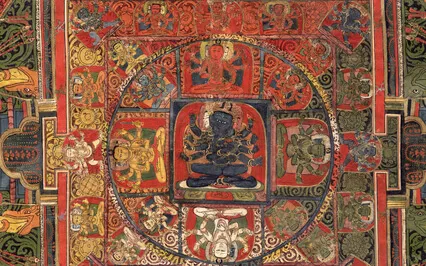
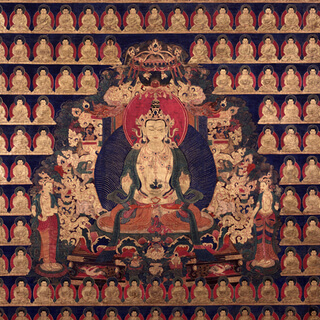
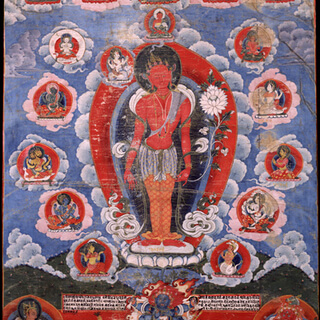
This is the mandala of Guhyasamadja,
Akshobhyavadra,
And this is from 14th century Tibet,
Pigments on cloth and mandalas play a very important part in Buddhist practices,
Symbolizing the cosmos as the divine palace of a deity.
So whether it's created in paint,
Like we're seeing here or in sand,
Right?
We often think of the sand mandalas when we think of mandalas and even sculpture,
Right?
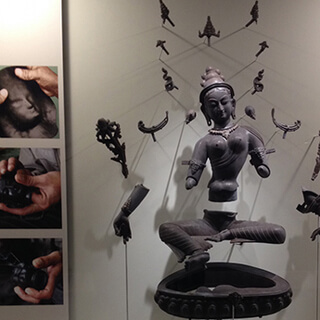
We've seen some 3D depictions.
So mandalas depict this divine abode as a geometric diagram,
This three-dimensional architectural structure and ritual items in these offerings and Buddhist practitioners use mandalas to help visualize the awakened beings who dwell there in order to evoke their power and gain a similar relationship to their own minds.
So this mandala coming from the Sakhya lineage is focused on the meditational deity right at the center of this sort of indigo blue deity here,
Which is Guhyasamadja,
Who is a form of the Buddha,
Akshobhyavadra,
The unshakable,
Vajra,
Akshobhyavadra.
So you remember the vajra,
The symbol of the lightning bolt,
This clarity,
This action.
And Guhyasamadja here is surrounded by,
I believe,
Over 30 deities in this entirety of this mandala.
You can see it is just packed with detail,
Figures,
Symbolism.
We have the rings of fire here.
We have the four gates of the different directions.
And in fact,
The deities that surround him most closely are the so-called directional Buddhas,
With Vairochana in the east,
Ratnasambhava in the south,
Amitabha in the west,
Amoga city in the north.
And they represent the enlightened qualities and wisdom of the five constituents of the human body and the mind,
Which practitioners develop through these practices of visualization,
Meditation,
And ritual.
So we will bring on our teacher today,
The wonderful Sharon Salzberg.
Sharon is the co-founder of the Insight Meditation Society in Barre,
Massachusetts,
And has guided meditation retreats all over the world for many years and is the author of so many wonderful books,
Including Real Change,
Mindfulness to Heal Ourselves in the World,
And Real Love,
The Art of Mindful Connection.
So great to have you here,
Sharon,
And thanks again for guiding us.
So thank you all for coming.
It's so delightful to come together and practice together and look at such extraordinary pieces of art.
So I've been thinking of course about the mandala.
And one of the ways that term is used and the depictions the art is used is to symbolize a journey.
And I find that very interesting because just now looking at that beautiful,
Beautiful mandala,
It's really not a journey.
I don't think where you kind of start on the edge and you go right to the center and,
And there you are,
But you're absorbing and you're learning and you're,
You're gathering information and new ways of seeing and maybe things you didn't notice the last time you did the journey and so on.
As you go along,
It reminded me a little bit of,
Um,
In Burma,
There's this saying like a folk saying that when the hunter goes into the forest to capture a bird,
It ultimately doesn't really matter if they capture the bird or not because in their wandering,
They learn the ways of the forest.
So we learn the ways of our bodies and minds and our consciousness and our,
Our longing and our fears and everything as real everything as we make this journey.
And that's kind of the whole point,
You know,
In terms of our,
Uh,
Western conditioning,
Of course we tend to get fixated on,
On the goal and,
Uh,
Capturing that bird and getting that insight and having a different state of consciousness and maybe don't pay as much attention to the actual benefit and the,
Uh,
Kind of beautiful aspects of,
Of the actual wandering.
But that's,
That's what is evoked for me.
It also reminded me of a labyrinth in a way,
Which as you know,
Is a kind of patterned walk that zigs and zags and does these turnings with the ultimate goal of being just in that center point.
I remember the first time I ever walked a labyrinth,
It can be etched in concrete.
It could be in a rug,
A carpet,
There's so many different ways,
But it's the same kind of zigzag movement.
So the first time I ever walked a labyrinth was outdoors at Grace Cathedral in San Francisco.
And I started at the edge and I was walking along and it was very much that kind of,
You know,
You're almost at the center and then you just keep following the path,
Which is laid out and you end up right back at the edge.
And I remember the first time that happened,
I stood there and I thought I made a mistake.
I was almost in the very center and somehow this path has taken me on a kind of loop and I'm,
I'm way out here sort of near the edge again.
I must've made a mistake,
But there's nothing to do,
But keep on going,
Uh,
Step by step.
As the path is laid out.
So I kept on going and lo and behold,
Having almost been in the center and then being way out on the edge again,
I kept going and found myself right in the very center.
So I went from the outdoor labyrinth inside the cathedral where they had another identical labyrinth on a carpet and I started walking and I had the identical experience.
I was almost in the center and the path took me way out,
More close to the edge.
And I had the thought,
I must've made a mistake.
I did this wrong.
And then I thought,
Didn't you just have that experience a few minutes ago where you saw that sometimes a path does that.
You feel like you're almost right at the very,
Very center,
The heart of everything.
And then you just keep going and you're way out on the edge again.
But if you keep going,
You will find that you are in fact back into the center in the long run.
And so I found that also interesting,
Including our tendency to chastise ourselves for not having the right experience,
Even though we just learned something a minute and a half ago about all experience is important and it's all valuable.
So there's so many ways of looking at a mandala and looking at a journey.
And I would urge you if you either later today with Tashi or at some time,
If you're just looking at a mandala in that way,
To start imagining it as a journey,
Not sort of cutting through,
You know,
Like clear cutting the forest to get through to the center,
But just as you wander throughout and see what happens.
And so too,
In our meditation practice,
We set out maybe to capture that bird,
To have a certain insight,
To have a breakthrough,
To stop feeling something that we're awfully tired of feeling or to finally feel something when we feel nothing or to have a kind of transcendent experience or something so different from our ordinary state of consciousness.
But ultimately what is most important is learning the ways of the forest.
It's learning the ways of the body and the mind,
Learning how they relate to one another,
Learning what brings us sorrow,
In fact,
Which may not be what we think.
Learning what brings us joy and a sense of fulfillment,
Which may not be what we think.
So many of us have,
We all have different kinds of conditioning,
But you know,
So many of us have a kind of conditioning where we feel,
Or we've been taught,
You know,
Something like endless competition,
Endless accumulation.
This is real strength and outstanding as qualities and the,
What we might call softer qualities,
You know,
Compassion and generosity and kindness are really kind of foolish and will weaken us and bring us down.
And when we really get the chance to look,
Which is what we do in meditation practice,
We simply look and we see things are kind of different than that actually.
And really the opposite,
The things we sometimes hold onto,
Like holding on itself,
Thinking,
Oh,
This is going to make me be in control.
This is going to keep change from happening.
This is going to get me what I really want.
You realize,
Wow,
That is one uptight state that's never fulfilled because nothing ever ceases changing.
Or we look at those so-called softer qualities like kindness and compassion and realize that's some of the greatest feeling of connection I can have,
Especially when it's not say generosity with strings attached,
When it's really like a freely given gift,
Which may be material,
May not be material at all.
It may be our attention or our gratitude towards someone,
Something like that.
And so we are basically honing the power of attention so that we can really learn our lives.
We can learn the world in a whole different way.
So let's sit together and look at our own inner Mandela.
You can sit comfortably,
Close your eyes or not,
However you feel most at ease.
You can listen to the sound of my voice or other sounds.
And unless you are responsible for responding to the sound,
See if you can just let it wash through you.
Bring your attention to the feeling of your body sitting or whatever sensations you discover.
Bring your attention to your hands and see if you can make this shift from the more conceptual level like fingers to the world of direct sensation,
Picking up pulsing,
Throbbing pressure,
Whatever it might be.
You don't have to name these things,
But feel them.
And bring your attention to the feeling of your breath,
Just the normal,
Natural breath,
Wherever you feel it most distinctly.
That may be at the nostrils or the chest or the abdomen.
Find that place,
Bring your attention there and just rest.
See if you can feel one breath.
That concern for what's already gone by,
That leaning forward for even the very next breath,
Just this one.
And if images or sounds or emotions or sensations should arise,
But they're not all that strong,
If you can stay connected to the feeling of the breath,
Just let them flow on by.
Your breathing,
It's just one breath.
Something arises somewhat more strongly with more intensity.
It's capturing your attention.
Spend a few moments just recognizing,
Oh,
This is what's happening right now.
Forgive yourself for whatever you're feeling,
Whatever's coming up.
You simply want to acknowledge it.
This is the truth of the present moment.
There's joy,
There's sorrow,
Whatever it might be,
If that's easy.
And then bring your attention back to the feeling of the breath.
And for all those perhaps many times you are just gone,
Spun out in a fantasy,
Lost in thought or you fall asleep,
Truly don't worry about it.
Can recognize that,
See if you can let go gently of whatever's taken your way.
Bring your attention back to the feeling of the breath.
There's joy,
There's sorrow,
Whatever it might be.
You you you you you you you you It's really quite amazing no matter where our attention goes or for how long we can always always Practice letting go we can practice beginning again.
Keep wandering you nothing's been lost nothing's been ruined you you you you you you you you you It's just one breath at a time and the breath is happening anyway All you need to do is feel it receive it Be present for it And when you lose it see if you can let go and begin again you you you you you you you Thank you Thank you all That concludes this week's practice If you'd like to support the Rubin in this meditation series We invite you to become a member if you're looking for more inspiring content Please check out our new podcast awaken hosted by Laurie Anderson The 10-part series features personal stories that explore the dynamic path to enlightenment and what it means to wake up Now available wherever you listen to podcasts.
Thank you for listening and thank you for practicing with us