Welcome to the Mindfulness Meditation Podcast presented by the Rubin Museum of Art.
We are a museum in Chelsea,
New York City that connects visitors to the art and ideas of the Himalayas and serves as a space for reflection and personal transformation.
I'm your host,
Tashi Chodron.
Every Monday we present a meditation session inspired by a different artwork from the Rubin Museum's collection and led by a prominent meditation teacher from the New York area.
This podcast is a recording of our weekly practice currently held virtually.
In the description for each episode,
You will find information about the theme for that week's session,
Including an image of the related artwork.
Our Mindfulness Meditation Podcast is presented in partnership with Sharon Salzberg and teachers from the New York Insight Meditation Center,
The Interdependence Project,
And Parabola Magazine and supported by the Frederick Lance Foundation for American Buddhism.
And now,
Please enjoy your practice.
Hello and Tashi Delek.
Welcome everyone.
Welcome.
So nice to see so many of you joining from everywhere from North Carolina,
Manhattan.
Thank you all so much.
Welcome,
Welcome.
Tashi Delek and I am back.
Those of you who are first time,
I've been traveling all over India and Nepal and finally I'm back home and it's so nice to be back here.
I'm Tashi Delek and welcome to Mindfulness Meditation Online with the Rubin Museum of Art.
My name is Tashi Chodron and I'm happy to be your host today.
We are a museum of Himalayan art and ideas in New York City and we are so glad to have all of you join us for our weekly program where we combine art and meditation online.
Inspired from our collection,
We will take a look at work of art from our collection.
We will hear a brief talk from our wonderful teacher,
Tracy Cochrane,
And then we will have a short set,
15 to 20 minutes for the meditation guided by our teacher.
So let's take a look at today's theme and artwork.
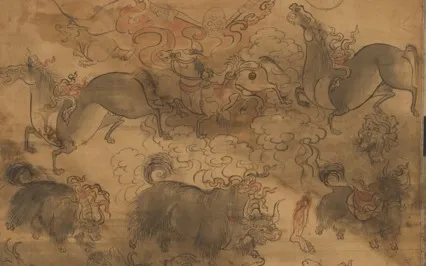
The theme for this month is perspective and the artwork for today is wrathful offering.
So here we're looking at this beautiful silk painting.
It's a 19th century.
The origin is from Tibet and about 35 into 12 inches on silk and the perspective of a common theme,
This painting of wrathful offerings scattered in a charnel ground excels in its free execution with outlines only partially filled with color.
As you can see here,
The silk background's earthen color,
Beautiful earth tone actually resembles the clay walls that would more often be used as a ground for this subject.
A sense of perspective is found only in the lower section where human parts are spread across the charnel ground.
There is no notion of space and the relative proportions are upset by the large skulls in the upper portion of the painting.
The wrathful offerings are an extremely rare subject for portable paintings,
But a common theme in the Dharma Protectors shrine room of Tibetan monasteries.
The Dharma Protectors room is often referred to in Tibetan as Wong Kang,
Which basically means the Dharma Protectors temple or a chapel.
In other words,
At the top of this work are three offering bowls,
The central one containing an offering of the five senses,
Each represented by its corresponding organ.
The animals underneath horses,
Yaks,
Sheep,
And dogs are the main domestic animal of Tibet and the Himalayas,
Here shown in hierarchy with the most valuable on top.
The corpses at the bottom and the human body parts between them remind us that the scenery represented is a charnel ground,
Like a cemetery,
Right?
So in the Tibetan Buddhist Vajrayana tradition,
There are actually three kinds of offerings,
The outer,
Inner,
And secret or sacred offerings.
Like those of you who are familiar with the female buddha-tara,
The offerings that you would find,
Or in fact,
In the Tibetan Buddhist shrine room at the Rubin Museum,
You would find offerings of the referred to as the outer offering,
Like the flowers and the water,
Grains,
And things like that.
But the wrathful deity offerings are more often referred to as the inner offerings,
Which is more like what you see here,
Very fierce internal organs,
Charnel ground,
Something that is all the rawness,
Symbolizes all emotions and ego.
Like for instance,
One teacher says,
Without blood,
That means we are not alive.
So you know,
Wrathful offering is to destroy,
Right,
All the sources of suffering in the samsara or destroy the duality mind,
Which is the ego and afflictive emotions,
And to transform into non-dual,
Which is awakening,
Basically.
So at the top of this work are three offering bowls,
As I mentioned earlier,
The central one containing the offering of five senses,
Each represented by its corresponding organ,
And the animals you see,
They're very playful looking animals with very cloud-like or fire-like flames circled around.
And now let's bring on our teacher for today.
Our teacher is a wonderful teacher,
Tracy Cochran.
So nice to have Tracy back.
Tracy has been a student and a teacher of meditation and spiritual practice for decades.
She's the founder of Hudson River Sangha,
Which is now virtual and is open to all.
The link for her weekly meditation can be found on our website,
Tracycockran.
Org.
In addition,
Tracy had taught mindfulness meditation and mindful writing at the Rubin Museum of Art and the New York Insight Meditation.
She's also a writer and the editorial director of Parabola,
An acclaimed quarterly magazine that seeks to bring timeless spiritual wisdom to the burning questions of the day.
Her writings,
Podcasts,
And other details can be found on our website and on parabola.
Org.
Tracy,
Thank you so much for being here.
Thank you,
Tashi.
I'm delighted to be back and welcome back to you too.
Welcome home.
And I'm very touched by this particular illustration because it's always my wish to help us,
Including myself,
Find ways to approach these beautiful sacred artworks from our own experience.
And this particular illustration reminded me at first glance of cave paintings,
Ancient cave paintings,
Meaning it portrays something universal in the beautiful movement of the animals and also the impulse.
Going back to what Tashi shared about this being a depiction of something that takes place in a charnel ground,
A cemetery.
I remember learning that young monks,
Or maybe not so young,
And nuns would often go into these places which weren't just sad and frightening,
Like cemeteries we may have seen in the West.
But there was another component of fear because the aerials were open and predators would come to these places.
So it was a very frightening place to be.
And these young monastics would go and sometimes sit all night in the middle of this place and meditate,
Basically facing their deepest fears,
Their deepest sorrows,
Inviting demons,
However we understand them,
Inside or out,
To come and devour them,
Testing their practice.
So this certainly seems frightening,
But since the theme is perspective,
I invite you to entertain the idea that meeting the things that frighten us can be something that we can approach,
Not with a fearful sense of being entirely alone in the face of something very,
Very painful or shameful,
But something that opens to another kind of discovery.
What do I mean?
Just this,
Even as we sit here right now,
Before we begin our formal practice,
Let yourself take note of how you feel today.
Just today could be a bit tired,
Could be hopeful,
Could be happy,
Could be with some trace of sorrow or pain.
And just notice that our attention naturally knows how to meet what comes up.
There's something in us that is constantly striving for things to be better,
To feel better,
Or to have this moment be a little bit better,
Or to harken back to something we once loved or liked.
But notice that there's something in us that's already here that knows how to just rest with what is.
And if these offerings intended to close the gap between this state called awakening and our usual state,
What if,
What if we could shift perspective to see that in a moment and sometimes just for a moment,
Just that is enough,
We can touch the truth that this awakening is already here.
And that when painful feelings,
Sensations,
Memories and thoughts arise,
Like demons,
Like ghosts,
There is an awareness that's ready to meet them with openness and compassion.
And that the offering that we can give in that moment is a willingness,
Just a little bit of willingness to touch,
To allow ourselves to feel in an embodied way what's here,
What hurts,
What frightens,
What makes us sad.
Just that.
And that this touching,
This act of touching ultimately sets us free.
There's an ancient Inuit story of a fisherman who pulls up a net in an icy sea and it's full of bones and frightening things,
Mangled pieces of some being.
And his first impulse is to cast it away,
Which is the first impulse I have and many of us have when something painful comes up,
I don't want to think about that,
I don't want to remember that,
Or something so uncomfortable,
Quick,
I want to fix it,
What can I pull out of my dharma toolkit to fix this,
To course correct,
Instead of that to just let yourself feel it,
Touch it.
So this fisherman overcame his impulse to reject,
To flee what scared him in the same way that these monastics sit still in the middle of the charnel ground.
And he took that horrible mass of bone and blood and hair back to his hut and gently and carefully laid it aright and it became a beautiful living woman.
Residualized by his compassion and interest and knowing it and setting it right.
So we discover in this work,
We shift in our perspective from thinking that what will shortly save us is out there somewhere beyond us,
To settling down into our living experience and begin to touch the truth that there is nothing in us,
No beast,
No ghost,
No frightening feeling,
No shame that isn't acceptable.
Thich Nhat Hanh,
The beloved Zen teacher,
Would remind people that to be beautiful is to be yourself,
To be fully yourself,
To be accepted and not by a crowd out there or some kind of judge on high but by yourself.
It's an action,
This practice,
An action of opening to receive ourselves,
Our whole experience.
Not with our usual thinking mind but with that awareness that's deep inside us and also surrounding us that sees with openness and compassion.
This is the way to awaken.
So let's sit together and see for ourselves.
We take a comfortable seat which means give yourself welcome,
Welcome yourself to sit here for this little while,
Letting the eyes close or looking down,
Close eyes is best and just allow yourself to take in an impression of how you feel today.
And notice how it feels to bring an attitude of acceptance instead of an impulse to flee or fix or space out but just to be with what's here.
Allowing it to be seen,
To be touched by an awareness and you might experience it more by a sensation,
An awareness that allows us to be ourselves.
Notice how it feels to just let yourself rest,
To rest in stillness.
A stillness that doesn't mean silence but not resisting,
Not striving,
Just being.
And notice how it feels to let the attention come to rest on the breathing,
The in-breath and the out-breath without changing,
Just seeing,
Sensing.
And allow yourself to experience the in-breath as taking in what's here,
Your experience.
And allow yourself to see,
To sense the out-breath as letting go of this experience,
Releasing it into a field of tenderness and compassion.
Realizing it as surrounding you.
Taking in your experience including painful feelings,
Difficult feelings without thinking about them but allowing them to be touched,
To be felt in an embodied way.
Sorrow,
Shame,
Worry,
Conflict,
Just felt and allowing it to be breathed out into a field of compassionate awareness surrounding you.
An attention that sees with care and interest and no judgement.
Breathing in,
Breathing out.
Noticing how it feels to come home to the body,
To the present and to open up to the present and to an attention that sees with kindness and complete acceptance.
If you get lost or start sleeping,
Dreaming,
Worrying,
Just gently come home again to the body and the rhythm of the breath.
Breathing in,
Experience,
Emotion.
No matter how painful,
Breathing out into a field of compassionate awareness.
Tenderness.
Noticing how it feels to allow yourself to be vulnerable,
Undefended,
Surrounded by an awareness,
A And not seeking out yourself thoughIDKAS Speaker Surrounded by an awareness that's kind,
Open like the sky.
Let yourself be still.
And notice as we practice that you may feel less alone.
More open and connected to life.
Two forces of compassion and acceptance and wisdom.
Two forces of compassion and wisdom.
Two forces of compassion and wisdom.
When you get lost in thinking,
Notice how it feels to just be still.
And let that guide you home,
Back to the body,
Open to an awareness that sees with acceptance,
With caring.
And notice how it feels to just be still.
And notice how it feels to just be still.
Notice how it feels to relax into the body,
Knowing that you're surrounded by the body,
Knowing that you're surrounded and received by benevolent forces.
Seeing just as you are.
And notice how it feels to just be still.
And notice how it feels to just be still.
And noticing how it feels to offer yourself compassionate awareness,
Allowing your feelings to be felt.
Offering them out to an awareness that's sky-like,
Compassionate,
Caring,
Not in words but in light.
Sight.
And notice how it feels to just be still.
Just rest in presence.
Knowing that you're more than you're thinking and fears and pain.
That you're also connected to this awareness that's vast.
And notice how it feels to just be still.
And notice how it feels to just be still.
And notice how it feels to just be still.
And notice how it feels to just be still.
And notice how it feels to just be still.
Thank you.
Thank you.
Thank you so much for that beautiful session,
Tracy.
That concludes this week's practice.
If you would like to support The Rubin and this meditation series,
We invite you to become a member of The Rubin.
If you're looking for more inspiring content,
Please check out our other podcast,
Awaken,
A podcast that uses art to explore the dynamic paths to enlightenment and what it means to wake up.
Available wherever you listen to podcasts.
Thank you for listening.
Have a mindful day.