Welcome to the mindfulness meditation podcast presented by the Rubin Museum of Art.
We are a museum in Chelsea,
New York City that connects visitors to the art and ideas of the Himalayas and serves as a space for reflection and personal transformation.
I'm your host,
Dawn Eshelman.
Every Monday we present a meditation session inspired by a different artwork from the Rubin Museum's collection and led by a prominent meditation teacher from the New York area.
This podcast is a recording of our weekly practice currently held virtually.
In the description for each episode,
You will find information about the theme for that week's session,
Including an image of the related artwork.
Our mindfulness meditation podcast is presented in partnership with Sharon Salzberg and teachers from the New York Insight Meditation Center,
The Interdependence Project,
And Parabola Magazine.
And now,
Please enjoy your practice.
Welcome,
Welcome everybody to mindfulness meditation online here with the Rubin Museum of Art.
I'm Dawn Eshelman and we are a museum of Himalayan art and ideas in New York City.
Thank you so much,
All of you,
For joining us for our weekly meditation program where we combine art and meditation online.
It is great to have so many of you joining and welcome to all of you.
Welcome to those listening through our podcast.
And yeah,
I'm hoping that some of you who do listen regularly to the podcast are able to join us here in our new online iterations.
This is just our second episode online and it's really wonderful to be able to connect with so many of you this way.
So for today's session,
We will take a look at a work of art from our collection.
We'll hear a brief talk from our teacher and then we'll have a short sit,
15 to 20 minutes.
So I hope you are very well and that your meditation practice is serving you well and being there for you.
Again,
Even if that just means that you remember to take a good deep breath now and then.
And it's so wonderful to have people joining from so many corners.
You've got,
Let's see,
We have Zurich,
Chicago,
India,
Lucknow,
India,
And Canada and New York City,
Even Chelsea,
New York City,
Our neighborhood,
The Rubens neighborhood.
So great to have you.
And this month,
August,
This program is completely free.
We would love to have you join in and invite your friends.
So if you have been tuning into the Rubin and to our social media over the past month or so,
You will know that we are in the midst of a beautiful participatory project called the Lotus Effect,
Which invites you to fold a lotus out of paper in honor of someone or something that has helped you during a difficult time.
So this month during mindfulness meditation,
We're thinking all about the symbolism of the lotus,
What it represents,
Especially in some of the Buddhist and Hindu art in our collection.
And we're talking about one of the ideas the lotus represents,
Which is awakening.
So let's take a look at a work of art.
So to some of you,
This deity here may be very familiar.
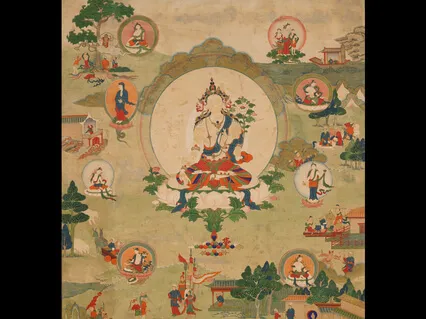
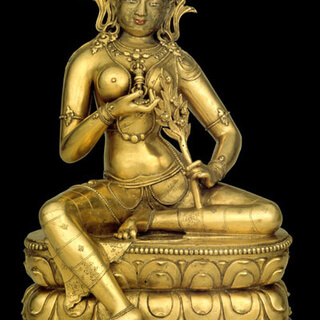
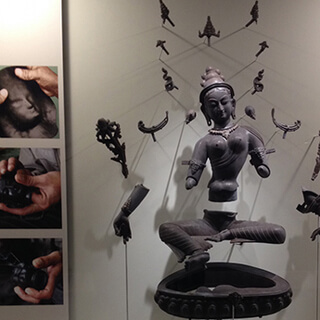
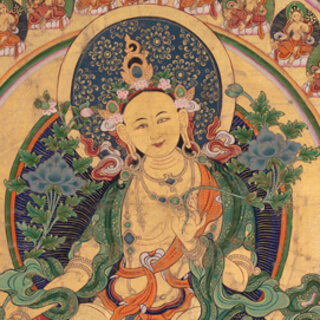
This is Tara.
And here we see the goddess Tara in her white colored form,
Which is associated with practices that are helpful for increasing the lifespan and removing illness.
And we also know Tara as the deity that helps protect us from fears.
Right.
So she's peaceful,
Smiling.
And with a moon as a backrest,
She's adorned with silk and jewel ornaments.
And she's offering a gesture of supreme generosity with her right hand.
And in her left hand,
She holds a lotus flower.
She holds the stem right between her fingers and the blossom blooms right over her shoulder there.
She is also seated in what we call a lotus position with her legs crossed.
And she's resting on a lotus throne that is shaped like a lotus.
You can see the petals there.
So lotuses grow in these muddy,
Murky waters.
They rise to the surface and then they unfold at the top.
They bloom untainted by the muck.
And in fact,
They are nourished by it.
And they serve as a reminder to us that even with their delicate,
Temporary bloom,
That these moments of beauty can emerge even from the toughest situations.
So in Tibetan Buddhism,
The sacred symbol and in Buddhism in general is associated with spiritual awakening or enlightenment.
And we can think of this from a secular perspective as well.
And I'll offer you the question to what have you woken up to in your life lately?
So we'll take a more in-depth look at this work of art at the end of the program with Tashi.
But now let's bring on our teacher today,
Sharon Salzberg.
Hey,
Sharon.
Hi,
Sharon.
Hi there.
How are you?
Hi.
Great.
How are you?
I'm good.
Good to see you.
So good to see you too,
Sharon.
And I do want to introduce you properly and read your bio here for folks.
But wow,
A lot has happened since we were last together.
And yes,
It's wonderful,
Wonderful to be here with you.
I see people saying,
I missed you,
Sharon,
On the chat.
I missed you too.
So many of you know Sharon and her wonderful work.
In case you're new to her,
She is the co-founder of the Insight Meditation Society in Barry Massachusetts where she's guided meditation retreats worldwide and she has since 1974.
She has a new book.
It's coming out September 1st.
And it's called Real Change,
Mindfulness to Heal Ourselves and the World,
September 1st.
However,
You can pre-order it right now.
And actually,
Sharon will be back here as part of this program on September 14th to celebrate the book release with us then.
So I hope you can mark your calendars and make sure to come back then.
And of course,
Many of you know Sharon's other wonderful books such as the New York Times bestseller,
Real Happiness,
The Power of Meditation,
And so many others.
And we're so grateful Sharon's been a regular participant here on this program and at many of our onstage conversations.
Sharon,
Over to you.
Thank you so much for being here.
Thank you so much.
I really miss you all too.
I miss getting together physically in that beautiful spot,
That beautiful room.
But it was so delightful really to see as people were signing in the range of places that people were signing in from.
And I thought,
Okay,
Well,
That is the silver lining that here we are,
People tuning in really from all around the world.
It's quite lovely.
So awakening.
Awakening is such an interesting word because I think often of that very famous story of the Buddhas where he was just post enlightenment.
It was 48 days,
49 days before his big awakening sitting under the Bodhi tree.
And he spent those 49 days in the presence of the tree happily contemplating various things.
And then when he got up to walk to a nearby town to meet up with his old friends,
His old comrades,
And to actually do his first sermon,
He came to some road and he came upon this man who said to him,
49 days after his big enlightening,
He was quite radiant.
And he said,
Who are you?
What are you?
Are you like a celestial being?
Are you some kind of unearthly being?
And the Buddhist said in response to the man's inquiry,
Like,
Who are you?
What are you?
He said,
I am awake.
I'm an awakened one.
And at that point,
He said,
The man just said,
Yeah,
Maybe.
And he walked away,
Which is another whole discussion about the right kind of doubt to have.
And then the wrong kind of doubt to have where you just walk away instead of inquiring further.
But I always thought that was so interesting,
Right?
He didn't say I'm Siddhartha Gautama from this place,
From this cast,
Or I'm so special.
You have no idea or I'm nobody at all.
Or I mean,
He said,
I'm awake,
Which is the kind of major consideration.
And I extrapolate that of course,
To our lives.
What's it like to feel awake or what's it like to be kind of half asleep in some stupor?
And what are the qualities in wakefulness?
Of course,
Not to the degree perhaps the Buddha was expressing by any means,
But more than before we made some conscious effort to really wake up.
I think when the Buddha is talking about being awake,
An awakened one,
He's talking about having dissolved the conditions that give rise to distortion,
To ignorance,
To disconnection,
To the various ills that we suffer from to one degree or another.
He's talking about having created the conditions in his being so that he can see clearly.
And seeing clearly may not seem like any great accomplishment,
But let's think about that for a minute.
To have an uncluttered,
Clear view of what our experience actually is gives us the opportunity not to be fooled,
Not to be beguiled by the,
Say the messages of society,
To be able to live in harmony with the truth because we can see the truth.
You know,
If you're confused and you're just buying into the myths,
Say that have been fed to you.
You know,
One of my favorite stories about myself is when I was in Israel many years ago and I was about to teach,
But I was staying in the old city of Jerusalem before then.
I was just walking through the marketplace one morning and it's a very narrow set of alleyways with sights and sounds and goods for sale.
And I was just walking along and I heard this merchant call out to me,
Oh,
I have what you need.
And I stopped and it's like this thrill went through my entire body.
I thought,
Oh,
He has what I need.
And I kind of turned to go to him and then I said,
Wait a minute.
First of all,
How would he know he has what I need?
And second of all,
I don't need anything.
But we hear that kind of message all the time,
Don't we?
I have what you need and I have what you need and I have what you need.
Here's happiness.
Here's completion.
Here's,
You know,
The only thing you'll ever need because it's going to last forever,
Whatever.
Or we hear those messages that say don't trust anybody,
Everyone's out for themselves,
So you better be out for yourself and don't rely on anybody,
Which is actually a lie,
Right?
What do we wake up to when we tune into what is actually true,
Which is that our lives are all connected.
I mean,
Look at the conditions of our current time.
You know,
Things that we feel are just going to nicely stay somewhere else.
They don't do that.
We have connection.
We have interconnection,
Which is not actually a very romantic notion,
But that's the truth of things.
So what happens when we wake up to it and we actually can live in harmony with that?
I think of the Buddha as sort of not being startled or having this kind of overwhelming sense of protestation.
Things are not really like this that any of us might have or just being in the clouds and not actually tuning in to how things are.
I think about his state,
Perhaps,
As so naturally abiding being at home in that way of being that it's not even like a state anymore.
It's just an expression of that wisdom and that tremendous compassion that arises from wisdom so we can wake up,
Maybe not again fully,
You know,
Today or tomorrow,
But a great deal more than we have been trained to and conditioned to.
It's a question largely of seeing that conditioning and almost like asking ourselves,
Like,
Is this true?
You know,
The assumptions we make about who we are and others are and how separate we are and so on,
Is it true?
And we don't have to have an immediate conclusion.
Being able to sit with those questions is part of the waking up process.
I also think of something like Tara,
The goddess Tara,
Or the bodhisattva Kuan Yin and how they are symbols in many ways of awakening.
What kind of awakening?
Well,
Back to the lotus and mud.
Can we wake up to the truth of the mud and also hold the truth of,
If not the full blooming lotus,
The potential,
The capacity for a beautiful lotus to grow out of that mud.
If we only focus on one,
I think we miss the more complete picture,
Obviously.
And it's very important that we learn how to hold both as true.
If you only focus on the lotus,
You know,
The silver lining,
Those are those people who,
You know,
Uh,
Don't take a moment and reflect,
Oh,
That probably really hurts what you're describing,
Or it sounds like it could be really difficult,
But leap into,
You know,
Lessons to be learned here or,
Uh,
Something,
Um,
But these days we would call it kind of spiritual bypass.
They are missing a lot of the truth.
One of my sayings,
One of the things I like to say is some things just hurt.
Like you're stuck in the mud.
It's not that pleasant.
It's not that it doesn't really,
Some things just hurt.
And it's not because of our bad attitude.
It's not because of our,
Uh,
Needing to change our outlook.
Something's really just hurt.
And I've always said that,
Uh,
Two things.
One is we don't need,
What we don't need is the extra suffering,
You know,
That comes from adding isolation and,
Um,
Kind of reification.
This is the only thing I'll ever feel or,
Uh,
All kinds of things,
Blaming ourselves,
Feeling ashamed.
There's so many things we can lay on top of a challenge or difficulty that makes it really like extra suffering that we do not need.
And the other thing I've always said is that I want someone to make me,
Um,
A cup or a t-shirt or a cap that says something's just hurt.
And somebody just did.
I don't have it in this room.
Uh,
Maybe next time we get together,
I'll be able to show it to somebody sent me two cups that say something's just hurt,
Uh,
Which I really like.
So that is part of our vision,
Um,
To be open to the truth of the pain that we or others are going through.
And at the same time,
Not to overlook the fact that it is also true that a Lotus can grow out of that mud,
That enormous compassion can grow out of that,
That a sense of connection with all of life can grow out of that.
A sense of obviously,
You know,
Priorities and understanding and an ability to let go can grow out of that.
That's the Lotus.
And even in the thickest of the mud,
There is that potential.
And we need really to awake and to both be able to hold both truths at the same time.
And that is really a moment to moment expression of that final,
You could say state of wakefulness or awakening.
It's the way we bring it to life and in a very real way.
So let's sit together.
You can just sit comfortably,
Close your eyes.
If you feel at ease doing that,
If not,
It's fine.
Keeping your eyes open or partially open.
And we can start just by listening to sound,
Whether it's the sound of my voice or other sounds.
It's a way of relaxing deep inside,
Allowing our experience to come and go.
Of course,
We like certain sounds,
We don't like others,
But we don't have to chase after them to hold on or push away.
Just let them come,
Let them go.
Peace.
Bring your attention to the feeling of your body sitting,
Whatever sensations you discover.
Bring your attention to your hands and see if you can make the shift from the more conceptual level like of fingers to the world of direct sensation.
Picking up pulsing,
Throbbing,
Pressure,
Whatever it might be.
You don't have to name these things but feel them.
Picking up pulsing,
Throbbing,
Pressure,
Whatever it might be.
You don't have to name these things but feel them.
Picking up pulsing,
Throbbing,
Pressure,
Whatever it might be.
You don't have to name these things but feel them.
Bring your attention to the feeling of your breath,
Just the normal natural breath.
You don't have to try to make it deeper or different.
Just find the place where the breath is strongest for you or clearest for you.
Maybe that's the nostrils,
The in and out movement of air,
Or the chest or the abdomen.
Find that place,
Bring your attention there and just rest.
See if you can feel one breath without concern for what's already gone by,
Without leaning forward for even the very next breath.
Just this one.
Not very strong.
If you can stay connected to the feeling of the breath,
Just let them flow on by your breathing.
It's just one breath.
But if something comes up and is very strong,
You can spend a moment just recognizing it.
This is what I'm feeling right now.
See if you can let go.
Bring your attention back to the feeling of the breath.
And for all those perhaps many times you're just gone,
Lost in thought,
Spun out in a fantasy,
Or you fall asleep,
Truly don't worry about it.
The most important moment in the whole practice is the next moment after you've been lost.
It's the moment of letting go,
Gently,
And being able to begin again.
Bring your attention back to the feeling of the breath.
This ability to gather our energy,
To steady our attention,
Is an important step in the ability to really see clearly what is happening.
.
.
.
.
.
.
.
.
.
.
.
.
.
.
.
.
.
.
.
.
.
.
.
.