Welcome.
What you're about to do is one of the most well-supported tools available to you for restoring mental clarity,
Resetting your nervous system and genuinely recovering,
Not just resting,
But recovering from the demands of your day.
It's called non-sleep deep rest,
NSDR.
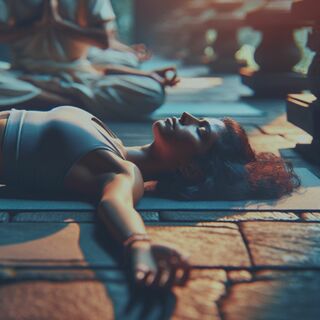
Find your way into a comfortable position lying down,
On your back if that works for you,
On a mat,
On a couch or bed,
Wherever you are.
Let the surface beneath you do the work of holding you,
Of supporting you.
Let the arms rest a little away from the sides,
Palms open if that's comfortable.
Let the feet fall gently outward and if you need a blanket or a pillow under the knees,
Take a moment now just to arrange everything for your deepest comfort.
The practice begins when you are ready.
And when you're settled,
Allow the eyes to close or lower your gaze.
Take one full breath,
Inhale through the nose,
Let the belly rise first and then the chest.
Fill your body completely and then a long slow exhale through the mouth.
Once more,
Inhale fully and exhale completely unhurriedly to the very end of the breath.
One final time,
Inhale fully to the depths of your belly and then sigh it all out,
Let it all go.
Exhale through your mouth.
And then let the breathing return to its own natural rhythm.
Just let the breath do what the breath does.
Bring your attention to the top of your head and imagine a soft light coming on,
Simply noticing whatever is there.
Then move your attention to your forehead,
The light moves down.
The space between your brows,
The place that so often holds the effort of the day,
Let it be lit and let it soften in the light.
The eyes resting softly in their sockets,
Illuminated at rest.
The jaw,
Bring the light here and notice what you find.
Let the light rest here for a moment,
Let the jaw soften in it.
The throat,
The light moves down.
The right shoulder,
The right upper arm,
Elbow,
Forearm.
The hand,
Each finger lit one by one like a string of lights coming on.
The left shoulder,
The left upper arm,
Elbow,
Forearm,
Hand,
Each finger.
Both hands together now,
Resting open,
Both of them lit,
Both of them warm.
The chest,
Notice your heartbeat,
The belly rising and falling,
The light moving with it.
The lower back in contact with the surface beneath you,
The hips,
The right thigh,
Knee,
Calf,
Ankle,
The foot and all the five toes,
Each one lit.
The left thigh,
Knee,
Calf,
Ankle,
The foot and all the toes,
Each one lit.
The whole body at once,
Simultaneously illuminated.
37 trillion cells quietly going about their work.
The heart,
The lungs,
The lymph,
The quiet hum of everything running itself without a single instruction from you.
Let the body do what the body does best.
Trust your body,
Trust the practice.
Bring your attention back to your breath now.
Inhale through the nose,
A full normal inhale,
And then at the top,
Take one more short sniff in,
Filling the lungs completely,
Then exhale,
Long,
Slow,
And all the way out through the mouth.
Empty your lungs fully.
Inhale through the nose,
A short sniff at the top,
And then a long,
Complete exhale through your mouth.
One more time,
Inhale,
Sniff at the top,
And then exhale through your mouth all the way out.
And then let the breath return to its normal,
Natural pace.
And notice that the exhale tends to be slightly longer than the inhale.
Every exhale activates the vagal break.
Every exhale slows the heart marginally.
Your body already knows how to do this.
We're just giving it the space.
Each time a thought arises,
Simply notice it and then gently return your attention to physical sensation,
The weight of the body,
The breath,
The temperature of the air on the skin.
This returning is the practice,
Not the absence of thought.
So just be patient with yourself if the mind starts to wander.
Keep coming back to the breath,
The weight of the hands,
The points of contact between the back and the floor,
The air slightly cooler as it enters the nose,
Slightly warmer as it leaves.
Stay here.
And if you find yourself drifting towards sleep,
Let it happen.
Don't resist it.
The brain at the threshold of sleep,
In that hypnagogic borderland between waking and dreaming,
Is doing some of its most important work.
Memory consolidation,
Emotional processing,
The quiet integration of everything the day has asked of you.
If sleep takes you,
It's because your brain needs it.
But if you can,
Stay on the edge,
Awake,
Aware,
And still.
Right on the threshold.
The brain doesn't build resilience through stillness alone.
It builds it through contrast,
Through the deliberate experience of moving between opposite states,
And discovering that you can hold both.
The brain doesn't experience light without the context of dark.
It doesn't register calm without some memory of activation.
Every sensation exists on a spectrum,
And the brain's capacity to move fluidly along that spectrum,
To feel fully and then release,
Is itself a trainable skill.
Feel heaviness.
Let the full weight of the body drop onto the surface beneath you.
Imagine the bones themselves becoming dense,
The way old stone is dense,
The way dark earth is dense.
Something ancient and unhurried,
Going nowhere.
Heavy.
Now feel lightness,
As if the breath alone could lift you,
As if the body had become less substantial,
More air than matter.
Light.
Move between them.
Heaviness and light.
Notice you can do this,
That in the same body,
In the same position,
On the same surface,
You can generate both of these experiences.
Your attention moving between two very different states of being.
Now feel contraction.
Allow the awareness to draw inward,
As if the body is gathering itself toward its own center.
The skin pulling in,
The breath becoming smaller,
The field of attention narrowing to a single concentrated point,
The way light contracts to the tip of a flame.
Contracted.
Now feel expansion.
Let the awareness begin to move outward from that center,
Slowly,
In all directions at once.
Outward through the chest,
Through the arms to the fingertips,
Down through the legs to the soles of the feet,
Through the crown of your head.
Keep going,
Beyond the skin,
Beyond the edges of the body,
Into the air around you,
The room around you,
The space that holds you without effort or condition.
Expanded.
Notice the quality of that expansion,
How the breath deepens into it naturally,
How the jaw releases,
How something in the chest opens,
As if it too suddenly had more room.
Stay here,
Rest here,
In that wide,
Open,
Outward reaching quality of awareness.
Let the field of awareness expand,
Not focusing on anything,
Not looking for anything,
Simply letting the periphery open,
The way a lens widens,
The way a room becomes a landscape,
The way the view from a window becomes the view from a hillside.
Let it keep opening,
Wider than the room you're lying in,
Wide as an open plain,
A coastline,
A sky full of unhurried cloud,
Vast and soft.
This is your nervous system responding to its own cues.
Stay here now in this wide,
Open,
Panoramic awareness.
Rest here now in this vast field of your own quiet attention.
We're going to start coming back.
Take this transition slowly.
Begin by deepening the breath intentionally,
A full inhale,
A long exhale,
And let movement come back into your fingers and maybe your toes,
And let the ankles and wrists rotate slowly if they want to.
Begin to feel the weight of the body returning,
The sense of being back in the room,
On the surface,
In this particular place and time.
Take one more deep breath and when you're ready,
Roll to one side and rest there for a moment.
There's no hurry.
Let the nervous system shift gears at its own pace.
What you have just experienced is real and measurable.
Your cortisol levels have dropped.
Your nervous system has moved through a genuine period of parasympathetic dominance.
Your brain has had an opportunity to consolidate,
To restore,
To do the quiet maintenance work that it can only do when you give it the conditions it needs.
Those conditions are not complicated.
Stillness,
Your breath,
And your own unhurried attention.
That's the practice.
If you can do this once a day,
Ideally in the early afternoon when the body's cortisol levels naturally dip,
You will notice a difference in your focus,
In your mood,
In your capacity to meet the demands of your day without running on empty.
The science supports it clearly.
And perhaps more than that,
You deserve it.
Thank you for taking your time to practice with me today.