Welcome to the Mindfulness Meditation Podcast presented by the Rubin Museum of Art.
We are a museum in Chelsea,
New York City that connects visitors to the art and ideas of the Himalayas and serves as a space for reflection and personal transformation.
I'm your host,
Tashi Chodron.
Every Thursday we present a meditation session inspired by a different artwork from the Rubin Museum's collection and led by a prominent meditation teacher from the New York area.
This podcast is a recording of our weekly in-person practice.
In the description for each episode,
You will find information about the theme for that week's session,
Including an image of the related artwork.
Our Mindfulness Meditation Podcast is presented in partnership with Sharon Salzberg and teachers from the New York Inside Meditation Center,
The Interdependence Project and Parabola magazine and supported by the Frederic P.
Lenz Foundation for American Buddhism.
And now,
Please enjoy your practice.
Hello,
Everybody.
Good afternoon and Tashi Delek.
Welcome.
Welcome to the Mindfulness Meditation at the Rubin Museum of Art.
I'm Tashi Chodron,
Himalayan Programs and Communities Ambassador,
And I'm so happy to be your host today.
We are a global hub for Himalayan art with a home base in Chelsea,
New York City,
And we are so glad to have all of you join us for this weekly program where we combine art and meditation.
Inspired from our collection,
We will first take a look at work of art from our collection.
We will then hear a brief talk from our teacher,
Kimberly Brown.
So wonderful to have Kimberly Brown back.
And then we will have a short set,
15 to 20 minutes for the meditation guided by her.
And let's take a look at today's theme and artwork.
This month,
The theme is compassion.
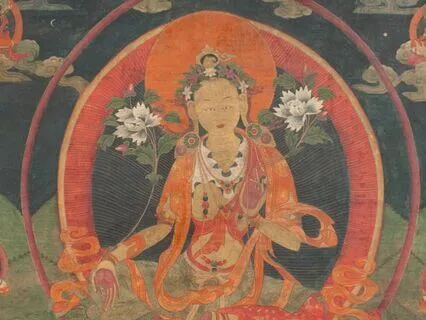
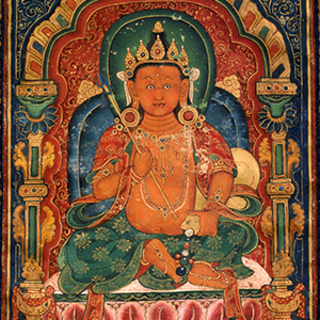
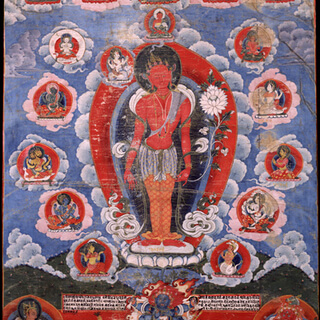
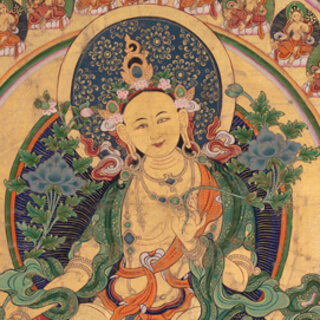
And the artwork for today is this beautiful Thangka painting,
Which is a mineral pigment on cloth.
So this is the painting of Tara.
It's in fact,
Tara emanates in 21 different forms.
And out of the 21 forms,
There are two Taras that is most popular and very common.
And it's green Tara and white Tara.
They each associate with certain roles.
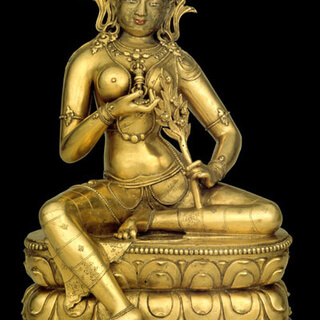
How you can identify which Tara it is is you look at how she is sitting.
So the white Tara sits in a full lotus position.
Therefore,
If you look at this one,
She's actually sitting in this royal ease position,
Left leg folded,
Right leg extended and resting on a lotus flower.
So this position is called royal ease position.
And that's how you can identify.
Besides the color,
You know,
Which Tara it is.
And the green Tara,
Left hand folded in a blessing gesture,
Holding the Utpala flower,
The stem sprouted on her shoulder.
And the right hand also holding the Utpala flower,
But her palm facing up,
Resting on her right knee.
And this mudra is called supreme generosity,
Granting,
Bestowing.
So Tara is one of the most highly revered female Buddha.
She's known for her compassion and regarded as the mother of all saviour.
So this is an 18th century mineral pigment on cloth,
Beautiful Thangka painting.
Now Tara is completely enlightened Buddha,
But she promised to keep coming back in a Bodhisattva form to help all sentient beings reach the enlightenment or remove our sufferings.
And Tara is revered in all of the Tibetan schools of Buddhism.
There are four main schools,
Nyingma Sakya Kaju Gelug,
And her 10 syllable mantra,
Om Tare Tu Tare Ture Swaha,
Is actually,
Any little children would actually know the mantra as well.
And even those who are illiterate,
Who have not studied the language,
Even,
You know,
I grew up watching elderly reciting the praises to Tara.
It's about three pages long and they have memorized.
So day in and day out,
People seem to recite Tara's mantra for protection.
It's very important protector in protecting us from the eighth grade fear.
The fear has outer aspects as well as an inner aspect.
So the outer aspects would be a house getting burned down by fire,
And that is like a physical damage,
Right?
But the metaphor or the inner aspect of that symbol is one's own anger,
The afflictive emotions.
So Tara helps us in removing from those afflictive emotion.
Now Tara's 21 form appears in different colors.
White is for the peaceful activities,
And then sometimes she appears in yellow color,
Which is magnetizing or increasing activity.
And then there are others that is dark and blue in color,
Which is for fierce and wrathful activities.
So she does manifest.
I think there are also red color as well,
And the red is for powerful activities.
And so let's bring on our teacher for today.
Our teacher is Kimberly Brown.
Kimberly is a meditation teacher and author.
She leads classes and retreats that emphasize the power of compassion and kindness meditation to reconnect us to ourselves and others.
Her teachings provide an approachable pathway to personal and collective well-being through effective and modern techniques based on traditional practices.
She studies in both the Tibetan and Insight Schools of Meditation and is a certified meditation mindfulness instructor.
Kimberly is author of two books,
Navigating Grief and Loss,
And Steady,
Calm and Brave.
And so please help me in welcoming Kimberly Brown.
Everyone,
You're the A-team coming out in this heat and the difficult air quality.
So thank you so much for being here.
And I hope you'll all recognize that coming out like this,
Having an intention to explore your mind,
Develop compassion,
That that is an expression of your inherent compassion and wisdom.
So if any of you doubt that,
As many of us do,
You can just notice when you have intentions and certain actions.
Well,
It's telling you something.
It's telling you that everything you need is in you.
So the theme is compassion.
And,
You know,
We have the beautiful Tara mural,
The thangka.
But also Tashi Chodron was sharing with us that this tradition is a tradition it exists today.
And this tradition,
It doesn't necessarily mean Tibetan Buddhism.
It means a tradition of recognizing what's valuable in our lives,
Of being able to see clearly what it means to be a living human being.
What does that mean?
What's true for all of us,
Everybody that's ever lived,
Is that life is constantly changing.
That everything is impermanent,
That we all have struggles and we are deeply interconnected.
Okay,
So you can think to yourself,
You know,
I think to myself some days when I catch myself on the Internet or reading some silly thing about a celebrity texting.
And I have to just stop and say,
Gosh,
I don't.
That's not healthy for my mind because it is taking me away from what's true.
Okay.
And what's true is that I have struggles and suffering and all of you have struggles and suffering.
Okay.
And we have set up a culture that takes us away from that all the time.
I mentioned the Internet and then we are very busy with work and we have so much to entertain us.
Headphones to wear all the time.
Someone was telling me how excited they were about Apple has some new virtual reality goggles.
It's supposed to be really great.
And the friend said to me,
Kim,
That's going to be amazing.
When I'm on an airplane,
I hate being there.
It's so boring.
I can just put that on.
Right.
And that's horrible.
Okay,
That's horrible.
Why is it horrible?
Not because it in itself is bad,
But anything that's taking us away from what we're experiencing.
And we are not addressing with compassion and with wisdom what's going on in ourselves.
Well,
That means we will continue to be greedy,
Be needy,
Be angry,
Be filled with these afflictive emotions,
As Tashi Trojan put it.
Tara helps us with afflictive emotions.
Why?
Well,
Because they're painful and also because they create harm in the world.
They create harm through our words and through our actions.
They don't benefit us and they don't benefit other people.
So the practice and what you saw in that living tradition are all of us coming together to say,
Hey,
How do I feed my beautiful qualities,
My compassion,
My kindness,
My appreciation,
And my wisdom?
How can I do that?
How can I be a reliable support for me and for everybody else?
Because we're all connected.
So today,
I'm going to guide us in a meditation practice.
But before we close our eyes and quote,
Unquote,
Meditate,
Take a look around you at everybody else who's here.
Right?
And you can,
You know,
Silently say,
Thank you.
Thank you for being here.
Thank you for supporting each other.
And go ahead and close your eyes if you'd like.
Now,
Some of you might find that disorienting or you might be too flooded to do that.
That's okay.
That's just one eye position.
You could also just gaze softly,
Lower your gaze.
The idea is just so your eyes aren't moving around.
I just noticed what's arising in this silence.
I often notice there's a little dissatisfaction there.
Or I notice,
Wow,
I'm still really upset.
Or I notice,
Oh,
I'm so spacey in this moment.
So allowing whatever's there to arise.
Hello.
Welcome.
Welcome.
Experiencing your body.
You might feel a little tired or sleepy.
How do you know that you're tired and sleepy?
Experiencing any tightness in your body?
Heaviness.
Places of coolness.
Places free from tension.
Tight places.
Warm places.
Notice that you're breathing.
And how do you know you're breathing?
I would have told you many years ago,
I know I'm breathing because all humans are breathing.
It's science.
Right?
But how do you know you're breathing?
Through your experience of your breath.
You might feel it in your belly.
You might feel your chest moving.
You might sense the air coming in and out of your nose.
And if you're paying attention,
You might notice you don't have to do anything right now.
It's all happening.
Your body's breathing for you.
It's amazing.
Like,
I'm breathing.
I'm breathing.
I'm breathing.
I'm breathing.
It's amazing.
Light is entering through your eyes and smell.
Sound is entering your ears.
You don't have to go out and get it.
So just for two minutes,
Relaxing here in this silence.
Allowing what's arising to arise.
Allowing it to move and change and dissolve.
If you get caught in a story,
That's okay.
Come back to your breath.
And letting yourself recognize the motivation that brought you here today.
You might be curious.
You might be struggling and finding a way to care for yourself.
You might want to be,
Quote unquote,
Better person,
Kinder,
More loving.
But whatever your particular reason for being here today,
It's a beneficial reason.
You're in New York City.
You could be doing anything,
And you chose to do this.
So really appreciate that.
Rejoice in your good sense.
And placing your hand on your heart,
On your belly,
Too,
If you'd like.
You really get a sense of your presence here.
And I'd like you to connect with yourself through your hands,
Through your breath.
And you might even imagine yourself.
Imagine yourself as you're looking in the mirror,
Or imagine yourself as a child.
And silently say these loving kindness phrases,
These compassion phrases to you.
May I be gentle with you.
May I be kind to you.
May I be gentle with myself.
May I be peaceful and at ease.
May I be gentle with myself.
May I be peaceful and at ease.
May I be gentle with myself.
May I be peaceful and at ease.
And continuing here,
Just for,
We're just doing this for a few minutes.
Silently repeating these phrases to yourself.
If you get distracted or lost,
It's okay.
Coming back,
Reconnecting like you're giving yourself a gift.
May I be gentle with myself.
May I be peaceful and at ease.
And I'd like you to connect with a suffering that you have,
A struggle.
A suffering that you have,
A struggle,
A difficulty.
Might be loneliness.
Might be a physical ailment.
It might be grief or stress.
But connecting with this struggle that you have,
This suffering,
This pain.
Recognizing that you share it with countless other beings.
So maybe imagining all the other beings on the planet that share your struggle.
For me,
I have asthma.
So I will often imagine all of the beings with asthma.
Or I imagine all the people whose dad died because my dad died.
So for you,
Imagining all the others who share your particular struggle today.
Might be people you know.
Others in New York City.
Others in the U.
S.
Canada and Mexico.
In Europe.
Places in Asia,
Nepal,
India.
Australia.
Places in Africa.
Morocco and Senegal.
Nigeria.
South America.
So all the beings.
Might be animals.
Animals are lonely.
Animals lost their dad.
So imagine all of you together.
You're including.
And give all of you this compassion and wisdom.
May we be gentle with ourselves.
May we be peaceful and at ease.
May we be gentle with ourselves.
May we be peaceful and at ease.
May we be gentle with ourselves.
May we be peaceful and at ease.
And continuing just for two minutes here.
Repeating these phrases.
Giving your gifts to all of you.
May we be gentle with ourselves.
May we be peaceful and at ease.
And just taking a few seconds to include everybody.
People you love.
All the strangers.
All the people you don't like.
And all the living beings on the planet.
May we be gentle with ourselves.
May we be peaceful and at ease.
You can let go of your thoughts.
Let go of those phrases.
Just feeling your breath.
Relaxing your jaw.
Relaxing your shoulder blades.
Thanking yourself.
And thanking everyone here for your support and your patience and your kindness and your good hearts.
Please stay still until you can no longer hear the bell.
At which time if you'd like you can offer yourself a bow or just gently stretch and open your eyes.
Thank you so much for that wonderful session,
Kimberly.
That concludes this week's practice.
To support the Rubin and this meditation session,
We invite you to become a member at rubinmuseum.
Org.
If you are looking for more inspiring content,
Please check out our other podcast,
Awaken,
Which uses art to explore the dynamic paths to enlightenment and what it means to wake up.
Season 2,
Hosted by Raveena Arora,
Is out now and explores the transformative power of emotions using a mandala as a guide.
Available where?
To stay up to date with the Rubin Museum's virtual and in-person offerings,
Sign up for a monthly newsletter at rubinmuseum.
Org.
I am Tashi Chodron.
Thank you so much for listening.
Have a mindful day.