Welcome to the Mindfulness Meditation Podcast presented by the Rubin Museum of Art.
We are a museum in Chelsea,
New York City that connects visitors to the art and ideas of the Himalayas and serves as a space for reflection and personal transformation.
I'm your host,
Tashi Chodron.
Every Monday we present a meditation session inspired by a different artwork from the Rubin Museum's collection and led by a prominent meditation teacher from the New York area.
This podcast is a recording of our weekly practice currently held virtually.
In the description for each episode,
You will find information about the theme for that week's session,
Including an image of the related artwork.
Our Mindfulness Meditation Podcast is presented in partnership with Sharon Salzberg and teachers from the New York Insight Meditation Center,
The Interdependence Project,
And Parabola Magazine and supported by the Frederick Lance Foundation for American Buddhism.
And now,
Please enjoy your practice.
Hello Tashi Dalek and welcome.
Welcome to Mindfulness Meditation Online with the Rubin Museum of Art.
I am Tashi Chodron and I'm happy to be your host today.
It is so wonderful to see so many familiar names on the chat here.
I see people joining from all over Seattle,
Upper Manhattan,
Brooklyn,
Queens,
Staten Island,
Georgia,
And wow,
All the way from Finland.
How nice to make best use of this virtual session.
Those of you who are new,
The Rubin is a Museum of Himalayan Art and Ideas in New York City,
And we are so glad to have all of you join us for our weekly program where we combine art and meditation online.
Inspired from our collection,
We will take a look at a work of art from our collection.
We will hear a brief talk from our teacher,
And then we will have a short sit,
15 to 20 minutes for the meditation guided by our teacher.
And today we are so thrilled to have Kimberly Brown back.
And now let's take a look at today's theme and artwork.
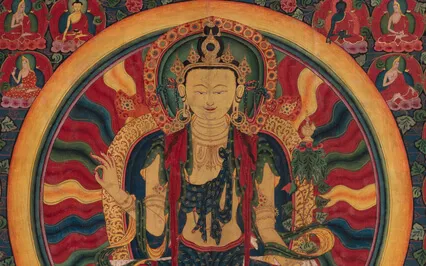
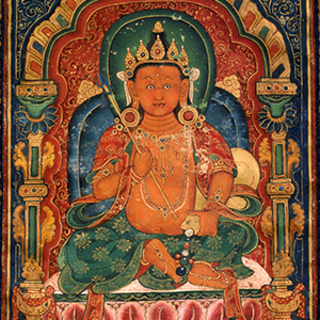
This month's theme is awakening and the art connection for today's session is Maitreya,
The Future Buddha.
This thangka originated from Tibet,
15th century,
34 and a half into one and a half into 28 and a quarter inches.
A thangka is a scroll painting,
Mineral pigment on cloth,
A gift of Shelley and Donald Rubin Foundation.
The name Maitreya is derived from the Sanskrit word Maitreya,
Which stands for friend.
And in Tibetan,
He's called Champa,
Which means loving or Jejun Champa Gombo.
Therefore Maitreya's name means loving friend.
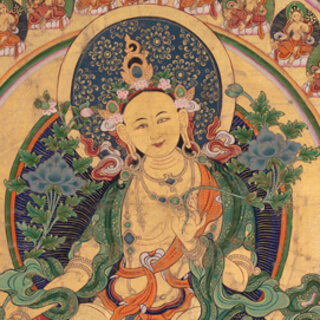
Look at this luminous thangka painting of the Future Buddha.
Maitreya shows him sitting on his celestial throne in Tushita heaven,
Radiating light.
The Future Buddha sits with his legs extended as if poised and ready to descend to earth and take up his role as the Buddha of the next aeon.
He is adorned with the princely jewels and garb of a Bodhisattva,
Having not yet taken up his future role as the next Buddha,
When he would be depicted in monks robes like the Buddha of our current age Shakyamuni.
In his left hand,
Maitreya holds the stem of a Naga Kesara blossom,
Carrying a flask,
His distinctive identifying attribute.
Maitreya is commonly depicted in peaceful appearance.
His throne is supported by a lotus emerging from a fence pond,
The branches of which form the subtle scroll that frames all of the secondary figures.
The extensive teaching lineage it contains at the sides indicates that this painting refers to the five treatises of Maitreya,
The five commentaries on Buddha Shakyamuni's teachings attributed to Maitreya.
The mantra for Maitreya is Om Maitri Maha Maitri Maitriya Soha and there's also a root mantra Namo Ratna Trayaya.
Now let's bring on our teacher for today,
Kimberly Brown.
Kimberly Brown is a meditation teacher and author.
She leads classes and retreats that emphasize the power of compassion and kindness meditation to reconnect us to ourselves and others.
Her teachings provide an approachable pathway to personal and collective well-being through effective and modern techniques based on the traditional practices.
She studies in both the Tibetan and inside schools of Buddhism and is a certified mindfulness instructor.
Her new book,
Navigating Grief and Loss,
25 Buddhist Practices to Keep Your Heart Open to Yourself and Others is published now and ready and is available at the Rubens gift shop.
And an updated edition of Steady,
Calm and Brave will be released in January 2023.
Both are published by Promethus Books.
You can learn more about Kimberly on our website.
Kimberly,
Thank you so much for being here.
Thank you,
Tashi Chodron and hello everyone,
Nice to be back,
Nice to see you again.
So the theme this month at the Rubin for our mindfulness program is awakening.
And some of you may have been here last week where I was also teaching.
And in the tradition,
In the Buddhist tradition,
What we're awakening to is the truth.
Dharma,
The word Dharma can mean the Buddhist teachings,
And it can also mean truth.
And what is true about our lives,
The nature of our lives?
Well,
We will all grow older,
We will all get sick,
We will all die.
This is a truth,
A hard truth for many of us,
All of us really.
So that's one aspect of the teaching to remind ourselves and use different trainings to understand the impermanence and change of all of our lives.
We also another truth that we all share is that we,
All of us here on this call,
We all have what is considered to be a precious human birth.
That is,
That we have all been born as humans,
That we all have enough leisure time to practice and learn these teachings.
We have the opportunity and the luck to live in a time where there is a Buddha and there are Buddhist teachings.
And right now you can get teachings from amazing,
Amazing teachers all over the globe.
They're available on the internet.
Another part of our precious human birth is that each one of us have enough health that we can practice.
We have enough intelligence that we can use these practices and learn.
And those conditions,
These conditions I just noted are what make up a precious human birth and why it's so precious and valuable is because if we,
Anyone with these conditions that we have are able to awaken,
Right?
A way able to develop our wisdom and our compassion to such an extent that we are dispelling our hatred and our greed and our delusion.
And we're awake to the reality of our lives,
Which also include another truth,
Our interconnection with all other beings.
And that's where the Maitreya,
The future Buddha becomes important.
Maitreya is the embodiment,
As Tashi's children mentioned,
Of a great Bodhisattva who recognizes the value of wakening up and making a commitment to help everybody else wake up too.
Maitreya,
This future Buddha also represents another truth of our lives that when we recognize how precious life is,
The conditions we have that enable us to awaken,
We also recognize that we too have the nature of a Buddha.
All of us are born with the nature of a Buddha,
That is the nature to develop our capacity for wisdom and for compassion for ourselves and each other.
Now,
There are of course,
Many stories about the Buddha,
He was great religious figure and just like any,
There are lots of tales about him.
And there are many tales about the time,
The moment of his awakening.
And you may,
You will see representations of this at the museum,
The Buddha practiced for seven years,
He did all of the trainings available to him at that time for great teachers before him of contemplation of meditation of physical training.
And after seven years,
He said,
You know,
I'm going to do it,
I'm going to really awaken to what's true,
What's true of life.
And the story says that he went to the Bodhi tree,
Which an ancestor of that same tree is available is still is living in Bodh Gaya,
Which is where he is thought to awaken,
He sat under this tree in India.
And the whole world really came out to help him.
It said that snails crawled up on his head to keep him cool,
The snail martyrs are called.
It said that the earth,
You know,
Held him.
And one of the ways it's described his awakening is that what happened was is that he saw his confusion.
One text says that he saw the dust melts of his confusion.
And in so seeing,
He recognized his own true nature and awakened.
So this is one interpretation that I think is very important for all of us,
Because we all have dust,
Obscurations,
Obstacles to our pure heart.
And the practice helps us to recognize,
See them.
And in so doing,
We recognize and see and are able to access our true nature,
Okay,
The truth of our lives.
And in our life,
You know,
The biggest obstacles are in general,
Hatred,
Or aversion,
Read or neediness,
And delusion or ignorance.
And the practices that all of the teachers that come here to teach and in all of the traditions are designed to free us from hatred,
Greed and delusion,
Which are deep sufferings.
So we can take these conditions were given from our precious human birth,
And really start to use our thoughts and our words and our behaviors in ways to orient them to wake up for ourselves to wake up for each other to be of benefit and to not harm.
And in so doing,
We recognize this great treasure that we have this treasure of our beautiful heart,
Mind,
Our Buddha nature.
And so in a certain way,
We are all my trace.
So we're going to do a practice today.
Practice First,
We'll do some focus and concentration through our breath.
And then we will move into some meditation offering phrases of wisdom and kindness.
Metta is a Pali word that is the same word in Sanskrit is my tree.
So Metta practice is a type of love practice just like my trail,
My tree.
So find a spot where you can be comfortable for just a little bit.
Actually children mentioned will be here 10 to 15 minutes.
So find a seat that's comfortable for you.
Find a seat that you can be both alert and relaxed,
Tranquil and awake.
This is the balance we're looking for a tranquil at a lake.
So take your time to find this spot.
It might mean that you sit up straighter today that you notice you're kind of slumpy.
It might mean that you relax a little bit because you're holding on too tight.
And you have a choice.
You can't keep your eyes closed.
Or you can gently gaze down with your eyelids just open enough to see down.
And again whichever eye posture is most conducive to being relaxed and alert.
You're feeling sleepy today just lower your case.
If you're feeling super anxious or super scattered you might want to just close your eyes.
So give it a try.
And choosing to bring your attention to your senses.
This is the easiest quickest way to be with what's real and what's true.
And entering your ears,
Smell,
Taste,
Your body in space.
Noticing there is light entering your eyes and that there is sound entering your ears.
It might be images that arise,
Ideas.
And you'll just notice everything comes and goes.
The light changes the sound.
Comes and goes.
Thoughts move and shift.
You might feel cold and tight and then feel loose and warm.
And just taking a moment now to recognize what brought you here today.
What is your motivation to be here to practice meditation to learn about Buddhism and mindfulness?
And it's very,
I'm certain that it's a beneficial reason that you're here.
Curious about the practice.
You want to develop your heart.
You want to feel less scattered.
Whatever it is.
I doubt that you're here because you want to feel more jealous and angry.
So recognizing your intention is valuable and worthwhile and it's an expression of your inherent wisdom and Buddha nature.
Winking yourself rejoicing that you have such a beautiful intention.
And choosing to bring your attention to your breath.
I suggest that you take your hand and place it on your belly.
And as soon as you do that,
You'll notice,
Oh,
I'm breathing.
And resting your attention here on your breath.
Perhaps counting your breaths.
One inhale and one exhale is one.
The next inhale,
Next exhale is two.
So just for a minute,
We're going to develop a little concentration by just being with the breath,
Counting to five and then beginning again.
Five.
You you you And you don't have to count your breaths anymore But continuing to place your attention here on your breathing and like I said you can keep your hand on your belly and And see if you can do your best just to receive the breath So this is an opportunity you don't do anything You have to make anything happen to the letting go Letting go to just being receiving the breath letting your body do what it does I will just be here a couple minutes as you experience and Be with your breath allow you you you you you you you you you you you Noticing where your attention is and Choosing to bring it to your heart center to the middle of your chest if you'd like you put your hand on your heart and Making a connection now with someone who has loved you very easily Someone who has delighted and you encouraged you thought you're really great Could be someone from your past someone from your present It's likely to be An aunt or an uncle or a teacher or an old friend Maybe even a pet It's not likely to be parents or siblings because those are more complicated Looking for such a simple easy Love And make a connection with this being that means you might feel their presence here with you or you might imagine them If you have an image of them in your mind feeling they're here with you and and giving this loving being These two phrases these meta or my tree phrases May you care for yourself with ease?
May you be undisturbed by the changes in life?
May you care for yourself with ease may you be undisturbed by the changes in life?
May you care for yourself with ease may you be undisturbed by the changes in life?
And repeating these phrases silently like you're giving a gift to this being You You You You You May you care for yourself with ease may you be undisturbed by the changes in life?
Letting go of this connection with this loving being Noticing your feet your seat your belly Paying attention to your breath And now taking a moment to connect with yourself Can you can put your hand on your heart if you'd like?
You could just feel your presence you can also Imagine yourself imagine yourself as though you're looking at the mirror or as a child And giving yourself this same matter the same my tree May I care for myself with ease?
May I be undisturbed by the changes in life?
May I care for myself with ease may I be undisturbed by the changes in life?
May I care for myself with ease may I be undisturbed by the changes in life?
By.
Again,
Just taking a moment here to repeat these phrases silently like you're giving yourself a gift.
May I care for myself with ease,
May I be undisturbed by the changes in life.
And you can keep this connection with yourself,
Including that first loving being,
Including everyone that you care about,
Your pets,
Your people.
May we care for ourselves with ease,
May we be undisturbed by the changes in life.
And starting to include everyone here tonight today and everyone at the museum that makes this possible.
May we care for ourselves with ease,
May we be undisturbed by the changes in life.
And like my Tran all the bodhisattvas recognizing our deep interdependence with each other how our words and our speech and our thoughts affect others.
We also include everyone in our,
Our meds are my tree.
So including everyone you care about all the strangers all over the world,
People were never going to paint all of the animals,
All of the humans that we have conflict with that you don't like offering from our hearts indiscriminately to all beings.
May we care for ourselves with ease,
May we be undisturbed by the changes in life.
You can let go of any technique,
Any method,
Any practice,
Not meditating,
Not not meditating here just for a few seconds.
Thanking yourself for practicing together.
I thank you for sharing your wisdom and your generous heart.
Whenever you're ready,
You can offer yourself a bow if you'd like and bring your attention back to our group.
Take your time,
Move or stretch.
Thank you.
Thank you so much for that wonderful session,
Kimberly.
That concludes this week's practice.
If you would like to support the Ruben and this meditation series,
We invite you to become a member of the Ruben.
If you're looking for more inspiring content,
Please check out our other podcast Awaken,
Which uses art to explore the dynamic path to enlightenment and what it means to wake up.
Season two hosted by Raveena Arora is out now and explores the transformative power of emotions using a mandala as a guide.
Available wherever you listen to podcasts.
Thank you for listening.
Have a mindful day.