Welcome to the mindfulness meditation podcast presented by the Rubin Museum of Art.
We are a museum in Chelsea,
New York City that connects visitors to the art and ideas of the Himalayas and serves as a space for reflection and personal transformation.
I'm your host,
Dawn Eshelman.
Every Monday we present a meditation session inspired by a different artwork from the Rubin Museum's collection and led by a prominent meditation teacher from the New York area.
This podcast is a recording of our weekly practice currently held virtually.
In the description for each episode,
You will find information about the theme for that week's session,
Including an image of the related artwork.
Our mindfulness meditation podcast is presented in partnership with Sharon Salzberg and teachers from the New York Insight Meditation Center,
The Interdependence Project,
And Parabola Magazine.
And now,
Please enjoy your practice.
Hello,
Everybody.
Welcome,
Welcome.
Welcome to mindfulness meditation online with the Rubin Museum of Art.
I'm Dawn Eshelman.
Great to be here with you today.
We're a museum of Himalayan art and ideas in New York City.
For those of you who are new to us,
We're so glad to have you joining us.
And this is our weekly program where we combine art and meditation online.
We get some inspiration from our collection and take a look at a work of art that we've chosen in collaboration with our teacher.
And today we have the fantastic,
Shall we say legendary,
Sharon Salzberg,
Who is so beloved as a teacher,
Not just here at the Rubin,
But around the world.
And Sharon will lead us in a short sit,
15 to 20 minutes.
We'll be guided by her.
And that follows a brief talk by Sharon.
And we're talking about kindness this month.
And I've had so much,
So many experiences of kindness here at the Rubin Museum from many of you in the chat here,
But in person as well.
And also from you,
Tashi,
And through challenging times and easy times,
Kindness has always been there.
And I'm grateful for that.
And Sharon,
Oh my gosh,
Sharon has taught me so much about kindness,
Especially kindness to myself.
And I'm going to talk about that in just a second.
But we're going to look today at the artwork that's inspired us.
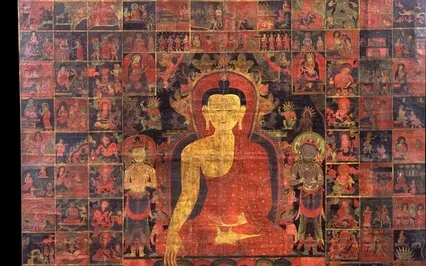
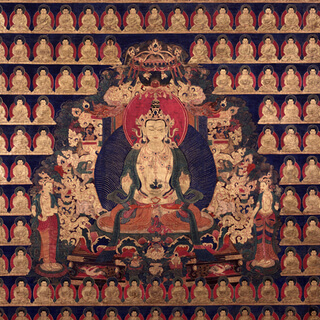
Here is Buddha Shakyamuni and stories of his previous lives.
And this is from Tibet.
This is mid to late 14th century.
And it's a rather big painting.
So it's about 60 inches by 46 inches.
And we're looking and talking today about the Buddha who is known for incredible kindness,
Kind of superhero-like kindness in some ways.
And this painting really tells the story of that.
This is,
Of course,
Shakyamuni and stories of his previous lives.
So the Jataka tales and many stories of the Buddha,
Over 100 stories here are depicted in this kind of geometric grid.
Lots of red,
Some dark,
Dark blue and black colors as well,
A bit of green,
But just in this field of kind of these squares of almost like a checkerboard or film strips laid out that show us all the previous lives of the Buddha here.
And one such scene you can find in the very top left corner shows the Buddha sacrificing himself to feed a hungry tigress and her starving cubs.
And there are stories also of the Buddha coming across hungry people and telling them that they can find an elephant that's fallen off a cliff at the bottom.
And then he's an elephant who jumps off a cliff and offers his body to the hungry people.
And then here,
This narrative scene that's really closest to the central Buddha figure depicts his deeds during his final life as Prince Siddhartha,
During which he achieved this enlightenment or awakening on behalf of all beings.
And that is an incredible act of dedication and kindness.
And his appearance is interesting.
His appearance helps to date this painting.
And also we can see the scrolling floral patterns within the red halo and the dark blue-black background,
All of these narrative cells as well,
This thin yellow lines that kind of separate them are very distinctive of features drawn from Nepalese paintings.
So thank you for that.
We're going to bring on our teacher today,
Sharon Salzberg,
Who I first sat with and learned about this idea of kindness and meditation,
Kindness to oneself.
And I'll never forget learning that from you,
Sharon,
And learning that meditation is not about sitting with some perfectly still brain.
It's how we treat ourselves when we realize we've gone away and how,
With what kindness we bring ourselves back.
And I'm grateful to you for that.
Sharon is the co-founder of the Insight Meditation Society in Barre,
Massachusetts.
She's guided meditation retreats all over the world for many years.
She has incredible books like Real Change,
Mindfulness to Heal Ourselves and the World,
And Real Happiness,
And Real Love,
The Art of Mindful Connection.
And she runs her own really great podcast,
The Meta Hour,
Where she interviews influential voices in the meditation,
Mindfulness.
And she is a huge contributor here at the Rubin Museum and has been for many,
Many years gracing our stage and being here as a very important part of this program.
Thank you so much for being here,
Sharon.
Well,
Thank you so much.
And I'm so glad we get to talk about kindness today and do some sitting.
And we are all here together,
Everywhere from New York City to Ladakh.
And it's really a fantastic thing.
I was thinking,
Listening,
Looking at the art again and listening about,
Well,
First of all,
I get to talk about kindness again next week,
So that's good.
So this is really almost like an overview that will get more detailed next week.
But I was thinking about a story I've told you many times,
Which is about when I was practicing intensive loving kindness meditation in Burma in 1985.
When we do loving kindness meditation,
We silently repeat certain phrases and we can try some of that today together.
The phrases are meant to be very big,
Very general.
Their generosity of the spirit,
Their offerings of the heart to ourselves and to others.
It's like you call someone to mind,
Perhaps,
And you repeat silently,
May be safe,
May be happy.
It's gift giving,
It's offering,
It's generosity of the spirit.
So practicing in Burma,
I was given certain phrases to use and it was just kind of the style of that teacher,
That monastery.
And so I just used those phrases.
And the phrases that I used and you make this offering beginning to yourself were,
May I be free from danger,
Which means inner and outer danger.
Inner danger being overcome by diluting qualities that lead us astray.
Outer danger being unfortunate things in life.
It's like a blessing.
May I be free from danger,
Be free from mental suffering.
Be free from physical suffering.
May I have ease of well-being or may I live with ease.
That means the things of day to day life,
Livelihood,
Family.
May it not be such a struggle.
May I live with ease or may you live with ease as we go on and extend that well wishing to others.
So there I was with my four phrases in a very kind of strict atmosphere.
When I teach,
When my colleagues teach,
We have people have an option of creating their own phrases,
But that was not the case in this particular school.
So there I was using my phrases and I didn't like that fourth phrase very much.
I thought,
Well,
That's kind of stupid.
May I live with ease.
It's so trivial compared to may I be free of mental suffering.
That one I liked a lot.
But there I was,
Just an obedient student.
I kept repeating it.
And it was like one day it shifted and it just took on this whole other aura and feeling tone for me.
And I thought we have so many like decisions to make and choice points and sometimes crazy moral dilemmas like may I live with ease.
That's a beautiful wish.
I like that phrase a lot.
So I told that story when I got back to the States and I was teaching and this was in contrast to a friend of mine who at the time worked for the federal government.
And she said she heard that phrase for the first time.
May I live with ease or may I have ease of well-being.
And it just like lit up for her,
Exemplified being kind to yourself for a change.
Give yourself a break.
Look at those possibilities in front of you.
Is one of them likely going to lead to complexity,
To secrets,
To hiding parts of yourself or as the other may lead to more transparency,
More openness,
More connection,
More clarity.
Well guess what?
You know,
If that's the case,
They're going to have very,
Very different feelings.
Feeling tones,
Consequences as you go on,
As we go on.
So she loved that phrase,
May I live with ease.
And she said that became her guiding light.
It became her North star.
The way she posed it was as she faced a choice or decision would be,
Does this pass the may I live with ease test?
And I told that story more publicly,
Her story.
And I have a friend who's an artist who made me a stamp pad,
You know,
That said,
Does this pass the may I live with ease test?
And my friend at the time,
Still working for the federal governments,
I lent her the stamp pad and she said she would kind of randomly now and then just stamp a document from the government,
Does this pass the may I live with ease test?
And she'd send it off through the bureaucracy.
And who knows what people thought when they saw it or they received it.
And I thought about what if we had that sort of North star,
We had that vision and we had that sense of what's thing that with quality or attribute or characteristic might I try to bring into my everyday.
It may not seem that glamorous or exciting on the face of it,
But it's the bedrock of how I want my life to go.
And what if we made that kindness?
And that definitely has to include kindness toward ourselves.
And here we are,
You know,
We have every possibility of doing just that.
And you see,
You know,
The art,
We see the Buddha's previous lives,
All linked through the qualities he was endeavoring to develop of generosity and kindness and wisdom and so on.
We have that possibility with our own lives of having that vision of creativity of every element of it,
Even the most sort of ordinary conversation or encounter being a part of this larger home that we can if we want direct toward kindness.
Okay,
So why don't we do some loving kindness practice?
It is a special day after all.
And I'll guide you through it.
The practice of loving kindness is done in many different ways.
There are lots of different styles.
The way that I was taught was really instead of resting our attention on something like the sensation or the feeling of the breath,
We rest our attention on the silent repetition of certain phrases.
And the phrases aren't meant to like,
Try to force us to feel certain things that we're not feeling.
But really as a way of paying attention differently.
If you for example,
As many of us do,
If you have the habit at the end of the day,
Thinking back on your day,
Like how did I do today?
Many of us have the habit of pretty well only remembering the mistakes we made or what we did wrong or could have done better.
Let's just say.
And we're acknowledging that,
You know,
We're flawed beings,
We're human beings.
And this is all that happened today.
There were moments we could be grateful for,
There were moments where we did try to establish a connection,
There were moments where we kept quiet because it seemed like the most simple thing to do.
And we can appreciate our being evolving,
Growing,
Developing with all of that potential.
May I be safe,
Be happy,
Be healthy,
Live with ease is the most contemporary common way phrases are expressed.
And we just repeat the phrases over and over again.
We gather our attention fully behind one phrase at a time.
You don't have to force a feeling,
You don't have to make anything happen.
The skill set is what we have been practicing all this time.
Your mind will wander.
You'll find yourself lost in the past,
Lost in the future,
Judgment speculation all over the place.
It's okay.
You realize that,
See if you can let go and just come back and in this case,
Come back to the phrases.
So let's begin.
You can sit comfortably,
Close your eyes or not,
However you feel most at ease.
Let your attention kind of settle into your body.
Begin repeating phrases for yourself.
Three or four phrases like,
May I be safe,
Be happy,
Be healthy,
Live with ease.
You can repeat the phrases with enough space and enough silence so that it's a rhythm that's pleasing to you.
This is like the song of our heart.
You want to be able to gather all your attention behind one phrase and then the next.
May you be safe,
Be happy,
Be healthy,
Live with ease.
And see if you can call to mind a benefactor.
Benefactor is someone who's helped you.
Maybe they've helped you directly.
They've helped pick you up when you've fallen down or maybe you've never met them.
They've inspired you from afar.
The benefactor is said to be the one who when you think of them,
You smile.
They just kind of lift your spirits.
Could be an adult,
Could be a child,
Could be a pet.
Is there someone who you think of them,
You just smile.
And if there is,
You can bring that being here.
Maybe a puppy,
So let's say person.
You bring that being here.
Get an image of them.
Say their name to yourself.
Get a feeling for their presence.
And offer the phrases of loving kindness to them.
May you be safe,
Be happy,
Be healthy,
Live with ease.
Even if the words aren't perfect,
They're carrying the heart's energy so they're serving us.
May you be safe,
Be happy,
Be healthy,
Live with ease.
May you be safe,
Be healthy,
Live with ease.
May you be safe,
Be healthy,
Live with ease.
May you be safe,
Be healthy,
Live with ease.
May you be safe,
Be healthy,
Live with ease.
May you be safe,
Be healthy,
Live with ease.
May you be safe,
Be healthy,
Live with ease.
May you be safe,
Be healthy,
Live with ease.
May you be safe,
Be healthy,
Live with ease.
May you be safe,
Be healthy,
Live with ease.
The primary place where you'll find the application of kindness toward yourself is once your attention has wandered.
You're in the past,
You're in the future,
You've fallen asleep,
You're somewhere else.
It's okay.
Rather than berate yourself or consider yourself a failure,
See if you can let go gently and come back to the phrases.
Thank you.
Now let's have an open house,
Just whoever arrives.
Colleagues,
Family,
Friends,
Neighborhood puppies,
Whoever.
Those who are not having an easy time with it right now.
Whoever comes to mind,
Invite them.
And we can just keep offering loving kindness to the collective.
May you be safe,
Be happy,
Be healthy,
Live with ease.
Thank you.
Thank you.
And all beings everywhere,
All people,
All creatures,
All those in existence near and far,
Known and unknown.
May all beings be safe,
Be happy,
Be healthy,
Live with ease.
Thank you.
Thank you.
And when you feel ready,
You can open your eyes or lift your gaze and we'll end the meditation session.
So thank you.
All beings,
Thank you for the loving kindness.
Thank you,
Sharon.
Thank you all.
Thank you.
That concludes this week's practice.
If you'd like to support the Rubin and this meditation series,
We invite you to become a member.
If you're looking for more inspiring content,
Please check out our new podcast Awaken hosted by Lori Anderson.
The 10 part series features personal stories that explore the dynamic path to enlightenment and what it means to wake up.
Now available wherever you listen to podcasts.
Thank you for listening and thank you for practicing with us.