Hello and welcome.
My name is Anna Maria Kanidi and I'm a teacher here on Insight Timer.
Today's practice,
We'll start with a small talk and then we'll gently meander into the practice.
So allow yourself just to settle in.
To get comfortable,
To find a position that feels supportive in this moment.
I want to start with a question.
And I'd like you just to sit with it rather than trying to answer it.
Do you wake up feeling refreshed,
Even after a full night's sleep?
For so many of us,
The honest answer is no.
We live in a culture that doesn't really leave room for that answer.
The thinking goes.
You got your seven to eight hours.
You should be granted.
So when we still wake up feeling tired,
We might think that something is wrong.
We just try to push through.
Recaffeination.
You take a sugary snack.
Keep going.
I'd like to introduce a concept.
This concept is of the five distinct types of fatigue.
There's physical fatigue,
Mental fatigue,
Emotional,
Social,
And sensory.
And each one of these requires its own kind of restorative strategy.
Sleep of course helps with physical tiredness,
But it does very little for a mind that's been overstimulated all day,
Or an emotional body that's been holding too much.
Or a nervous system that simply had too much input,
Too many screens,
Too much noise,
Too many people.
So before we move into our practice,
I'd like you to ask yourself gently,
No need to overthink it,
Which of these resonates most for you right now?
Is it physical fatigue?
Your body feels heavy,
Tired.
Genuinely in need of rest and recovery.
Is it mental fatigue?
Your mind feels as though it won't switch off.
It's overstimulated,
Overloaded with decisions and information.
Is it emotional fatigue?
You hold a lot.
You feel deeply.
Maybe holding space for others at the expense of yourself.
Is it social fatigue?
Too much time with people,
Not enough time for yourself to restore.
Or sensory fatigue.
Sense that you're overwhelmed by noise,
By screens,
By too much stimulation.
There's no right or wrong answer here.
You might notice you feel one of those more than another.
You might notice a combination of them.
Allow whichever one feels a little bit louder today,
Just to come into your awareness.
And this is actually something that yoga has understood for a very long time.
There's a model called the Pancha Kosha.
Five sheets or layers of the human being.
It maps the self across the physical,
Energetic,
Mental,
Emotional and spiritual dimensions.
And the teaching is the same.
True restoration means attending to each layer.
Not just the outermost.
Not just the one that sleep touches.
Practice today is the practice of Yoga Nidra.
Sometimes called yogic sleep.
It's a practice of conscious rest.
And it works across these different layers simultaneously.
Inviting your body to rest deeply.
While a thread of awareness stays gently present.
It isn't sleep per se.
And it isn't meditation in the way we usually think of meditation.
It sits somewhere in its own unique category.
And for many of us,
It offers a quality of restoration that neither sleep nor seated meditation quite reaches.
As we move into the practice now.
I invite you to hold whichever fatigue you named physical,
Mental,
Emotional,
Social,
Sensory.
Loosely in your mind.
And we're not trying to fix it.
Just letting the practice.
Meet you where you are.
Letting the practice do the work.
Letting the practice unfold those layers.
Take a little mental note of how you feel now.
And again,
At the end of the practice,
I'll invite you just to notice how you feel afterwards.
True rest isn't a one-size-fits-all.
But it does have to be prioritized.
It needs a space in our modern world.
And it does have to be personalized.
It needs to be unique to you.
For the practice of Yoga Nidra,
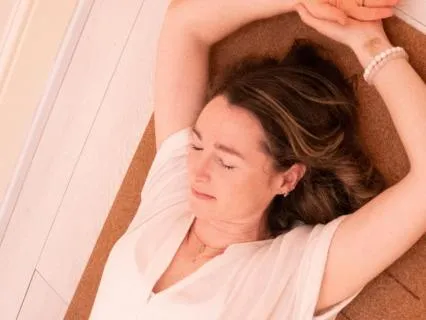
I invite you to lie down.
You can either lie on your back or your side.
Whichever position feels most comfortable for you.
Make sure you have enough comfort around you that allows you to feel completely supported.
You might like a cushion under your knees.
Little pillow under your head.
A blanket to gently wrap around.
Your body.
You might even use an eye pillow.
And you can use an eye pillow in different ways.
Sometimes if it doesn't feel comfortable to rest an eye pillow directly on your eyes,
It could feel nice to let it rest just above the eyes on your forehead.
Longer chest.
Or even as a gentle weight on your belly.
Don't let your hands rest in any position that feels comfortable.
On your body or by your sides.
Establishing a certain level of comfort.
Helps the body.
The muscles,
All the tissue of your body.
To gently yield into the support.
When your body feels supported.
Your nervous system.
Follow us!
Let your eyes close if that feels right.
Take some gentle,
Natural breaths in through your nose.
And out through your nose.
Again,
Gentle,
Natural breaths in through your nose.
And out through your nose.
Then let your breath return to its own natural rhythm.
No need to try to control or change in any way,
Just let the body breathe itself.
Like you to bring to mind the fatigue you named earlier.
Whichever one felt most true for you.
And underneath that,
See if you can find a simple intention.
What's called in the Yoga Nidra practice,
Sankalpa.
It doesn't need to be complex or elaborate.
It might be as simple as,
I rest fully.
Or I allow myself to receive.
Or I am restored.
Choose something that feels true.
Choose something that is present moment.
In the now.
Allow yourself to plant that intention gently.
Into your subconscious mind.
As if the subconscious mind was a rich,
Deep soil.
As you plant that seed.
Allow it to grow.
But let it go for now.
Now bring your awareness to your physical body.
As it rests heavily.
On the surfaces beneath you.
Notice your right hand.
The thumb of your right hand.
Index finger.
Middle finger.
Ring finger.
Little finger.
The palm.
The back of the hand.
The rest of your right hand.
Move up into the right forearm.
The elbow,
The upper arm,
The right shoulder.
Now bring your attention to the left hand.
Left hand thumb.
Index finger.
Middle finger.
Ring finger.
Little finger.
Palm of your left hand.
The back of your left hand.
The rest.
Up into the left forearm.
Elbow.
The upper arm.
The shoulder.
Both shoulders together.
Your collarbones.
Your chest.
The upper back.
Bring your attention to your throat.
Your jaw.
Letting there be a softness.
Releasing any clenching.
Soften around the lips.
Soften the sides of your tongue.
The front of your tongue.
And the root of your tongue.
Notice your cheeks.
Your eyes,
Soft in their sockets.
Your eyebrows.
The forehead.
As if it smoothens and widens.
Muscles relaxing.
Notice the crown of your head.
Now the whole of your head resting.
Gently onto the surface.
That it's resting upon.
Moving down through the neck.
Your chest.
Maybe noticing the gentle rise and fall Your belly soft.
Bring your attention to your right hip.
By SY.
By knee.
Right shin and calf.
Right ankle.
Right foot.
The toes of the right foot.
Big toe.
Second toe.
Third toe.
Fourth toe.
The little toe.
Bring your attention to the left hip.
Left thigh,
Left knee.
Left shin.
Left calf.
Left ankle.
Left foot.
The toes of the left foot.
The big toe.
The second toe.
Third toe,
Fourth toe,
And the little toe.
Visualize the whole body,
The whole of your body.
Resting completely,
Supported and at ease.
Bring your attention now.
To the natural rhythm of your breath.
Just allow yourself to watch your breath.
As it moves in and out in its own natural cadence.
Watching the breath as it enters.
Watching the breath as it leaves.
Notice the three parts of your breath.
The beginning of the inhale.
The filling up of the lungs.
And then the emptying out completely.
You might notice a slight pause in between in-breath.
And out-breath.
And the pause between the out-breath.
And the next in-breath.
If it's helpful.
Silently begin to count your breaths.
Backwards from 27.
Counting one number on each.
Inhale and exhale.
For example.
27 in 27 out.
26 in 26 out.
25 in.
25 out.
If you lose,
Count.
Simply begin again,
Wherever it feels right.
There's no failing here.
There's no wrong or right.
Let the counting go now.
And let your breath simply be.
I'm going to gently guide you now through each of the five layers we spoke about earlier.
We'll offer each one a moment of rest.
Allow your physical body.
To feel completely held.
In this moment.
That physical part of you that is so used to holding everything else up.
Can gently yield into the Earth's support.
Yield into the surface beneath you.
Allow that surface to take all of you.
So that you can feel completely helped.
Physical fatigue is met here.
Simply through stillness.
Through pausing.
And through allowing.
For a fatigued mind.
Notice if your thoughts still feel like they're moving,
Like they're whirling.
Know that that's alright.
You don't have to push them away.
See if you can imagine each thought.
As if it were a passing cloud.
Through a wide open blue sky and you are the sky.
The mind doesn't need to switch off completely.
It only needs somewhere spacious to rest.
For your emotional body.
Bring to mind,
If it feels right.
Anything you've been holding on to.
Even the smallest stones we carry become heavy over time.
Notice if you've been carrying something for yourself or for someone else.
You don't need to do anything with it here.
And even if you're not ready to put it down,
Just let it be witnessed.
Without judgment.
Notice if you can place even a small part of it down.
Resting it onto the soft earth.
For the part of you that might be tired from over-connection,
From constantly being with others.
Feel the quality of residing completely in your own presence in this moment.
Not alone,
Not lonely,
But completely with yourself.
Supported.
In the warmth of your own solitude.
No one needs anything from you right now.
There's nothing to perform.
There's nothing to justify.
For your senses.
Notice how still the world has become in this moment.
There's no demands on your eyes.
Your ears.
Let the senses rest in words.
Let your eyes drop deeper into their sockets.
And feel the ZIF.
The sense of hearing is turned inwards.
Drawn away from the outer world.
Resting in the stillness and the quiet.
Now allow an image to arise in your mind's eye.
A place where you feel completely at rest.
Might be a real place that you've been before.
Or somewhere imagined.
Take some time to fully fill in the details.
If it's somewhere you've been before,
Try to remember the small things.
Somewhere you've been imagining.
Fill in the colors,
The sounds,
The sights.
Textures.
Notice the temperature on your skin in this place.
Quality of the air.
Let yourself simply be there.
Wandering through this place.
That feels so restful.
For a few moments.
Notice this place asks nothing of you.
Gently begin to bring your mind once more back to the intention that you planted in the fertile soil of your subconscious mind.
That place we visited at the very beginning of this practice.
Your Sankalpa.
Repeat it now to yourself silently three times.
Fulfilling.
So it is true.
I am rested.
Gently begin to deepen your breath ever so slightly.
Allow your breath to take up a little bit more space in your body with each inhale.
Start to invite some very gentle movements back into your body.
See what feels natural.
Wiggle stretch.
Yawn.
Might choose to stay lying here for longer.
But when you feel ready,
Take a moment.
Before moving on,
Just to notice how you feel right now.
Without needing to change or evaluate it.
Just notice,
How are you in this moment?
Remember,
Rest isn't one thing.
It can be personalized layer by layer.
And it can be something you return to again and again.
Thank you so much for practicing together.