Hello and welcome to today's breathwork practice.
We'll do a few different techniques today that will open up.
The breath capacity,
So we breathe a little more deeply,
Fully,
And then we'll go into some calming,
Centering,
Nadi Shodhana practices to build equilibrium,
A sense of harmony within the body and the nervous system,
And hopefully find a little bit of clarity.
So these are,
We'll do three techniques today.
They're things that you can do on their own,
But of course all together will hopefully leave you feeling really calm.
Centered and these are really great tools as well to do before you do a yoga practice or any other movement practice too because they really release and Kind of expand the breath if you've been a little bit anxious or a little bit stressed and the breath is quite high or quite short These help to really centre and release the breath too.
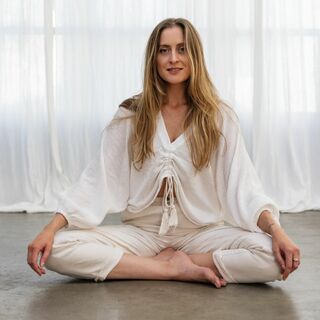
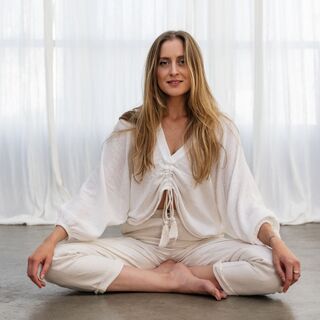
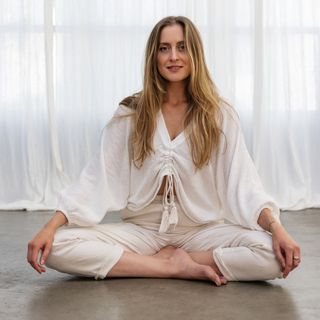
Let's start just by sitting.
However you're comfortable,
You can be sat on a chair,
You can be sat on a boulder like me,
Or however else you want to be.
So your spine is long,
Shoulders up,
Back and down.
Do that a few times if that felt good.
Softening your hands on your thighs.
Lengthening up through the back of your neck.
And if you haven't already just gently close your eyes.
We'll start just by noticing the breath as it is dropping into your body and noticing a gentle rise and fall of breath.
For today's practice,
It would be really helpful if you just isolate the breath to breathing in and out through your nose.
Breathing in and out through the nose actually calms the nervous system We also filter the air and we use more of our lung capacity when we breathe through the nose,
Which is another reason why it's calming for the nervous system,
But also really nourishing to the rest of the body.
So the first technique that we'll do,
You may want to gently blink your eyes open for a moment,
Is all we're going to do is Start to explore.
And open up a little bit of curiosity around deepening our breath,
Deepening our lung capacity.
And that is something that I speak about a lot,
Especially within movement classes,
But also within breath work,
Is actually where in your body you're kind of focusing the breath towards.
Has an effect on so many things.
On muscles.
It has an effect on how we strengthen the muscles from the inside out.
It has an effect on directing your energy.
It has an effect on the nervous system,
Releasing the fascia,
The connective tissue.
There's so much.
And often we think that when we're breathing,
It's something that only really happens down in the belly or something that happens maybe in the front of the body,
Which is kind of odd.
The lungs fill this whole space from the whole rib cage,
The bottom of the ribs,
All the way up to your shoulders.
There are big organs and we can breathe into that whole space.
So we're going to breathe and I'll ask you to bring your hands to certain places and see if you can breathe into those spaces in the body to kind of increase and feel the full capacity of your lungs.
So we'll start with a very easy one and we'll start just by breathing low down into the belly.
So bring your hands to your belly.
Relax your shoulders.
You may want to close your eyes again.
Again,
Breathing in and out through your nose,
But see if you can feel the rise and fall of the lowest part of your belly as you breathe in and out.
So you can feel breathing into the front of the belly.
Now see if you can breathe to the higher part of your belly,
So around the solar plexus.
This will be breathing out into the palm of your hands here,
Right at the solar plexus.
Upper part of the abdomen all the space in between your navel and your ribs.
So now we've felt breathing into the whole part of the front of the belly.
I'm going to ask you now to do something a little bit weird and bring your hands to your lower back.
So with your hands on your lower back,
These lower muscles in between your ribs and your hips,
Now we'll breathe into the hands,
Into your lower back.
This is something that you won't be able to feel as strongly as you can in your belly,
But just get curious.
See if you can notice that slight pressure into your hands as you inhale.
Again,
We'll just do five breaths here.
Directing the breath now keeping your body relatively still directing to the breath into your lower back Great.
Now we'll come up the body into the sides of the rib cage.
So bring in your hands to the side of the ribs.
Now see if you can breathe out to the side into your hands.
This is one I bang on about enough.
So see if you can breathe out to the sides into your hands.
Feeling your ribs expand with your inhale and knit together with your exhale.
We'll just kind of relax.
We're not squeezing the ribs together.
We're just allowing them to relax.
Inhaling again out to the side.
Exhale,
Relax.
Inhale out to the sides.
Exhale,
Relax.
Coming up the body still.
Now we're going to breathe into the top of the chest.
So bringing your hands one on top of each other onto the sternum.
This flat bone right in the middle of the chest.
And see if you can breathe up into your hands.
So now the belly,
The ribs stay relatively still.
See if you can breathe up into your hands.
And again this is another space that might feel a little bit more subtle than the other ones before.
If you struggle to feel it in the centre of the chest,
You can also bring your hands right underneath your collarbones.
And then last one,
And again,
It's another weird one,
Breathing into the back of the body.
Now give yourself a hug.
Round your upper back a little bit so you increase that space in between your shoulder blades and then now see if you can breathe into the space in between your shoulder blades so keeping your belly and your rib cage relatively still see if you can breathe into your upper back and again be curious about it it's one that you might not feel as strongly as other places just start to notice subtle sensations of breath at the top of your upper back and then release So relaxing your hands down once again.
Hands to your knees.
And now see if you can just take five breaths.
Breathing into all those spaces at once.
So expanding the breath throughout the whole torso.
Inhaling,
Feeling your belly rise.
Side to the waist or ribcage expand.
You might feel the lower back as well.
Feel it coming up into your chest and the upper back.
As you exhale the whole torso just kind of softly relaxes back to centre as the air lifts up and out through your body,
Through your nose.
Inhale,
Expand.
Bye.
Now we're back.
Ribcage upper back and chest and relax Take three more rounds of breath like that in your own time.
Now keep that expansion.
You might want to gently open your eyes.
Keep that expansion,
Maybe not in such a forced way,
But just feeling the expansion of breath all moving through the whole torso as we go into our next practice.
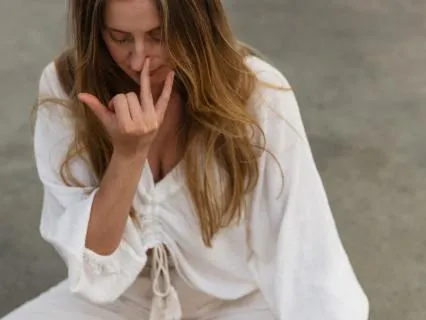
We'll do Narishodhana or alternate nostril breathing.
We'll do one round normally and the second round with Kumbhaka or breath retention.
So anyone newer to the practice,
Narishodhana is,
Well we call it alternate nostril breathing but actually translates to nerve cleansing.
So what we're doing is we're cleansing the nervous system by balancing the nervous system by balancing the right and left hemispheres of the brain.
By breathing through one nostril at a time.
So,
In fact,
The nostrils are different.
The left nostril is associated with the right side of your brain,
The right nostril more with the left side of the brain.
And you'll notice the more you practice this practice that.
.
.
The attention on each nostril or the kind of strength of each nostril will change throughout the day and that's totally normal.
Normally to be able to go to sleep,
We need to be breathing a bit more through the right side.
Normally when we wake up,
We're breathing more through the left side.
This practice brings balance to both,
A kind of a reset to both.
It can be really great for insomnia,
Really good for anxiety and stress as well.
Right hand you can bring your into The traditional mudra,
Which is you bring in your peace fingers down to your palm.
Your thumb and your fourth finger will use to block one nostril at a time.
So thumb to the right nostril,
Fourth finger to the left.
However,
If this is uncomfortable.
.
.
You can also bring your fingers to your forehead and again use your thumb and your fourth finger.
And we'll do five,
Inhale left,
Exhale right.
Five,
Inhale right,
Exhale left.
Five,
Inhale,
Left,
Hold.
Then exhale and right,
But we'll come back to that another time.
So bringing your peace fingers to your palm or to your forehead,
Soften your shoulders down.
Take a big exhale first.
Then block your right nostril,
Fully inhale to the left.
Block your left nostril with your fourth finger.
Fully exhale to the right.
Inhale left.
Exhale,
Right.
Inhale left.
Exhale,
Right.
Inhale,
Left.
Exhale right.
Inhale left.
Exhale,
Right.
Now keep your hands exactly as they are at the end of this exhale.
Swap over.
So now inhale right.
Exhale,
Left.
Inhale,
Right.
Exhale,
Left.
Inhale right.
Exhale left.
Inhale right.
Exhale there.
Last one,
Inhale right.
Exhale,
Left.
And soften your right hand down for a moment.
Just come back to a natural rhythm of breathing.
Notice how you're feeling after that practice,
All those two practices.
And then whenever you're ready,
We're going to do that one again.
But this time with the top of the inhale,
We'll hold the breath in for a count of four.
It's called kumbhaka or retention.
And what we're doing with breath retention,
It has loads of different benefits.
But the one you can feel the most is a little bit of discomfort.
So with discomfort,
Our job for that short count of four is to find comfort within discomfort.
So for that count of four,
We say one,
Soften your shoulders.
Two,
Relax your jaw.
Three,
Maybe relax your belly.
And then before you know it,
It's time to breathe again.
Again,
We're strengthening our resilience to discomfort through that really short space of time.
It's really what we're doing.
But as I said,
There are loads of other benefits.
But we'll just do that one again and again.
Inhale,
Hold for four.
Exhale.
But if you find at the end that holding the breath is a little bit too uncomfortable for you,
That's totally fine,
Totally normal,
Not a defeat.
You can just repeat what we did before to the same thing without the kumbako,
Without the breath attention.
Whenever you're ready,
Soften your shoulders again.
Take your right hand.
Same as before,
Piece fingers to your palm or to your forehead.
Take a big exhale first.
And block your right nostril with your thumb fully inhale to the left Hold,
Two,
Three,
Four,
Block your left nostril,
Exhale,
Right.
Inhale left.
Hold,
Two,
Three,
Four.
Exhale,
Right.
Inhale left.
Hold,
Two,
Three,
Four.
Exhale,
Right.
Inhale left.
Hold,
Two,
Three,
Four,
Exhale right.
Inhale left.
Hold 2,
3,
4,
Exhale right.
Keep your hands as they are.
Now inhale right.
Hold,
Two,
Three,
Four,
Exhale,
Left.
Inhale,
Right.
Hold,
Two,
Three,
Four,
Exhale,
Left.
Inhale right Hold,
Two,
Three,
Four,
Exhale,
Lift.
Inhale right.
Hold,
Two,
Three,
Four.
Exhale,
Left.
Last one,
Inhale right.
Hold,
Two,
Three,
Four,
Exhale,
Left.
Soften your right hand down,
Soften your shoulders.
Come back to a natural rhythm of breathing.
No controlling,
No trying to breathe the deepest breath ever,
But just start to breathe and notice how you're feeling after those practices.
In your mind and your body.
Your energy.
Even if your eyes are still closed,
Just gently blink your eyes open.
Thank you so much for joining me for this short breathback practice.
I hope that you find it helpful.
As I said,
Those three techniques can be used on their own.
Um,
Or altogether,
To feel expanded within the breath,
More balanced in your mind and body,
And centred,
By the way.
Enjoy the rest of your day,
And I'll see you again very soon.