Welcome to the mindfulness meditation podcast presented by the Rubin Museum of Art.
We are a museum in Chelsea,
New York City that connects visitors to the art and ideas of the Himalayas and serves as a space for reflection and personal transformation.
I'm your host,
Dawn Eshelman.
Every Monday we present a meditation session inspired by a different artwork from the Rubin Museum's collection and led by a prominent meditation teacher from the New York area.
This podcast is a recording of our weekly practice currently held virtually.
In the description for each episode,
You will find information about the theme for that week's session,
Including an image of the related artwork.
Our mindfulness meditation podcast is presented in partnership with Sharon Salzberg and teachers from the New York Insight Meditation Center,
The Interdependence Project,
And Parabola Magazine.
And now,
Please enjoy your practice.
Hi,
Welcome everyone to mindfulness meditation online with the Rubin Museum of Art.
I'm Dawn Eshelman,
And we are a museum of Himalayan art and ideas in New York City,
And we're so glad to have you all join us for our weekly program where we combine art and meditation online.
And it's so great to see some of you showing up in the chat here,
Letting us know where you're joining us from.
And I also just wanted to offer another prompt if you'd like to tell us ways in which you are cultivating awareness in your life,
Just in your daily life.
That would be great.
We are delving into that topic this month,
The topic of awareness.
This is something that we certainly cultivate in our meditation practice,
But also that we think about as being a first step in this journey towards enlightenment through the lens of Tibetan Buddhism.
We are really bringing you this theme because it comes from an exhibition that's on view right now,
A beautiful exhibition called Awaken,
A Tibetan Buddhist journey towards enlightenment.
And this explores the steps in the journey of self-knowledge and transformation from chaos to awakening and everything in between.
So inspired from the exhibition,
We will take a look at a work of art from our collection today.
We will hear a brief talk from our teacher who is the wonderful Sharon Salzberg.
And then we will have a short sit together,
15 or 20 minutes for the meditation,
Which is guided by Sharon.
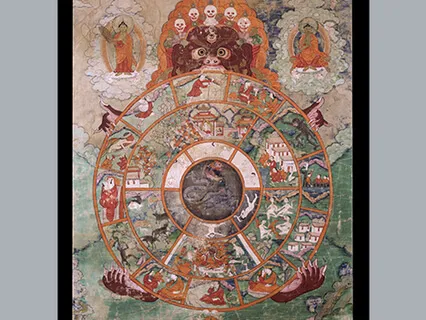
So we're looking today at this beautiful object that is probably one of the most well-known in our collection.
This is the wheel of life.
This is from 18th century Tibet,
This particular depiction,
Although there are many,
Many depictions of the wheel of life or wheel of existence as it's also called.
The first thing that I want to point out to you is the earth tones that are represented here in this particular depiction.
So we're seeing a kind of ochre background with a green landscape behind.
And the major figure here is this big circle right in the middle,
Right?
And then behind it,
This kind of looming figure.
And we're seeing the circle and the figure really depicted in these orange kind of burnt umber colors and dark red,
So greens,
Ochres,
Reds,
Oranges are really coming to the surface here.
The large red figures of a personified samsara or suffering kind of personified as who's known as Yama.
And Yama has a crown of skulls and flaming orange hair and is holding this wheel with his claws and jaws.
So an intimidating figure here and really representing the immediacy of impermanence.
This wheel can be gobbled up at any moment.
We also see at the very center of the wheel,
Three poisons represented by three animals,
A black pig for ignorance,
A snake for anger and a rooster,
A multicolored rooster here for desire,
Clinging.
In the next circle,
We see the five realms,
Humans at two o'clock.
We see hungry ghosts,
Hell at the bottom,
Animals,
And then gods and demigods.
And enlightenment we know is possible from any realm,
But it's actually considered to be easiest from the human realm,
Right?
Which is interesting to think that the human realm is actually providing us with more opportunities and say we might find in the gods or demigods realm.
So this is all reminding us of the cycle of samsara,
Of suffering and of birth and rebirth.
And that while the cycle continues over and over again,
That there is always an opportunity for awakening,
For awareness that translates into enlightenment.
And the last thing I'll say about this is that this object,
This depiction of the wheel of existence is usually found outside of every shrine room of every place of worship in Tibetan Buddhism because the purpose of it here is to really wake you up,
To cultivate awareness,
To say,
Hey,
Get yourself in your most intentional space before you enter this place that is sacred.
So it's a tool.
It's a tool for cultivating awareness.
Sharon Salzberg is our teacher today.
She is the co-founder of the Insight Meditation Society in Barre,
Massachusetts.
She's guided meditation retreats all over the world for many years,
And she's the author of many books,
Including her latest Real Change,
Mindfulness to Heal Ourselves and the World.
And we're so delighted to call her a regular participant in many of our on-stage conversations at the Rubin.
You can always find what she's up to at SharonSalzberg.
Com.
Sharon,
Thank you so much for being here.
It's a delight to gather with all of you once more.
And I actually have long loved that piece of art,
The Wheel of Life,
And it's possible to just go into it and look at it in so many different layers and levels.
And one of the elements of it,
Those different realms of existence are sometimes taken as a cosmology and sometimes,
Of course,
Taken as symbolic of different ways we might live.
And so there are the hell realms we may feel we are consigned to and,
You know,
Everything is condensed and we're enraged all the time.
And it's so lonely and awful.
And then there's the hungry ghost realm,
Which is full of desire that can never be satisfied.
And the human realm,
Which we know.
And then the higher realms.
And just as Dawn said,
It's interesting because the gradation of all of these different realms has to do with the degree of suffering that tends to be around.
And the human realm has a certain mix for many people.
I mean,
It depends on whether you live within a hell realm,
Within the human realm and so on.
But in general,
As a symbolized,
The human realm has a certain mix of pleasure and pain.
And so it's enough pleasures that it's not all about survival.
And we're not just trying to get through the day for God's sake,
But enough pain so that we wake up so that we want to look deeper.
And that's the problem with those higher realms is that as symbolized,
You know,
As depicted,
You have like a body made of light and you live in jeweled palaces and all of that.
And so you can frolic your time away in these pleasure groves and not really want to look deeper until you face death,
You face change,
You face the unknown,
You face being out of control,
Which inevitably happens.
And so,
Um,
It's a very meaningful map for,
First of all,
Understanding life is big.
The universe is big.
It is so much more than our current situation.
And to understand that awareness is actually the alchemical agent that is,
It's almost like the holding tank for all of these different experiences,
Extreme pain,
Extreme desire.
Delight,
Joy,
Uh,
Frolicking enjoyment.
Um,
That mix of pleasure and pain,
All of it is held within this,
This large sphere,
The ability of awareness to be present,
To be,
Um,
Kind of like the sky,
Um,
Constrained,
Kind,
Not really determined by the situation happening within it.
You know,
We can be aware of enormous joy and be aware of enormous sorrow.
And the awareness itself has certain qualities.
As we use that word,
It has that quality of presence of openness,
Some kind of spaciousness.
It has the quality of interest rather than rushing to judgment.
Um,
It has a quality you could say of compassion of kindness.
And that is really fundamentally,
It is like the alchemical agent,
Whatever we may be going through and whatever may be happening in our lives day to day,
We have this capacity.
It is said to pay attention differently.
And so awareness will change a lot.
It may not change the circumstance and that's important to recognize you haven't failed because you've,
You know,
Not managed to make it all very sweet or something like that.
Um,
And at the same time,
Our experience of what's happening is very,
Very different.
So it's awareness of a certain kind that is talked about as the cell chemical agent.
It's not just knowing that you're angry,
For example,
You're afraid it's knowing in a certain way because simply knowing,
Which is good.
I mean,
That's a step forward for sure.
For many of us,
You know,
To realize like,
Oh yeah.
Um,
I was in a fog before I was kind of oblivious before and a lot of mindfulness quizzes and tests are really about that.
Can you identify,
Can you actually name what you're feeling and some ways we can and some ways we can't,
But increasingly we can as we pay attention,
Even if not with absolute precision,
We can get in the neighborhood.
We know this feels like a drag,
Whatever it is.
We know this feeling has a,
Um,
Almost a kind of tunnel vision function.
We feel really shut down.
Uh,
We learn a lot and,
And we do that through paying more and more attention.
So awareness or mindfulness,
I'm using them almost,
Um,
Synonymously right now means paying attention in a certain way,
Because if you know you're afraid and you cannot stand that and you're full of judgment and you're,
You're angry about that and you feel like you failed,
That's not exactly the awareness that is going to liberate us.
So the characteristics,
The qualities within the awareness as the holding tank,
As the,
As the vehicle for liberation,
Whatever it's looking at would be interest.
For one thing,
It would be balance.
It would be an ability to discern the difference between what our experience actually is and the story or the narrative or the judgment.
We tend to lay on top of it.
That doesn't mean we do that for the sake of passivity or for that matter,
We don't cultivate awareness for the sake of never trying to do anything about the conditions or the circumstance we do.
But the start of all that,
The foundation of all that is being able to be with what we're experiencing so that we can see it more truthfully,
More honestly,
More comprehensively.
I had a Burmese meditation teacher named Saira Upadita that we brought here in 1984 to Barry Mass,
Which is where I am now,
To the Insight Meditation Society in order to have him teach a three month retreat,
Which I sat under his guidance and we had never met him before,
But we heard he was a really powerful teacher,
Which he really was.
And one of the interesting aspects about practicing with him,
Aside from his own abilities,
Was just the format within which we practiced with him and that we met him six days a week.
We met him and his translator's interpreter for what was a very short meeting during which we were asked to describe our meditation practice and then he could give us some feedback.
And so most of us took some notes,
Like at the end of a sitting,
Just like it was really sleepy or whatever,
Whatever you want to say to him.
And one of the interesting aspects of that whole system was that it was very formal.
It was very formulaic.
It was a certain way you were supposed to describe things.
And that was partly so that it was easier for the translator.
And partly it was actually,
I think,
A lesson for each of us not to like leap into interpretation right away and judgment and conclusion,
But to be actually able to present this is what the experience was.
So if you walked in there and you said,
I had a terrible morning,
That was not helpful.
I mean,
That tells him nothing really tells him.
You think you had a terrible morning,
But sometimes what we think is a bad sign is actually a good sign.
It didn't hurt,
But it was good.
It was important.
It was opening.
Sometimes what we think is great is just a detour.
And so he wanted to know,
We would say these days,
The data,
He just wanted to know,
This is what my experience was.
I sat down,
I brought my attention to the feeling of the breath.
I fell asleep.
Then I woke up and I was really angry at myself for having fallen asleep.
I neglected to look at the anger and be with that as an object of meditation and became very judgmental.
And then I felt defeated.
And I got up,
That's a description that actually gives him some information that's different than I had a terrible morning.
And even if you were describing an insight,
Something powerful and opening,
Something that had really changed things for you,
He didn't want to hear the conclusion.
He wanted to hear the actual experience that led to the conclusion.
In writing,
We would say,
Show,
Don't tell.
You don't say,
Actually gave someone this feedback once.
You don't say,
The doctor came into the room and was clearly nervous.
You say,
The doctor came into the room and they dropped five instruments on the floor and they were sweating or whatever.
That's what Upanishad wanted to hear is like the richness of,
This is what my experience was,
Which led me to feel everything's changing all the time.
And so that became more a habit of like,
Okay,
What's actually happening?
What's the experience?
What am I aware of when I am directly aware of what's happening without the overlay or the filter of this should be happening,
This shouldn't be happening.
I've got to keep this going on.
I've got to shut this down.
What is this?
What is this?
It's not right.
It's wrong.
It's not right.
And so that's the kind of awareness that we strongly try to cultivate in our meditation practice.
So let's do some together.
You can sit comfortably.
Close your eyes or not.
Just relax.
Start by listening to sound,
Whether it's the sounds of my voice or other sounds.
It is a way of relaxing deep inside,
Allowing our experience to come and go.
And even though of course we like certain sounds and we don't like others,
We don't have to chase after them to hold on or push away.
Just let it come,
Let it go.
And bring your attention to the feeling of your body sitting,
Whatever sensations you discover.
See if you can feel the earth supporting you.
Feel space touching you.
Usually we think about touching space and we think about picking up our finger and poking it in the air,
But space is already touching us.
It's always touching us.
It's always touching us.
Bring your attention to your hands and see if you can feel the different sensations,
Not get caught up in the idea of hand or fingers,
But what are you picking up directly?
The pressure,
Warmth,
Coolness,
Whatever it might be.
You don't have to name it,
But feel it.
And bring your attention to the feeling of your breath,
Just the normal natural breath,
Wherever you feel it most distinctly.
This is like home base.
It's a place to rest.
Can find that area where the breath is clearest for you or strongest for you,
Like the nostrils,
The chest or the abdomen.
Bring your attention there and just rest.
See if you can feel one breath without concern for what's already gone by,
Without leaning forward for even the very next breath,
Just this one.
And if you like,
You can use a quiet mental notation like in,
Out,
Or rising,
Falling to help support the awareness of the breath,
But very quiet.
So your attention's really going to feeling the breath one breath at a time.
If your attention wanders,
You get lost in thought spun out in a fantasy or you fall asleep.
Truly don't worry about it.
Can realize you've been gone.
See if you can let go gently and just bring your attention back to the feeling of the breath.
Okay.
S hospital.
You you you no matter how far away our attention goes no matter for how long we've been gone doesn't matter we can actually still let go and begin again you you you you you you you you you you you you you you