Welcome to Restful Journeys.
In this track I will be reading a story about the goddess Athena.
Please find a comfortable place to sit or lie down and relax.
Take a few moments to clear your mind and allow yourself to listen to these words.
Let's enjoy this journey of Athena.
An elderly woman wakes with the morning sun,
But lies in her cline.
The bed that she has rested in,
All throughout the night,
She does not rise with the city at dawn.
She simply rests,
Breathing with ragged inhales.
Her exhales break into coughing fits.
Her face is pale,
Her skin beating with sweat at the fever in her body.
She dabs at her wrinkled skin with a cold compress,
Each line on her face a sign of the life she has lived,
But it was clear it was now coming to an end.
Alone in her home,
She whores herself from her bed with a cacophony of cracking joints and groans of pain.
She hobbles to her hearth,
Starting a fire and warming her bones on the flames.
She then goes to pray,
As she has every day of her life,
Calling to each god and praying for favor,
For health,
For peace.
Then she called on the goddess she had followed her whole life,
Athena.
For the goddess of wisdom had been the protector and patron of her city since she had been born.
The elderly woman had always loved Athena most,
But in her dying days she had begun to question things.
The nature of the goddess she had followed her whole life,
The one she had prayed to at every bad moment.
But in these days of pain,
The empty loneliness and the waiting,
Waiting for death to come for her,
As it had her husband,
As it had her son,
She wondered why she felt so alone.
Had her goddess ever been there for her,
Truly?
She had begun to doubt.
The city of Athens was quieter than expected,
But after days of celebration in the June heat,
Everyone needed some time to rest,
For the great festival of Athena,
The Panathenaia,
Had just concluded and so all were recovering from the excitement.
For once,
The city was calm.
No longer were the people drinking and laughing in the streets.
They were laid about in drunken stupors and remaining there to avoid the hangover.
The elderly woman prepared for her journey,
And it took most of the afternoon.
By the time she left her home at the start of her short pilgrimage,
The sun was already setting.
The streets were dotted with a few of the familiar faces,
And they greeted her as they passed her,
For she was slow,
Holding a sling of precious items on her arm,
Trudging the road up to the Acropolis,
Toward the temple.
Pylea,
The elderly woman,
Arrived at the top of the steps of the temple with a huff.
The sun now long set,
Stars filled the night skies above her.
She stopped to take in the view and catch her rasping breath.
Coughing overtook her body,
And she grasped at her sling,
Scrambling for a cloth.
She held it to her lips and heaved.
When she caught her breath,
She stepped towards the altar for believers.
Only priestesses were given the honor of entering into the temple dedicated to Athena and Nike,
But from the altar in front,
Pylea could see between the columns to the grand silhouetted statues.
As a patron of Athens,
There were huge statues to the goddess of wisdom built in her honor.
In the cooling night,
Elderly Pylea felt something in her spirit,
A call,
A burning fire,
A courage she had never felt before.
She looked around,
But there was no one in sight.
The temple was empty entirely,
Almost eerily.
Pylea seized her moment and marched inside.
Her eyes roamed everywhere.
At the great tapestries,
Every wall and nook,
For this place had been forbidden and she had always wondered.
She gawked at the sacrificial offerings and then came to a stop as her eyes fell upon the largest statue.
She shuffled over to the immense altar before it.
The statue was vast,
Regal,
Cosmic,
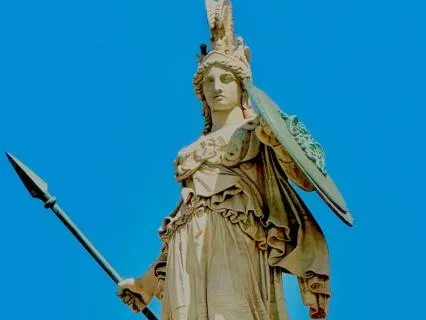
Depicting a woman with a helm balanced atop the head,
Held high.
With bright eyes,
She held a large round shield and spear,
Placed firmly to the ground on her left.
Near it,
A sacred snake of stone.
Pylea admired the scales in the stonework.
Then she saw the base of the statue.
It was delicately carved with animals,
Scenes,
And images.
Pylea pressed her withered hand to the symbols,
Recognizing some snakes and gorgons from the tails.
She smiled and looked back to the statue.
Athena,
In her robes,
Stood proud and in her other hand,
She held a small goddess with wings.
Nike,
The goddess of victory,
Stood in the palm of Athena's hand.
But Pylea could not recall which victory it was for.
She sighed and then got her sling off her shoulder.
Pylea's wrinkled hands took many items from her sling.
With shaking hands,
She placed her own fresh bowl of offerings before the grand statue.
She took a flame from the fires before it and lit her bowl.
It slowly caught light,
The smoke smelt of burning animal fat,
And the bones cracked and snapped as they burned.
It rose high into the air and she closed her eyes and began to pray.
Words whispered.
She mumbled a name with vague breaths.
Athena,
I hear her call,
As I hear them all,
Overlapping prayers,
All calling to me.
Her voice rises above the discordance of noise,
Becoming clear.
I know her instantly.
Seldom do we gods appear to mortals as our true selves.
We come disguised most often.
It is simpler to see the truth of a man when they think nothing of you.
But there are times where the best face to wear is your own.
I take a deep breath and I feel my spirit now back to my physical form,
No longer lost in the worlds between,
Where I listen to the prayers all sent to the skies.
I rise from my desk in my quarters on Olympus.
I take up my helm and place it on my head.
My armor and aegis shine in the firelight.
Collections of books line the walls.
The tables are strewn with maps and numerous tools.
A war map,
With carved stone sigils in various positions,
Haunts the edges of my vision.
I leave it all behind and walk to the balcony.
There I transform with sparks of bright silver light into a large owl with gray eyes.
I fly through the skies swiftly,
Noting the air currents and jet streams.
South astrally,
I soar above the clouds until my city shines on the horizon.
I dip down and glide,
Observing the many houses and structures.
Streets lined with decorations,
Empty vessels,
And piles of emetic outpours left behind.
I follow the roads from above and spy the columns of my temple.
I dip down and weave through the columns until I am face to face with the statue of myself.
I flap my wings until I can perch myself atop the stone head of Nike.
There I watch Pilea and hear her prayers in person.
Her eyes remain closed,
Her head held low.
Her idle hands pick at the hem of her peplos.
She does not look up at the statue,
As many in her place before her did,
Saying their prayers to my stone features.
No,
She seems hollow,
Her belief waning in her spirit.
It was evident to me she prays for reassurance,
A sign for hope,
An answer to prove her faith had been worth something that her many years of devotion had not gone to waste.
Her mind was deteriorating,
As was her body.
It would not be long.
She ends her prayer and looks up at the statue once more,
Locking in on my wide,
Owl-eyed gaze.
I drop down from the statue and in that fall,
With a bright flash of silver light,
I transform again,
Taking my true form,
With my godly soul,
My true power,
Shielded from her to protect her mortal sight.
She gasps and steps back in shock and awe.
Dropping her sack to the floor,
She falls to her knees before me.
Her eyes flicker over my shining armor,
My spear and shield,
And my helm upon my head.
The sparks of light shimmer and fall onto the stone floor.
Pilea breaks out into a coughing fit,
Falling onto her hands.
She pushes herself up and struggles to grab at her handkerchief.
Once found,
She raises it to her lips.
As she draws it away,
A flutter of fabric reveals a splatter.
It is stained with blood.
I offer my hand to old Pilea,
Crumpled on the floor.
With a shaky gasp,
Her eyes find mine.
She looks up and sees a kind smile on my face.
I hope my gray eyes convey the warmth I wish.
And she takes my hand.
I am careful not to break her brittle bones as I help her stand.
Pilea turns her head and there are two chairs that were not there before,
Set near a sacrificial torch,
The flames warm and inviting.
I use a small part of my power to create these items for a short time.
I have no need for shows and extravagance to overall mortals.
But this was a private moment,
And so I reached out with my gifts and push all from this place.
All mortals who might come to this very room on this very night would be distracted by thoughts and tasks elsewhere.
None would disturb us.
I led Pilea to sit beside the fire.
And as she stares,
I take the seat beside her.
I set down my shield and spear,
But my helm I do not move.
And we sat.
We do not speak for a time.
We observe one another,
Her eyes wide,
Her face pale and drained of blood.
Sweat beads on her brow,
And she begins to fidget in her seat like a child.
She is terrified,
Confused,
But all remains steadfast in her eyes.
I smile at her,
And she eases slightly.
She returns my peace offering with a smile of her own.
I slowly stand for my seat,
Walk to the altar,
Bringing back two cups of wine.
I give one to her,
Sit back down,
Smile,
And drink from my own cup.
She drinks hers down,
And then I see it all.
The questions,
Thoughts,
And emotions she has.
With my power,
I could hear her very mind calling out in a jumble.
Who are you?
Are you Athena?
Have you come to kill me?
Am I chosen?
Why me?
Are you really my goddess?
Fear,
Awe,
Wonder,
Curiosity,
And even hate,
Loss,
Doubt,
And overwhelming sadness.
What are you?
What do the gods want from me?
Why did you let my husband die?
Why did you kill my son?
Why did you let me live?
Who are you?
We gods can sense things on planes mortals could never even dream of.
But some of my family themselves are not observant enough to see.
Pelia,
Now calmer of body and mind,
Begins to ask her thoughts aloud.
I take a breath and begin to answer her questions.
To begin,
Who am I?
Do I come truly as Athena?
Yes,
I am Athena,
Goddess of wisdom in the court of Olympus,
Daughter of Zeus.
Mortals have heard many tales of me,
But not all of them ring true.
Fabrications,
Falsehoods,
And often it is simply a lack of sight.
Seldom do mortals have the purview that we gods do.
You have not the sight or the knowledge to understand,
For it is all a matter of perspective.
Pawns do not know the battle plans,
Nor can they see all the pieces in play.
Without the sight to see,
You cannot ever truly know.
The confusing voices of thousands,
All crying out different stories,
But all from their sight,
Stuck on earth.
I do not have the time nor the will to correct them.
What would be the point?
But Pelia,
You ask,
You want to know why?
Why you?
Why now?
I will come to that.
But for now,
I will answer a much harder question.
For you wish to know the true nature of your goddess,
Your patron,
The protector of your city.
Let me tell you who I am.
To understand me truly,
We must go back to my beginning,
My conception and birth into the world.
You know that I be the daughter of Zeus alone,
Cracked from his very skull fully formed.
In legend and myth,
It is so.
But my first memory is darkness.
I inherited the body of Metis and then my father Zeus.
Metis,
The Titaness,
A sister of Rhea and Kronos.
She was the titan of wisdom and good counsel.
She among the most astute of their generation.
Metis was one of the few to ally herself with the rebels in the first war,
The Titanomachy,
The war of the gods.
It was her aid which allowed Zeus to challenge his father in the court of the old king.
For Metis snuck my father into his very throne room on Mount Othrys,
Helped him poison my grandfather into releasing the children he had swallowed.
Metis helped Zeus and the Olympian siblings escape.
For my mother's loyalty,
Wisdom in the decade-long war that followed,
When the Titans fell and my father emerged victorious,
Metis was chosen as his queen to rule by his side,
Counsel him in the ways of peace when the young god knew only war.
But prophecy comes for us all.
Zeus did not escape the curse of the line.
Dreams and visions,
The words of his father Kronos and his father before him,
Uranus,
The mighty skies.
Zeus began to dream of children.
They plagued his nights and days.
Paranoia grew until it pushed him to swallow his own wife in a game.
A display before the court,
Metis transformed and was swallowed whole,
All because he had heard me inside his head.
The seed of concept in her head too.
Barely in existence,
Just thought and idea and a heartbeat thumping in his head.
His dreams told of a baby flickering between visions of a girl and a boy in his arms.
My father has spoken of this with me in the years since,
But Kronos was not supplanted by a daughter,
But a son,
And Uranus before him,
Betrayed by Kronos,
His son.
Zeus's dreams of me were different,
Where the boy brought death,
Doom,
Zeus's blood on his tiny hands.
My father saw light,
Hope,
Inspiration,
And love in my eyes.
He swallowed my mother whole,
And in the vast ocean that is Zeus,
She was caught,
Like a fly in honey,
Drowning in golden light.
But my mother did not lie still as Zeus's soul began to absorb hers.
No,
She got to work.
Metis took her essence and began to mold and reforge it.
As I grew in the body of Metis,
The mind of Zeus consumed me too,
But I began to grow in earnest.
No longer a concept,
But thought made flesh,
Intellectual worlds,
The merging minds of two gods made manifest in me.
Metis hammered the pieces of her soul,
Made physical,
Hammering and hammering,
Molding and shaping,
Thumping inside the being of Zeus.
She took the parts of her godly power,
And over weeks,
Carefully,
Created a helm,
A spear,
And armor,
A breastplate,
To protect me,
Her final gifts to me.
I remember her warmth,
But no face,
No physical body or soul,
No physical body or voice at all.
In my being,
I am part of her spirit,
The very essence of her soul.
She gifted me knowledge,
Wisdom,
No memory,
But all the lessons she took from her memories.
Like the muscled reflexes of an aged and trusty fighter,
His body having repeated motions for years,
But translated unto the mind.
She gifted me the muscle memory,
The divine gifts of the titan goddess of wisdom.
I was now to fill that hole she had left,
The balance of the universe.
I was to be the wisdom of the new generation.
From her,
I have wisdom beyond my years,
Beyond the millennia of many,
But the flesh of which I am made is of Zeus himself.
Fermetus was absorbed into him,
And so she is inside us both.
Zeus Metiata,
The wise counselor,
For she fused into his being as he remains alive,
Leaving him a greater ruler.
Sage,
And with the surprise of his daughter inside his head.
Zeus's body grew me,
And it was I,
In my armor,
That hammered at his skull when Metis was gone.
Weeks of choosing the worst places to strike,
To free myself of the bodily prison,
Until a bright light in a crack appeared,
And I plunged my hands into this crack and heaved it apart.
Fully armed and ready,
I emerged from his skull and struck the floor of the palace with my spear.
Zeus is my mother and father both in flesh.
I,
Athena,
His firstborn child,
Am one of the most powerful of his children.
Fate decreed I would be as strong as my father.
My brother was the one who would have surpassed his strength.
But Zeus cleverly never let the chance of a second child occur.
What can outgrow you that never had the chance to grow at all?
At times,
He seems to forget the prophecy called that his daughter would match him in strength.
I was made,
As many gods are,
To fill a role the universe requires.
An absence that my mother had left,
I am filled with pride to provide it,
Happy to share in the knowledge and skills I possess.
Wisdom is just one part of the puzzle that is Athena.
Pylea sits and takes it all in.
The firelight crackles and she finishes her wine.
With the wave of my hand,
The cup refills in a blink.
I know her next question,
But I let her ask it aloud.
Pylea's curiosity is ravenous.
I admire it.
She wishes to know of my many names,
All the tales she had heard as a girl,
And those long forgotten.
Now,
Being told my history,
With new details from the voice of her goddess,
She wishes to know all,
But for now,
She wishes to know which tales are true.
For,
As a child,
She would hear of different stories,
Different tales from different mortals,
Stories of giants I had slain,
The truth about my ages,
Countless names of heroes and villains,
Their numerous rewards and punishments,
All by my hand.
But Pylea chose and asked me,
Is it true that my name,
Pallas,
Comes from the slaying of a giant?
To this I replied,
Yes,
But there is more than just the death of giants.
For names are repeated throughout time.
Many can bear one name,
And so it can represent more than one event.
There are two called Pallas in my past that outshine the rest.
Before the war with the giants,
In the days before mankind,
I would travel the vast world and continue to expand the knowledge granted to me.
From Mount Olympus to the very poles of the planet,
I would explore,
Spending time with Demeter,
Picking flowers with Persephone.
I went on hunts with Artemis,
Followed Apollo into the sunlit skies.
Zeus and his new wife were growing the court on Mount Olympus.
I often went to the palaces under the ocean instead.
There in the golden palace under the watery depths,
I would oft spar with a second cousin.
This was the first palace,
A young warrior and daughter of Triton.
We spent many days studying old combat tactics and years-long wars.
We would train from the breaking rays of morn to the last glows of dusk,
And at night read on the old war of the gods,
The titans,
The years of fighting and names of old titans we would never know.
Yet one day,
My father Zeus had come to observe our progress.
It all went wrong.
Sparring as usual in the ring,
Pallas laughed as she parried my next jab.
I dodged her spear as she slammed it down.
As I moved to strike again,
She caught the blow and pushed back.
My spear sent flying from my hand to the edge of the ring.
We were evenly matched at this point,
Knowing each other as if we were siblings.
She could predict my movements as I hers.
I had fallen into patterns,
Grown excited at the thought of Zeus's watching.
It had distracted me.
As I snatched my weapon back up,
Zeus caught my eye over Pallas's shoulder,
Her dark hair dancing in the current of the waters.
I hardened myself.
Focusing on the battle at hand,
I struck harder,
Faster,
Yet each attack was parried or deflected away.
I stuck to the same pattern as I thought,
Focusing on tiring her out.
Then I noticed the hole in her defenses.
As we set back into the motions,
I broke the pattern and struck,
But I miscalculated,
For Pallas had spotted the king,
Zeus,
Observing the match.
My father had reflected a light and Pallas had slipped right into my waiting spear.
Had she been where I calculated,
I would have disarmed her,
Had her on the floor,
With the blade nowhere close to piercing her.
Yet she faltered and I struck a fatal blow.
Even gods cannot deny fate.
When they cut a lifeline,
We can do nothing to spare them.
We tried to save her,
Heal her somehow,
But my spear was too accurate.
It pierced her lung and threw her chest out to the other side.
She was gone before her father could run into our fighting pit.
She was my friend and I learned of the fragility of mortality that day.
I still blame myself.
I was but a child.
Yes,
I was but a child,
Inexperienced.
But if it were not for me,
If it were not for my father,
I would still have that sweet second cousin at the bottom of the ocean.
She was one of the few that understood womanhood and war.
This is part of the reason I have the name Pallas Athena.
Most remember the heroic slaying of foes on the battlefield,
But it too honors a dear friend.
I would not let her name be forgotten.
And here you,
Pellaea,
Stand,
Giving her name life with your breath.
But I am Athena,
Goddess of war.
You are correct in your tale of a giant too.
I never fought in the Titanomachy,
Yet I have all the knowledge from it,
The memories of my mother like old history books in my head,
Whispering the different outcomes of each chosen action.
It became useful quickly as the peace was shattered.
The giants rose against we Olympians at the beckoning of the grandmother,
Gaia,
The earth.
We gods fought for our home.
Myself,
A Nike,
And my father's chariot stood shoulder to shoulder.
We rode,
We fought,
And we killed.
But then,
The dead would stand back up.
On and on,
We killed and maimed those giants.
The slaughter did not end.
They would not stay dead until we learned Gaia's trick.
Augmented herbs,
Once removed,
The giants fell and stayed dead,
Finally.
Enceladus,
I crushed under a mountain.
But Pallas,
Here be the second Pallas.
He was a brash giant.
He tried to grab at me during the fray.
At one point,
Pallas had caught me in his very hands.
Lust was clear in his eyes.
But I blinded him with a fistful of earth,
And I broke from his grasp.
I darted under his legs,
Then behind him.
I took up my fallen weapon,
And I struck with my spear.
I leapt up,
And it sunk deep into his neck.
My blade sliced him down his back.
It became a fatal blow as I ripped through his spine,
Through the sinew of his central nervous system.
We gods won the day,
And I skinned Pallas.
Pieces of him and the beast Aix were brought together.
Their goat-like hides I used to cover my Aegis.
From this war,
I learned much.
I saw first-hand the brutality of killing,
And yet,
The necessity in fighting for what is right.
It was the just thing to do,
For the universe and the souls that were yet to walk the lands.
There must be balance.
My father knows this.
Pelia looked to the shield with intrigue,
Studying the shining metals and delicate craftsmanship.
It had changed in the ages since the Gigantomachy.
Having seen ages more war,
It had been damaged and reforged so many times,
It was a wonder there were still any original pieces of it at all.
But it shone like new,
Thanks to the gifts of Hephaestus.
Pelia hesitantly reached down with her hand.
She hovers to touch the edge of my shield,
But stops.
Her eyes meet mine with respectful questioning,
And I nod.
She gently strokes the edge,
Light as a feather,
And then she brings her hand back to her lap,
Holding her cup with both hands once more.
She asks another question.
How do I feel about my family,
The other gods on Mount Olympus?
But I feel the question in between.
That a mortal is too polite to pose out loud to a goddess she wishes to know of contention.
If there be disputes,
Discord,
And rivalry,
I realize what the mortals might assume.
That Ares and I are at odds as two war gods in one court.
But it is not so.
We share an aspect.
But at the same time,
We are opposites.
We are contrasting and different in every way.
Just as love comes in many forms,
So too does war.
I,
Being the embodiment of the plans,
The grand scale,
The larger picture,
Years-long strategy in a never-battling war,
A protector and shield in defense and never-irrational violence.
I use the weapons given to me to fight for justice and ensure peace comes.
Yet he,
Ares,
Is anything but rational.
Brutal and base,
His spirit and will are a roaring flame out of control.
He strikes for the pleasure of it,
For the blood.
He relishes in the filth of war,
The mud and mess.
He seldom thinks before he acts and often cannot strategize to save his own skin.
The dull brute,
Ares,
Blunders through the world and dirties his hands with his bloodlust.
As Athena Promakos,
She who fights in front,
I see him in every awful detail.
I do not lust for blood.
I do not relish the fight as he does.
War requires sacrifice.
To win,
One may have to lose a battle or two,
But all lives lost must be for the right reason.
The defense of our people,
The honor of battle,
Fighting for the very gods you believe in.
Ares is brash,
But he is also a necessity.
He has a part to play.
He arms the troops at my command with the spirit,
The will of stronger,
Braver men.
He keeps the morale high through the horrors they have seen.
He is the raw force of war made manifest.
Ares and I must work in tandem at times to achieve victory.
We may duel over methods,
Fighting styles,
And over zealousness.
Even Zeus himself has admitted to his disappointment.
But that is not my tale to tell.
My half-brother and I may clash,
But he is not my true enemy at court.
As for Ares's mother,
Our queen,
The wife of Zeus is no great ally of mine.
Off bound with another,
Aphrodite goddess of love,
She thinks herself above us all.
Ares is infatuated with her,
Like mother,
Like son.
They both fall for her charms,
And I see them clear in their vanity.
Aphrodite is often at odds with me.
She leads the mockery the court throws my way.
Glaucopus,
She and Hera whisper behind my back and laugh when I think they cannot hear.
It means grey-eyed,
Dull,
And unattractive.
A shallow jab would hurt a shallower god.
She is always hopping on about her beauty,
Her delicacy,
Her feminine charms that could control any man or woman,
Divine or beast.
They call me mannish and brutish in comparison,
The beast to her beauty.
They say that I am undesirable,
Unwanted.
But why would I want to be desired?
Why would I want to be wanted?
I am as desired as any goddess.
They lie,
But these matters do not affect me.
War is not a pretty business,
And it affects the world more than love.
Aphrodite is one who challenges the status quo.
She causes trouble and strife,
The deaths of innocent in the name of her love spells.
She is more trouble than she's worth,
But I see her use the role she must fill in the universe.
Zeus knows the world needs love,
And the trouble she brings is good entertainment for the court day to day.
She is no true threat to peace on Olympus,
But the mortals die at her whim daily.
She is no friend of mine.
I know she tries to control me with her taunting,
All because she cannot to control me at all.
Her powers may fool many,
But not I.
That of lust and the wicked spell of Aphrodite.
Her charms that make men and women lose all sense.
Her call to carnal desire,
Which makes animals of us all.
I do not fall for the whims of bodily desire.
No,
I do not concern myself with matters on such a small scale.
That is not my domain,
Nor would I ever wish it so,
Nor is it what the universe decreed for me.
The fates themselves,
Clotho,
Laxus,
And Atropos,
Spun the string that decreed I shall not birth a child.
Forever remaining,
Athena Parthenos,
Athena the virginal.
My own vow of chastity must have felt like salt in the wound,
As it just reinforced her lack of power over me.
Perhaps this is why she calls me ugly so often.
Aphrodite floats through the court with smiles,
Playing the role of a friend to all.
But I do not believe it in her to be friends to any.
Her own son,
Eros.
Even then,
I wonder how much is the power she holds over him too.
She is the thorn under the flower,
Where others see only the petals of the rose.
You should know of how she mocked Hephaestus,
A god deserving kindness,
After his rough start to life.
The relationship between him and myself is complicated.
Even so,
He never deserved the ridicule and humiliation she bestowed upon him.
Hephaestus and I worked together on a trick or two in our time.
Another name of mine is Athena Urgain,
Meaning industrious,
For I am a patron of crafters,
Weavers,
And inventors.
I inspire many.
I spend much of my time in the forges of Olympus.
Hephaestus and I are friends for the most part,
Working together or in tandem.
I saw firsthand his art with the creation of Pandora,
And the cloak I sent him a pattern for.
I had requested an exact design,
Part of the trick we played in anger on Aphrodite and Ares.
The cloak went to their daughter,
Harmonia,
Sealing her fate.
In part,
It fills me with shame.
In part,
I knew it was just,
But I shall not speak on it now.
Pelia finishes her cup of wine,
And again the winery fills.
I drain my own and watch it fill in the cup.
I look back up,
And she seems delighted by my confessions.
Sitting up in her chair and waiting for more,
Her mind races to understand.
Some pieces click into place,
But then more questions emerge.
From her wrinkled lips,
She asks another.
If your greatest foil is not Ares,
Then who?
Aphrodite?
Hera?
Who is your enemy at court?
No,
My uncle,
The god of the seas,
Poseidon.
Ares and he are alike in many ways,
Stubborn,
Arrogant,
And entitled.
They both believe themselves to be the one to follow Zeus' reign.
His own vanity and ego will be his downfall.
Pompous and prideful,
The arrogant king of the seas is an annoyance to court.
He is seldom invited and stays longer than he is welcome.
Zeus values my counsel above his,
Which angers him further.
Although he might wish so,
He cannot oust me.
He cannot be rid of me,
For I am too vital.
My insight is necessary.
This causes him to lash out.
If he cannot at court,
He does so wherever he can,
For I am a greater asset than him,
And it kills him.
Just like the challenge over Athens,
The city we both vied for,
Gods and goddesses claim different places of personal patronage.
We all desire praise from the worthiest and most impressive of mortals.
It was obvious when I set my sights on the mighty city of Attica.
Poseidon would not let it go without a fight.
His greed knows no bounds.
Clearly he was still hurt that the city of Trojan would worship us both,
A trident on one side of their coins,
My face on the other.
He held a grudge as he felt the sting of disrespect.
He clung to it.
I am sure this spurred his need for the city in Attica to be entirely his own.
A battle of sorts was fought,
Not one of arms,
But one of mind.
Zeus had said the mortals would decide.
The gift with the most value would win the loyalty of the people.
We both went down to the city,
To the very top of the lands.
We landed and the mortals gathered.
There we announced our wish to give patronage to their fair city.
For this,
We would each give a gift to prove our own admiration of them.
Whomever provides the best would be their patron.
Naming the city after themselves,
Poseidon smirked and puffed out his chest.
He struck the earth with his golden trident and it cracked open with resounding echoes of rockfall.
Then rumbling and vibrations came from the earth below.
Waters rushed and we heard their approach until they burst from the hole.
Out poured bright water that caught the sunlight.
A geyser sprung in the middle of the stone.
The mortals gathered and cheered at the sight.
Some rushed to bathe themselves in the stream.
Poseidon smiled and raised his trident high before winking at me.
But I turned my back and continued my work.
In my hands,
I created a seed.
I dug at the earth and planted it there.
I interlaced my fingers with the earth and I called to Gaia and to Demeter of agriculture.
I asked their help to speed my seed into a mighty tree,
To show my gift to its full extent.
With my power and their approval and praise,
The tree grew wildly.
It burst from the ground and in seconds stopped as a looming force,
As if a hundred years had passed in a flash.
Shade covered the applauding crowds and fruit blossomed in the branches.
It swayed in the wind,
But none rushed to it as they had the spring.
What was a tree to waters of life?
The mortals continued to cheer for Poseidon,
Fetching jugs and vessels to store the waters he had provided.
Poseidon basked in the praise and cocked his head to me,
A sneering grin on his face.
He bragged of the city now named Poseidonis,
But then the cheering stopped as the mortals began to drink,
And then they spat out the water with disgust.
The cheers turned to silence.
Coughs and splutters were all that were left.
Poseidon was a fool,
For he had made a spring of salt water,
Entirely useless.
I then turned to the mortals and declared my gift aloud.
From these trees there is fruit to eat.
This tree can be used for shade in the hot summer heat,
And when it is done with its life,
Its body can be harvested and made new,
Wood to create,
Oils to eat or use.
This gift had many uses,
And I looked forward to seeing all the ways that humanity would discover it.
Poseidon's face fell as the cheering began again.
But for me,
They rushed to the tree to taste the fruits,
The olives that lay in its branches,
They lay in its shade,
They took the branches and gathered the harvest,
And the mortals broke out into chants of my name.
The city would forever be known as Athens.
Even the Acropolis's first stone were laid by my hand.
It was always meant to be my city.
But boastful Poseidon humiliated himself,
Not an unwelcome sight to see.
Pilea looked at me with pride in her eyes now.
Love and devotion conveyed in her gaze.
She raised her glass to me,
And we both drank.
Then she asked of Hephaestus.
For if we were close,
What incident drew us apart?
It is true,
We were once much closer friends.
But one night Hephaestus betrayed my trust.
He thought to woo me,
To lure me to bed.
But in his excitement,
In his longing to hold me,
He grabbed suddenly.
I knocked him back,
Pushed him away from myself,
Uninterested in all thoughts on the matter.
In the commotion liquid had spilled onto my leg.
I scrubbed every bit off my thigh,
And it fell onto the earth.
From that seed,
A glow of green and orange shimmers appeared,
Fading until it revealed a small babe,
Half man,
Half serpent.
Something struck me as I locked eyes with him.
Half Gaia the Earth,
The Great Grandmother,
Half Hephaestus.
To make the child before me,
Erichthonius,
I felt so many things in that moment.
But overpowering them all was a need to protect,
To care,
And watch this child grow.
I took the child as Hephaestus ran with shame,
And placed him in a chest.
There I ordered mortal princesses and crow to keep a watchful eye of the chest while forbidding them from looking inside.
But they disobeyed.
The girls,
The mortal princesses even went on to spread lies of my virginity being spoiled.
And so they became part of the punished mortals.
Despite this,
Erichthonius grew,
And I,
Like a mother,
Raised him up.
Until,
In good time,
He became a fine man.
I treat mankind,
All mortals,
Like my children,
For in a way they are.
You are.
I helped give you life.
Erichthonius is less my child of physicality and more my child in spirit.
I have always been fascinated with mortals,
Ever since I observed their creation.
Had a hand in it.
I felt close to them,
Closer than some of the other gods in my family,
For I had a hand in their conception.
Pellaeus' head tilts in confusion.
She has no recollection of the tales of humanity's creation containing me.
I tell her how Zeus asked Prometheus and Epimetheus,
The Titan brothers,
To create all life on earth.
When the clay figures of man and animal were ready to be born,
He bequeathed me his breath of life,
But I delivered it unto them,
Bestowing each of the statues with the jolt of life they needed.
Humanity,
Fickle and filled with folly,
You need help,
Steady hands to show you the way.
I do admit of many of the gods,
I am one to be spotted on earth more often than others.
Walking amongst them,
Gently pushing you in the right direction.
At times I worry for them.
I wish to help them.
I saw the conditions in which they were forged,
The mistakes the elder titans made.
Prometheus and Epimetheus,
Forethought,
Never did check to see if afterthought wasted all their materials on animals.
Their workshops were a wonder,
Their creations greater.
But man was most beautiful of all.
In the image of we gods,
They would have the chance to create and share,
To build together as one,
And they are so defenseless.
Fire truly was the only hope for them.
This is why I stayed silent when I caught Prometheus in the forges.
Mortals are so distracted by my warring side,
They forget my many myriad of other skills.
I am a patron of craft and weaving also,
Not just war and wisdom,
Bestowing industrious thought on mortals,
A muse of ideas that I grant them,
To teach them,
To help them.
Prometheus taking the flame was the right thing to do for man.
But Zeus was right to punish Prometheus.
Both actions were right,
For man needed help,
Something to defend them from the beasts.
But do not the beasts and the earth require restraint?
We cannot give mortal creatures such power to destroy the others.
Man is wild and unruly,
They use fire with no respect for the consequences.
They deserved Pandora.
Their punishment too.
Man is not the center of the universe.
We gods must keep the balance in check.
And yet,
At times,
I cannot help myself but favor man.
Pelia pipes up suddenly from her seat.
The wine makes her bold,
Confident,
Forgetful of who she has sat before.
She asks if I remember them.
All the people I had granted gifts,
Favors,
Or answered prayers.
Did I remember each one?
Did I ever forget them?
No,
I do not forget.
I am a goddess,
And I remember each face and name.
Heroes have come before and will come in time.
Argus,
Attis,
Asclepius,
Beliphron,
Cadmus,
The Coronids,
Daedalus,
Diomedes,
Apeius,
Uranus,
Jason,
Pandorus,
Paradix,
Perseus,
Palaeus,
Theseus,
Odysseus,
And Telemachus.
Each of these mortals I gave favor.
Gifts,
Knowledge,
And my aid.
Some are granted extraordinary gifts.
Some are given help to pass impossible tasks.
Some earned their favor by proving their worth.
Each impressed me,
So I granted them my support,
My power.
I even aided my half-brother Heracles.
But that is for another time,
Another place,
Another's voice.
But there are also the mortals I have to punish.
We gods must act as stern parents and school the mortals when they fall out of line.
Hubris enough to believe themselves above the gods is against the natural order.
We cannot let man,
Even individual,
Become too brash.
I am a goddess.
It is part of our role to keep humanity in line.
Punishments and curses we hand out to mortals are meant to teach lessons to all.
They act as deterrents in the times to come.
I do not usually regret my actions,
But I am not infallible.
We gods,
Too,
Feel the emotions that man does,
Only far more powerfully.
We can make decisions in rash bursts of volatile emotion.
Yes,
I am strategy,
I am restrained.
Seldom do I act in haste or rash outbursts,
But it can overcome us all.
We are not perfect.
If we were,
Would you not be perfect also?
For you are a reflection of us.
But I digress.
Pelia has understanding in her eyes,
But fear,
Too,
As if in our talk she had forgotten all the power I hold and the lives of those punished by my hand.
Names filter through her mind then.
Tiresias,
Agralias,
Olion and Ajax,
Org,
Crow,
Iodama,
Elias,
Izmini,
Cherops,
And his three daughters,
Agralos,
Hers,
Pandaros,
The Locrian people,
Arachne,
Medusa,
Meropus,
Alcino,
And Thutis.
All questions of why,
How,
What did they do,
Did they deserve all that I gave them.
The curses and punishments destroyed countless lives.
They did,
For she did not see the consequence of leaving them unpunished.
Of the lives that would go on to destroy hundreds or thousands,
Making the same mistakes those mortals did.
Pelia looks up at me with concern and I sigh.
I take off my helm and place it on the floor with a gentle tap.
The metal rings through the temple hall.
I look at her plane with my face uncovered.
You will not like to hear this,
But this is the best outcome for each of these events.
Mistakes are made and sometimes they cannot be undone.
Gods are both guides and models,
Reflecting reality as representations of different pieces of the universe.
Yet,
Mistakes are still made.
What of Tiresias,
A mistake?
Bathing in rivers,
The mortal came upon me.
As I relaxed,
Washing in the waters,
My physical form was not fully containing my godly gifts.
Tiresias wandered through a bush and was struck blind.
Eyes burned out as they beheld power beyond their comprehension.
But I gifted the mortal with new sight,
Prophecy,
And vision of the future.
I favor Tiresias and I regret my mistake.
Medusa,
Tall tales told by mortal mouths.
She was a gorgon from birth,
But there is more to this tale.
What of Arachne,
The weaver of great talent?
So much so,
She boasted her skills to be above that of my own.
I appeared before her,
Shocked at her bold declaration,
Spoken like fact.
The young girl tried her best not to show her fear,
But I saw it,
And yet she did not back down.
She still challenged me.
We sat at looms opposite one another the next day,
Working hard at weaving fine tapestries.
Mortal said I was jealous,
That when I looked upon her perfect piece,
An envy grew.
They say I snapped,
To transform her,
To show her the power of the god she almost beat in this challenge.
It is true,
Her work was near perfect,
But it was not her work that shocked me.
For the tapestry depicted the gods,
My family,
Disguised as beasts,
Bedding mortals,
Swans and bulls,
Horses and snakes.
She had made sacrilege.
Disrespect not just to the gods,
But Zeus,
My father,
Our king.
I tore it to shreds,
As my being overflowed with rage,
Taunting the girl until she hanged herself.
Fate decreed she would not die.
I transformed her into the eight-legged insect,
Forever weaving webs.
Arachne became a spider,
Not out of jealousy,
But because she broke the rules.
Pilea seemed more afraid of me,
But she did not dare interrupt.
You see,
It may seem harsh,
But this is our role.
Mortals need us,
For who would inspire you without us,
And yet we do make mistakes.
Oftentimes I wonder if what I did to Arachne was right,
But fate decreed it so,
And it is out of my hands.
What is done cannot be undone.
We sat in silence,
The mortal and myself.
I could feel her question,
But I wished to lighten the heavy atmosphere.
I chose to delay the inevitable and told her the story of the fluid.
It was Hera and Aphrodite,
Always with their smiles and whispers.
They poked and tried to taunt me,
Constantly.
One day I went alone to a grove,
And there I fashioned my own fluid,
The first of its kind with two pieces.
It mimicked the sounds of snakes,
And there I practiced,
Trying to create something of intangible and undeniable beauty.
For I am known to create and craft,
But music,
Beauty.
After all the whispers of the court,
I wanted to show my father's wife and the love witch what I was capable of.
As if they could never call me ugly again,
If I could just make something beautiful.
But I am no musician.
Try as I might,
I could not work the flute to make a decent tune.
In my anger,
I tossed the frustrating instrument,
Cursing it as it fell.
Let no one pick this pipe up and make the beauty that I cannot.
But in the end,
It did not matter.
The child of a nymph,
Marcius,
Found it.
With no idea of the curse on the object,
He took it home and learned to play.
In time,
He made the sweet music I had hoped to.
Marcius went on to compete with the god of music,
My half-brother,
Apollo,
With my double flute.
A strange moment in my life.
But I say this to prepare you for the competition that began a war.
For this tale shows just how much Hera and Aphrodite have affected me.
How much their insults and snide remarks have gotten under my skin.
I am ashamed to say that they do,
But I do not wish to allow them that power over me.
But every laugh and jab fuels this fire inside me.
And this was why the apple of Eris became such an important moment.
At a grand wedding,
Set in the Garden of the Hesperides,
The entire Olympian court in attendance.
The wedding of Palaeus and Thetis was joyous and sweet.
Golden apples hung above them,
But as Eris arrived,
They shunned her,
Wished her to depart at once.
The goddess of strife and discontentment did not leave.
With one simple move,
The enraged Eris chose to rip the scabs within our own court.
For she plucked a golden apple from the tree above the happy couple.
With her long fingernail,
She inscribed it.
Words she scratched into its flesh.
Juices dripped down her hands,
And she threw it back into the crowds.
Sunlit hit the apple,
As it dropped to the floor and rolled slowly to a stop.
I read the three words,
To the fairest.
It fell near the gathered goddesses attending,
All in white gowns.
Of course,
Aphrodite in her vanity stepped forward first.
But Zeus's wife Hera,
As the queen,
Also stepped forward to retrieve it.
As they both looked at each other,
Frozen,
I seized the apple on the floor.
Both turned to look at me and laughed.
Others in the court in the wedding,
Among many of the crowds that day,
Joined them.
But there were those at the wedding that cheered for me still.
I am a goddess,
Despite what they say.
I am a child of Zeus.
I have beauty too.
Then,
The goddess of love wiped away the tears of joy from the corner of her eyes,
Sighed,
And held out her hand.
She expected me to just drop it into her hands.
But I had had enough.
I thought if I beat them,
Then perhaps it would settle this once and for all.
I could secure victory,
Prove that I am above her and her deceitful love spells.
But Hera stepped forward first.
Proclaiming herself to be the fairest.
Yet still,
I did not move to hand it over.
Aphrodite opened her mouth to argue,
But the queen cut her off,
Her shrill tone calling my father's name.
Of course,
She would call the king to heel.
But as the wedding and all the court turned to face the king,
He paled when met with our angry eyes.
The tension in the air only grew.
It felt like sparks of electricity ready to light the place aflame.
I watched the king's eyes dart between the three of us,
His wife and lover,
The queen,
The goddess of love and beauty,
With Ares wrapped around her finger,
And myself,
His trusted advisor in peace and war,
And his eldest daughter.
He called to Hermes,
Unable to choose between the three of us,
Ignoring the rifts between us once more.
Zeus wished to be left out of the war between us women.
Little did he know of the war that would come to mortals because of this choice.
But Hermes appeared at his side,
And Zeus decreed to all a mortal man would be the judge of our little contest.
Paris on Mount Ida would be arbiter to settle the debate without strife.
But strife began it,
And she would thrive long after it had been resolved.
None of us knew then,
As we goddesses followed Hermes to the mortal,
And we each lay out our argument.
Hera,
With her own entourage of charities and graces at her sides,
She looked regal and started her proclamation to convince Paris.
Zeus's wife offered him dominion,
The chance to rule,
And the wealth to accompany it.
All of Asia was her offer,
All his to command and govern.
She offered kingship to lead,
But also the responsibility that goes with it.
As a warrior,
Paris wanted honor,
Fame,
Power,
Perhaps.
The wealth did have him wavering,
But responsibility?
I could see it in his stance,
Straight and polite before us,
But uninterested.
His smile wide,
But his eyes wandered to my armor,
Unbothered by Hera's offer.
She doesn't understand how people can be different to herself.
She offers what she would want,
Power.
Then I stepped forward.
Deimos,
Terror,
And Phobos,
Fear,
Stood in dark armor just behind.
I said my peace to Paris.
I did not offer leadership,
Nor jewels,
Or flattery,
But I would grant him far greater knowledge,
Battle strategy,
And fighting prowess above his peers.
Skills to match any warrior that lived on earth.
The histories of man,
To find the repetitions and reap the rewards.
I offered him the tools to win in battle and build his own fortune.
I offered him the skills of any warrior.
I offered him,
Above all,
Wisdom.
The foolish mortal looked uninterested still.
He nodded to me with respect,
And then he moved on,
Into the arms of Aphrodite and her erodes.
Her children accompanied her,
Surrounding him like a pack.
She declared that she offered him a bride,
For Paris to love and be loved,
Be married and happy.
But she said it in her seductive tone.
Like thick honey,
She poured her words into his ears.
Insinuating his lust would be quenched.
For she offered Helen.
Her beauty was known throughout our world.
Cities spoke of her face and the beauty that inspired songs.
We did not know of the ships that would launch.
That was worlds away yet.
Mortal men are so easily swayed by base desire.
Paris chose wrong.
He gave the apple to the pretty viper,
Aphrodite.
But a silver lining to the whole affair is knowing the goddess of beauty bribed him.
Her beauty was not enough to sway his heart.
Only the offer of Helen had him scrambling to give his apple to her.
If he had chosen wisely,
He could have had all three.
If he had the wisdom and skill I would have granted,
He could have used it to conquer Asia himself.
Winning the leadership and wealth on his own merit.
With that power,
Perhaps he could woo the most beautiful woman in the world.
This is why Paris chose wrong.
He did not value wisdom nearly enough.
Beauty outshines brains perhaps.
But it is easy to see which is most valuable.
In times of war,
A pretty face cannot help.
And this is how the great war began.
The War of Troy.
Pilea looks pale now.
Her eyes are distant and hollow somehow.
But also wide in shock.
I look away as she sighs.
She begins to tell me my husband went to fight,
But he did not return.
And when my son,
Who was young when it started,
Said he dreamt of joining his father,
Of finding him,
Ending the war,
And bringing him home in glory.
He was not yet a man when he went to fight.
So I begged him not to go.
I prayed to you for them,
And I know it is my time to join them.
But I wish to know,
Were you ever listening?
Were you ever truly there for me?
As I believed,
It is only now I begin to doubt.
Her breaths are slow and becoming shallower.
The rattle is growing worse,
And I hear her heart racing,
Thudding like a drum.
Slowly it beats weaker and weaker.
I look into her eyes.
I stand and walk to her side.
I take her hand in mine.
Her muscles ease and relax as I use my powers to block her sense of pain.
All aches and sharp pangs that came with every breath now removed.
Pilea let out a final sigh,
And her heart stopped.
I help the glowing shade of Pilea stand,
Rising from her body that was still sat in the chair beside the fire.
She looks to me confused for a moment,
But relieved.
I place my hand on her immaterial shoulder and say,
Fate decrees when we die,
Every mortal life must come to an end.
We gods may bend the rules on occasion,
But loopholes are hard to find.
We gods do our best to guide you,
But we too are flawed.
Your husband,
Your son,
Fate decreed their lives long ago,
But now we go to them.
There you will meet again in fields of flowers.
I have been there since your birth,
And now I will take the last journey with you.
You were never alone,
For I have watched you at every step.
I have heard your prayers to me,
And I have appeared to you in spirit sometimes,
In your very heart,
In symbols and animals at others.
And finally,
I appeared to you now with my true face.
Pilea looks to me imploringly.
I can hear her thoughts.
She has not the obelisk to pay the ferryman.
She believes she will reside on the banks of the Styx,
Wandering for all eternity.
You have no need of the obelisk.
I have sent Hermes away.
There will be no need for him to escort you.
For today,
I shall pay Charon with an obelisk of gold,
And I shall personally walk with you to Hades,
Into the underworld itself,
And give my case for your life.
You ask,
Was I there with you?
I say,
Yes.
But Pilea,
You were always with me.
When your husband went to war,
Your faith in me did not diminish.
When your son was taken,
You did not curse my name.
When you were left alone for all of these years,
Each day you have kept constant.
Each day you have sung my praises,
Doing so with my own holy words.
So I shall stand with thee as you have stood by me.
And when we face the Lord of the underworld,
I shall tell him of the many deeds you have done.
For not only the warrior is to be lorded,
Not only the leader provides an example.
Your faith has been like a light that has shone on all you have ever met.
Through your kind heart has my city become a greater,
Better place than it would be without you.
Come,
Pilea,
Let us go,
And I will tell you of your life through my eyes.
All I have seen,
We have much to discuss.
As you have admired me,
I too have admired you.
That concludes the story of the Confessions of Te Goddess Athena.
Thank you for listening.
I hope you have enjoyed this story,
Become relaxed,
And possibly fallen asleep.