Welcome to the I Can't Sleep podcast,
Where I read random articles from across the web to bore you to sleep with my soothing voice.
I'm your host,
Benjamin Boster.
Today's episode is from a Wikipedia article titled Galaxy.
A galaxy is a gravitationally bound system of stars,
Stellar remnants,
Interstellar gas,
Dust and dark matter.
The word galaxy is derived from the Greek Galaxius,
Literally milky,
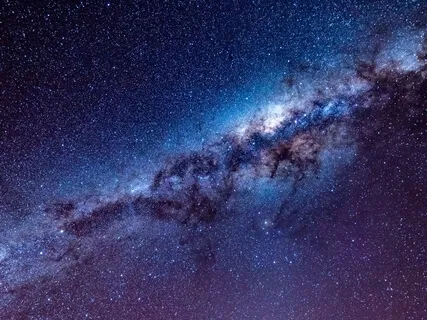
A reference to the Milky Way.
Galaxies range in size from dwarfs with just a few hundred million stars to giants with one hundred trillion stars,
Each orbiting its galaxy's center of mass.
Galaxies are categorized according to their visual morphology as elliptical,
Spiral or irregular.
Many galaxies are thought to have supermassive black holes at their centers.
The Milky Way's central black hole,
Known as Sagittarius A,
Has a mass four million times greater than the sun.
As of March 2016,
GN Z11 is the oldest and most distant observed galaxy with a cummiving distance of 32 billion light years from Earth,
And observed as it existed just 400 million years after the Big Bang.
Research released in 2016 revised the number of galaxies in the observable universe to a previous estimate of 200 billion,
To a suggested 2 trillion or more,
And overall as many as estimated 1 x 10 to the 24th stars,
More stars than all the grains of sand on planet Earth.
Most of the galaxies are 1000 to 100,
000 parsecs in diameter,
Approximately 3000 to 300,
000 light years,
And separated by distances in the order of millions of parsecs,
Or megaparsecs.
For comparison,
The Milky Way has a diameter of at least 30,
000 parsecs,
100,
000 light years,
And is separated from the Andromeda Galaxy,
Its nearest large neighbor,
By 780,
000 parsecs,
2.
5 million light years.
The space between galaxies is filled with a tenuous gas,
The intergalactic medium,
Having an average density of less than one atom per cubic meter.
The majority of galaxies are gravitationally organized into groups,
Clusters,
And superclusters.
The Milky Way is part of the Local Group,
Which is dominated by it and the Andromeda Galaxy,
And is part of the Virgo Supercluster.
At the largest scale,
These associations are generally arranged into sheets and filaments surrounded by immense voids.
The largest structure of galaxies yet recognized is a cluster of superclusters that has been named Linnaeaeae,
Which contains the Virgo Supercluster.
The word galaxy was borrowed via French and Medieval Latin from the Greek term for the Milky Way,
Galaxios Kuklos,
Milky Circle,
Named after its appearance as a milky band of light in the sky.
In Greek mythology,
Zeus places his son born by a mortal woman,
The infant Heracles,
On Hera's breast while she is asleep,
So that the baby will drink her divine milk and will thus become immortal.
Hera wakes up while breastfeeding and then realizes she is nursing an unknown baby.
She pushes the baby away,
Some of her milk spills,
And it produces the faint band of light known as the Milky Way.
In the astronomical literature,
The capitalized word galaxy is often used to refer to our galaxy the Milky Way to distinguish it from the other galaxies in our universe.
The English term Milky Way can be traced back to a story by Chaucer circa 1380.
See yonder,
Lo the galaxy,
Which men clepeth the Milky Way,
For it is white.
Geoffrey Chaucer,
The House of Fame Galaxies were initially discovered telescopically and were known as spiral nebulae.
Most 18th to 19th century astronomers considered them as either unresolved star clusters or anaglactic nebulae,
And were just thought as a part of the Milky Way,
But their true composition and natures remained a mystery.
Observations using larger telescopes of a few nearby bright galaxies,
Like the Andromeda galaxy,
Began resolving them into huge conglomerations of stars.
But based simply on the apparent faintness and sheer population of stars,
The true distances of these objects placed them well beyond the Milky Way.
For this reason they were popularly called island universes,
But this term quickly fell into disuse as the word universe implied the entirety of existence.
Instead they became known simply as galaxies.
Tens of thousands of galaxies have been catalogued,
But only a few have well established names,
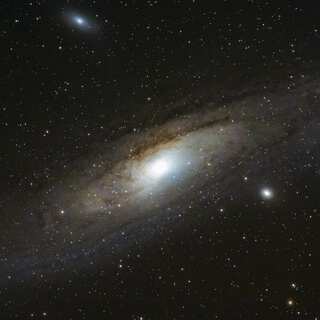
Such as the Andromeda galaxy,
The Magellanic clouds,
The Whirlpool galaxy,
And the Sombrero galaxy.
Astronomers work with numbers from certain catalogs such as the Miser catalog,
The NGC general catalog,
The IC index catalog,
The CGCG catalog of galaxies and of clusters of galaxies,
The MCG morphological catalog of galaxies,
And UGC,
Uppsala general catalog of galaxies.
All of the well-known galaxies appear in one or more of these catalogs,
But each time under a different number.
For example,
Miser 109 is a spiral galaxy having the number 109 in the catalog of Miser,
But also having the designations NGC 3992,
UGC 6937,
CGCG 269-023,
MCG plus 09-20-044,
And PGC 37617.
The realization that we live in a galaxy which is one among many galaxies parallels major discoveries that were made about the Milky Way and other nebulae.
The Greek philosopher Democritus proposed that the bright band on the night sky known as the Milky Way might consist of distant stars.
Aristotle,
However,
Believed the Milky Way to be caused by the ignition of the fiery exhalation of some stars that were large,
Numerous,
And close together,
And that the ignition takes place in the upper part of the atmosphere,
In the region of the world that is continuous with the heavenly motions.
The Neoplatonist philosopher Olympiodorus the Younger was critical of this view,
Arguing that if the Milky Way is sublinary,
Situated between Earth and the Moon,
It should appear different at different times and places on Earth,
And that it should have parallax,
Which it does not.
In his view,
The Milky Way is celestial.
According to Mohani Muhammad,
The Arabian astronomer Al-Hazen made the first attempt at observing and measuring the Milky Way's parallax,
And he thus determined that because the Milky Way had no parallax,
It must be remote from the Earth,
Not belonging to the atmosphere.
The Persian astronomer Al-Biruni proposed the Milky Way galaxy to be a collection of countless fragments of the nature of nebulous stars.
The Andalusian astronomer Ibn Basha proposed that the Milky Way is made up of many stars that almost touch one another and appear to be a continuous image due to the effect of refraction from sublinary material,
Citing his observation of the conjunction of Jupiter and Mars as evidence of this occurring when two objects are near.
In the 14th century,
The Syrian-born Ibn Qayyim proposed the Milky Way galaxy to be a myriad of tiny stars packed together in the sphere of the fixed stars.
Actual proof of the Milky Way consisting of many stars came in 1610,
When the Italian astronomer Galileo Galilei used a telescope to study the Milky Way and discovered that it is composed of a huge number of faint stars.
In 1750,
The English astronomer Thomas Wright,
In his An Original Theory or New Hypothesis of the Universe,
Speculated,
Correctly,
That the galaxy might be a rotating body of a huge number of stars held together by gravitational forces akin to the solar system but on a much larger scale.
The resulting disk of stars can be seen as a band on the sky from our perspective inside the disk.
In a treatise in 1755,
Immanuel Kant elaborated on Wright's idea about the structure of the Milky Way.
The first project to describe the shape of the Milky Way and the position of the sun was undertaken by William Herschel in 1785 by counting the number of stars in different regions of the sky.
He produced a diagram of the shape of the galaxy with the solar system close to the center.
Using a refined approach,
Kaptein,
In 1920,
Arrived at the picture of a small diameter about 15 kiloparsecs ellipsoid galaxy with the sun close to the center.
A different method by Harlow Shapley based on the cataloging of globular clusters led to a radically different picture,
A flat disk with diameter approximately 70 kiloparsecs and the sun far from the center.
This analysis failed to take into account the absorption of light by interstellar dust present in the galactic plane.
But after Robert Julius Trumpler quantified this effect in 1930 by studying open clusters,
The present picture of our host galaxy,
The Milky Way,
Emerged.
A few galaxies outside the Milky Way are visible on a dark night to the unaided eye,
Including the Andromeda Galaxy,
Large Magellanic Cloud,
The Small Magellanic Cloud,
And the Triangulum Galaxy.
In the 10th century,
The Persian astronomer Al Sufi made the earliest recorded identification of the Andromeda Galaxy,
Describing it as a small cloud.
In 964,
Al Sufi probably mentioned the Large Magellanic Cloud in his book of fixed stars,
Referring to Al-Bakr of the southern Arabs,
Since at a declination of about 70 degrees south,
It was not visible where he lived.
It was not well known to Europeans until Magellan's voyage in the 16th century.
The Andromeda Galaxy was later independently noted by Simon Marius in 1612.
In 1734,
Philosopher Immanuel Swedenborg in his Principia speculated that there may be galaxies outside our own that are formed into galactic clusters that are minuscule parts of the universe which extends far beyond what we can see.
These views are remarkably close to the present-day views of the cosmos.
In 1745,
Pierre-Louis Mauportouille conjectured that some nebula-like objects are collections of stars with unique properties,
Including a glow exceeding the light its stars produce on their own,
And repeated Johannes Hewieluus' view that the bright spots are massive and flattened due to their rotation.
In 1750,
Thomas Wright speculated correctly that the Milky Way is a flattened disk of stars and that some of the nebula visible in the night sky might be separate Milky Ways.
At the end of the 18th century,
Charles Messier compiled a catalog containing the 109 brightest celestial objects having nebulous appearance.
Subsequently,
William Herschel assembled a catalog of 5,
000 nebulae.
In 1845,
Lord Rosa constructed a new telescope and was able to distinguish between elliptical and spiral nebulae.
He also managed to make out individual point sources in some of these nebulae,
Lending credence to Kant's earlier conjecture.
In 1912,
Vesto Slieffer made spectrographic studies of the brightest spiral nebulae to determine their composition.
Slieffer discovered that the spiral nebulae have high Doppler shifts,
Indicating that they are moving at a rate exceeding the velocity of the stars he had measured.
He found that the majority of these nebulae are moving away from us.
In 1917,
Heber Curtis observed Nova S.
Andromedae within the Great Andromeda Nebula,
As the Andromeda Galaxy Messier Object M31 was then known.
Using the photographic record,
He found 11 more Novae.
Curtis noticed that these Novae were,
On average,
10 magnitudes fainter than those that occurred within our galaxy.
As a result,
He was able to come up with a distance estimate of 150,
000 parsecs.
He became a proponent of the so-called Island Universe's hypothesis,
Which holds that spiral nebulae are actually independent galaxies.
In 1920,
A debate took place between Harlow Shapley and Heber Curtis,
The Great Debate,
Concerning the nature of the Milky Way,
Spiral nebulae,
And the dimensions of the universe.
To support his claim that the Great Andromeda Nebula is an external galaxy,
Curtis noted the appearance of dark lanes resembling the dust clouds in the Milky Way,
As well as a significant Doppler shift.
In 1922,
The Estonian astronomer Ernst Uppek gave a distance determination that supported the theory that the Andromeda Nebula is indeed a distant extragalactic object.
Using the new 100-inch Mount Wilson telescope,
Edwin Hubble was able to resolve the outer parts of some spiral nebulae as collections of individual stars and identified some Cepheid variables thus allowing him to estimate the distance to the nebulae.
They were far too distant to be part of the Milky Way.
In 1936,
Hubble produced a classification of galactic morphology that is used to this day.
In 1944,
Hendrik van der Hulst predicted that microwave radiation with wavelength of 21 centimeters would be detectable from interstellar atomic hydrogen gas,
And in 1951 it was observed.
This radiation is not affected by dust absorption,
And so its Doppler shift can be used to map the motion of the gas in our galaxy.
These observations led to the hypothesis of a rotating bar structure in the center of our galaxy.
With improved radio telescopes,
Hydrogen gas could also be traced in other galaxies.
In the 1970s,
Vera Rubin uncovered a discrepancy between observed galactic rotation speed and that predicted by the visible mass of stars and gas.
Today the galaxy rotation problem is thought to be explained by the presence of large quantities of unseen dark matter.
Beginning in the 1990s,
The Hubble Space Telescope yielded improved observations.
Among other things,
Hubble data helped establish that the missing dark matter in our galaxy cannot solely consist of inherently faint and small stars.
The Hubble Deep Field,
An extremely long exposure of a relatively empty part of the sky,
Provided evidence that there are about 125 billion galaxies in the observable universe.
Improved technology in detecting the spectra invisible to humans,
Radio telescopes,
Infrared cameras and X-ray telescopes,
Allow detection of other galaxies that are not detected by Hubble.
Particularly,
Galaxy surveys in the Zone of Avoidance,
The region of the sky blocked at visible light wavelengths by the Milky Way,
Have revealed a number of new galaxies.
In 2016,
A study published by the Astrophysical Journal and led by Christopher Kansalis of the University of Nottingham,
Using 3D modeling of images collected over 20 years by the Hubble Space Telescope,
Concluded that there are over 2 trillion galaxies in the observable universe.
Galaxies come in three main types,
Ellipticals,
Spirals and irregulars.
A slightly more extensive description of galaxy types based on their appearance is given by the Hubble Sequence.
Since the Hubble Sequence is entirely based upon visual morphological type,
Shape,
It may miss certain important characteristics of galaxies,
Such as star formation,
Rate in starburst galaxies and activity in the cores of active galaxies.
The Hubble Classification System rates elliptical galaxies on the basis of their ellipticity ranging from E0 being nearly spherical up to E7 which is highly elongated.
These galaxies have an ellipsoidal profile,
Giving them an elliptical appearance regardless of the viewing angle.
Their appearance shows little structure and they typically have relatively little interstellar matter.
Consequently,
These galaxies also have a low portion of open clusters and a reduced rate of new star formation.
Instead,
They are dominated by generally older,
More evolved stars that are orbiting the common center of gravity in random directions.
The stars contain low abundances of heavy elements because star formation ceases after the initial burst.
In this sense,
They have some similarity to the much smaller globular clusters.
The largest galaxies are giant ellipticals.
Many elliptical galaxies are believed to form due to the interaction of galaxies resulting in a collision and merger.
They can grow to enormous sizes compared to spiral galaxies,
For example,
And giant elliptical galaxies are often found near the core of large galaxy clusters.
A shell galaxy is a type of elliptical galaxy where the stars in the galaxy's halo are arranged in concentric shells.
About one-tenth of elliptical galaxies have a shell-like structure,
Which has never been observed in spiral galaxies.
The shell-like structures are thought to develop when a larger galaxy absorbs a smaller companion galaxy.
As the two galaxy centers approach,
The centers start to oscillate around a center point.
The oscillation creates gravitational ripples forming the shells of stars,
Similar to ripples spreading on water.
For example,
Galaxy NGC 3923 has over 20 shells.
Spiral galaxies resemble spiraling pinwheels.
Though the stars and other visible material contained in such a galaxy lie mostly on a plane,
The majority of mass in spiral galaxies exists in a roughly spherical halo of dark matter that extends beyond the visible component,
As demonstrated by the universal rotation curve concept.
Spiral galaxies consist of a rotating disk of stars and interstellar medium,
Along with a central bulge of generally older stars.
Looking outward from the bulge are relatively bright stars.
In the Hubble classification scheme,
Spiral galaxies are listed as type S,
Followed by a letter A,
B,
Or C,
That indicates the degree of tightness of the spiral arms and the size of the central bulge.
An SA galaxy has tightly wound,
Poorly defined arms and possesses a relatively large core region.
At the other extreme,
An SC galaxy has open,
Well-defined arms and a small core region.
A galaxy with poorly defined arms is sometimes referred to as a flocculent spiral galaxy,
In contrast to the grand design spiral galaxy that has prominent and well-defined spiral arms.
The speed in which a galaxy rotates is thought to correlate with the flatness of the disk as some spiral galaxies have thick bulges,
While others are thin and dense.
In spiral galaxies,
The spiral arms do have the shape of approximate logarithmic spirals,
A pattern that can be theoretically shown to result from a disturbance in a uniformly rotating mass of stars.
Like the stars,
The spiral arms rotate around the center,
But they do so with constant angular velocity.
The spiral arms are thought to be areas of high-density matter,
Or density waves.
As stars move through an arm,
The space velocity of each stellar system is modified by the gravitational force of the higher density.
The velocity returns to normal after the stars depart on the other side of the arm.
This effect is akin to a wave of slowdowns moving along a highway full of moving cars.
The arms are visible because the high density facilitates star formation,
And therefore they harbor many bright and young stars.
A majority of spiral galaxies,
Including our Milky Way galaxy,
Have a linear bar-shaped band of stars that extends outward to either side of the core,
Then merges into the spiral arm structure.
In the Hubble classification scheme,
These are designated by an Sb followed by a lower case letter,
A,
B,
Or c,
That indicates the form of the spiral arms in the same manner as the categorization of normal spiral galaxies.
Stars are thought to be temporary structures that can occur as a result of a density wave radiating outward from the core,
Or else due to a tidal interaction with another galaxy.
Many barred spiral galaxies are active,
Possibly as a result of gas being channeled into the core along the arms.
Our own galaxy,
The Milky Way,
Is a large disc-shaped barred spiral galaxy,
About 30 kiloparsecs in diameter and a kiloparsec thick.
It contains about 200 billion stars,
And has a total mass of about 600 billion times the mass of the sun.
Recently researchers described galaxies called superluminous spirals.
They are very large,
With an upward diameter of 437,
000 light years,
Compared to the Milky Way's 100,
000 light year diameter.
With a mass of 340 billion solar masses,
They generate a significant amount of ultraviolet and mid-infrared light.
They are thought to have an increased star formation rate around 30 times faster than the Milky Way.
Peculiar galaxies are galactic formations that develop unusual properties due to tidal interactions with other galaxies.
A ring galaxy has a ring-like structure of stars,
An interstellar medium,
Surrounding a bar core.
A ring galaxy is thought to occur when a smaller galaxy passes through the core of a spiral galaxy.
Such an event may have affected the Andromeda galaxy,
As it displays a multi-ring-like structure when viewed in infrared radiation.
A lenticular galaxy is an intermediate form that has properties of both elliptical and spiral galaxies.
These are categorized as Hubble type S0,
And they possess ill-defined spiral arms with an elliptical halo of stars.
Barred lenticular galaxies receive Hubble classification SB0.
Irregular galaxies are galaxies that cannot be readily classified into an elliptical or spiral morphology.
An IRR-1 galaxy has some structure but does not align cleanly with the Hubble classification scheme.
IRR-2 galaxies do not possess any structure that resembles the Hubble classification and may have been disrupted.
Nearby examples of dwarf irregular galaxies include the Magellanic clouds.
An ultra-diffuse galaxy,
UDG,
Is an extremely low-density galaxy.
The galaxy may be the same size as the Milky Way,
But has a visible star count of only 1% of the Milky Way.
The lack of luminosity is because there is a lack of star-forming gas in the galaxy,
Which results in old stellar populations.
Despite the prominence of large elliptical and spiral galaxies,
Most galaxies in the universe are dwarf galaxies.
These galaxies are relatively small when compared with other galactic formations,
Being about 100 the size of the Milky Way,
Containing only a few billion stars.
Ultra-compact dwarf galaxies have recently been discovered that are only 100 parsecs across.
Many dwarf galaxies may orbit a single larger galaxy.
The Milky Way has at least a dozen such satellites,
With an estimated 300 to 500 yet to be discovered.
Dwarf galaxies may also be classified as elliptical,
Spiral,
Or irregular.
Since small dwarf ellipticals bear little resemblance to large ellipticals,
They are often called dwarf spheroidal galaxies instead.
A study of 27 Milky Way neighbors found that,
In all dwarf galaxies,
The central mass is approximately 10 million solar masses.
Regardless of whether the galaxy has thousands or millions of stars.
This has led to the suggestion that galaxies are largely formed by dark matter,
And that the minimum size may indicate a form of warm dark matter incapable of gravitational coalescence on a smaller scale.
Interactions between galaxies are relatively frequent,
And they can play an important role in galactic evolution.
Near-misses between galaxies result in warping distortions due to tidal interactions,
And may cause some exchanges of gas and dust.
Collisions occur when two galaxies pass directly through each other,
And have sufficient relative momentum not to merge.
The stars of interacting galaxies will usually not collide,
But the gas and dust within the two forms will interact,
Sometimes triggering star formation.
A collision can severely distort the shape of galaxies,
Forming bars,
Rings,
Or tail-like structures.
At the extreme of interactions are galactic mergers.
In this case,
The relative momentum of the two galaxies is insufficient to allow the galaxies to pass through each other.
Could they gradually merge to form a single larger galaxy?
Mergers can result in significant changes to morphology as compared to the original galaxies.
If one of the merging galaxies is much more massive than the other merging galaxy,
Then the result is known as cannibalism.
The more massive larger galaxy will remain relatively undisturbed by the merger,
While the smaller galaxy is torn apart.
The Milky Way galaxy is currently in the process of cannibalizing the Sagittarius dwarf elliptical galaxy and the Candace Major dwarf galaxy.
Stars are created within galaxies from a reserve of cold gas that forms into giant molecular clouds.
Some galaxies have been observed to form stars at an exceptional rate,
Which is known as a starburst.
If they continue to do so,
Then they would consume their reserve of gas in a time span less than the lifespan of a galaxy.
Hence,
Starburst activity usually lasts for only about 10 million years,
A relatively brief period in the history of a galaxy.
Starburst galaxies were more common during the early history of the universe,
And at present still contribute an estimated 15% the total star production rate.
Starburst galaxies are characterized by dust concentrations of gas and the appearance of newly formed stars,
Including massive stars that ionize the surrounding clouds to create H2 regions.
These massive stars produce supernova explosions,
Resulting in expanding remnants that interact powerfully with the surrounding gas.
These outbursts trigger a chain reaction of star building that spreads throughout the gaseous region.
Only when the available gas is nearly consumed or dispersed does the starburst activity end.
Starbursts are often associated with merging or interacting galaxies.
The prototype example of such a starburst forming interaction is M82,
Which experienced a close encounter with the larger M81.
Irregular galaxies often exhibit spaced knots of starburst activity.
A portion of the observable galaxies are classified as active galaxies if the galaxy contains an active galactic nucleus,
AGN.
A significant portion of the total energy output from the galaxy is emitted by the active galactic nucleus instead of the stars,
Dust,
And interstellar medium of the galaxy.
The standard model for an active galactic nucleus is based upon an accretion disk that forms around a supermassive black hole,
SMBH,
At the core region of the galaxy.
The radiation from an active galactic nucleus results from the gravitational energy of matter as it falls toward the black hole from the disk.
In about 10% of these galaxies,
A diametrically opposed pair of energetic jets ejects particles from the galaxy core at velocities close to the speed of light.
The mechanism for producing these jets is not well understood.
Sievert galaxies or quasars are classified depending on the luminosity or active galaxies that emit high energy radiation in the form of X-rays.
Quasars are believed to be an active galaxy with a relativistic jet that is pointed in the direction of Earth.
A radio galaxy emits radio frequencies from relativistic jets.
A unified model of these types of active galaxies explains their differences based on the viewing angle of the observer.
Relatively related to active galactic nuclei,
As well as starburst regions,
Are low ionization nuclear emission line regions,
Liners.
The emission from liner-type galaxies is dominated by weakly ionized elements.
The excitation sources for the weakly ionized lines include post-AGB stars,
AGN,
And shocks.
Approximately one-third of nearby galaxies are classified as containing liner nuclei.
Seyffert galaxies are one of the two largest groups of active galaxies,
Along with quasars.
They have quasar-like nuclei,
Very luminous,
Distant,
And bright sources of electromagnetic radiation.
With very high surface brightnesses but unlike quasars,
Their host galaxies are clearly detectable.
Seyffert galaxies account for about 10% of all galaxies.
Seen in visible light,
Most Seyffert galaxies look like normal spiral galaxies,
But when studied under other wavelengths,
The luminosity of their cores is equivalent to the luminosity of whole galaxies the size of the Milky Way.
Quasars or quasi-stellar radio sources are the most energetic and distant members of active galactic nuclei.
Quasars are extremely luminous and were first identified as being high redshift sources of electromagnetic energy,
Including radio waves and visible light that appear to be similar to stars rather than extended sources similar to galaxies.
Their luminosity can be 100 times greater than that of the Milky Way.
Galaxies have magnetic fields of their own.
They are strong enough to be dynamically important.
They drive mass,
Inflow into the centers of galaxies.
They modify the formation of spiral arms,
And they can affect the rotation of gas in the outer regions of galaxies.
Magnetic fields provide the transport of angular momentum required for the collapse of gas clouds and hence the formation of new stars.
Galactic formation and evolution is an active area of research in astrophysics.
Other cosmological models of the early universe are based on the Big Bang Theory.
About 300,
000 years after this event,
Atoms of hydrogen and helium began to form in an event called recombination.
Nearly all the hydrogen was neutral,
Non-ionized,
And readily absorbed light,
And no stars had yet formed.
As a result,
This period has been called the Dark Ages.
It was from density fluctuations,
Or anisotropic irregularities,
In the primordial matter that larger structures began to appear.
As a result,
Masses of baryonic matter started to condense within cold dark matter halos.
These primordial structures would eventually become the galaxies we see today.
This for the early appearance of galaxies was found in 2006 when it was discovered that the galaxy IOK 1 has an unusually high redshift of 6.
96 corresponding to just 750 million years after the Big Bang and making it the most distant and primordial galaxy yet seen.
While some scientists have claimed other objects,
Such as Abel 1835 IR 1916,
Have higher redshifts and therefore are seen in an earlier stage of the universe's evolution,
IOK 1's age and composition have been more reliably established.
In December 2012,
Astronomers reported that UDFJ 395 46284 is the most distant object known and has a redshift value of 11.
9.
The object,
Estimated to have existed around 380 million years after the Big Bang,
Which was about 13.
8 billion years ago,
Is about 13.
42 billion light travel distance years away.
The existence of such early proto-galaxies suggests that they must have grown in the so-called Dark Ages.
As of May 5,
2015,
The galaxy EGS ZS8-1 is the most distant and earliest galaxy measured,
Forming 670 million years after the Big Bang.
The light from EGS ZS8-1 has taken 13 billion years to reach Earth and is now 30 billion light years away because of the expansion of the universe during 13 billion years.
The detailed process by which early galaxies formed is an open question in astrophysics.
Galaxies can be divided into two categories,
Top-down and bottom-up.
In top-down correlations,
Such as Egan-Linden-Belsandage-ELS model,
Proto-galaxies form in a large-scale simultaneous collapse lasting about 100 million years.
In bottom-up theories,
Such as the Searle-Zinn-SZ model,
Small structures such as globular clusters form first,
And then a number of such bodies accrete to form a larger galaxy.
Once proto-galaxies began to form and contract,
The first halo stars,
Called population 3 stars,
Appeared within them.
These were composed almost entirely of hydrogen and helium and may have been massive.
If so,
These huge stars would have quickly consumed their supply of fuel and become supernovae,
Releasing heavy elements into the interstellar medium.
This first generation of stars reionized the surrounding neutral hydrogen,
Creating expanding bubbles of space through which light could readily travel.
In June 2015,
Astronomers reported evidence of population 3 stars in the cosmos Redshift 7 galaxy at z equals 6.
60.
Such stars are likely to have existed in the very early universe,
I.
E.
At high redshift,
And may have started the production of chemical elements heavier than a hydrogen that are needed for the later formation of planets and life as we know it.
Within a billion years of a galaxy's formation,
Key structures begin to appear.
Globular clusters,
The central supermassive black hole,
And a galactic bulge of metal pore population 2 stars form.
The creation of a supermassive black hole appears to play a key role in actively regulating the growth of galaxies by limiting the total amount of additional matter added.
During this early epoch,
Galaxies undergo a major burst of star formation.
Within the following 2 billion years,
The accumulated matter settles into a galactic disk.
A galaxy will continue to absorb in falling material from high velocity clouds and dwarf galaxies throughout its life.
This matter is mostly hydrogen and helium.
The cycle of stellar birth and death slowly increases the abundance of heavy elements,
Eventually allowing the formation of planets.
The evolution of galaxies can be significantly affected by interactions and collisions.
Mergers of galaxies were common during the early epoch,
And the majority of galaxies were peculiar in morphology.
Given the distance between the stars,
The great majority of stellar systems in colliding galaxies will be unaffected.
However,
Gravitational stripping of the interstellar gas and dust that makes up the spiral arms produces a long train of stars known as tidal tails.
Examples of these formations can be seen in NGC 4676 or the Antenna Galaxy.
The Milky Way Galaxy and the nearby Andromeda Galaxy are moving toward each other at about 130 km per second,
And depending upon the lateral movements,
The two might collide in about 5 to 6 billion years.
Although the Milky Way has never collided with a galaxy as large as Andromeda before,
Evidence of past collisions of the Milky Way with smaller dwarf galaxies is increasing.
Such large-scale interactions are rare.
As time passes,
Mergers of two systems of equal size become less common.
Most bright galaxies have remained fundamentally unchanged for the last few billion years,
And the net rate of star formation probably also peaked approximately 10 billion years ago.
Spiral galaxies,
Like the Milky Way,
Produce new generations of stars as long as they have dense molecular clouds of interstellar hydrogen in their spiral arms.
Spiral galaxies are largely devoid of this gas and so form few new stars.
The supply of star-forming material is finite.
Once stars have converted the available supply of hydrogen into heavier elements,
New star formation will come to an end.
The current era of star formation is expected to continue for up to 100 billion years,
And then the stellar age will wind down after about 10 trillion to 100 trillion years,
As the smallest,
Longest-lived stars in our universe,
Tiny red dwarfs,
Begin to fade.
At the end of the stellar age,
Galaxies will be composed of compact objects,
Brown dwarfs,
White dwarfs,
That are cooling or cold,
Black dwarfs,
Neutron stars,
And black holes.
Eventually,
As a result of gravitational relaxation,
All stars will either fall into central supermassive black holes or be flung into intergalactic space as a result of collisions.
Deep-sky surveys show that galaxies are often found in groups and clusters.
Solitary galaxies that have not significantly interacted with another galaxy of comparable mass during the past billion years are relatively scarce.
Only about 5% of the galaxies surveyed have been found to be truly isolated.
However,
These isolated formations may have interacted and even merged with other galaxies in the past,
And may still be orbited by smaller satellite galaxies.
Isolated galaxies can produce stars at a higher rate than normal as their gas is not being stripped by other nearby galaxies.
On the largest scale,
The universe is continually expanding,
Resulting in an average increase in the separation between individual galaxies.
Associations of galaxies can overcome this expansion on a local scale through their mutual gravitational attraction.
These associations formed early in the universe as clumps of dark matter pulled their respective galaxies together.
Nearby groups later merged to form large-scale clusters.
This ongoing merger process,
As well as an influx of in-falling gas,
Heats the intergalactic gas within a cluster to very high temperatures reaching 300 to 100 megaKelvins.
About 70 to 80% of the mass in a cluster is in the form of dark matter,
With 10 to 30% consisting of this heated gas and the remaining few percent of the matter in the form of galaxies.
Most galaxies in the universe are gravitationally bound to a number of other galaxies.
These form a fractal-like hierarchical distribution of clustered structures.
With the smallest such associations being termed groups.
A group of galaxies is the most common type of galactic cluster,
And these formations contain a majority of the galaxies as well as most of the baryonic mass in the universe.
To remain gravitationally bound to such a group,
Each member galaxy must have a sufficiently low velocity to prevent it from escaping.
If there is insufficient kinetic energy,
However,
A group may evolve into a smaller number of galaxies through mergers.
Clusters of galaxies consist of hundreds to thousands of galaxies bound together by gravity.
Clusters of galaxies are often dominated by a single giant elliptical galaxy known as the brightest cluster galaxy,
Which over time tidally destroys its satellite galaxies and adds their mass to its own.
Superclusters contain tens of thousands of galaxies which are found in clusters,
Groups,
And sometimes individually.
At the superclusters scale,
Galaxies are arranged into sheets and filaments surrounding vast empty voids.
Of this scale,
The universe appears to be the same in all directions,
Isotropic and homogeneous.
The Milky Way galaxy is a member of an association named the Local Group,
A relatively small group of galaxies that has a diameter of approximately 1 megaparsec.
The Milky Way and the Andromeda galaxy are the two brightest galaxies within the group.
Many of the other member galaxies are dwarf companions of these two galaxies.
The Local Group itself is a part of a cloud-like structure within the Virgo supercluster,
A large extended structure of groups and clusters of galaxies centered on the Virgo cluster.
And the Virgo supercluster itself is a part of the Pisces-Cetus supercluster complex,
A giant galaxy filament.
The peak radiation of most stars lies in the visible spectrum,
So the observation of the stars that form galaxies has been a major component of optical astronomy.
It is also a favorable portion of the spectrum for observing ionized H2 regions and for examining the distribution of dusty arms.
The dust present in the interstellar medium is opaque to visible light.
It is more transparent to far infrared,
Which can be used to observe the inferior regions of giant molecular clouds and galactic cores in great detail.
Infrared is also used to observe distant redshift galaxies that were formed much earlier in the history of the universe.
Water vapor and carbon dioxide absorb a number of useful portions of the infrared spectrum,
So high-altitude or space-based telescopes are used for infrared astronomy.
The first non-visual study of galaxies,
Particularly active galaxies,
Was made using radio frequencies.
The Earth's atmosphere is nearly transparent to radio between 5 MHz and 30 GHz.
The ionosphere blocks signals below this range.
Large radio interferometers have been used to map the active jets emitted from active nuclei.
Radio telescopes can also be used to observe neutral hydrogen via 21 cm radiation,
Including,
Potentially,
The non-ionized matter in the early universe that later collapsed to form galaxies.
Ultraviolet and X-ray telescopes can observe highly energetic galactic phenomena.
Ultraviolet flares are sometimes observed when a star in a distant galaxy is torn apart from the tidal forces of a nearby black hole.
The distribution of hot gas in galactic clusters can be mapped by X-rays.
The existence of supermassive black holes at the cores of galaxies was confirmed through X-ray astronomy.