Welcome to this guided meditation for sleep and storytelling.
Focus on the sound of my voice and feel free to fall asleep at any time.
Tales of Greek Mythology Poseidon Poseidon was the son of Cronos and Rhea,
And the brother of Zeus.
He was god of the sea,
More particularly of the Mediterranean,
And,
Like the element over which he presided,
Was of a variable disposition,
Now violently agitated,
And now calm and placid,
For which reason he is sometimes represented by the poets as quiet and composed,
And at others as disturbed and angry.
In the earliest ages of Greek mythology he merely symbolized the watery element,
But in later times,
As navigation and intercourse with other nations engendered greater traffic by sea,
Poseidon gained in importance and came to be regarded as a distinct divinity.
Holding indisputable dominion over the sea and over all divinities who acknowledged him as their sovereign ruler,
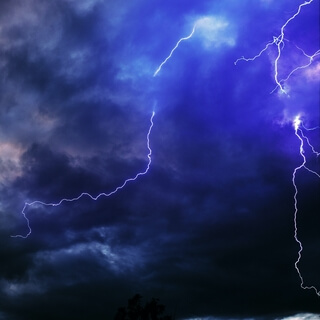
He possessed the power of causing at will mighty and destructive tempests in which the billows rise mountains high,
The wind becomes a hurricane,
Land and sea being enveloped in thick mists,
Whilst destruction assails the unfortunate mariners exposed to their fury.
On the other hand,
His alone was the power of stilling the angry waves,
Of soothing the troubled waters,
And granting safe voyages to mariners.
For this reason Poseidon was always invoked and propitiated by a sea of libation before a voyage was undertaken,
And sacrifices and thanksgivings were gratefully offered to him after a safe and prosperous journey by the sea.
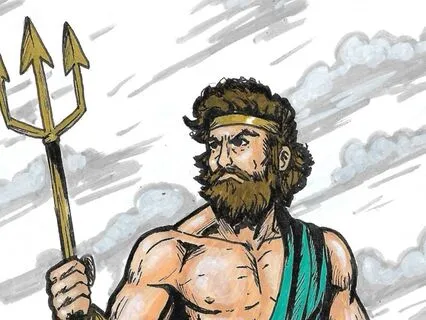
The symbol of his power was the fisherman's fork or trident,
By means of which he produced earthquakes,
Raised up islands from the bottom of the sea,
And caused wells to spring forth out of the earth.
Poseidon was essentially the presiding deity over fishermen,
And was on that account more particularly worshipped and revered in countries bordering on the sea coast,
Where fish naturally formed a staple commodity of trade.
He was supposed to vent his displeasure by sending disastrous inundations,
Which completely destroyed whole countries,
And were usually accompanied by terrible marine monsters who swallowed up and devoured those whom the floods had spared.
It is probable that these sea monsters are the poetical figures which represent the demons of hunger and famine,
Necessarily accompanying a general inundation.
Poseidon is generally represented as resembling his brother Zeus in features,
Height,
And general aspect,
But we miss in the countenance of the sea god the kindness and the benignity which is so pleasingly distinguishing from his mighty brother.
The eyes are bright and piercing,
And the contour of the face somewhat sharper in its online than that of Zeus,
Thus corresponding,
As it were,
With his more angry and violent nature.
His hair waves in dark,
Disorderly masses over his shoulders,
His chest broad and his frame powerful and stalwart.
He wears a short,
Curling beard and a band round his head.
He usually appears standing erect in a graceful shill chariot drawn by hippocamps or sea-horses with golden manes and brazen hoofs,
Who bound over the dancing waves with such wonderful swiftness that the chariot scarcely touches the water.
The monsters of the deep,
Acknowledging their mighty lord,
Gamble playfully round him,
Whilst the sea joyfully smooths a path for the passage of its all-powerful ruler.
He inhabited a beautiful palace at the bottom of the sea at Aegea and Euboea,
And also possessed a royal residence on Mount Olympus,
Which,
However,
He only visited when his presence was required at the council of the gods.
His wonderful palace beneath the waters was of vast extent,
And its lofty and capacious halls thousands of his followers could assemble.
The exterior of the building was of bright gold,
Which the continual wash of the waters preserved untarnished.
In the interior lofty and graceful columns supported the gleaming dome.
Everywhere fountains of glistening,
Silvery water played.
Everywhere groves and arbors of feathery-leaved sea plants appeared,
Whilst rocks of pure crystal glistened with all the varied colors of the rainbow.
Some of the paths were strewn with white sparkling sand,
Interspersed with jewels,
Pearls,
And amber.
This delightful abode was surrounded on all sides by white fields,
Where there were whole groves of dark purple coralline,
And tufts of beautiful scarlet-leaved plants,
And sea anemones of every tint.
Here grew bright pinky seaweeds,
Mosses of all hues and shades,
And tall grasses,
Which growing upwards formed emerald caves and grottos such as Daenerys loved,
Whilst fish of various kinds playfully darted in and out in the full enjoyment of their native element.
Nor was the illumination wanting in this fairy-like region,
Which at night was lit up by the glowworms of the deep.
But although Poseidon ruled with absolute power over the ocean and its inhabitants,
He nevertheless bowed submissively to the will of the great ruler of Olympus,
And appeared at all times desirous of conciliating him.
We find him coming to his aid when emergency demanded,
And frequently rendering him valuable assistance against his opponents.
At the time when Zeus was harassed by the attacks of the giants,
He proved himself a most powerful ally,
Engaging in single combat with a hideous giant named Polybaris,
Whom he followed over the sea,
And at last succeeded in destroying,
By hurling upon him,
The island of Kos.
These amicable relations between the brothers were,
However,
Sometimes interrupted.
Thus,
For an instance,
Upon one occasion Poseidon joined Hera and Athene in a secret conspiracy to seize upon the ruler of heaven,
Place him in fetters,
And deprive him of the sovereign power.
The conspiracy being discovered,
Hera,
As the chief instigator of this sacrilegious attempt on the divine person of Zeus,
Was severely chastised and even beaten by her enraged spouse as a punishment for her rebellion and treachery,
Whilst Poseidon was condemned for the space of a whole year to forego his dominion over the sea,
And it was at this time that in conjunction with Apollo he built for Laomedon the walls of Troy.
Poseidon married a sea-nymph named Amphitrite,
Whom he wooed under the form of a dolphin,
And she afterwards became jealous of a beautiful maiden called Scylla,
Who was beloved by Poseidon,
And in order to revenge herself she threw some herbs into a well where Scylla was bathing,
Which had the effect of metamorphosing her into a monster of terrible aspect,
Having twelve feet,
Six heads,
And six long necks,
And a voice which resembled the bark of a dog.
This awful monster is said to have inhibited a cave at a very great height in the famous rock which still bears her name,
And was supposed to swoop down from her rocky eminence upon every ship that passed and with each of her six heads to secure a victim.
Amphitrite is often represented assisting Poseidon in attaching the seahorses to his chariot.
The Cyclops,
Who have been already alluded to in the history of Cronus,
Were the sons of Poseidon and Amphitrite.
They were a wild race of gigantic growth,
Similar in their nature to the earth-born giants,
And had only one eye each in the middle of their foreheads.
They led a lawless life,
Possessing neither social manners nor fear of the gods,
And were the workmen of Hephaestus,
Whose workshop was supposed to be in the heart of the volcanic mountain Etna.
Here we have another striking instance of the manner in which the Greeks personified the waters of nature,
Which they saw in active operation around them.
They beheld with awe,
Mingled with astonishment,
The fire,
Stones,
And ashes which poured forth from the summit of this and the other volcanic mountains,
And with their vivacity of imagination found a solution of the mystery in the supposition that the god of fire must be busy at work with his men in the depths of the earth,
And that the mighty flames which they beheld issued in this matter from his subterranean forge.
The chief representative of the Cyclops was the man-eating monster Polyphemus,
Described by Homer as having been blinded and outwitted at last by Odysseus.
This monster fell in love with a beautiful nymph called Galatea,
But,
As may be supposed,
His addresses were not acceptable to the fair maiden,
Who rejected them in the favor of a youth named Asses,
Upon which Polyphemus,
With his usual barbarity,
Destroyed the life of his rival by throwing upon him a gigantic rock.
The blood of the murdered Asses gushing out of the rock formed a stream which still bears his name.
Triton,
Rhoda,
And Benthysissimi were also children of Poseidon and Amphitrite.
The sea-god was the father of two giant sons called Otus and Thialtis.
When only nine years old,
They were said to be twenty-seven cubits in height and nine in breadth.
These youthful giants were as rebellious as they were powerful,
Even presuming to threaten the gods themselves with hostilities.
During the War of the Gigantomachia,
They endeavored to scale heaven by piling mighty mountains one upon another.
Already had they succeeded in placing Mount Ossa on Olympus and Pelion on Ossa,
When this impious project was frustrated by Apollo,
Who destroyed them with his arrows.
It was supposed that had not their lives been thus cut off before reaching maturity,
Their sacrilegious designs would have been carried into effect.
Peleus and Aeneleus were also sons of Poseidon.
Their mother Tyro was attached to the river-god Aenepeus,
Whose form Poseidon assumed and thus won her love.
Peleus became afterwards famous in the story of the Argonauts,
And Aeneleus was the father of Nestor,
Who was distinguished in the Trojan War.
The Greeks believed that it was to Poseidon they were indebted,
For the existence of the horse,
Which he is said to have produced in following manner.
Athena and Poseidon both claiming the right to name Cecropia,
The ancient name of Athens.
A violent dispute arose,
Which was finally settled by an assembly of the Olympian gods,
Who decided that whichever of the contending parties presented mankind with the most useful gift should obtain the privilege of naming the city.
Upon this,
Poseidon struck the ground with his trident,
And the horse sprang forth in all his untamed strength and graceful beauty.
From the spot which Athena touched with her wand issued the olive tree,
Whereupon the gods unanimously awarded to her the victory,
Declaring her gift to be the emblem of peace and plenty,
Whilst that of Poseidon was thought to be the symbol of war and bloodshed.
Poseidon Athena accordingly called the city Athens after herself,
And it has ever since retained this name.
Poseidon tamed the horse for the use of mankind,
And was believed to have taught men the art of managing horses by the bridle.
The Isthmian games,
So named because they were held on the Isthmus of Corinth,
In which horse and chariot races were a distinguished feature,
Were instituted in honour of Poseidon.
He was more especially worshipped in the Peloponnesus,
Though universally revered throughout Greece,
And in the south of Italy.
His sacrifices were generally black and white bulls,
Also wild boars and rams.
His usual attributes are the trident,
Horse,
And dolphin.
In some parts of Greece,
This divinity was identified with the sea-god Nereus,
For which reason the Nereides or daughters of Nereus are represented as accompanying him.
Neptune The Romans worshipped Poseidon under the name of Neptune,
And invested him with all the attributes which belonged to the Greek divinity.
The Roman commanders never undertook any naval expedition without propitiating Neptune by a sacrifice.
His temple at Rome was in the Campus Martius,
And the festivals commemorated in his honour were called Neptunalia.
When Jupiter assigned to each of his brothers a separate portion of the universe,
He decreed that Neptune should govern all the waters upon the face of the earth,
And be the sole monarch of the ocean.
Neptune Neptune,
The mighty marine god,
I sing,
Earth's mover and the fruitless ocean's king,
That helicon and the Aegean's deep's dust hold,
O thou earthshaker,
Thy command twofold.
The gods have sorted,
Making thee of horses,
The awful tamer,
And of naval forces.
The sure preserver,
Hail,
O Saturn's birth,
Whose graceful green hair circles all the earth.
Bear a benign mind,
Thy helpful hand,
Lend all submitted to thy dread command.
Before this new ruler made his appearance,
The titan Oceanus had wielded the scepter of the sea,
And regretfully he now resigned it to his youthful supplanter,
Whom he nevertheless admired sincerely,
And described in glowing colours to his brothers.
Have ye beheld the young god of the seas,
My this possessor?
Have ye seen his face?
Have ye beheld his chariot,
Foamed along,
By noble-winged creatures he hath made?
I saw him on the calmed water's cud,
With such a glow of beauty in his eyes,
That it enforced me to bid sad farewell to all my empire.
Oceanus was the son of Uranus and Gaia.
He was the personification of the ever-flowing stream,
Which,
According to the primitive notions of the early Greeks,
Encircled the world,
From which sprang all the rivers and streams that watered the earth.
He was married to Tethys,
One of the titans,
And was the father of a numerous progeny called the Oceanids,
Who are said to have been three thousand in number.
He alone of all the titans refrayed from taking part against Zeus in the Titanomachia,
And was,
On that account,
The only one the primeval divinities permitted to retain his dominion under a new dynasty.
Nereus appeared to have been the personification of the sea in its calm and placid moods,
And was,
After Poseidon,
The most important of the sea-deities.
He is represented as a kind and benevolent old man,
Possessing the gift of prophecy,
And presiding more particularly over the agency of which he was considered to be the protecting spirit.
There he dwelt with his wife Doris and their fifty blooming daughters,
The Nerides,
Beneath the waves in a beautiful grotto palace,
And was ever ready to assist distressed mariners in the hour of danger.
Proteus,
More familiarly known as the Old Man of the Sea,
Was a son of Poseidon,
And gifted with prophetic power,
But he had an invincible objection to being consulted in his capacity as seer,
And those who wished him to foretell events watched for the hour of noon when he was in the habit of coming up to the island of Pharos with Poseidon's flock of seals which he tended at the bottom of the sea.
Surrounded by these creatures of the deep,
He used to slumber beneath the graceful shade of the rocks.
This was the favorable moment to seize the prophet,
Who,
In order to avoid importunities,
Would change himself into an infinite variety of forms,
But patience gained the day,
For if he were only held long enough,
He became wearied at last,
And resuming his true form,
Gave the information desired,
After which he dived down again to the bottom of the sea,
Accompanied by the animals he tended.
Triton and the Tritons Triton was the only son of Poseidon,
An amphitrite,
But he possessed little influence,
Being altogether a minor divinity.
He is usually represented as preceding his father and acting as his trumpeter,
Using a conch shell for this purpose.
He lived with his parents in their beautiful golden palace beneath the sea at Aegea,
And his favorite pastime was to ride over the billows on horses or sea monsters.
Triton is always represented as half-man,
Half-fish,
The body below the waist terminating in the tail of a dolphin.
We frequently find mention of Tritons who were either the offspring or kindred of Triton.
Glaucus Glaucus is said to have become a sea divinity in the following manner.
While angling one day,
He observed that the fish he caught and threw on the bank at once nibbled at the grass and then leaped back into the water.
His curiosity was naturally excited,
And he proceeded to gratify it by taking up a few blades and testing them.
After having tasted them,
No sooner was this done than,
Obeying an irresistible impulse,
He precipitated himself into the deep and became a sea god.
Like most sea divinities,
He was gifted with the prophetic power and each year visited all the islands and coasts with a train of marine monsters foretelling all kinds of evil.
Hence,
Fishermen dreaded his approach and endeavored,
By prayer and fasting,
To alert the misfortunes which he prophesied.
He is often represented floating on the billows,
His body covered with mussels,
Seaweed,
And shells,
Wearing a full beard and long flowing hair,
And bitterly bewailing his immortality.
Thank you for listening,
And I really hope you enjoyed it.
Good night.