Welcome to this guided meditation for sleep and storytelling.
Focus on the sound of my voice and feel free to fall asleep at any time.
Tales of Greek Mythology – Zeus Zeus,
The great presiding deity of the universe,
The ruler of heaven and earth,
Was regarded by the Greeks first as the god of all aerial phenomena,
Secondly,
As the personification of the laws of nature,
Thirdly,
As lord of state life,
And fourthly,
As the father of gods and men.
As the god of aerial phenomena,
He could,
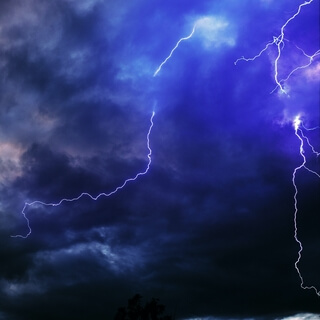
By shaking his aegis,
Produce storms,
Tempests and intense darkness.
At his command,
The mighty thunder rolls,
The lightning flashes,
And the clouds open and pour forth their refreshing streams to fructify the earth.
As the personification of the operations of nature,
He represents those grand laws of unchanging and harmonious order by which not only the physical but also the moral world is governed.
Hence he is the god of regulated time as marked by the changing seasons and by the regular succession of day and night,
In contradistinction to his father,
The titan Cronus,
Who represents time absolutely,
I.
E.
Eternity.
As the lord of state life,
He is the founder of kingly power,
The upholder of all institutions connected with the state,
And the special friend and patron of princes,
Whom he guards and assists with his advice and counsel.
He protects the assembly of the people and,
In fact,
Watches over the welfare of the whole community.
As the father of the gods,
Zeus sees that each deity performs his or her individual duty and punishes their misdeeds.
He settles their disputes and acts towards them on all occasions as their all-knowing counselor and mighty friend.
As the father of men,
He takes a paternal interest in the actions and well-being of mortals.
He watches over them with tender solicitude,
Rewarding truth,
Charity,
And uprightness,
But severely punishing perjury,
Cruelty,
And want of hospitality.
Even the poorest and most forlorn wanderer finds in him a powerful advocate,
For he,
By a wise and merciful dispensation,
Ordains that the mighty ones of the earth should succor their distressed and needy brethren.
The Greeks believed that the home of this their mighty and all-powerful deity was on the top of Mount Olympus,
That high and lofty mountain between Thessaly and Macedon,
Whose summit,
Wrapped in clouds and mist,
Was hidden from mortal view.
It was supposed that this mysterious region,
Which even a bird could not reach,
Extended beyond the clouds right into Aether,
The realm of the immortal gods.
The poets describe this ethereal atmosphere as bright,
Glistening,
And refreshing,
Exercising a peculiar,
Gladdening influence over the minds and hearts of those privileged beings permitted to share its delights.
Here youth never ages,
And the passing years leave no traces on its favored inhabitants.
On the cloud-capped summit of Olympus was the palace of Zeus and Hera,
Of burnished gold,
Chaste silver,
And gleaming ivory.
Lower down were the homes of the other gods,
Which,
Though less commanding in position and size,
Were yet similar to that of Zeus,
In design and workmanship,
All being the work of the divine artist Hephaestus.
Below these were other palaces of silver,
Ebony,
Ivory,
Or burnished brass,
Where the heroes or demigods resided.
As the worship of Zeus formed so important a feature in the religion of the Greeks,
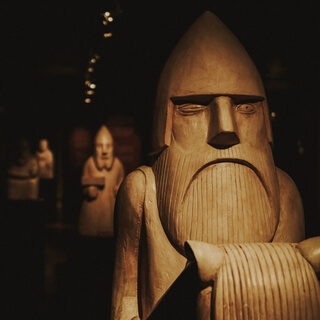
His statues were necessarily both numerous and magnificent.
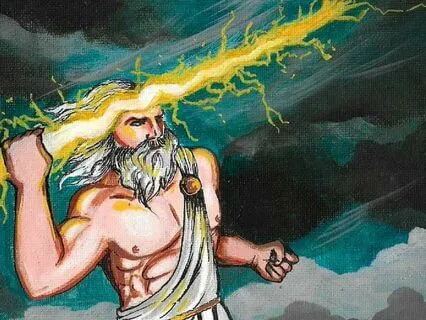
He is usually represented as a man of noble and imposing mien,
His countenance expressing all the lofty majesty of the omnipotent ruler of the universe combined with the gracious yet serious benignity of the father and friend of mankind.
He may be recognized by his rich flowing beard and the thick masses of hair which rise straight from the high and intellectual forehead and fall to his shoulders in clustering locks.
The nose is large and finely formed,
And the slightly opened lips impart an air of sympathetic kindliness which invites confidence.
He is always accompanied by an eagle which either surmounts his scepter or sits at his feet.
He generally bears in his uplifted hand a sheaf of thunderbolts just ready to be hurled whilst in the other he holds the lightning.
The head is frequently encircled with a wreath of oak leaves.
The most celebrated statue of the Olympian Zeus was that by the famous Athena sculptor Pytherius which was forty feet high and stood in the temple of Zeus at Olympia.
It was formed of ivory and gold and was such a masterpiece of art that it was reckoned among the seven wonders of the world.
It represented the god seated on a throne holding in his right hand a life-size image of Nike,
The goddess of victory,
And in his left a royal scepter surmounted by an eagle.
It is said that the great sculptor had concentrated all the marvellous powers of his genius on this sublime conception and earnestly entreated Zeus to give him a decided proof that his labours were approved.
An answer to his prayer came through the open roof of the temple in the shame of a flash of lightning which Pytherius interpreted as a sign that the god of heaven was pleased with his work.
Zeus was first worshipped at Dodona in Epirus where,
At the foot of Mount Timaurus on the woody shore of Lake Joannina,
Was his famous oracle,
The most ancient in Greece.
Here the voice of the eternal and invisible god was supposed to be heard in the rustling leaves of a giant oak,
Announcing to mankind the will of heaven and the destiny of mortals,
These revelations being interpreted to the people by the priests of Zeus who were called Selim.
Recent excavations which have been made at this spot have brought to light the ruins of the ancient temple of Zeus and also,
Among other interesting relics,
Some plates of lead on which are engraved enquiries which were evidently made by certain individuals who consulted the oracle.
These little leaden plates speak to us,
As it were,
In a curiously homely manner of a bygone time in the buried past.
One person enquires what god he should apply to for health and fortune,
Another asks for advice concerning his child,
And a third,
Evidently a shepherd,
Promises a gift to the oracle should a speculation in sheep turn out successfully.
Had these little memorials been of gold instead of lead,
They would doubtless have shared the fate of the numerous treasures which adorn this and other temples,
And the universal pillage which took place when Greece fell into the hands of barbarians.
Though Dodona was the most ancient of his shrines,
The great national seat of the worship of Zeus was at Olympia in Elis,
Where there was a magnificent temple dedicated to him,
Containing the famous colossal statue by Pythidias above described.
Crowds of devout worshippers flocked to this world-renowned vein from all parts of Greece.
Not only to pay homage to their supreme deity,
But also to join in the celebrated games which were held there at intervals of four years.
The Olympic Games were such a thoroughly national institution that even Greeks who had left their native country made a point of returning on these occasions,
If possible in order to contend with their fellow countrymen in the various athletic sports which took place at these festivals.
It will be seen on reflection that in a country like Greece,
Which contained so many petty states,
Often at variance with each other,
These national gatherings must have been most valuable as a means of uniting the Greeks in one great bond of brotherhood.
On these festive occasions the whole nation met together,
Forgetting for the moment all past differences and uniting in the adjoinment of the same festivities.
It will doubtless have been remarked that in the representations of Zeus he is always accompanied by an eagle.
This royal bird was sacred to him probably from the fact of its being the only creature capable of gazing at the sun without being dazzled,
Which may have suggested the idea that it was able to contemplate the splendor of divine majesty unshrinkingly.
The oak tree and also the summits of mountains were sacred to Zeus.
His sacrifices consisted of white bulls,
Cows,
And goats.
Thank you for listening and enjoy the rest of your sleep.
Good night.