It is a�T This is Kibala 99.
I'm Deborah Sophia.
Today we have on the call Michael Harrison,
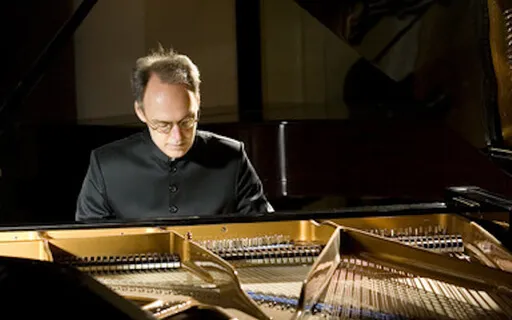
An American contemporary classical music composer and pianist living in New York City,
And a dear friend.
Welcome Michael.
Thanks so much Deborah.
You have been commissioned by the Grammy winning vocal group Roomful of Teeth,
Alarm Will Sound,
The cellist Maya Beiser,
The Del Sol String Quartet,
And many others.
And in 2018 you won a Guggenheim Fellowship for the academic year.
So congratulations Michael.
And what did that allow you to do?
And can you share with us a composition that you began working on at that time?
The Guggenheim is a once in a lifetime thing and it's really fantastic that John Simon Guggenheim that in his name this foundation was created as a memorial for him but has supported thousands of artists and scientists over many decades to create some of their best work.
Because what you do is when you apply for the Guggenheim you come up with a big project that you want to work on and then they provide you with funding basically that's going to cover your living expenses while you're working on that project.
So it's really an incredible opportunity for artists and scientists to fulfill their deepest dreams and ambitions.
In my case I worked on a number of different pieces.
One was a commission from Alarm Will Sound which is one of the leading contemporary chamber orchestras in the world.
And then I also worked on a number of chamber pieces and one of my big projects which is combining Indian classical music with Western classical music which is like a lifelong project of mine.
Well let's focus there.
You started out your musical training in classical piano and when did you begin to study classical Indian Raga?
In my late teens I was fortunate enough to hear about Pandit Pranav who was also the Indian music guru for two of our best Western classical composers,
Terry Riley and Lamont Young and many other really great musicians.
And so at a very early age I found out about Pandit Pranav and started studying first with his disciples and then I became a disciple of his myself.
And so I was living in Eugene,
Oregon at the time.
Pranav was in Berkeley,
California so I would drive down I-5,
A good 10 hour drive and take a few lessons you know multiple times a year.
And then Pranav would come up to Oregon and visit me and give concerts and teach workshops.
And then I started also studying with Lamont Young in New York City and so when I was there very often Pranav was there and I could study with him there.
Towards the end of his life I started going to India with him and some other musicians every year and that was an opportunity to go really deep into the music in its natural setting.
So it's been about 43 years now that I've been studying and practicing Indian classical music on a daily basis.
And what draws you to that music?
So many things.
I would say the primary thing is I started meditation when I was 16 and music being my life's path I either consciously or unconsciously sought out to combine my life's path which is music with my spiritual path.
And so Indian music provided that for me so that music is my meditation,
Is my spiritual path.
Not necessarily all the music that I do but I certainly a big part of my Indian music practice and some of my other music practice as well which is my meditation practice.
And so it's really nice to combine those two rather than to have them be two separate paths or practices.
I can understand what you're saying because that's how you and I met was through Paniparnath or Guruji,
Guruji to us and I also studied with him and that is what drew me because not being a musician what drew me was the spiritual opening singing Raga with Guruji.
Let me just say that it is perhaps the oldest continuous music tradition in the world.
My current Indian music guru who I've been studying with for the last 20 plus years since Paniparnath died is a part of a musical family,
The same family that Pranath studied with that goes back in the same family lineage something like 20 generations,
I mean like 700 years and it's all been passed down within the family in the same way that you would like have chefs you know have their secret recipes that they would only maybe give to their family members.
It's a very similar kind of thing.
So it's a really rich deep tradition and one of the richest musical traditions in the world I would say perhaps as deep and rich as the Western classical music tradition.
It provides me with not only a very complete musical training which complements my Western classical training but with many ideas that I can work with as a composer and pianist that I wouldn't have access to otherwise.
So really I have like a lifetime of work ahead of me in how I'm combining these different elements from Indian classical music and Western classical music.
For example Indian classical music,
Well one of the great things about it which really changed my life and my whole approach to music was the tuning because when you learn Indian music there's incredible attention put especially as a vocalist on what we call intonation which means tuning and you sing without vibrato and the notes have to be perfectly in tune.
So after the first year of study my main instrument the piano started sounding out of tune and what I realized which they never taught me in music school is that the Western tuning system is actually a compromised system where the purity of tuning of all the notes is compromised so that the notes can be equally spaced and the advantage of that is that you can transpose music or play in any key but the disadvantage is that the purity of harmony and intonation is all compromised and so when I found this out I got a second piano and started tuning it by ear and that was the beginning of what is one of the main threads of my musical narrative which is just intonation or true tuning so that's something that I learned organically and naturally not book learning but actual experiential learning through studying Indian music.
Could you tell us a piece that you've composed that is in the just intonation?
Yeah,
I think the most important one is a piece called Revelation.
It has my own tuning system.
It is a just intonation system but not a historical one it's my own version and it creates kind of otherworldly sounds.
It makes the piano sound different than anyone has really ever heard it before.
If you listen to Revelation give yourself a chance to get into it deeply a few times because the first time you listen it might really sound out of tune because you've never heard a piano sound that way but as you get used to the tuning system it starts to sink in.
So that is one of my favorite works of yours.
It was named one of the best classical recordings of 2007 by the New York Times among other high praise.
We will provide a link to a recording of Revelation for our listeners to enjoy.
In our previous season,
In season one,
Kabbalah 99 interviewed Surawati William Gebel.
He chose you to compose the music to accompany his book Nature's Hidden Dimension envisioning the inner life of the universe.
Your commission was to express the seven leading names musically.
Can you tell us about the seven leading names and how you came to choose or compose the music?
Right,
Well,
Surawati's book takes as its premise that the universe has an inner as well as an outer life and that intelligence has always existed and the unfolding and evolution of the universe is a sign of the universal intelligence wishing to know itself.
The seven compositions in the album are reflections of the perfect qualities of the seven leading names.
The seven leading names tell the story of an awakening primal self.
So the seven leading names are like universal archetypes.
All high signals the realization that I exist when nothing else is known.
All alim is a self-reflection with a discovery I know I exist.
All kadar is an awakening of agency.
I have the power and the will to do something.
All murid signifies the birth of desire the motivation needed to direct the will.
I desire for something.
All sami is an awakening to an innate capacity for self-discovery.
In this case an ability to detect vibration.
I have the capacity of hearing.
All basir is the second capacity of discovery to awaken the ability to detect light.
I have the capacity of seeing.
And finally all kalim is the culminating capacity needed to fulfill the desire for self-knowledge.
In order to know oneself one must have the capacity to express what one contains.
I have the capacity to express all that is within me.
So these seven leading names are beautifully described as I recited by Sir Wardi Gebel.
It's a collaboration where music which transcends the intellect and which transcends language can give us the ability to tap into the primordial essence of these universal archetypes.
I'm spellbound hearing you list seven leading names coming into being like that.
And really what you're saying is that this is something happening all the time.
It's not something that happened in the past.
Sometimes we think of the world as being linear like at one point there was Yahya and then Yahalim that this is happening all the time and in every one of us in every manifestation.
Is that true to say that?
Absolutely true and it's happening not only at the individual human level but at a cosmic level as well.
So how did you choose music to express each name?
Well it was a collaboration with Sir Wardi.
He's really in touch with the teachings.
These are age-old teachings and so I composed various pieces and fragments of pieces and sent them back and forth.
You know some of them would say oh this is you know exactly what he's looking for.
He thinks he's right for Basir and then others were not quite right and so through that process we refined it until we got music that really felt like it hit the nail on the head so to speak.
And then you know I finished the pieces and went into the recording studio with some really great musicians and recorded them.
So you found pieces that express the inner intention or the experience of the names?
Exactly.
Yeah okay.
So describe the music.
What instruments are being used?
Is it vocal?
Do you use your just intonation when you composed it?
All of the pieces except for one are in just intonation.
All high which is the realization I exist.
I actually am using the opening section for Revelation.
It's called Revealing the Tones which is a gradual unfolding of notes up from the harmonic series so it's very universal and it's like a slow birth of the process.
Aleem is an Indian raga called Malkants which is very primordial and it was a recording that I did with two colleagues,
Peyton McDonald and Ina Felipe both who are drupad singers.
That's the ancient form of Indian classical singing.
And what we're doing that's different from Indian music is what we call polyphonic raga because ragas traditionally have one melody happening at a time.
Well those western music often like Bach for example have more than one melody happening at a time.
We call that polyphonon.
And so what we're doing is we're taking the raga and adding many layers of melody at the same time by overdubbing the voices and the piano.
So I'm very excited about it because it's the first recording of a concept that I've been developing with these other musicians over a number of years which is the concept of polyphonic raga.
Al-Qadir is the awakening of agency.
I have the power and will to do something.
So for that I'm using another section of Revelation which is called Tone Cloud II.
It's very kind of exciting and rhythmic and also kind of reflects this primordial vibration.
Murid,
The fourth one signifies the birth of desire.
That's a piano and violin piece that I recorded with the great violinist Tim Fain.
Sami is an awakening to an innate capacity for self-discovery through hearing.
And for this I used a piece that I composed for the vocal group Roomful of Teeth where they're singing different notes of the scale together and in this kind of echoing capacity.
So it creates this beautiful cascade of sound.
Basir is the second capacity of discovery to awaken through light and the capacity of seeing.
And for this I used my instrument the harmonic piano which I created and which plays 24 notes in an octave.
And I took the recording and I slowed it down very slowly so that you hear the notes of angels because of the way the just intonation on the harmonic piano is working and the electronics that I used to slow it down.
You were saying it was the voice of angels?
Like choirs of angels.
And I don't think anyone will know how I actually created that sound because it doesn't sound like any instrument you've ever heard.
Colim is the last piece in the culminating capacity to fulfill the desire for self-knowledge.
And this is a piece that is written for just intonation piano,
Violin,
Viola,
And cello.
And it's perhaps the most traditional piece on the album.
It uses triadic harmonies,
Major and minor chords,
And a beautiful melody that happens in a canon with the strings.
That piece is also dedicated to one of my favorite composers,
Arvo Pert,
And was inspired by his piece Spiegel and Spiegel.
I love that piece.
Well,
Michael,
You very kindly offered for our listeners to hear the composition Colim now.
It's the seventh leading name,
Which is the culminating capacity to fulfill the desire for self-knowledge.
We opened this podcast with the first few phrases of this piece and we'll play it in its entirety now.
Okay.
You you you you you you you you you you That's beautiful.
I want to linger with that music for a long time You're ending at Kalima and that is the desire for self-realization Correct correct right well in in Kabbalah That's one step,
But there's another step which is self transcendence so beyond realizing the self is the desire to go back to source So this is self-realization and self transcendence are looked at as two different Aspects of living does that come up in any way in in your understanding?
Well the desire for self-realization is the same as Kaleem and the desire for self-knowledge or self-reflection would come up with Aleem and The realization that I exist in the first place comes up with all high these universal teachings all came from the same part of the world right okay from the Middle East and And ultimately are also connected from the same source,
Which is Abraham from the tent of Abraham So I would say to your question yes,
Yes,
Yes We're almost getting at what I'm trying to eke out here and that is There are two human intentions both are important one is to fulfill my purpose my individual purpose I'm here for a reason and I need to self realize self actualize be the best I can be like you are as a musician You have a tremendous drive to be the very best musician you can be There is another human drive which is a negation of the self.
It's also known It's a very strong word,
But it's an experience of annihilation where the individual no longer is That is what is talked about a self transcendence when you're no longer working toward your own Expression but more to go back to source and and dissolve into the oneness Now we don't stay there.
That's why annihilation is not so scary because we recollect afterwards but we move in the world with a different understanding of Oneness is that also expressed or is that or is this these are the leading names and hasn't quite gotten to that point Yes I kind of suspect this these leading names are about coming into being and Not that other step talked about in the parasha of going back to to oneness Or am I missing something here?
Well,
That was really deep Deborah.
I I hope everyone can follow along with that press replay because what Deborah just said is basically the essence of the spiritual path and I Believe that the seven leading names are really taking us to that capacity for a self realization,
But of course self realization involves the annihilation of the limited ego we live in physical bodies in the world and so our souls which are eternal are Connected to this body with a limited ego but we have the capacity to Transcend that ego or as you use the word annihilate that ego Temporarily so that it doesn't control us So that in fact our souls have freedom from the limitations of the ego at least for some time in this life and I believe that that is One of the most important things we can do on the path of awakening Right and in very simple terms everyday terms.
We have the desire to improve ourselves and we have the desire to Serve so in a relationship with two people let's say husband and wife one is in school while the other one's working and then The one who was in school goes on to fulfill their purpose with their work Perhaps they've become a doctor or a nurse or some great service that self transcendence to be of service to others So these are not just lofty terms.
They're things we experience in everyday life.
Do I Focus on taking care of my personal needs or do I spend more time with my children or my spouse?
These are things that constantly come up in our lives daily What choices we make to live this life fully to feel fulfillment both come into play?
You know can sound lofty,
But it's actually very much every day exactly and for example in In a marriage if each partner is willing to compromise 90% of the time Then you'll you'll reach 100% Everyone gives a hundred percent Right and you give a hundred percent each child even if you have one or ten It's the mystery of living Michael tell me how this engagement to come up with music for the seven leading names has impacted you has it Given you insights that you didn't have before is it changed you in some way or impacted your music?
I?
Think the main thing is that it's a beautiful concept and it's not my concept It is Sarah Wardy's concept.
He was the one that reached out to me to do this collaboration because music in itself Represents and gives us an experience of something pre verbal something deeper than words and even deeper than imagery and these seven leading names are universal archetypes and So to have the opportunity to create music which in essence is to meditate upon the essence of the these Archetypes has been a really great journey There are other things like this like for example the Indian ragas each different Raga Invokes a different type of archetype and when you play or sing that Raga You experience the being of that Raga.
So it's a very actually it's a very similar Idea That you're you're creating music that taps into a universal archetype that you're Meditating on or you getting into the essence of so I think it is deepened my capacity for that understanding and also Those types of relationships between the seven leading names and the Indian ragas for example,
It's beautiful So Michael,
What are you working on these days?
So I'm working on multi-dimensional project which involves interdisciplinary collaborations and Also Indian ragas one of the forms of the project is called passage and Passage in its ultimate form will be a 24-hour art installation we have a museum lined up for the initial show in 1993 and it's a collaboration with visual and media artist Nina Elder but it also involves Sir Wardi Gebel as a astrophysicist and a roboticist and some other collaborators as well and the concept is to go into a 24-hour cycle of human time planetary time in cosmic time and There will be a lighting installation that gives you a sense of what is happening at that time between the earth and the moon and the Sun and their relationships and Then the music is going to be a 24-hour Music cycle so that it's gradually evolving in tune With what's happening?
With the cosmic cycle and And for the music,
I'm also drawing on Indian ragas,
Which I have extensive Experience and have been studying and practicing daily for over 40 years and the Indian ragas Correspond to different times of day.
So it's a natural connection To have you know,
You have morning ragas Dusk ragas evening ragas midnight ragas,
Etc.
And so I'm using The ragas as we go around the 24-hour cycle to tap into these cosmic rhythms That's amazing in Daoist philosophy They'll show the circular day Set inside of the circular year so that there is that feeling of that One cycle is reflective of another and another it sounds a bit like what you're doing that they each overlay one over the other They have similar qualities and it's it's an ancient concept You know the ancient Greeks Greeks and Pythagoras and the Renaissance thinkers were all Realizing that there was a connection Between the whole number of proportions of music for example and The orbits of the planets and in a sense you could say that The universal foundation for music which is vibration Is the software of the universe?
Oh,
I like that analogy So Michael for our last question why music what drives you to continue to perform and compose?
Such path-breaking music.
Well,
I just love music,
You know,
And I feel really blessed to be able to have a life in music I get up every day and think wow,
You know,
I get to be a musician today And it's a blessing I'm gonna read a few quotes from the Sufi message of Hazrat and night-con Volume two which is all about music and this book has been my lifelong companion and my inspiration Music being the finest of the arts helps the soul to rise above differences It unites souls because even words are not necessary Music is beyond words That is beautiful.
And when I listen to your music Michael it for me it is also beyond words and I so appreciate you coming on this podcast today and sharing your insights with our listeners So,
Thank you.
It's been my joy.
Thanks for inviting me For more mind heart awakenings like these you can follow us on this podcast and on our blog at kabala99 That's where we discuss the weekly Torah portion through the lens of today's challenges and offer Practices to stay sane grounded and connected if you like this episode Please remember to tell one friend about it Next week.
We'll hear from another thought leader who will help us to explore our Experience of life and our place in this universe of wonder Thanks for listening.
I'm Deborah Sophia.
See you next week You You You You You