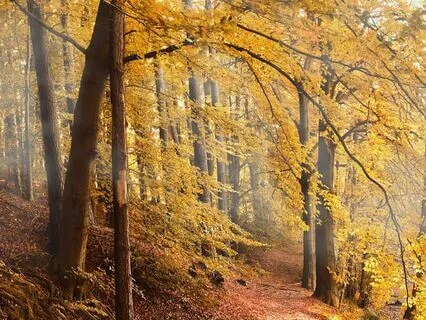
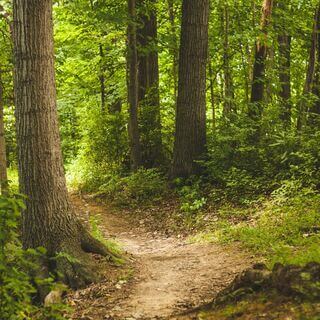
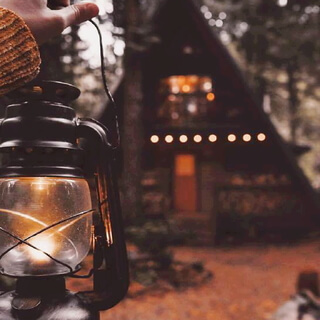
The woods in autumn.
Maples are trees that have primal fire in their souls.
It glows out a little in their early youth,
Before the leaves open in the redness and the rosy yellowness of their blossoms.
But in summer it is carefully hidden under a demure silver-lined greenness.
Then,
When autumn comes,
The maples give up trying to be sober and flame out in all the barbaric splendor and gorgeousness of their real natures,
Making of the ancient wood a thing out of an Arabian night stream in the golden brime of good.
You never may know what scarlet and crimson really are until you see them in their perfection on an October hillside under the unfathomable blue of an autumn sky,
All the glow and radiance and joy at earth's heart,
Seem to have broken loose in a splendid determination to express itself for once before the frost of winter chills.
It is the year's carnival,
The dull Lenten days of leafless valleys,
And penitential mist come.
The maples are the best vehicle for this hidden immoral fire of the earth and the woods,
But the other trees bear their part valiantly.
The sumacs are almost as gorgeous as the maples.
The wild cherry trees are,
Indeed,
More subdued as if they are rather too reserved and modest to goad the Lent,
The maples too,
And prefer to let their crimson and gold burn more dully to the true overtones of bronzy green.
I know a dell far in the bosky deeps of the wood where a row of maiden birches fringe a deeply running stream,
And each birch is more exquisite than her sisters.
And as for the grace and godness of the young things that cannot be expressed in terms of a dictionary or symbols of earth,
But must be seen to be believed or realized,
I stumbled on that dell the other day quite by accident.
If indeed there can be such a thing as accident in the woods,
Where I am tempted to think we are led by the good people,
Along such of their fairy paths as they have,
A mind for us to walk in.
It was lying in benediction of amber sunshine,
And it seemed to me that a spell of eternity was woven over it,
That winter might not touch it,
Nor spring evermore visit it.
It must continue forever so.
The yellow trees mirrored in the blessed stream,
With now and then a leaf falling on the water,
To drift away and be used,
May have,
As a golden shell for some adventurous wood sprite.
Who had it in mind fare forth to some wonderful far-off region,
Where all the brooks run into the sea?
I left the dell while the sunshine still shone on it,
Before the shadows had begun to fall,
And I shall never,
If I can help it,
Revisit it again.
I wish to remember it always as in that one vision,
And never see it changed or different.
I think it is one of the places where dreams grow,
And hereafter,
Whenever I have a dream of a certain kind,
A golden,
Mellow,
Crimson-winged dream,
The very dreams of dreams,
I shall please my fancy with the belief that it came from my secret dell of birches,
And was born of some mystic union between the fairest of the sisters and the genius of that crooning brook.
The woods are full of purple vistas,
Treaded with sunshine and gossamer,
Down drop the tinted leaves,
One by one with the faintest of sighs,
Until our feet rustle most silvery through their fallen magnificence.
The woods are friendly as ever,
But they do not make the advantage of spring,
Nor do they lavish attentions on us,
As in summer they are full of gentle,
Place-it indifference.
We have the freedom of their wonders,
As old friends,
But we are not any longer to expect them to make much fuss over us.
They want to dream and remember,
Undisturbed by new things.
They have spread out a spectacle that cannot be surpassed,
Have flung all their mounts of hoarded sunlight into one grand burst of colour,
And now they wish to take their rest.
The gone bearers hardly know what to make of the transformation that has come over their neighbours,
Who comported themselves so,
Discreet respectively,
All through the earlier months of the year.
The pines and hemlocks and spruces seem to wrap their dark mantles around them,
With a tinge of haughty disapproval.
No change of fashion for them.
It is theirs to keep up the dignity of the forest.
Only the firs are more tolerant.
Indeed,
Here and there a fir seems trying to change.
It's sober garments also,
And has turned a rich red-brown,
But alas,
The poor fir pays for its desertion,
Or fir tradition by net.
Only the dying fir can change its colour,
And exhale that haunting,
Indescribable odour,
Which steals out to meet us in a shadowy hollows and silent dingles.
There is a magic in that scent of dying fir.
It gets into our blood like some rare,
Subtly-combounded wine,
And trills us with unutterable sweetness,
As of recollections from some other,
Fairer life,
Lived in some happier star.
Compared to it,
All other scents seem heavy and earth-borne,
Luring to the valleys instead of the heights.
But the tang of the fir summons upward,
And onward to some far-off divine event.
Some spiritual peak of attainment,
Whence we shall see,
With unfaltering,
Unclouded vision,
The spires of some aerial city,
Beautiful,
Or the fulfilment of some fair,
Faithless land of promise.
Old moods give us another rare fragrance also,
The aroma of frosted ferns.
The morning is the best time for it,
A morning after a sharp frost,
And the sunshine breaks over the hollows in the woods.
But sometimes we may catch it,
In the evening after the afternoon sun has steeped the feathery golden sheets of a certain variety of fern,
And drawn out their choicest savour.
I have a surprise for you,
If you will,
But walk with me through these steel-stained mazes,
And over the enclosed harvest field,
And along this maple-fringed upland meadow.
There will be many little things along our way to make us glad.
Joyful sound will come,
Ringing down the wind.
Gypsy gourd will be ours for the gathering.
I can promise you a glimpse,
Now and then,
Of a shy,
Patric,
Scuttling away over the fallen leaves.
As the evening deepens,
There will be a nun-like shadow under the trees,
And there will be squirrels,
Chattering in the beaches where the nuts are.
Squirrels,
You know,
Are the gossips and busybodies of the woods,
Not having learned the fine reserve of its utter denizens.
But there is a certain shrill friendliness in their greeting,
And they are not really half such scouts as one might imagine from appearances.
If they would but take a thought,
And meant,
Their shrewd-like ways,
They would be dear,
Lovable creatures enough.
Here is my promised surprise.
Look,
You!
A tree,
An apple-tree,
An apple-tree laden with fruit,
As I live,
A veritable apple-bearing apple-tree,
Here in the very heart of the woods,
Neighboured by beaches and pines,
Miles away from any orchard.
Years ago it sprang from some chance-sown seed,
And the alien thing has grown and flourished and hold its own.
In the spring I wandered this way,
And saw it white amid wildness with its domestic blossom.
Pluck and eat fearlessly,
I pray you.
I know these apples of Odin,
Fruit of Hesperides,
Had not a rare flavour,
Nor the fatal apple of Eden.
They have a tawny skin,
But a white,
White flesh,
Faintly veined with red,
And besides their own proper apple taste,
They have a certain wild,
Delicious flavour no orchard-grown apples ever possessed or can possess.
Let us sit here on this fallen tree,
Cushioned with mosses and eat our fill,
With the shafts of sunshine turned crimson,
And grow remote until they vanish altogether and the early autumn twilight falls over the woods.
Surely there is nothing more for our quest,
And we may as well go home.
Nothing more,
Look,
I pray you,
Or yonder through the mist of this mild,
Calm evening.
Beyond the brook valley,
Halfway up the opposite slope,
A brush fire is burning clearly and steadily.
In a maple grove there is something indescribably alluring in that fire,
Glowing so readily against the dark background of forest and twilight hill.
A wood fire at night has a fascination not to be resisted by those of mortal race.
Come,
Let us arise and go to it.
It may have been lighted by some good,
Honest farmer,
Bent on tidying up his sugar orchard,
But it may also,
For all we know,
Have been kindled by no earthly woodman,
A beacon or summoned to the tribes of Faerie.
Even so we shall seek it fearlessly,
For are we not members of the immoral free masonry of the woods?
Now we are in the grove,
Is it not beautiful,
O comrade of my wonderings?
So beautiful that it makes us perfectly happy.
We could sit down and cry for pure,
Unearthly joy,
And we desire fervently some new language,
Rich in unused,
Unstained words,
To express our rapture.
The fire burns with a clear,
Steady glow and a soft crackle.
The long arcades beneath the trees are illuminated with a rosy radiance,
Beyond which lurks companies of enticing grey and purple shadows.
Everything is very still and dreamy and remote.
It is impossible that out there,
Just over the hill,
Lies a village of men,
Where tame household lamps are shining.
We must be thousands of miles away from such things.
It is an hour and place when and where anything might come true,
When men in greed might creep out to join hands and foot fealty around the fire,
Or wood nymphs steal from their trees to warm their white limbs,
Grown chilly in autumn frost,
By the blaze.
I don't think we would feel much surprise if we should see something of the kind,
The flash of an ivory shoulder,
True yonder gloom,
Or a queer little elfin face peering at us around a twisted grey trunk.
Oh,
I think I do see it,
But one cannot be sure,
Mortal eyesight is too slow and clumsy a thing to match against the flicker of a pixie-little fire.
Everything is in this hour the beauty of classic myths,
The primal charm of the silent and the open,
The lure of mystery,
The beguilement of grim air.
It has been a pure love-match,
Twilight and dark,
And beautiful exceedingly are the offsprings thereof.
We go home by the old fir lane,
Over the hill,
Though it is somewhat longer than the field way,
But it always drags terribly at my heart to go past the wood lane,
If I can make any excuse at all for traversing it.
Sometimes I like to walk in this lane alone,
For I know it well and can trust here with many shapes of old dreams and joys,
But to-night I am glad to have a comrade,
For the dark is coming down,
And I am just a wee bit afraid,
With a not unpleasant fear,
The whole character of the lane seems changed,
It is mysterious,
Eerie,
Almost sinister.
The trees,
My old well-known friends,
Are strange and aloof,
The sounds we hear are not the cheery,
Companionable sounds of day-time,
They are creeping and whispering and weird,
As if the life of the woods had suddenly developed,
Something almost hostile,
Something at least alien and unequated and fertile.
I could fancy that I hear stealthy footsteps all around us,
But strange eyes were watching us through the bows.
I feel all the old primitive fear known to the childhood of the race,
The eave of the dark and shadowy,
The shrinking from some unseen menace lurking in the gloom.
My reason quells it into a frequent watchfulness,
But were I alone it would take but little,
Nothing more than that strip of dried bark keeling so chilly on the rail fence,
To deliver me over to a blind panic in which I should turn and flee shamelessly.
As it is,
I walk more quickly than I want,
And feel as we leave the lane behind,
That I am escaping from some fascinating,
But not altogether hallowed,
Locality,
A place still given over to paganism,
And through a wealth of fauns and satyrs,
None of the wild places are ever wholly Christian in the darkness,
However much they may seem so in daylight.
There is always a lurking life in them that dares not show itself to the sun,
But regains its own with the night.
Comrade,
I wow!
I am right glad to see the steady gleaming home light below us shining on homely mortal faces.
It is a good thing after the uncanny enchantment of the autumn forest.