Hello,
Future speakers.
Thank you so much for your interest in this class.
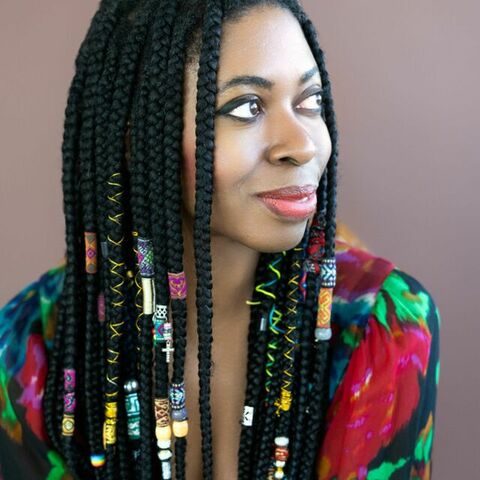
My name is Gigi Bissong.
And during this time together today,
I really want to set the foundation and the basics on what I believe it takes to be a dynamic and captivating speaker.
Personally,
I have been public speaking for over 15 years.
I started off doing motivational talks to high school kids,
And then that's escalated to doing speaking gigs for corporations,
For nonprofits,
And also on spiritual stages.
And I'm really grateful for this time together today.
And these are just the basics,
But these basics will take you a very long way,
I believe.
And I first off want to say thank you for showing up.
I believe more than ever right now is such a very pivotal time for people to stand up and to speak their truth,
Whether that means speaking on an actual stage or virtually speaking or even doing different short messages on social media and online.
I think it is pivotal and very important right now for us not to be in this state of regurgitating information,
And for us to tune in to the specific frequency of light that we hold within us.
And as easy as it is to say that and for that to come out of my mouth right now,
I know it can be a lot harder to actually ground ourselves in that and to birth those messages that are within us.
So I hope this short class gives you enough information to feel a little bit more confident in sharing your message and tuning in to your unique gift and your unique voice.
The number one thing I believe that is really important when it comes to public speaking is structuring your life so that you are always prepared to speak.
And the way that that looks like is number one,
I believe it's important for you to know your crossroad stories.
So all of us have so many stories,
So many lived experiences,
And a lot of times we haven't written those out.
We forget them or we minimize them.
We think some are more important than others,
Or we forget exactly all of the information and lived experiences that are held within us.
So I think it's important to write down,
Take an afternoon or a few hours or even just 30 minutes and start jotting down the different crossroad moments in your life.
Now,
A crossroads is a particular point in your life where you had a choice,
Like a fork in the road.
You could go left or you can go right.
Maybe you've always gone left,
And maybe in this moment there is a choice that you can make to go to the unknown,
To actually push yourself a little bit past your edge and go to the right.
There might be some fear,
There might be some unknown territories,
But you know that growth is in the direction of the right.
So you go that way.
And then when you do,
You see that there was so many opportunities,
So many ahas,
So many beautiful experiences that you were able to move through because you chose a different route.
So those crossroad stories are going to be very impactful stories in your speeches,
In the messages you share on your email list.
They're going to come up at so many different points.
And so if you actually have a list of all your crossroad stories,
The moments when you're asked to speak,
Or the moment when you feel inspired to create a new post online,
You can go to your crossroad stories,
And you can pull out one of the messages that you've already lived through.
And you can apply that to your audience.
And you can share that with them in a way that actually ignites something in them.
So that's why it's so important to know and to write down your crossroad stories.
I think it's also as important to write down and to know your shadow stories and your light stories.
And those stories are going to be similar to your crossroad stories,
But a little different.
So maybe there weren't actually a fork in the road where you had a choice to go left or right.
But maybe your shadow story was just at a time in your life where you needed to go inward.
Maybe it was after a divorce.
Maybe when your kids graduated high school and went off to college or to live on their own.
Or maybe it was just a time in your life where you lost friends or you lost your housing,
Or you lost a job,
Or you lost your identity.
You know,
Maybe you thought that there was a time in your life that all these things were going to happen and you realize the life you thought you were going to be living at this date did not happen.
And there's a loss that comes with that.
And so in that loss,
You chose to go inward,
You chose to reflect,
And you chose to see yourself from a new point of view,
A new position.
And so in that time,
You went into the underworld,
You went into your shadow,
You saw all the bits of shame,
All the anger,
All the rage,
All the fear,
All of it,
And you got to meet it face on.
And through meeting it face on,
You learned so much about the power of your emotions,
The power of accepting all of you,
And the power of your strength and your courage.
Those stories are so important.
And those stories are so impactful for others to hear.
And as are your light stories,
Your light stories are going to be the exact opposite.
They're going to be those times in your life where something magical happened almost out of nowhere.
It's almost as if somebody had called you that you weren't expecting to call,
And that phone call changed your life forever.
The light stories are those stories that you just routinely tell over and over again.
It's the stories that you will never forget.
You live for those stories.
Those stories can also impact others.
So actually writing them down and getting into the habit of remembering your shadow stories,
Remembering your light stories,
Bring forward all of the experiences that you've lived to the surface,
So you can share them with others in a way that gives impact.
And the third thing that I would offer you to do is to structure your life around always being prepared to speak,
Is to actually use your phone.
To use your phone and to create different voice notes during your day to record any thoughts,
Any points of view,
Any perspectives that come through you.
Maybe it's after reading a book or listening to a podcast,
An idea comes,
An aha comes,
Record that in your phone.
And just use your phone as a way to record all these random little messages,
Maybe poems.
I don't know if you're like me,
If you are,
You get songs that come to you in the middle of the day,
You think they're just worthless,
Like why is this song come to me today?
And you kind of just move it to the side and you don't think about it.
But no,
Actually record it and put it in your phone.
I bet you more than anything,
That piece of information,
Even if it's just two words together,
Can actually go into a speech later in your life when you are prepared to actually stand on stage.
All of this information becomes useful.
I will share my own personal story and my own personal way of creating speeches.
If you're like me,
You're not a linear public speaker,
You're not a linear creator,
Meaning I do not write my speeches from beginning to end.
And usually I don't even write my speeches.
I'm usually more of a person who tunes in and speaks from my soul,
Speaks from my heart.
Things get channeled through me and I talk from that place.
But what I do do sometimes is if I have to do a speech and they want me to have something prepared for them,
I actually will go through all my voice notes,
I will go through all my notebooks,
And I'll just start looking at all my writings.
Because I actually write down everything.
I write down random ideas,
I write down really cool phrases,
I write down maybe one sentence that just comes to me that sounds really powerful and very poetic.
I'll write that down and then I'll go through my notebooks and I'll start pulling out different language,
Different words,
Different phrases,
Different points and parts of poetry that really strike me as something powerful,
Something meaningful,
Something I would love to weave within my speech.
I pull them all out and I put them into another document.
And so in that document are all these different pieces of language and they're not in any order.
And then when I get the speech and they tell me the topic they want me to speak on,
What I now do is I go to the quote-unquote random page that I have all these words on.
I go to that page and then I also go to the page where all my stories are.
Where my crossroad stories,
My shadow stories,
My light stories.
All of those stories I go and I pick out one or two or three of those stories and then I put them into the other documents.
And now I have this beautiful masterpiece of all of this incredible creative juiciness.
And what I start doing is playing puzzle.
I start piecing together all these different parts in different ways.
I'll put maybe this story at the beginning,
This story at the end,
This other story in the middle.
I'll bring this line of poetry maybe at the beginning,
This other line of poetry at the end.
And I'll just start moving things around in that way,
Copy and paste,
Copy and paste,
Over and over again.
And I do this until I have my speech completely written.
And another thing that I do is with each story,
I try to bring in three ways that people can apply that story to their own life.
So if I'm sharing a crossroad story of maybe when I had a breakup and after that breakup,
I said,
I can choose to stay in the same relational pattern,
Or I can choose to break it.
And maybe I chose to break it.
And when I broke that pattern,
All this amazingness started to happen in my life.
All these ahas,
All these other patterns I had in my life that are breaking.
And I want to actually share that and teach that with my audience.
So now I create three tools,
Three tangible tools I can now add to that story.
And so that becomes a part of my speech.
And so another thing that I do,
I've already mentioned that I have a crossroad story list.
I have a list for my shadow and light stories.
I also mentioned I have an audio section in my phone where I flush out all the thoughts and points of views and random language things that come to me throughout the day.
But the last thing that I also do is I have a sheet where I put all of the tools that I have,
Like any random tool.
It could be tools that I use on my own meditation mats.
They could be tools that I read out of a book that I think is really amazing when it comes to healing trauma.
Maybe it's a tool I learned in my yoga class.
I will write that down in this document.
So when I go to actually writing my speech and I want to share something with the audience,
Like a takeaway,
Something they can actually leave that auditorium or that Zoom room and do in their own real life,
In their own world,
I want them to have that tool so they can integrate.
So I have a whole sheet for tools.
So this is a way that you can structure your life so you're always prepared to speak.
So you can start that right now.
Start all those different documents in this moment,
Those different audios in this moment.
And then by the time you have your first speaking gig,
You'll be ready to go.
The second piece is I would invite you all to build your inner energetic muscle to hold the presence of you on stage.
I think many of us can have a hard time not just being on stage,
But holding our unique presence,
Our unique essence.
We maybe get insecure.
We shrink.
We get anxious.
Maybe we kind of hide even with our voice or we try to outperform and we try to get loud.
We think we have to perform or have a different personality to speak.
I believe that what the audience is actually really craving is you.
We do not actually want to see a person pretending to be like another person.
For whatever reason,
We already get that intuition that something about that person is not to be trusted.
And it's not that their information they're saying is wrong,
But when a person is on stage and they're doubting themselves internally,
The audience starts to doubt them as well.
There's an energetic signal that goes off that says this person is not to be trusted.
And it's not that you are saying something wrong,
But that inner self-doubt starts to be felt by the others in the room.
And they feel that.
And then they start to question,
Can I trust you?
Can I believe you?
I wonder.
And that's not what we want as speakers.
We want our audience to feel safe and to feel comfortable with us.
So the number one thing I think is important is to own your own unique style.
I did a personal class with a lady yesterday actually on public speaking,
A one-on-one session,
And she was giving speeches to corporations.
So she works for a company and so she's giving these customer service type can-sell speeches to her other employees.
And one thing that she noticed is she has a hard time when it comes to feeling comfortable in that space.
So I asked her,
I said,
What's your natural presence when you walk into a room?
Who are you more than anything?
And she had to take a while to answer that.
And what she came up with was that she naturally is very observant.
She's very calm.
She has a very present energy about her.
So I told her that that energy is very powerful and not a lot of people have that type of energy.
And so I told her to utilize it and to own it and to turn the volume up on her natural energy.
So when she walks into a room to speak,
She doesn't need to be the loudest person.
She doesn't need to be over charismatic.
She just needs to be grounded in her present energy.
And I asked her if she could do that,
What would happen?
And so she gave me some ideas and I agreed completely.
And one thing I also offered to her was that I also have that same type of presence.
When I go on stage,
I am definitely not the one who jumps on stage cracking jokes and got this raw,
Raw energy.
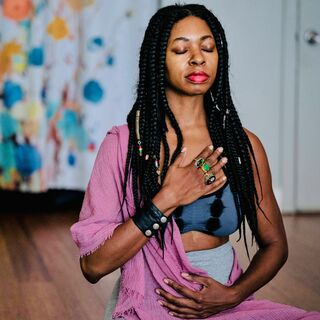
I'm a meditation teacher.
And so I bring that energy on stage with me.
So when I go on stage,
I stand there and I actually hold the microphone in my hand as I look to my left and I slowly start to gaze around the room,
Looking at every single person deep into their eye,
Giving them the sense of,
I see you,
Seeing them in a way that maybe they've never been seen before,
Giving them that softness,
That presence,
Taking in deep breaths myself,
Giving them that invitation to take a deep breath for themselves,
Grounding myself even more in my own body,
Rooting myself in that space,
Which gives them permission to do the same.
And one thing that I noticed as I get more calmer,
As I get more rooted,
So does the space.
So does the audience.
And so when I shared that with her,
She was shocked.
She never thought about that before.
And so for me,
That's the power of bringing your own transmission and letting your body take the shape of that on stage,
Knowing what it is you bring.
If you're a person who is very charismatic and a little bit more extroverted and kind of the life of the party energy,
You can bring that on stage and own your presence,
Own your energy.
So choose your transmission and feel it off stage as well.
If you have a hard time of not numbing out,
I feel like the majority of us can go into spaces and we can match the energy of the room.
We look around and we see,
Okay,
Everybody's at this stage.
I'm going to come in and bring that same type of energy.
But what I want you to do is to start building the muscle of your own transmission and building that so strong that you can hold that energy when you're at a cocktail party,
When you're at a one-on-one meeting and when you're on stage.
Second thing that I would invite you to do is to know your natural vibe and to turn up the volume on it.
And so turn the volume of it,
Not just when you're on stage,
But practice doing that when you're off stage.
So if your natural energy is being present and calm and understanding and inviting,
Then I want you to turn the volume up on that all the way to the top.
So when you come into spaces,
Think how can people feel more invited by me?
How can people feel more seen by me?
What can I do to cultivate that energy?
How can I be more me?
Instead of shrinking from my natural self,
How can I fully embody my natural state?
By doing that off stage,
When you get on stage,
You are more in your presence.
People don't just remember the information that you shared,
But people are going to remember how you made them feel.
It's an experience that most people are craving.
Most people want to feel a person who is fully being themselves.
That's what invites people into a new way of showing up,
Is that invitation in your energy field.
That's what it is that being called of you,
I believe in this moment as a speaker,
Is not just writing a good speech.
We all can put information together,
But it's you.
It's the quality of your frequency is what people are really yearning for.
And so that's the power of being on stage,
Is learning how to amplify that part of you.
And the third thing I want to invite you to do is to write a speech that connects deeply with the audience.
And three things that I think that are important to do that is number one is weaving in different experiential things.
So if you are a breathwork facilitator,
Then bring in some breathwork.
If you lead meditations,
Bring in some meditation.
Maybe if you do a cultural dance and you have that,
And that's a part of your upbringing,
Your roots,
Then maybe sharing some of that in the actual presentation.
Maybe people don't have to get out of their seats,
But maybe they could do something in their seats.
Getting people to move their bodies to actually embody something really creates transformation.
So making the speech more than just information that they're taking in to the head,
But making them feel something,
Bringing in the heart into the speech,
Bringing the body into the speech,
Bringing all the bodies into the speech,
Not just the mental body.
And so that's where we bring the speech out of just hearing something and into an experience.
And again,
People really remember speeches where there was an experience.
Number two is always keep your audience in mind,
Thinking about how does this relate to them?
And one way you can do that is actually ask yourself,
How do I want my audience members to feel when they leave this auditorium or the Zoom room or this speech?
I want them to feel empowered.
I want them to feel moved.
I want them to feel charged.
I want them to feel angry or ready to take action.
I want them to feel like action oriented.
How do you want them to feel?
Get really clear on that and then work backwards in terms of what experiences will you create in your speech to get them to feel that way.
And then the third thing is to always have a thread line.
There should be a thread that's moving through your speech at all the time.
And so whatever that thread might be,
I'll give you an example.
I recently did a summit online and it was called the Help Her Rise,
Help Her Leap,
Help Her Business Get On Its Feet Summit.
And in that summit,
My thread line was,
We all know it takes a village to raise a child,
But it also takes a village to raise a woman's business into maturity.
That was my thread line.
That thread line was in everything of that summit.
You could feel it even in my videos,
My welcome videos.
You could feel it in my email correspondence with the speakers and with the attendees.
You could feel it everywhere.
And it was felt so powerfully that even on the last day of my summit,
The speakers were actually sharing the same information,
The same thread line to the people in the audience that they were teaching.
That's how powerful my thread line was.
So choose your thread line and weave it in and out of your whole entire speech.
And so these are things I think that are going to be really important just to have a good baseline for creating a speech.
And let me know if any questions do arise.
And I do hope to maybe create a deeper program in the future.
But if anything does come up in the meantime,
I'm always open for more questions or to help you answer a couple more questions on some of the different tips that I offered.
I would love to support you in stepping into your public speaking and into writing your speech.