As part of our daily routine,
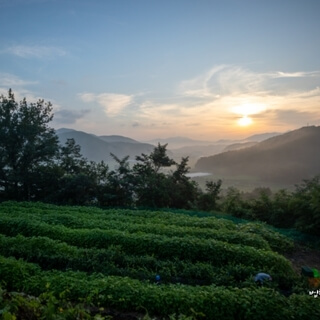
My wife and I are working in the land.
My stepfather was a farmer,
And working in the land,
Although it's a hard work,
Gives me great peace and satisfaction.
How can we incorporate this routine of working in the land to enhance our mindfulness?
As part of our daily routine,
My wife and I are working in the land.
My stepfather was a farmer,
And working in the land,
Although it's a hard work,
Gives me great peace and satisfaction.
How can we incorporate this routine of working in the land to enhance our mindfulness?
As part of our daily routine,
My wife and I are working in the land.
If you are forcing yourself to farm because you have to feed yourself and your family,
But you don't really want to do it,
Then farming causes suffering.
But if you are enjoying it,
And exercising,
You have to move your body anyway.
All animals in the wild run around to eat.
So,
Work and exercise are not separate in the wild.
But humans are separate in work and exercise.
So,
If you exercise,
You will be able to do it.
But if you don't exercise,
You will be able to do it.
So,
Even if your body is a little bit tired,
It's not psychologically hard.
This is the first point.
First,
If you however try to enjoy,
For example,
By thinking that farming is an exercise.
Since in nature,
Only human beings actually delineate the exercise and actual moving about to survive.
If you are not healthy,
Then your body may be tired,
But your mind does not have that contradiction of doing something you don't want to.
And another way is to kind of meditate as you farm.
Because meditation is about focusing and investigating intently your breath when you are doing it sitting down.
It's not anything about investigating your movements.
So,
In moving meditation,
You have to become fully aware when you are standing,
Or when you are walking,
Or when you are moving your arms.
So,
Likewise,
When you are farming,
Make every action,
Be mindful of every action and be fully invested and aware of those actions.
For example,
If you are harvesting peppers,
Every time you cut a pepper off the branch,
Be fully aware how your fingers are moving,
How you are looking at it,
How the sensation feels.
So,
If you incorporate everyday activities of farming into meditation,
You don't need to delineate between the two activities.
We have to engage in productive work in order to survive.
Until now,
We engaged in meditation that's actually based on the production of others.
So,
Our meditation was a consumptive meditation.
So,
We were trying to relieve our physical fatigue by rest,
But also our mental fatigue through meditation from the stress that we got doing our everyday productive activities.
So,
If you consider everyday farming activities as an extension of your exercise for your health,
You don't consider it as a separate labor.
Likewise,
If you incorporate constant mindfulness and meditation into your everyday farming activity,
Then meditation does not become something to relieve yourself afterwards,
But it becomes part of your everyday farming actions,
And so you can synthesize the both.
The reason that the Buddha prohibited his followers to engage in productive labor was not because labor itself is bad,
But because engaging in production naturally leads to certain desire to achieve,
And he thought that was bad for spiritual practice.
But if you are able to let go of your self-centered desire to achieve,
But be able to engage in labor in a mindful way,
Then that's one of the traditional practices that Korean Buddhism is traditionally engaged in.
So there is a tradition of Seon-Nong Il-Chi,
Which literally translates into the synthesis of Zen plus farming.
Likewise,
For myself as well as this community,
I went out in the morning and engaged in farming,
And tried to engage in weeding and other farming activities,
Because we want to be as autonomous and self-productive as possible within this community.
So we learn to be humble.
So we learn to be humble,
And we learn to be self-productive,
And we learn to be self-productive,
And we learn to be self-productive,
And we learn to be self-productive,
And we learn to be self-productive,
And we learn to be self-productive,
And we learn to be self-productive,
And when we respect each other's roles as fully important and fully invested in our everyday lives,
Can we lead a life based on modesty and mutual respect?
And we also can be proud of the work we do.
The Buddha told his followers to be proud of who you are and what you do,
And do not be obsequious to those others who are more powerful than you are.
Also at the same time,
Be modest and humble.
The reason why some religious leaders or some others who are so celebrated in a public fashion lose their way and consider themselves better than others and are too proud of their own existence is because they lose the underlying truth that existence is equal across the way.
I apologize for going off a tangent a little,
But coming back to the question,
If you can integrate mindfulness along with your everyday farming,
Then you don't have to delineate the two.
You are fully able to meditate and be mindful as you farm.
In the last week's session,
I think I made a slight joke,
But that might have led to a misunderstanding.
There was a question having to do with dealing with distractions while you are meditating.
So you are wanting to focus on something else as a way to get rid of those distractions.
And I kind of half-jokingly said that the best way to stop thinking during meditation is just to open your eyes.
I didn't actually mean literally open your eyes.
I'm saying that because your eyes are closed during meditation,
That stimulates distractions.
Because you have closed your eyes,
You are now triggering a lot of subconscious stimulus and thoughts to float up to the surface.
Basically,
The central question in that situation is,
Faced with such external situation,
Can you maintain your focus on the tip of your nose and on your breath?
Distraction itself is not actually a barrier to your spiritual practice.
It's actually something that you have to overcome to develop your capacity to maintain your focus in spite of those distractions.
So what I'm saying is that the goal of meditation is not to rid yourself of these distractions.
Because if you just open your eyes and come back to the everyday world,
Those distractions go away because you are stimulated by something else,
Right?
So what I was trying to say is,
The objective of meditation is not to eliminate those distractions.
If you hear cicadas crying outside your window,
And if you have strong ache attacking your body,
If you feel drowsy,
Whatever distraction thoughts you have inside your head,
These things happen without your intent for them to happen.
Do not make an issue of those.
Just let them be.
The key objective of the practice is,
Can I maintain my focus on the breath in spite of all this?
And that's the right approach to meditation.
Naturally,
The next question is the so what question.
Well,
The so what is that if you develop this capacity,
Then whatever happens in your everyday life that may displease you previously,
Whatever is a bad smell or insult or something that you saw that was unsightly,
That despite all that,
You have developed the capacity to maintain your equanimity in spite of this external stimulus.
And you also have developed the capacity to be resilient against bad emotions,
Whether it's anger,
Whether it's frustration,
Because you know immediately when you feel these,
You bring yourself back to equanimity.
So it would be nice if there was no noise outside.
That doesn't mean you can't meditate.
It would be nice if you don't have aches.
It would be nice if you're not drowsy.
It would be nice if you don't have all these distractions.
But just because these exist doesn't mean you cannot meditate.
It's like encountering different barriers or obstacles on your path.
It would be nice if you don't have those barriers.
But just because these obstacles exist doesn't mean they're necessarily bad because now you've developed the skills and capacity to overcome these obstacles.
So instead of despairing and being disappointed and giving up in front of barriers or obstacles,
Make sure you're proactive and investigate how you can overcome these.

![[Meditation Q&A] “Farming Gives Me Great Peace And...?](https://libraryitems.insighttimer.com/slugs/meditation-q-and-a-farming-gives-me-great-peace-and-dot-dot-dot/pictures/tiny_rectangle_medium.webp)