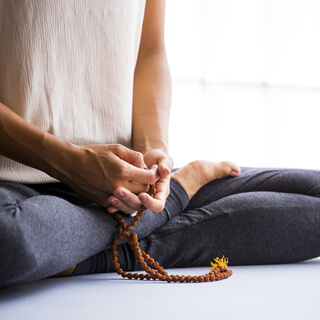
The sixth limb of yoga is dharana,
And that's concentration or one-pointed focus.
The point behind this is to constantly bring your attention back to an object over and over again.
In the Anapanasati,
This is a Buddhist meditation guide.
They've discussed a couple of different ways to do this.
So there are a couple of different objects you can meditate on.
There's a lot of different options actually.
You'll find that a specific object will have a certain effect on your body because what happens is that you're going to continuously focus on a particular object until you take on its qualities.
So knowing yourself and knowing what you want out of your meditation practice can also help.
But one of the examples they used is you can use a kasina,
Which is a disc.
This is a colored disc that you place in front of you.
And they've long known about color theory and how looking at certain colors will affect your mood.
So you can look at a particular kasina and then keep bringing your attention back to it.
And eventually what will happen is that your vision will be taken over by this certain color.
Another example,
And this is a little bit morbid,
But meditating on a corpse.
Hopefully people aren't pulling out corpses out of the graves right now,
But this is back in the day.
And by looking at a corpse,
You'll eventually bring the corpse into your mind's eye.
And that'll help build feelings of detachment towards life.
Another example would be meditating on a clay object in front of you.
And this is good for,
If you think about clay,
It's very inert and stable.
So if you want to get those qualities in yourself,
You can meditate on a clay object.
But perhaps it's not so good if you're already kind of a little bit more chill or lethargic anyways.
And other examples not really talked about would be,
Or at least more commonly used now,
Would be like third eye points,
So meditating in the space in between your eyebrows.
So you would keep bringing your attention back to your eye,
Point a little bit above your eyebrows over and over again.
You can do an inner body scan,
Which is something I really like doing.
That's when you feel the sensations in your hands or your feet.
Or you can follow the Zen tradition and you focus on your Tanden or Hara point.
So the space just about two inches below your navel,
You would just bring your attention there over and over again.
But in the Anapanasati,
The preferred method,
Or the most neutral method,
Is just focusing your breath.
Because you'll find that when you just focus on your breath,
The inhales and exhales,
There isn't really any negative effects or anything like meditating on a corpse or a candle,
For example.
It's just very neutral.
And a rule of thumb to keep in mind is that when you're meditating on a particular object,
You want to make your focus very small.
So in the case of meditating on your inner body,
So you're focusing on your hands,
Rather than focusing on your entire arm,
You'll focus on one specific point in your hand,
Maybe just the fingertips or just the hand itself.
When you're focusing on your breath,
You want to focus on just the tip of your nose or when air hits your nostrils,
That particular point,
Rather than focusing on the entire breathing process.
And the concept behind this is that you want to make your mind as sharp as possible,
And it's easier to do that when you're focusing on a very small object.
So that's just something to keep in mind.
And following your breath,
That's what I would recommend for most people,
Because it's very standard.
Anyone can do it,
And it works for every single personality type.
So once you've followed the last limb of pratyahara,
You bring your attention inwards,
Now you can do dharana,
And you're just focusing on the breath as it hits your nostrils or the tip of your nose,
In and out.
So you're not controlling your breath in any way,
But rather just letting the air hit the nose and then out.
So once you go deeper and deeper into the sensations,
You'll start to really delve really into it,
And you'll notice a lot of subtleties.
So for example,
If you're focusing on your breath,
After a certain point you'll notice that whenever you inhale,
The air feels a little bit cooler against your nose,
And then when you exhale,
The air feels warmer.
So that's one point.
And then once you keep going and going at it,
You'll start to develop more of that concentration and absorption.
And in the anapanasati,
They describe this into three different stages.
The first is preparatory sign,
And that's just when you're starting to take on that object and you're starting to focus on your breath or starting to focus on a candle.
And then the second stage is called an acquired sign,
So that's when you're starting to go deeper and you feel the sensations or you maybe even see some visualizations while you do that.
So that's the sign that you're kind of going deeper into it.
And then lastly,
You have the counterpart sign,
And that just means that now you're starting to get really absorbed in it and then you're on the path to absorption.
So that might be a little bit confusing,
So just keep in mind there are just three really basic steps,
And that's just you focus on an object,
Say for your breath for example,
Focus on it,
And then eventually you'll start to dive into it,
So you become the sensations itself.
And then once you keep following that,
You'll start to become absorbed in the sensation,
And then you reach a point called dhyana,
Which is the next step.
That's meditation absorption,
And that's when you know that you're meditating,
But you also can feel the sensations at the same time,
So there's no distinction between the person that's meditating and the object,
So it kind of becomes one.
So when we think of the really ancient teachings such as you are one and you're one with everything and all that,
I know that's thrown about quite a bit,
But it's really misguided if you attempt to do that just on your own without building some sort of concentration,
Because concentration is the basis behind this,
But eventually once you hit a point where you've developed that it's almost like a muscle of concentration enough,
The meditation or the absorption kind of comes easily.
So this is like a quote like I said a while ago,
And this is by Milrepa,
And he says a quote that in the beginning nothing comes,
In the middle nothing stays,
And at the end nothing leaves.
So when you apply that quote to your meditation practice,
In the beginning when you're really striving for meditation it feels like you're just really battling to get that concentration,
You're just keeping distracted by your monkey mind,
And then in the middle you finally start to sit for meditation,
You're able to sit and you feel really great,
You build that concentration power,
But then nothing really stays,
It kind of just goes away.
And then eventually once you've practiced long enough,
Nothing really leaves,
So you kind of stay in this state of absorption.
And a lot of meditation teachers kind of talk about it too,
I know Adyashanti who is really popular nowadays says that although he has had his awakening,
He doesn't really think if he could have just done that without his practice of concentration.
And that's something that's talked about a lot in Buddhism as well,
Just that in Zen Buddhism that you just need that basis of concentration,
And then it's through that concentration that the power that you develop that eventually you can just naturally experience the absorption.
So once you've developed this power of concentration,
Which is a foundation to your practice,
Then once you follow that and you become that object itself,
Then you're ready for that next step which is Dhyana,
So it kind of leads into Dhyana,
Which is meditation absorption perfectly.
So that's going to be talked about in the next talk.
Thank you.