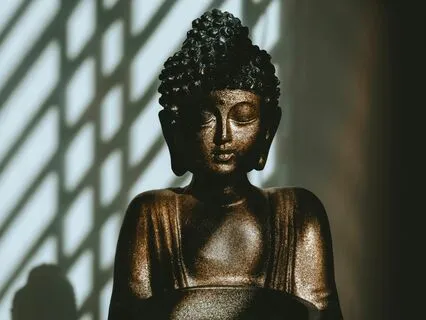
So last week we began exploring together the myth,
The story,
Of the Buddha's extraordinary awakening,
His extraordinary birth,
And kind of his early life.
When the Buddha was born,
Just to recap a little bit,
He proclaimed in the myth as a baby,
You know as he entered the world,
I am the world's honored one.
This is from a newborn.
So that's pretty mythological statement,
Right?
But as I pointed out,
Myths and stories often point to characteristics about ourselves.
Myths can be at times more true than reality because they they point to underlying patterns within us,
Within humanity.
Just like poetry,
Sometimes we can understand our life more fully through a poem.
So this statement,
You know,
Kind of I'm the best in all the land is what he proclaimed as a newborn.
Like what is that,
What does that mean for ourselves?
And what's interesting about this is in the Dhammapada,
Which is a collection of sayings that are attributed to the Buddha,
The first piece,
The first writing in the Dhammapada says,
Oh nobly born,
Remember who you really are.
Coupled with I am the world honored one.
Okay,
So if that's the first proclamation,
Oh nobly born,
Remember who you really are.
I am the world honored one.
Those were the first words spoken by the future Buddha.
Remember who you really are.
So coming together like this is that practice of remembering our inner nobility.
Oh nobly born,
You are the world honored one.
So we're noble and we've forgotten our inner nobility to some extent.
And that's kind of what this myth kind of points to a little bit.
So what we looked at last week a little bit,
And like I said I'll recap a little bit,
Is the early life of the Buddha when he was around 29 years old.
He snuck out of the palace that his father built to protect him and protect his position as a monarch.
He was being geared to become the next king of the land.
And so his father built all of these palaces and in the palace he was supplied with everything that he could want.
Not unlike a gated community in Aspen let's say.
Like we could just kind of use that as a parallel.
And when he snuck out he saw what are known as the four heavenly messengers.
And these four messengers came to the future Buddha to show him basically what what is the human condition that he had been protected from in his gated community.
And the human conditions,
The messengers,
Were old age,
Sickness,
Death,
And a renunciate,
A spiritual person on a spiritual path.
Those were the four.
And I think that it's not uncommon for people you know consciously or unconsciously to kind of protect themselves from what goes on in the world.
You know?
To not really see or choose to see the degree of suffering that exists and the challenges of the world.
I for one don't really look at the news very often.
Maybe every other week.
I don't really know what's going on.
And that's the way that I protect myself.
I just kind of do what I can in this life that I have right here.
That's a way of protecting myself.
Some people protect themselves in grand homes or maybe not even in grand homes.
Maybe you just you know like to stay at home and close to home and that feels like a sense of protection.
So we kind of share that.
You know?
We have ways of protecting ourselves.
And maybe,
Maybe we're lucky enough that we're gonna get old.
You know?
Someday,
Someday all of us are gonna get sick.
All of us here.
And then we're gonna die.
And for the Buddha this became kind of an existential crisis.
I mean can you imagine?
You're 29 years old.
You've been protected your whole life.
And seeing this for the first time it's like what is going on here?
I had no idea.
Like that would make a huge impact.
Like most of us have been exposed to aging,
Sickness,
And death.
We kind of know what's coming.
We just don't think it's gonna happen to us.
So after this kind of impact of the heavenly messengers,
Much of the palace life that he was living became kind of uninteresting and mundane.
He kept seeing the image of the renunciate who was walking so peacefully and at ease.
And he felt like I need to get to the bottom of this.
If I too am going to age and get sick and die,
I want to understand this.
I want to find out if there's anything beyond this.
If there's freedom in some other way than all that I have here in my palace life.
If there's something that has greater value than what I currently am experiencing.
So the next night after he had seen these heavenly messengers,
He snuck out again and he asked his charioteer to take him to the edge of the country.
And then just as he was about to cross the river,
He took out his sword and he cut off his long beautiful hair.
Because in those days that was kind of a sign of princely being is to have long flowing hair.
So he chopped off his hair.
He took off all of his royal jewels and his nice clothes and he gave them to the charioteer and went forth into the world.
And that story is called in the mythology the Great Renunciation.
So he renounced the palace life at that time.
So the same day that he took off,
His wife gave birth to their first and only son.
And in spite of just having a newborn baby,
He left.
Now that's pretty shocking,
Right?
You know in our modern world he would be considered kind of a deadbeat dad,
Right?
But in the ancient world,
So now we have to kind of go back,
The understanding was that as a royal member of the household,
He had fulfilled his duty.
The most important role that he had as the prince was to make sure there was an heir to the throne.
And so once he had his son,
He was free to do this.
To go off and discover something else.
And you know I had some judgment and some thoughts about,
You know,
This is a pretty dramatic act.
When I read this I didn't agree with it.
But remember,
Again,
Different time.
There were no schools or universities.
There was very little education if he wanted to understand the world,
Like understand it spiritually.
He just couldn't go off to a retreat center.
There weren't retreat centers.
There was nothing available.
So if you had this inquiring spirit or you had this existential sort of angst that was happening,
At that time what you would do is you would go forth and you would leave your kind of your regular daily life and you would become a renunciate,
An ascetic,
Or a contemplative in some form,
A yogi.
So this is kind of the archetypal setup that all of us in some way have gone through in our life.
You might not be the deadbeat dad scenario,
But you may have been a single mom.
And the palace,
The palace represents the structures that we create to block out unpleasantness.
Anything that's unpleasant or anything that is we see is wrong,
We create our palace.
Our palace is our home,
Right?
It creates a sense of certainty.
We have a sense of certainty.
Everything is in its place in our home.
In a world that's really uncertain.
So we build this sense of self around controlling our experience.
And every one of us tries to ensure comfort and protect ourselves against what lies out there,
You know,
Outside the gated palace,
The inevitable.
And we experience the inevitable as a sort of restlessness in the body or an underlying dissatisfaction.
Like something is around the corner.
You're just like,
Even when things are really good,
Something is around the corner that's going to happen.
And it is.
Because we're all going to die at some point.
And we have no idea when that is.
So he goes off,
The Buddha goes off into the world.
And the first thing he did is he found a meditation teacher of that time.
And in those in those days,
The meditation teachers taught to go into what are known as jhana states.
Jhana is a deep concentration state.
And he became the best of all of the students,
Equal to the teachers,
As the myth goes.
Realizing that he actually mastered what his teachers were teaching,
It didn't address his existential issue,
Which is to find out if there's something more beyond aging,
Sickness,
And death.
So he left,
Looking for the next teaching.
The other option that was available was ascetic practice,
Which is renunciation of food.
Like really living bare bones.
The story says he ate one kernel of rice a day.
One kernel of rice a day.
Like no clothes,
Just a loincloth.
Sleeping outdoors all the time,
Like severe asceticism.
Like practices like holding your breath,
And then maybe taking like a sip of air,
Almost fainting.
And as the myth got formed around the Buddha,
It always described the Buddha as being the one ascetic that was like,
Did it better than everybody else.
To the point where he collapsed,
And he was at the edge of the river.
And most people that were around at that time just thought he was a dead body by the side of the river.
And as he laid down,
Like as he lay there,
Pretty much dying,
Because he had starved himself.
So completely initiated.
And a lot of Asian art,
You will see this image of the skeletal Buddha by the river.
So as he lay there,
He somehow revived himself enough to have the thought,
Like I have done asceticism better than anyone.
Right up to this point where I'm on the edge of death.
And this isn't providing answers either.
So he decided to take in some food.
And as soon as he started eating,
And getting a little of his energy back,
His companions,
Fellow ascetics,
Saw him take in food.
And they were like,
He lost his status as the great ascetic.
And they took off.
So he was left alone by the river.
So what do you do next?
And what he did is he went and he found a place to sit under a tree.
And it's called the Bodhi tree for some of you who know this.
And nowadays,
It would be the ficus tree.
If you've ever seen a ficus,
It's a beautiful,
Beautiful tree.
And it's the ficus was not far from the river.
And he sat there.
And he wondered,
Well,
You know,
What's next.
And as you know,
He had done everything that the people of his time had done for kind of finding the truth of experience.
And nothing worked.
So then he remembered this one event in his life.
And it was an event that happened when he was about seven years old.
And his father was doing there's a ceremonial plowing of the fields in the spring.
So his father and the entourage were out in the fields of his youth.
And he the seven year old was left under a rose apple tree at the edge of the field.
And it was probably a lovely spring day and,
You know,
Nice weather.
And he was likely feeling safe and contented,
Just kind of watching the activities going on in the field.
And it said that his mind at that time,
Got really settled.
And he was very relaxed.
And he was very connected to the experience.
And he went into this first state of jhana,
Which he was just he was just trained to do by these other teachers.
But in the state that he entered,
There was a great peace and well being.
So he remembered this as he was trying to kind of like,
What's next for me?
What am I going to do next?
And that sense of peace and joy that he experienced at seven,
He thought,
Well,
Maybe,
Maybe just sitting in a really relaxed way.
That's the path.
Maybe that's the path to liberation.
It doesn't depend on anything being a particular way in the world.
So what he did is he set himself up sitting underneath this row,
This ficus tree.
And the same way that he was sitting under the rose apple tree as of his youth.
And he thought,
Well,
Maybe I'll just try to do what I did when I was a child,
And just sit in this relaxed way,
And pay attention to what's happening in the here and now.
In the here and now.
And so he sat.
And he,
As the story goes,
He sat in through the night,
Doing meditation.
And he got really connected to himself and to the environment around him,
Connected to his body.
You know,
It instead of breath practice,
In some ways,
We could consider mindfulness practice and body practice.
So he's very connected to his body.
And he was getting stiller and stiller in the body.
And the mind kind of like,
Narrowed in and the preoccupations with striving towards something kind of stopped and,
And calmed down.
And all kinds of like his ideas about himself and identity,
His preoccupations,
His perceptions,
All of them kind of just sort of faded.
And his mind was no longer fragmented,
And he was no longer caught up with the things of this world.
No longer preoccupied the way that we get preoccupied.
And he was just on the brink of becoming fully awake,
Liberated.
But then something happened.
One of the deities in this Buddhist mythology cosmology,
Known as Mara,
Entered his concentrated state of mind.
And Mara's job as this deity was to prevent people from waking up.
So Mara in our modern world can be considered like our egoic clinging.
You could consider advertisements as any like,
As a Mara,
Sort of like,
This is what will bring you happiness,
Right?
So Mara,
The aspects of our ego,
That kind of keeps us immersed in the world of seeking pleasure,
And pursuing like,
More experiences.
So when Mara saw that there was an individual that was going to leave this egoic realm of being,
Leave the world of sensual pleasure,
Or in our case,
In the modern times,
Leave the world of consumption and getting more stuff,
It was Mara's job to stop it.
So in the myth,
Mara came with these armies,
And this huge battalion of people,
And they started to try to scare the Buddha.
His fear is a really great way to motivate somebody to knock them off their,
Like off their concentration game.
But so they threw swords,
And they threw axes,
And the Buddha just sat there meditating,
And nothing,
The arrows and the spears were thrown,
And they turned into flowers and fell to the ground around him.
So his concentration was so steady that fear could not get in.
And so that's,
We've talked about fear in this group,
And we should definitely revisit it,
Because fear is such a strong factor in our lives.
We are,
We do things or we don't do things because of fear.
So Mara said,
Okay,
This isn't working.
Let me try something else.
So Mara got his daughters,
And Mara had these really beautiful daughters who had been trained for the purpose of seduction.
And so he sent in the daughters,
And thinking that,
You know,
The Buddha would be much more interested in pursuing something with the daughters than enlightenment.
And,
You know,
What they did was probably a little X-rated,
But the Buddha sort of sat peacefully,
You know,
Was,
Didn't take the bait,
Wasn't interested in the sensual pleasures,
The sexual pleasures that the daughters were offering.
So then Mara's like,
Okay,
What do I do?
And he came up with his biggest weapon yet.
He came to the Buddha himself,
As himself,
This evil,
Like,
Devil-type creature,
And said,
What right do you have to become enlightened?
So he brought doubt.
Doubt.
Now we all know what doubt feels like.
We often don't do things because we have doubts.
Many people have a lot of doubts about themselves.
They feel unworthy in some way.
They feel they don't deserve something.
So when doubt comes,
We can get shaken from from what would possibly be spiritual liberation.
So here is Mara saying,
What right do you have to become an enlightened being on this planet?
And so in reply,
The Buddha took his right hand and put it over his knee.
So he's sitting in lotus,
Put it over his knee,
And he touches the earth.
And he says,
As the earth as is my witness,
I will awaken.
And then it said that the entire,
There was a huge earthquake at this time.
And kind of the,
It was kind of a testament to his worthiness to awaken.
And the earthquake frightened Mara away,
And Mara ran away.
But just to note that Mara comes back later in the story.
So Mara,
Doubt doesn't ever fully extinguish.
But Mara left,
And the Buddha continued meditating till morning.
And as the sun was rising,
He was deeply transformed.
He had a deep insight into reality,
A deep understanding of the way things are.
He was able to let go in the very deepest way.
And he was enlightened.
So this is what the Buddha experienced.
This is the way that the story goes.
How does this relate to us?
Well,
We all have our version of Mara.
Doubt being one form.
But what prevents you?
So this is where we're going to take it into dialogue.
What prevents you from getting concentrated in your practice?
What is your version of Mara?
Like what prevents you from the cultivation and the development of ease and the development of calm?
What prevents you?
And just to consider that for a moment as we enter into conversation.
Thank you for your kind attention.