Hello there.
My name's Mandy.
I'm delighted that you've chosen to join me for tonight's reading.
It's one of the original stories brought to us by those well-known brothers,
Jakob and Wilhelm Grimm.
Before we start,
Let's just spend a few moments taking up a comfortable position,
Whether that's sitting or lying,
And do any of those little last-minute adjustments that you might need to do to make yourself as comfortable as you can be today at this particular moment in time.
Then I'll begin.
A great many years ago,
There lived in a village at the foot of this mountain,
One Karl Katz.
Now Karl was a goat herd,
And every morning he drove his flock to feed upon the green spots that are here and there found on the mountainside.
In the evening,
He sometimes thought it was too late to drive his charge home,
So he used in such cases to shut the goats up in a spot among the woods,
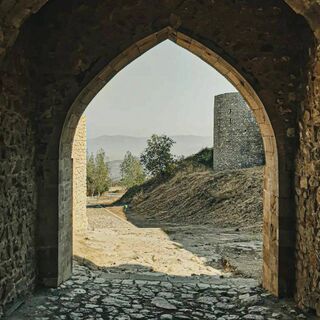
Where the old ruined walls of some castle that had long ago been deserted,
Were left standing and were high enough to form a fold in which he could count the goats and let them rest for the night.
One evening,
He found that the prettiest goat of his flock had vanished soon after they were driven into this fold.
He searched everywhere for it,
In vain,
But to his surprise and delight,
When he counted his flock in the morning,
What should he see,
The first of the flock but his goat?
At last he thought he would watch still more narrowly,
And having looked carefully over the old walls,
He found a narrow doorway,
Through which it seemed the path leading downwards through a cleft in the rocks.
On he went,
Scrambling as well as he could down the side of the rock,
But he came to the mouth of a cave,
Where he lost sight of his goat,
And just then he saw that his faithful dog wasn't with him.
He whistled,
But the dog wasn't there,
And he was therefore forced to go into the cave and try to find his goat by himself.
He groped his way for a while,
And at last he came to a place where a little light found its way in,
And there he wandered not a little to find his goat employing itself,
Very much at ease in the cavern,
In eating corn which kept dropping from some place over its head.
He went up and looked about him,
To see where all this corn,
That rattled about his ears like a hailstorm,
Could come from,
But all overhead was dark,
And he could find no clue to this strange business.
At last,
As he stood listening,
He thought he heard the neighing and stamping of horses.
He listened again,
It was plainly so,
And after a while he was sure that horses were feeding above him,
And that the corn fell from their mangers.
What could these horses be,
Which were thus kept in the clefts of rocks,
Where none but the goat's foot ever trod?
There must be people of some sort or other living here,
Who could they be?
And was it safe to trust himself in such company?
Carl pondered a while,
But his wonder only grew greater and greater.
Then,
On a sudden,
He heard his own name,
Carl Katz,
Echo through the cavern.
He turned around,
But could see nothing.
Carl Katz,
Again,
Sounded sharply in his ears,
And soon out came a little man,
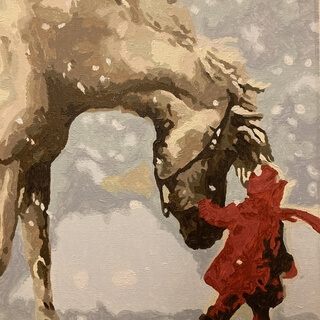
With a high-peaked hat and a scarlet cloak,
From a dark corner at one end of the cave.
The little man nodded and beckoned him to follow.
Carl thought he should first like to know a little bit about who it was that thus sought his company.
He asked,
But the dwarf shook his head,
Answering not a word,
And again beckoned him to follow.
He did so,
And winding his way through ruins,
He soon heard rolling overhead that sounded like peals of thunder echoing among the rocks.
The noise grew louder and louder as he went on,
And at last he came to a courtyard surrounded by old ivy-grown walls.
The spot seemed to be the bosom of a little valley.
Above rose on every hand high masses of rock,
Wide-branching trees threw their arms overhead,
So that nothing but a glimmering twilight made its way through.
And here,
On the cool,
Smooth-shaven turf,
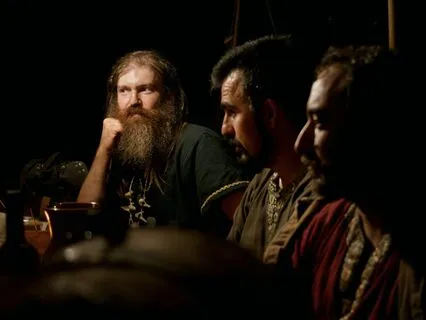
Carl saw twelve strange old figures,
Amusing themselves very sedately with a game of ninepins.
Their dress didn't seem altogether strange to Carl,
For in the church of the town where he went every week to market,
There was an old monument with figures of queer old knights upon it,
Dressed in the very same fashion.
Not a word fell from any of their lips.
They moved about soberly and gravely,
Each taking his turn at the game.
But the oldest of them ordered Carl Katz,
By dumb signs,
To busy himself in setting up the pins as they knocked them down.
At first his knees trembled as he hardly dared snatch a stolen side-long glance at the long beards and old-fashioned dresses of the worthy knights.
But he soon saw that as each knight played out his game,
He went to his seat and there took a hearty draft at a flagon,
Which the little man kept filled and which sent up the smell of the richest old wine.
Little by little,
Carl got bolder.
At last he plucked up his heart so far as to beg the little man,
By signs,
To let him too take his turn at the flagon.
The little man gave it him with a grave bow.
Carl thought he had never tasted anything half so good before.
This gave him new strength for his work,
And as often as he flagged at all,
He turned to the same kind friend for help in his need.
Which was tied first,
He or the knights,
Carl never could tell,
But what he knew was that sleep at last overpowered him,
And that when he awoke he found himself stretched out upon the old spot within the walls where he had folded his flock,
And saw that the bright sun was high up in the heavens.
The same green turf was spread beneath,
And the same tottering ivy-clad walls surrounded him.
He rubbed his eyes and called his dog,
But neither dog nor goat was to be seen.
And when he looked about him again,
The grass seemed to be longer under his feet than it was yesterday,
And trees hung over his head,
Which he had either never seen before,
Or had quite forgotten.
Shaking his head,
And hardly knowing whether he was in his right mind,
He got up and stretched himself.
Somehow or other his joints felt stiffer than they used to be.
This comes of sleeping out of one's own bed.
Little by little he recollected his evening's sport,
And licked his lips as he thought of the charming wine he had taken so much of.
But who,
Thought he,
Can those people be that come to this odd place to play at ninepins?
His first step was to look for the doorway through which he had followed his goat,
But to his astonishment not the least trace of an opening of any sort was to be seen.
There stood the wall,
Without chink or crack big enough for a rat to pass through.
Again he paused and scratched his head.
His hat was full of holes.
Why,
It was new last shrove tied,
Said he.
By chance his eye fell next on his shoes.
They'd been almost new when he last left home,
But now they looked so old they were likely to fall to pieces before he could get home.
All his clothes seemed in the same sad plight.
The more he looked,
The more he pondered,
And the more he was at a loss to know what could have happened to him.
At length he turned round and left the old walls to look for his flock.
Slow and out of heart he wound his way among the mountain steeps,
Through paths where his flocks were wont to wander.
Still,
Not a goat was to be seen.
Again he whistled and called his dog,
But no dog came.
Below him in the plain lay the village where his home was,
So at length he took the downward path and set out with a heavy heart and a faltering step in search of his flock.
Surely,
Said he,
I shall soon meet some neighbour who can tell me where my goats are.
But the people who met him,
As he drew near to the village,
Were all unknown to him.
They were not even dressed as his neighbours were,
And they seemed as if they hardly spoke the same language.
When he eagerly asked to eat after his goats,
They only stared at him and stroked their chins.
At last he did the same too.
And what was his wonder to find that his beard was grown at least a foot long.
The world,
He said to himself,
Is surely turned upside down,
Or if not,
I must be bewitched.
And yet he knew the mountain,
As he turned round again and looked back on its woody heights,
And he knew the houses and cottages also,
With their little gardens,
As he entered the village.
All were in the places he had always known them in.
And he heard children too,
As a traveller that passed by was asking his way,
Call the village by the very same he had always known it to bear.
Again he shook his head and went straight through the village to his own cottage.
Alas,
It looked sadly out of repair.
The windows were broken,
The door off its hinges,
And in the courtyard lay an unknown child in a ragged dress,
Playing with a rough,
Toothless old dog,
Who he thought he ought to know,
But who snarled and barked in his face when he called to him.
He went in at the open doorway,
But he found all so dreary and empty,
That he staggered out again like a drunken man,
And called his wife and children loudly by their names,
But no one heard,
At least no one answered him.
A crowd of women and children soon flocked around the strange-looking man with the long grey beard.
Most held their tongues and stared.
Carl Katz looked at the old women again and shuddered,
As he knew them to be old gossips,
But saw they had strangely altered faces.
But at last a young woman made her way through the gaping throng,
With a baby in her arms,
And a little girl of about three years old,
Clinging to her other hand.
All three looked the very image of his own wife.
What is thy name?
Asked he wildly.
Lisa!
Said she.
And your father's name?
Asked he.
Carl Katz!
Heaven bless him!
Said she.
But poor man,
He is lost and gone.
It is now full twenty years since we sought for him day and night on the mountain.
His dog and his flock came back,
But he never was heard of any more.
I was then seven years old.
Poor Carl could hold no longer.
I am Carl Katz,
And no other!
Said he.
And he took the child from his daughter's arms,
And kissed it over and over again.
All stood gaping,
And hardly knowing what to say or think,
When old Stropkin the schoolmaster hobbled by,
And took a long and close look at him.
Carl Katz!
Carl Katz!
Said he slowly.
Why,
It is Carl Katz,
Sure enough.
There is my own mark upon him.
There is the scar over his right eye,
That I gave him myself one day,
With my oak stick.
Then several others also cried out.
Yes,
It is!
It is Carl Katz!
Welcome,
Neighbor!
Welcome home!
But where,
Said or thought all,
Can an honest,
Steady fellow like you have been these twenty years?
And now the whole village had flocked around.
The children laughed,
The dogs barked,
And all were glad to see neighbor Carl home,
Alive and well.
As to where he had been for the twenty years,
That was a part of the story at which Carl shrugged up his shoulders,
For he never could very well explain it,
And he seemed to think the less that was said about it,
The better.
But it was plain enough that what dwelt most on his memory was the noble wine that had tickled his mouth while the knights played their game of ninepins.