Hi,
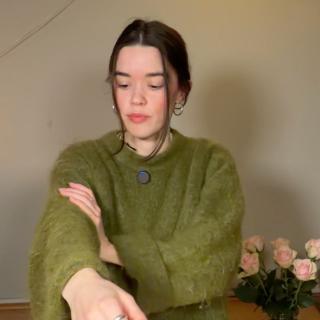
I'm Miriam Amavi and today we'll work on transforming your inner critic and getting to know it with the IFS framework or otherwise known as parts work.
And this is so healing because we're not just trying to override the inner critic but actually try to understand it and learn that even though its language is sometimes harsh,
Its origin is often a wish for safety and belonging or protection from pain.
So this meditation is not about getting rid of this part and also not about changing it.
It's about meeting it from a little bit more space,
With awareness instead of identification,
With contact instead of resistance.
Because the part that is seen often no longer needs to be so loud and we feel more in charge.
So make yourself comfortable.
This is about meeting yourself emotionally where you are right now.
We don't want to fix anything here.
We simply want to offer your system the support that it needs in this moment.
Because when the inner critic is very active,
It usually means that some part of your system does not feel safe.
And what doesn't feel safe needs comforting and safety.
And we offer this to ourselves by first meeting ourselves with curiosity,
Compassion and openness.
And if this feels impossible right now,
That too is completely human and completely okay.
I just invite you to be open.
So first settle in and notice the contact points of your body with the surface beneath you.
Notice the temperature there.
Is it warm or cool?
And just let your whole body sink into the surface.
You can relax the muscles in your face.
Lower your shoulders.
Let your tummy just spill out and your legs to be heavy.
And slowly turn your attention inward.
Perhaps toward a situation in which your inner critic shows up strongly or has shown up recently.
The part that judges,
Compares,
Doubts.
That points out what is not enough.
Or warns that something might go wrong.
And here you might notice thoughts or a certain tone of voice or images.
And all is allowed.
How do you notice this critic part in your body?
Is there pressure,
Tightness,
Tension,
Tingling or heat?
Or a coolness?
And where do you sense that?
Perhaps in your chest,
In your belly,
In the throat,
In the head,
Or somewhere else entirely.
There is no right or wrong here.
We just want to notice without correcting.
And just acknowledge that this is a part of you that is criticizing or very loud right now.
Notice that it's a part,
Not all of you.
And if it feels right,
You can let this critical part speak.
What do you want to tell me?
Maybe there is images or words or even feelings coming up.
Or nothing at all.
Everything is welcome.
Maybe it's just running wild and criticizing.
And then you can gently take the critic's hand and ask,
What are you trying to protect me from?
Or in other words,
What are you afraid would happen if you wouldn't constantly criticize me or my life?
And perhaps you sense an answer more as a feeling rather than words.
Some critics are afraid that if they wouldn't criticize so much,
You would lose everything,
Or people wouldn't like you anymore,
Because you're not doing it well enough or right.
Or they just want you to make enough money to be perfect,
Essentially.
So you're safe.
Some critics carry tension.
Others fear or exhaustion.
Or some carry an old assignment.
And maybe for the first time you notice how this part believes that what it is doing is helping you or protecting you.
Or that it acts out of fear.
Or because it longs to be finally heard by you.
And if it feels right,
You can wrap yourself in a blanket or hug yourself,
Maybe rock from side to side,
And offer this part some words.
Perhaps even embrace it inwardly and say,
I see you.
You're not alone anymore.
I'm here for you.
And you can thank it for its hard work,
Because it's surely not easy to always have to be so vigilant.
Sometimes it becomes clear that this critical part carries a great deal of responsibility,
Perhaps for a very long time.
And maybe it emerged in a time when vigilance was necessary.
When performance,
Adaptation,
Or control promised safety.
And you can acknowledge this without needing to get rid of the part.
Notice how this part responds when you see it that way.
When you offer it this loving,
Understanding recognition.
Perhaps its quality changes,
Or there is relief,
Or it just collapses in your arms and starts to cry,
Or emotions rise.
Perhaps there's exhaustion.
Whatever there is,
Allow all of it.
And if your body asks you to take deep breaths,
Or make noises,
Or move in a way that feels good,
You're always allowed to do that.
You don't have to be still and meditating.
You can just be a body.
Notice how the sensations in your body are now.
Have they changed?
And how do you notice what you're feeling?
And if nothing has changed,
Or if you feel nothing at all,
That too is okay.
Sometimes these parts hold onto their function very tightly,
Because they've been doing this job for such a long time.
They may just need more time,
More repeated,
Gentle attention,
Before they understand that they are allowed to let go.
It's like taking in a stray cat,
And it just needs time,
And attention,
And care,
Before it comes out under the couch.
This critical part does not have to change,
Does not have to learn anything.
It's allowed to simply be perceived from this slightly wider and calmer space.
Perhaps you can just sit next to it.
The distance that it feels comfortable with.
Maybe it's also in your arms.
Just coexist with it,
Without fighting,
Without explaining.
Just showing it that you are here,
That you are listening,
And that it is no longer alone.
And perhaps you can acknowledge inwardly that this critical part once had an important task.
It was vigilant.
It wanted to protect you.
It wanted to prevent something worse from happening.
And at the same time,
You may show it that the context has changed.
Your possibilities have expanded.
You are an adult now,
And there are far more inner and outer resources now.
The critic does not have to disappear,
But its role may change.
Perhaps from control to support.
Or into a voice that also allows pauses,
That speaks softer.
And showing it that the way you do things is valid.
That it's okay to make mistakes.
That our imperfections is what makes us so wonderfully human.
That other people too often long to recognize their own imperfection in others.
And that this is how deeper connections arise,
Rather than when everyone hides their humanity.
And remembering that things in life take time.
That these societal expectations that are placed on us are inhumane.
That it's okay to do things your way,
In baby steps,
And in a nervous system-friendly way.
I often imagine my different parts,
Each living in their own room inside my inner house.
Perhaps you can prepare a room for this inner critic.
Make it comfortable and invite it to stay there.
Let it know that you will check in on it again.
Let it lay in the bed and just rest.
That you've got it from here.
That you'll take care of it.
And notice how this feels for this part.
Maybe you want to offer some last,
Kind words.
And slowly let your attention return to the whole body.
The contact points where your body meets the surface beneath you.
Perhaps wiggling your toes and opening your eyes if you have closed them and orient through the room around you.
And notice what remains in your body.
Perhaps a little more spaciousness or clarity.
Or simply less identification.
And if you really want to sustainably transform your inner critic,
I invite you to come back to this meditation regularly.
Because in order for changes to take place in our brain,
It needs repetition and kindness.
And a strong inner critic is also a sign that your nervous system is in an alarm state.
And if you would like to learn how to regulate your nervous system,
You're welcome to explore my course here on Insight Timer.
Anxiety,
Stress and Overwhelm.
Practical tools to regulate your nervous system.
And on my profile you'll find many more somatic meditations for your nervous system and for building a more loving relationship with yourself.
So feel free to follow along.
I hope you have a wonderful day and see you next time.
I'm Miriam Umavi.
Bye bye.