Hello,
This is Ajahnachala again.
This is part two of a two-part talk series where I'm reading journal entries from a pilgrimage,
A three-week pilgrimage,
To northern India,
To the Buddhist holy sites.
Part one covered Lumbini,
Bogaya,
The cave where Buddha practised austerities,
Vulture's Peak,
Vellavana and Nalanda.
In this second talk we're covering Vaisali,
Kusanara,
Varanasi and Sadhas.
I hope something in this talk might be useful.
That's the Buddhist kuti on Vulture's Peak mountain,
The site of where the Buddhist kuti was,
The Gandakuti.
All of the places where the Buddhist kuti were called fragrant,
Gandam means fragrant,
If they were fragrant,
Probably devas would be dwelling nearby.
So they came to be known as fragrant kutis,
Gandakuti.
If you recall,
Sariputta became enlightened in a small cave just underneath Vulture's Peak also,
When he was listening to a discourse that Lord Buddha was giving somebody.
This is from the top of the mountain,
Another group,
I think,
Korean prayer flags.
So this is just after sunrise.
Isn't that beautiful?
There's a really lovely sense of seclusion on top of this mountain and a feeling of being close to heaven.
And it's very easy to contemplate space element and emptiness.
Chanting in the morning light,
It's quite cold on top of the hill,
And then it gets warm once the sun's up.
There are those monkeys.
They're literally about three meters away from us to the right.
The first morning they came and they made a lot of noise,
And the second morning it's like they knew us already,
And they came and they sat quite quietly.
When you get down from Vulture's Peak,
There are some very good samosas.
Hot,
Nice hot ones.
The Veluvana,
This is the site where the first Buddhist monastery,
King Bimbisara,
Offered to Lord Buddha for his order,
And Lord Buddha taught the Awada Patimokkha here,
The beginning of the Patimokkha,
The monk's rules of discipline.
You celebrate this on Magapucha,
Where 1,
250 bimbisara hunts spontaneously gathered.
This was the site where that occurred.
King Bimbisara is very beautiful contemplation,
His life.
He met the Bodhisattva as he was walking up the mountain before he was the Buddha,
And he was so impressed by his demeanor and appearance and grace.
He said to him,
I want you to leave my army.
I can tell that you're a noble warrior,
From the Manobul warrior clan,
And he said,
I don't want to lead your army.
And he said,
Okay,
Well,
Share half my kingdom,
We can rule it together.
That's how impressed he was by his obvious virtue.
He said,
I don't want half your kingdom.
He said,
Okay,
Take it all.
Can you imagine,
A king?
Okay,
Half my kingdom.
Then he said,
I am not looking for power or pleasure,
I see danger in these things,
Worldly power.
I am looking for the deathless.
And King Bimbisara said,
When you discover it,
Come back and teach me.
And that's exactly what happened.
After Lord Buddha attained enlightenment,
He went and taught his disciples.
The people were practicing austerities together in a deer park,
And a few others,
Yasa and his friends.
Then he wandered back to Rajgir,
Rajagaha.
It means the seat of the Raja,
The King.
So he came back to Rajgir,
And King Bimbisara gave him his bamboo grove,
The Veluvana.
And that's where the monks lived.
The first,
I don't know,
One or two years they didn't have kutis,
They just lived under the trees in this place.
And King Bimbisara attained to Sodapanna,
I think,
On the first time Lord Buddha taught him.
And he was met by,
If I recall,
He was met by 120,
000 Brahmins from the kingdom when he walked into Rajgir.
And then he taught them,
And each,
I think 11 out of the 12 leaders of those 12 clans,
Also they all became stream-enterers,
And one developed faith in the Buddha,
Dhamma and Sangha,
But was not yet a stream-enterer.
Tanarjanan,
I don't know where he gets his information,
But I trust that he has reliable sources.
He often says that in King Bimbisara's kingdom in the time of the Buddha,
75% of the laity were at least Sodapannas.
So that's pretty impressive.
You go there now,
And a lot has changed,
But you can feel that something amazing happened there.
You often find that you're able to become quite peaceful quite easily when you meditate in these places.
We just imagine tens of thousands of people becoming arahants in that very same space.
It's pretty amazing.
Nalanda,
Also in Rajgir,
Is what was the town of Nalanda.
Nalanda is the birthplace of Sariputta,
And it was also where he attained Mahaparinibbana,
And there's a stupa to Sariputta in Nalanda.
This was the site of Nalanda University,
Where at its peak there were at least 10,
000 monastics,
Until the Turkish Muslim invasions,
Where they killed many of them and burnt the library.
Everything arises,
Everything ceases.
I think I've got something to read from Rajgir.
After three powerfully serene morning sits in Valtter's Peak,
A long sit in the Velavana one afternoon,
And in the ancient ruins of Nalanda the following day,
We have moved from Rajgir through Vaisali and are currently in Kusanara.
This afternoon we will make the long drive to Savatthi,
An estimated nine hours drive I'm told.
Although many people caught colds early on,
The optional 5am practice at the Bodhi Tree in Bogaya was attended by awe.
I am very pleased at the level of commitment,
Energy and effort demonstrated by our group of pilgrims despite the obvious health challenges.
Even while travelling at a slow pace and with long meditation sittings in each place,
Time seems to be moving by very quickly now.
Looking back a few days ago,
It was wonderful to recollect the life of Sariputta in more detail whilst in Rajgir,
And then to pay our sincerest respects at the Sariputta stupa in Nalanda.
The harmonious and selfless teamwork between the Lord Buddha and his great disciples lay in monastic was both stunning and extraordinary.
And recollecting this reminds us palpably that we are still benefiting from these concerted efforts even today.
Recollecting the great faith,
Devotion and powerful practice of King Bimbisara and the devout residence of Rajgir is also quite moving.
Passing through Vaisali,
This time we had a full day to enjoy the sight where the Ananda stupa and the Asokan pillar with its grand lion capital still in place after 2200 years.
It is humbling to consider how many generations have come and gone since King Asoka had the pillar erected.
We considered the protective power of truth demonstrated through recollecting the three precious jewels as a protection at the place where the Ratana Sutta was taught.
We also reviewed the four foundations of mindfulness as taught by Lord Buddha here,
And considered the unusual,
Colourful yet encouraging example of Ambapali,
The high-class courtesan whose physical beauty was matched by even more beautiful spiritual qualities,
A fact exhibited through her eventual attainment of arahantship as a bhikkhuni in this place where the bhikkhuni order was born.
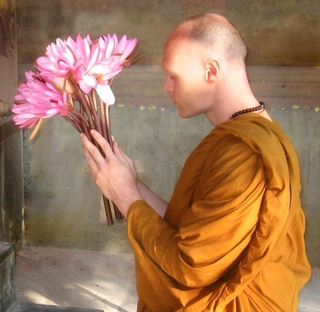
Here in Kusanara we have been the first into the Mahaparinibbana Vihara on two consecutive mornings,
With fresh pink lotus held in hand.
The Burmese groups with megaphones and amplifiers have been quick on our heels each time.
With earplugs and mudita we get by just fine.
Sitting still for about an hour and a half,
A quiet space has opened up on both occasions and we have been able to offer our humble puja without any amplification.
The marble floor and walls with arched and vaulted ceiling offer a lovely rich resonance just as they are.
The peacefulness here is different than in Bogaya – more sober and less celebratory,
Though stunning nonetheless.
Contemplating our potential to glimpse,
Experience and then eventually realise the deathless and unconditioned and unshakable deliverance of mind in the very place where the Lord himself was finally liberated from every painful condition is powerful to say the least.
We wish the same for all of our teachers,
Relatives and friends and for everyone really.
May it be so.
If all goes as planned we will soon have time to explore some of the wonderful teachings given in Savatthi and to celebrate some of the heroes and heroines of that extra special time and place where Lord Buddha spent at least 23 rainy season retreats.
Amazing.
The next few pictures are of Xaishali,
Where Lord Buddha taught the Ratanasuta,
Where the big Mahapajapati requested to be ordained as a bhikkhuni three times.
Lord Buddha gave his consent.
This is this lion capital that King Asoka had erected.
That's a 2,
200 year old monument still standing as it was.
Amazing.
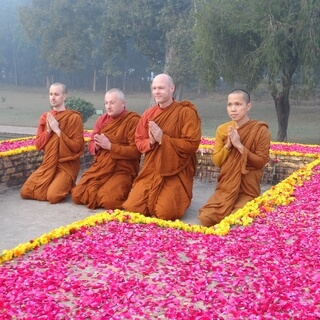
We were studying the Ratanasuta and chanting it under a tree in the site where it was taught.
This is on the way from Vaislita Kusanara.
This is a very big stupa,
I think the largest in India.
And apparently this is the site where the Kalamasuta was taught.
So we circumambulated this three times.
It's quite big.
And I think most of it is considered to be still underground.
It's amazing to just be driving on a road and be able to get off a bus and see such a monument and consider it was a monastery probably for more than a thousand years.
The Kalamasuta was taught there.
This is the site of the Mahaparinibbana in Kushinagar,
Or Kusinara.
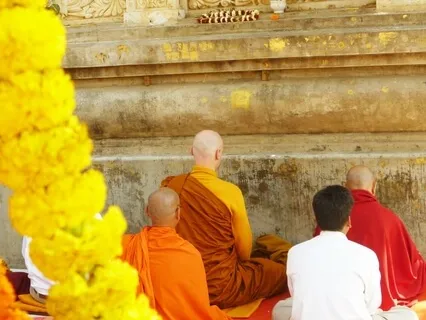
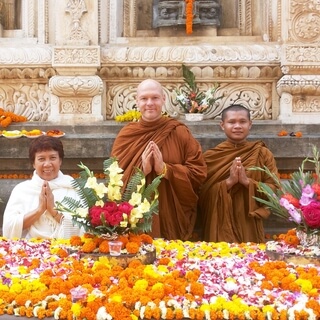
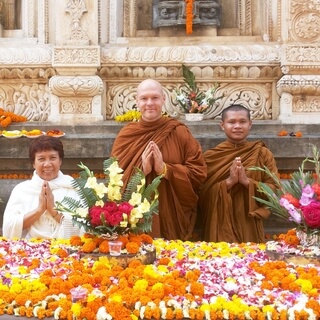
With our signature marigolds.
Many people feel a little bit sad here.
Some people,
Although peaceful,
Often people shed a tear.
This is a place where all beings that were not yet anagamis,
I believe,
Everybody less than an anagami cried when the Buddha passed into Mahaparinibbana.
The devas,
Even the monks and nuns who were sodapannas were,
What do they say,
Rolling around and pulling out their hair saying,
So soon the Lord has passed.
I felt sad the first time,
I've been four times now.
I felt sad the first time and I also wept the first time.
And then I considered what Lord Buddha says.
He wouldn't answer whether Nibbana was inside of or outside of samsara.
One of the questions the Buddha won't answer because it's imponderable.
But he does say those who practice Dhamma see the Buddha.
And he does say that what the Buddha attained to is deathless.
So if what the Buddha attained to,
The unshakable deliverance of mind is deathless,
Doesn't die,
Then he hasn't gone anywhere.
I'm considering this and I'm thinking,
Well,
What the Buddha attained to didn't die.
And those who practice Dhamma see the Buddha.
And so on subsequent occasions I've gone in there and I've meditated with determination to see the Buddha.
And I've felt very peaceful and I haven't felt sad.
This Buddha statue,
More than a thousand years old I believe,
Quite big.
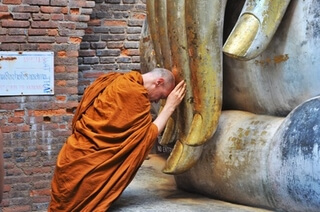
People offer a robe.
Many,
Many,
Many robes get offered every day.
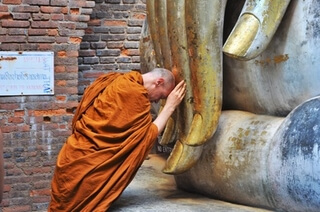
Beautiful feet.
Used to be able to press your head against the feet but they put up these stainless steel.
The numbers of pilgrims are increasing and places like Bangladesh,
Burma and Cambodia have their own airlines that land in Bogaya and have their own big temples.
And numbers of pilgrims is increasing over the years.
So I felt they had to protect the monuments.
That's Sarvatthi.
The site of the Buddha's kuti,
Because it was a fragrant kuti,
This is where they offer all these flowers.
The focus of the devotion in Jethavana is where the Buddha used to stay when he was there.
This is in front of the site of the kuti.
Arjuna,
Who has Bodhi leaves from Jethavana.
Early morning poocha.
This is a very,
Very old Bodhi tree.
Older than the one in Bogaya.
And they say the original,
But softwoods don't actually live for thousands of years,
So probably what has occurred is new little trees growing up on the outside of the tree as a fig species and then in the same spot from the same tree but the older part dying and then being replaced.
So remember it was a king,
A personatee,
Who wanted something to pay respects to when Lord Buddha wasn't at the Jethavana or when he went away.
And so he asked an under to ask the Buddha what would be suitable.
Lord Buddha said,
Plant a sapling from the Bodhi tree in Bogaya and then people can pay respects to the Bodhi tree instead of the Buddha when they come to Jethavana.
And so we are told that Mahamoggallana flew through the air using his psychic powers,
Got a sapling,
Came back and they had a ceremony.
In that ceremony Ananda said please plant the tree,
King Pasenadi.
And King Pasenadi,
It was very humble and very beautiful that the King,
Anathapindika was the one who offered the Jethavana,
If you recall.
He had to cover it with gold in order to be able to offer it because Prince Jeta was attached to it and Prince Jeta thought that he wouldn't.
He said,
Is it for sale?
Yes,
If you can cover it with gold it's for sale.
And he thought to himself he won't be able to.
And Anathapindika said,
Okay.
And Anathapindika was quite a wealthy person and so he covered nearly all of it.
Prince Jeta realized this can be no ordinary offering and Prince Jeta wanted to join in and the part that wasn't yet covered he said,
Okay,
I'll offer that.
Then King Pasenadi said,
Anathapindika,
You have more faith than I do.
You should be the one that plants this tree.
And so it was planted by Anathapindika in the Jethavana that he offered.
Reviewing some of the teachings taught in Savatthi,
If you open a copy of the Madhyamana Kaya and you look at most of the suttas,
They begin with,
Thus have I heard the Blessed One was staying at Savatthi,
Residing in a Jeta's grove in an Athapindika's park.
And then the teaching is given.
So a great number of really wonderful liberating teachings were taught in Jethavana and many thousands of beings were liberated there.
Greetings from Savatthi.
It is always possible to have a quiet puja under one of the grand old trees in the Jethavana.
But when one first arrives it is the sight of the Buddha's kuti that has an enigmatic allure.
One feels that it is appropriate to pay respects here first.
Many other groups feel this way too.
When we approached the site of Lord Buddha's kuti in Jethavana where he had spent 19 rainy season retreats,
There was already a Chinese group sitting on half of the veranda in front of the kuti,
Reciting a lengthy sutta.
I encouraged the group to quietly place flowers all around the kuti's perimeter.
Another layer of sweet smelling red roses and joyful looking yellow marigolds were placed amongst those already there.
We then sat on the other side of the veranda and waited for a quiet spell.
Within just a few more minutes there was a large Korean group chanting in front of the kuti with the wooden fish gong bok bok bok bok bok bok bok.
A small Burmese group then went right into the small kuti space and recited their quiet puja.
And a Thai group did their Pali puja off to the side of the kuti site as well.
On such occasions if one tries to listen to any one of these pujas too closely,
The other ones seem to impinge and one can feel irritated.
But if you allow the mind to become larger and listen as if from a distance,
One can hear a single expression of love,
Faith and gratitude.
Listening in this way,
It was 45 minutes before our little window opened.
And even so,
It was actually very pleasant warming up in the morning sun and breathing in the fragrance of the abundance of fresh picked roses.
I felt deep waves of joyful gratitude to the Buddha for his vast and profound teachings,
Inspired by boundless compassion and propelled by eons of unimaginable amounts of extraordinary effort.
After our Pali and Thai puja we recited a formal expression of respect,
Gratitude and appreciation towards the Buddha in English in this most sacred place.
It was poignant to offer these few humble words in English amid the traditional Asian chorus all around.
So many liberating teachings were given here,
Both to humans and devas,
That the sight of the Buddha's kuti in Jethavana really was like the epicentre of the Lord Buddha's explosion of wisdom dispelling darkness from the minds of millions of fortunate beings of that time.
It felt good to recognize how we are still benefiting from the heroic efforts of the Buddha and to say a simple yet sincere thank you.
Reviewing the Anapanasati Sutta in the Jethavana in the afternoon,
Which was actually taught here in Savatthi,
In the very first awesome paragraph one gets a sense for how well the Sangha was practicing at that time.
And what a boon that must have been for the residents of Savatthi!
The Sutta was taught in a monastery sponsored solely by Visakha,
So it was fitting to recollect her extraordinary practice and empowering contributions as well.
Reading of how King Piscinity developed both a deep respect and loving affection for the Buddha in his old age was both touching and revealing,
Of how completely the Buddha's presence here had a positive effect upon every level of society.
Meditating repeatedly in the Jethavana,
We could not overlook the kindness and generosity of the great benefactor Anathapindika.
So many wonderful personages fleshed out the awesome events here.
We feel blessed to have been able to spend two full days studying,
Chanting and meditating.
On the second morning it was a joy to circumambulate the Ananda Bodhi tree three times with our long and flowing golden coloured robe,
And then to wrap it around the sacred tree that came to represent the Buddha when he was away from the Jethavana.
Venerable Ananda had offered King Piscinity the honour in the planting ceremony,
But the modest king insisted that the benefactor Anathapindika was due the honour,
And so it was Anathapindika who planted this tree more than 2,
500 years ago.
Leaving Savatthi we stopped to pay respects at the site of the twin miracle,
Where Lord Buddha showed his spiritual might to crush the unfounded criticisms of suspicious sectarians,
Emanating fire and water from his body while levitating all at the same time.
After a short puja I encouraged everyone to aspire to perform two miracles,
Namely,
To truly benefit others while also benefiting oneself.
Now we're on the long drive to Lumbini.
I read from Lumbini first because it flows a bit better.
Sanath.
So the ride,
If I recall,
The ride from Lumbini to Sanath took 16 hours because of heavy fog.
So anyone who goes on pilgrimage,
You have to be prepared to practice quite a bit of patience.
My last reading is from Sanath.
Sanath is not very far from the city ancient Varanasi,
Hindu city.
Greetings from Varanasi Sanath.
Due to heavy fog and road repairs,
What had previously been a 12 hour journey took 16 hours yesterday.
We arrived in Varanasi from Lumbini just after midnight.
After a brief discussion it was decided that we would have a late rise,
The first in nearly three weeks,
And head out to Sanath around 10 am.
I invited each of the pilgrims to share some of their experience on the bus,
Using the microphone.
Why they had come on pilgrimage in the first place,
What was their experience,
What had they appreciated,
And what would they be taking away with them.
As a skillful means,
I had not told people quite how long this ride would be,
So the sharing,
As well as being genuinely interesting and touching,
Was also a very wholesome way to pass the time.
We had a five hour sharing,
By the way.
We started at 4.
30 and we finished at 9.
30 and then I was able to say,
I'm happy to tell you that in just two more hours we'll be at the hotel.
Everybody went,
Oh.
My own interest in leading a true practice-based pilgrimage was to help people to have a sacred journey within a safe container wherein they could have a break from their lives and then see their lives with more clarity.
With more meditation,
Chanting,
Listening to teachings and meditating daily in truly powerful sacred spiritual sites,
The sacredness of a three-week pilgrimage was assured.
The contrast of life in rural northern India compared to the places most people have come from is quite a mirror as well,
Bringing even more clarity and wise perspective,
Especially when the trip is a longer one.
There are so many shocking,
Stunning and humbling images to digest that after a few weeks everyone feels more grateful for the abundance and freedom in their lives.
It was very gratifying to hear most people express the fact that they had in fact experienced many moments of deeper clarity.
Others recognized that they had taken many things for granted and had been a little heedless and lazy in the past.
Everyone expressed the hope and intention to be more focused and diligent with regards to their spiritual practice.
The inspiring stories of the great disciples helped us all to realize that we can do quite a bit more.
Overall,
There was a lot of beautiful gratitude and sincere appreciation expressed for the teachings,
For the practice,
For the precious opportunity and for the warmth,
Friendship and harmony within the group and our guides.
We arrived at the Wat Thai Insanath around 11 a.
M.
And had our meal.
After this we headed over to the fantastic museum.
The sandstone images from the Gupta period in this museum really are superb,
Even with the noses and fingers chipped off by Islamic invaders.
One can still see the incredible skill of the artists who somehow captured an expression of purity,
Serenity,
Wisdom and love in solid stone.
The matte finish and flesh-like color of the stone also help in making these images seem remarkably alive.
Taking the time for a long chanting session in front of the Dharmika Stupa,
Including the Dhammacaka and Anattalakana Sutras that were actually taught here,
Was perfect.
And then we had a lovely long two-hour meditation session.
It was so nice to just be still,
Breathe fresh air and be on a surface that wasn't moving.
As the Indian and Japanese Prime Ministers are both visiting in two days,
The main ghat is closed to the general public.
The Indian guide had the good idea to board a boat quite some way up the river and then to ride the boat down to the ghat and watch the evening Aarti from the boat.
Aarti is the Brahman's puja.
The Brahman priests performed their puja to the goddess of the Ganges every morning and every evening.
This way we avoided a larger crowd with more hawkers pushing their wares,
But we did not avoid a team of young girl flower sellers who were particularly persistent and not very well-mannered.
It is very interesting to witness such a puja,
The likes of which have been going on in this ancient religious city for millennia.
We were surrounded by scores of other boats containing many hundreds of predominantly Indian tourists.
It was a colourful distraction before going to see the burning ghats just a few hundred metres away.
Several in the group had been reluctant to go,
But as I felt strongly that to go would be both an incredible privilege as well as a genuinely useful experience,
I was able to persuade the entire group to come along.
The burning ghats in Varanasi are powerful and remarkable in many respects.
Bodies have been being cremated here for at least 3500 years,
And on an average day they are still burning 200 bodies per day.
To stand on soil that contains the ashes of hundreds of burned bodies while being surrounded by many currently burning funeral pyres,
Even as new corpses continue to arrive,
Is an extraordinary teaching in and of itself.
Witnessing a large and fully operational charnel ground strikes a deep part of the human psyche as it is an ancient archetypal image that has the power to strike directly at the heart of delusion,
And this helps us to accept our own mortality more directly than anything else could.
There is a sacred fire here that is said to have been burning consistently for 3500 years,
And all of the funeral pyres must be lit from this flame.
We climb some stairs up to a small temple and balcony directly above the sacred flame,
Trying,
Often unsuccessfully,
To avoid a sacred kalpu,
To get a more comprehensive view of the scene.
As we stood on the smoky balcony contemplating the images,
One Brahmin priest was preparing for the evening puja in the small Shiva temple above the sacred flame.
Chanting alone as he cleared the old flowers from the Shiva lingam in the center of the little temple,
His chanting was some of the most melodic and beautiful devotional chanting I have ever heard,
And it appeared to be utterly effortless and unselfconscious as well.
I have always found this place to be as magical as it is macabre,
And this blossoming of unexpected beauty,
Just meters from a score of burning corpses,
Impressed this upon my heart once more.
Although the Hindus generally believe that to be burned here,
At Lord Shiva's sacred charnel ground,
Assures a heavenly rebirth,
For me,
Contemplating the fact that no matter how rich,
Beautiful or successful you might have been in life,
Your body will still wind up here on the muddy bank,
Surrounded by cowshit and burning bodies of scores of others,
Seems very humbling indeed.
Rajanananda has told me that those with strong faith and merit do indeed benefit from the loving kindness radiated by Shiva.
Those with little merit,
Though,
Frequently join thousands of other ghosts in the subterranean ghost city just meters below the river.
Karma,
It seems,
Is bigger and more powerful than God.
Tomorrow we will return for a full day at the deer park.
The pilgrims have completed their full pilgrimage.
As a little reward for everyone's sincere efforts,
We have agreed that shopping for souvenirs and gifts for relatives and friends will be allowed after lunch.
My own wish to support others to benefit from pilgrimage practices that I have benefited from has also been realized.
Although we all still have much more to do in terms of realizing our liberation,
At least in terms of this pilgrimage there is already a lovely sense of completion.
So just looking at these pictures of the guts,
That's the wood stacked up in the distance.
And these days you have to be fairly wealthy to be burned here because wood is very rare and very expensive.
You can see both on the left side and both on the right side,
Large piles of wood.
In the daytime there seem to be less corpses.
For some reason there's a lot at night time.
That night that we went was about 20 all burning at the same time.
In the 45 minutes that we were there,
Three or four new corpses arrived.
You don't actually see very much.
What you see is bodies wrapped in cloth and covered with flowers.
When they put the body on the wood,
They also put another layer of wood on top.
It's different to in Thailand.
In Thailand they just put the body on top but they don't put wood on top of the body.
I think the reason they do that is bodies,
When they get burned,
Have this interesting habit of sometimes sitting up and it freaks everybody out.
So if you place the wood on top of the corpse,
It tends to stay still.
I think we saw the next,
There's a corpse floating down the river.
There's four types of bodies that they don't burn,
Or five.
I can't remember if it's four or five.
Little children,
Holy men,
So sadhus,
Are considered already pure.
What they believe is if you get burnt by the fire from Shiva's fire,
That you go straight to heaven.
But they can see that the holy men are already holy.
They don't need that.
Pregnant women,
I'm not sure why,
But if you die when you're pregnant,
You don't get burnt.
And people who die from snakebite,
Yeah,
Five types.
The other one is if you have leprosy,
I'm not sure why.
One side of the bank,
A few photos back,
You can see that the city's on one side.
They're considered the side of life.
On the other side of the bank there,
You see,
There's no buildings.
They consider that to be the side of death.
And I think the reason is there's actually a bend in the river there and the corpses wash up against the sand on that side of the river.
And they get kind of stuck,
Bogged there.
They believe,
Hindus believe that when Shiva burns up the universe at the end of the aeon,
That Varanasi will be spared.
It's a kind of eternal city.
That's what they believe.
It's interesting,
Lord Buddha did not go to teach there after his enlightenment.
He came all the way back to Rajgir because the Hindus,
A very strong faith,
And this kind of washing the water through the hands,
They believe that they can wash away their sins,
That the water purifies.
But monks that I know who have special abilities said that the river is actually absolutely full of the consciousness of ghosts that didn't have the merit to be reborn,
That had the view that when they touched that water they would go and meet Shiva,
But they didn't,
They got stuck there.
And one student of Ajahn Anand bought a little souvenir of holy water from the Ganges back,
Put it on her shrine in Thailand,
And she dreamt of a long row of angry ghosts that wanted to go home.
She dreamt of that for about a week.
She said,
Don't touch the water.
Maybe if you have a very,
Very powerful face it's a protection,
But I myself,
I don't go near it.
There we go.
Just floating by.
Next one's even better.
There we go.
That's on the side of death.
Next one's very interesting.
I'll show you something.
It says in the morning,
Ajahn Parva and I have been there several times and we actually stayed in a guest house on the river so that we could go and contemplate the burning guts both late at night and early in the morning,
Just after sunrise.
That's how you feel after looking at lots of corpses.
Very sober.
Okay,
Look at that.
Isn't that familiar?
Any Chinese people?
Does that look familiar?
Dragon.
So I asked one monk with special abilities what that was.
Someone was just taking photos at the burning guts and they took this photo.
And this monk with special gifts says,
That is actually Shiva's blessing,
Flying down in the form of a dragon from the Brahma realm to bless those who have faith,
Travelling at the speed of mind.
It's very interesting,
Isn't it?
And my experience of standing on those burning guts is that it doesn't feel depressing at all.
It actually does feel quite magical.
And when you catch the boat and the boat comes close to where the bodies are being burned,
Because sometimes many people catch the boat and go very close looking from the river,
Then there's a completely different feeling down there in the water.
And it feels quite heavy and depressed and move away from that part of feeling quite sad.
But when you go up where the bodies are being burned,
There really is something magical there.
So in Buddhism we also understand there are Brahma deities,
There are heaven realms.
People who do good deeds and have faith do get reborn in heaven.
But Lord Buddha explains that that's not leading onwards,
Not leading inwards,
It doesn't lead to the deathless.
But it's interesting to see,
I mean,
What is this?
There's a camera caught this,
It's very interesting.
So Devanusati is recommended by the Buddha,
Recollecting the fact of the existence of devas and deities makes people more confident in the results of karma and merit and to be careful to not make bad karma and to be careful to make good karma.
So in Thai they call these four sacred holy sites the Samui Jnyasatan.
That word in Pali,
Samuega,
Going to the holy sites is intended to give people a sense of spiritual urgency.
And so it does seem to be the case that that's what happens,
People go and there seems to be a particular type of merit that gets accumulated in the very act of paying respect at these holy places.
And people come back and they realize that their precious human birth is rare and special,
That Lord Buddha's teachings are rare and special,
That our opportunity is limited and that we ought to knuckle down and practice as much as we can while we have the opportunity.
Sharing with you the extent that I can,
Some of our experience while in India.
And I hope that you found that interesting,
Uplifting,
Inspiring.