Welcome to the mindfulness meditation podcast.
I'm your host,
Dawn Eshulman.
Every Wednesday at the Rubin Museum of Art in Chelsea,
We present a meditation session led by a prominent meditation teacher from the New York area.
This podcast is a recording of our legal practice.
If you would like to join us in person,
Please visit our website at rubinmuseum.
Org.
We are proud to be partnering with Sharon Swalsberg and the teachers from the Interdependence Project and the New York Insight Meditation Center.
In the description for each episode,
You will find information about the theme for that week's session,
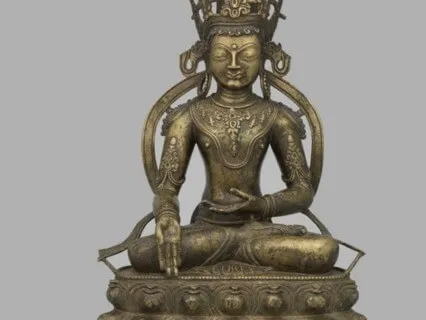
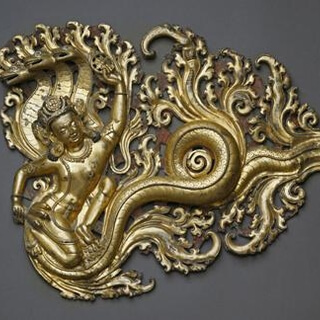
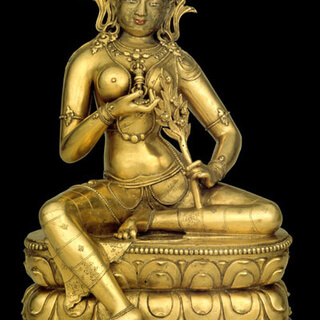
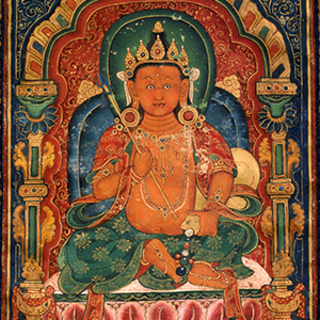
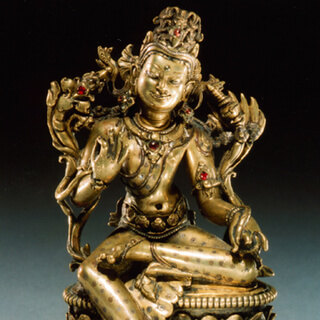
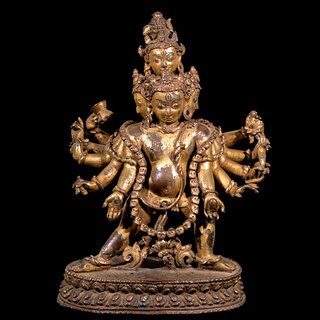
Including an image of a related artwork chosen from the Rubin Museum's permanent collection.
And now,
Please enjoy your practice.
Geitru Jigme Rinpoche is a socially engaged Buddhist whose philanthropic projects have become central to his work.
He was born in India and has had firsthand experience of the plight of Tibetan refugees and local villagers in finding and retrieving potable water.
This inspired him to found the Pure Water Project,
For which he received a citation from the Dalai Lama and the Tibetan government in exile.
He has many other amazing projects as well,
Including malaria prevention and treatment,
The support of orphans,
Schoolchildren and monks,
And the elderly,
And of course,
Miragom,
The rebuilding project that I just spoke about.
He is the son of the renowned Terton,
Or treasure revealer,
Namkha Dhrimid Rabjam Rinpoche,
The holder of the Rupa lineage.
And he oversees the Rupa monasteries in both Nepal and India,
Along with their growing monastic communities.
Please give him a warm welcome.
Geitru Jigme Rinpoche.
Thank you,
Dawn.
I'm reminded strictly about the time.
And I can share with her,
Sympathize with her,
How the Lamas are difficult to be on time or to be within the time limit.
So have a,
I don't know what to say today,
Good afternoon or good day.
I'm here to talk about mindfulness meditation on equanimity and it's a very interesting middle of the day time.
And meditation in the middle of the day time is always challenging.
I remember one Lama leading meditation on mindfulness around the middle of the day and as soon as the gong starts the Lama was dozing off.
And then the next gong was mindfulness.
Everybody wakes up.
So I hope it's not going to be that season today.
And the central to meditation,
I think everyone is doing some kind of meditation,
I believe so.
And so we all know that the mindfulness or for that matter shamatha or vipassana or any kind of meditation basically is about being aware.
Aware also means to be connected basically and I think that's the core of our quest in life.
About meditation it's about finding this connection.
This connection not necessarily just outer material connection but more deeper sense of connection.
And beginning with oneself,
Deepest,
On the deeper level of connecting to oneself.
And from then onward connecting to the world or others.
And so we often find that there's a sense of loneliness I would say in the deep in our heart.
And whenever,
Even though we do lead normal regular life,
Lots of things going on in life,
Many other engagements in life.
Somehow somewhere even though we live in the very middle of the city surrounded by so many millions of people but there's still a sense of loneliness.
I think deep sense of loneliness.
Something is there.
And so it's a sense of opening,
A sense of acceptance.
I think the essential is what I call connecting on the deeper sense to oneself.
Which brings certain warmth,
Certain joy of being myself.
I think that's the core of meditation.
Because if we do not feel good or comfortable or at ease within whatever we are,
It's not a question of who I can be or what I was.
It's a whole question of what I am available right now,
Right here.
So the whole question is about really feeling that,
That goodness,
That joyful about being oneself opens the door to connecting to others.
And this is what really is about meditation,
What I believe so.
Now,
Then the other part is to see how the interconnectedness and how interrelated we are.
Because the reason that we could really develop a sense of equanimity or sameness,
See,
Which enable us to open to others basically,
The platform and the vehicle from which brings us our ability to open to others is on the basis of sameness,
Equanimity.
Not because we are different.
It will be impossible to really connect profoundly to each other or understand each other profoundly if things are based on the difference.
See,
So I'm not talking about outer superficial secondary sense of differences.
See,
But it's most important is on the fundamental primary level,
The sameness.
This is what Don has just also repeated what I said,
What I experienced during the earthquake in Nepal,
That there was this,
Of course,
Tremendous tragedy.
I was there in the middle of this earthquake,
But the seconds after that what I saw is this outpouring sense of humanity.
Everyone,
That moment becomes same.
No one is different.
Rich,
Poor,
Educated,
Not educated,
Religious,
Different things.
Nothing matters at all.
At that moment everyone stands together.
Sameness,
Humanity.