Welcome to the Mindfulness Meditation Podcast.
I'm your host,
Dawn Eshelman.
Every Wednesday at the Rubin Museum of Art in Chelsea,
We present a meditation session led by a prominent meditation teacher from the New York area.
This podcast is a recording of our weekly practice.
If you would like to join us in person,
Please visit our website at rubinmuseum.
Org slash meditation.
We are proud to be partnering with Sharon Salzberg.
This series is supported in part by the Hemera Foundation.
In the description for each episode,
You will find information about the theme for that week's session,
Including an image of a related artwork chosen from the Rubin Museum's permanent collection.
And now please enjoy your practice.
Good afternoon.
Hi,
Welcome.
Welcome to the Rubin Museum to our weekly mindfulness meditation practice.
My name is Dawn Eshelman.
It's great to be here with you.
And as always,
We want to thank our partners that bring this program to you with us,
Particularly the Hemera Foundation,
Who's supporting this program.
So grateful to them.
So this month we've been focusing on the theme of listening.
And this is our last session to talk about this particular theme,
Although next month we'll be talking about something related to that,
This concept of liberation.
I'll explain.
But to spend a moment with the theme of listening here today,
We've been talking about not only how listening in the museum is a different experience when you really focus on listening instead of looking,
Which is often the focus in a museum,
What listening means in our lives around us in the world right now,
How important it is,
And what it means in our practice when we listen truly and compassionately to ourselves.
So we're bringing this theme to you in connection with the exhibition on the sixth floor and all around the museum called The World is Sound.
And so hopefully you've had a chance to take in some of these sonic experiences.
We're exploring this idea of what sound is and how it has the power to transform through the lens of Tibetan Buddhism and also through the lens of contemporary sound art and a variety of really interesting artist perspectives,
Everything from the birth of the cosmos to what we hear when we die.
And in the Tibetan Buddhist tradition,
The sense of hearing is known to be the last to go.
And of course,
The bardo is a really important practice around that time and that is known perhaps a little bit better in the West as the Tibetan Book of the Dead.
And this is something that Tibetan Buddhist practitioners rehearse for.
They practice dying and letting go.
And to do that,
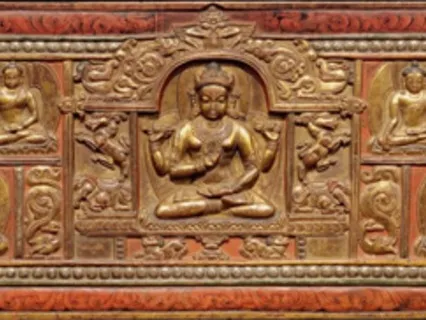
They use this book behind me.
This is a book.
It is a loose leaf book.
And this is the cover.
So we're looking kind of a bird's eye view at this book.
And this is one of the books that contains the manuscripts of the bardo or the Tibetan Book of the Dead.
And this is something that a teacher would use with their student to read through.
There are a variety of practices and meditations and sutras included in this that help the practitioner rehearse,
Get ready,
Because it's a really big important moment,
Particularly from the Tibetan Buddhist perspective.
And it's this liminal space,
This transitory period that is such a powerful place where the practitioner has the ability to,
Through this practice,
Using the bardo to become enlightened.
So our practice today,
I just want to be clear,
Is certainly through the lens of this Tibetan Buddhist object.
But we're really practicing with this idea of listening and how that is important to us,
No matter what our tradition is or our perspective is on spirituality.
And I hope that this will be accessible to you,
Whether you are an atheist or a devote practicing Buddhist or anything else.
So we are so happy to welcome back to this series,
Lama Arya Drolma.
And it's been great to have her as a recent addition to our family of teachers and delighted that she's going to be able to weigh in on this topic.
Lama Arya Drolma has been studying and practicing Tibetan Buddhism since 2008 and is trained in the Dharma Path program of progressive stages of meditation and contemplation for serious practitioners offered by the Kagyu Thupten Choling Monastery.
She teaches at the Hindu Samaj Temple and Cultural Center and Jane Temple in Poughkeepsie.
She is a graduate of a traditional Tibetan Buddhist retreat spanning three years and three months,
Which is an advanced and completely cloistered intensive meditation program.
Before she became ordained,
She attended Mumbai University in India and graduated with a BA in sociology.
And she also serves as an active volunteer for several nonprofit organizations,
Including fundraisers for breast cancer and HIV AIDS related issues.
Please give her a warm welcome back.
Lama Arya Drolma.
Hello and welcome everyone.
Thank you all for coming in today.
Such a beautiful day outside and I'm absolutely delighted to be with you all.
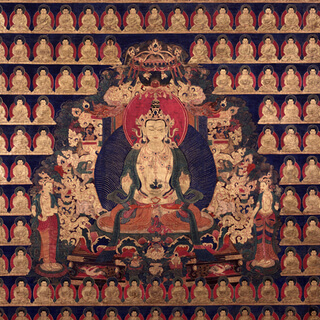
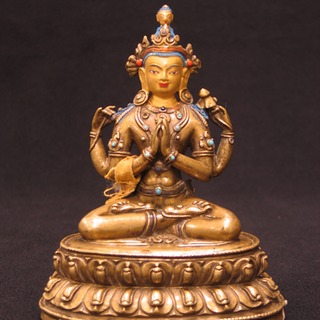
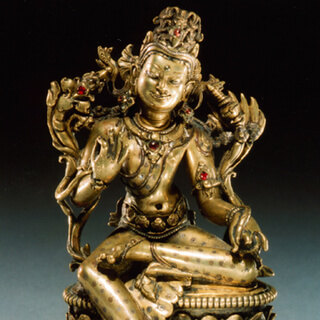
I chose this artwork for today because the central figure in the manuscript cover is the deity Prajnaparamita.
And we recite this condensed version of Prajnaparamita called Heart Sutra in the monastery every day we chant the Heart Sutra.
It's one of the most amazing and beautiful sutra that we chant in Tibetan.
It's and it's called Sherab Ningmo.
And this is one of the most important and profound sutra.
And so that's why I wanted you all to see this deity Prajnaparamita.
And there's a lot of blessings just looking at the picture and listening to the sutra.
So the deity Prajnaparamita is known as the mother of all Buddhas,
The great mother who embodies the perfection of wisdom.
The meaning of the word Prajnaparamita in Sanskrit Prajna means wisdom and Paramita is perfection.
So coined together the word is the perfection of wisdom.
The deity Prajnaparamita symbolizes the ultimate nature of all phenomena as shunyata or emptiness,
Which is the central most important concept of Mahayana philosophy.
The Mahayana philosophy shunyata or emptiness refers to the concept that all phenomena animate and inanimate are empty of inherent existence.
This is a little bit hard to understand,
But it takes a while.
It takes practitioners a very long time to understand these concepts.
And so just listening to this,
There's a plant seeded,
There's also blessings in these profound truth and the words of the Buddha and the teachings.
So here in the artwork,
You can see the deity on a lap is a hand and the mudra of meditation.
The right hand is in the mudra of fearlessness,
Which is like,
You know,
Having no fear and having peace,
Shanti.
And in our upper hands,
In the right hand,
She holds the Vajra,
Which is a scepter.
And in the upper left hand,
She holds the most important text of the Buddha's teaching,
The Prajnaparamita sutras,
Which contains the highest teachings of the Buddha and the most precious text for any Buddhist practitioner.
So what is a sutra?
It is in Buddhism,
Sutra refers to scriptures of the oral teachings of Buddha.
2500 years ago,
You know,
There were no papers and everything to write down.
So the teachings of oral transmission from one disciple,
Master to disciple,
Master to disciple.
And the lineage that I belong is called the Kagyo lineage.
And especially in the Kagyo lineage,
The transmission is all oral transmission.
So it's very apt to the theme today,
Which is listening.
So 2500 years ago,
Buddha gave the teachings of the Prajnaparamita Sutra about the concept of emptiness,
The illusory nature of all phenomena.
So now this sutra was written in Sanskrit.
And I have the English translation,
Which is very,
Quite close to the Sanskrit words.
And I want to read this to you all.
And although this may be not very easy to understand,
And for some people,
It may be very easy,
But there's a lot of blessings,
Just listening.
So when you're listening to any of the teachings,
It's always good to sit up right and kind of like,
You know,
Have the meditative posture,
Your hands can be,
You know,
Meet,
Your thumbs can be meeting together like this and on the lap.
And if this is not very comfortable,
Just place your hands on your knees,
Palms down and just sit up right.
So I have the English translation of the Prajnaparamita Sutta,
The Riddhiya Sutra,
The condensed version known as the Heart Sutra.
And I will read the read it aloud to you all.
And just to give a brief summary,
According to the Sutra,
Lord Buddha and his followers were gathered in the Vulture Peak Mountain in a place called Rajagriha in India.
This place still exists in India and is known as Rajgir in the state of Bihar.
And I had the wonderful opportunity to visit this holy site.
And there were a lot of monks and nuns gathered there.
And we recited the Heart Sutra on this amazing,
Beautiful holy site,
Where there were caves where Buddha had his summer place where he would go and meditate.
So it was such a beautiful,
Auspicious place.
And just to recite the Heart Sutra there was just an amazing opportunity.
So in this place there,
The Buddha went into a deep meditation.
And Avalokiteshvara,
The Bodhisattva of Compassion,
Taught Shariputra,
One of the chief disciples of Buddha,
About the Prajnaparamita teachings.
It refers to the five skandhas.
And what are five skandhas?
They are five factors that constitute a human being or a sentient being,
Mental and physical existence.
They are form,
Sensation,
Perception,
Mental activity,
And consciousness.
So Buddha's philosophy asserts that there is no self,
As being is merely made up of the five aggregates,
Which are form,
Sensation,
Perception,
Mental activity,
And consciousness.
And each of these five skandhas is empty in nature,
Without substance.
And this is a very hard concept,
You know,
For most beginners and even for most well-known practitioners.
But this is the shunyata of all these forms that this sutra will talk about.
So this sutra is very profound,
As I mentioned,
But keep an open mind and heart.
And just listen with your whole body.
And since today's theme is listening,
We will just focus on listening to this profound sutra.
And this sutra starts,
Thus have I heard.
All the Buddha sutras start like this,
Thus have I heard.
So I'm going to read this sutra now.
Once the Blessed One was dwelling in Rajagriha in Vulture Peak Mountain,
Together with a great gathering of the Sangha of monks,
And a great gathering of Sangha of Bodhisattvas.
At that time,
The Blessed One entered the Samadhi,
Deep meditation,
That expresses the Dharma called the profound illumination.
And at that same time,
Noble Avalokiteshvara,
The Bodhisattva,
Mahasattva,
While practicing the profound Prajnaparamita,
Saw in this way,
He saw the five skandhas to be empty of nature.
Then through the power of the Buddha,
Venerable Shariputra said to the noble Avalokiteshvara,
The Bodhisattva,
Mahasattva,
How should a son or daughter of noble family train,
Who wishes to practice the profound Prajnaparamita?
Addressed in this way,
Noble Avalokiteshvara,
The Bodhisattva,
Mahasattva,
Said to the venerable Shariputra,
Oh Shariputra,
A son or daughter of the noble family,
Who wishes to practice the profound Prajnaparamita,
Should see in this way,
Seeing the five skandhas to be empty of nature.
Form is emptiness,
Emptiness is also form.
Emptiness is no other than form,
Form is no other than emptiness.
In the same way,
Feeling,
Perception,
Formation and consciousness are emptiness.
Thus Shariputra,
All dharmas are emptiness.
There are no characteristics,
There is no birth and no cessation,
There is no impurity and no purity,
There is no decrease and no increase.
Therefore Shariputra,
In emptiness there is no form,
No feeling,
No perception,
No formation,
No consciousness,
No eye,
No ear,
No nose,
No tongue,
No body,
No mind,
No appearance,
No sound,
No smell,
No taste,
No touch,
No dharmas,
No aidhato up to no mindhato,
No dhato of dharmas,
No mind-consciousness dhato,
No ignorance,
No end of ignorance up to no old age and death,
No end of old age and death,
No suffering,
No origin of suffering,
No cessation of suffering,
No path,
No wisdom,
No attainment and no non-attainment.
Therefore Shariputra,
Since the bodhisattvas have no attainment,
They abide by the means of Prajnaparamita.
Since there is no obscuration of mind,
There is no fear.
They transcend falsity and attain complete nirvana.
All the Buddhas of the three times,
By the means of Prajnaparamita,
Fully awaken to the true complete enlightenment.
Therefore the great mantra of Prajnaparamita,
The mantra of great insight,
The unsurpassed mantra,
The unequaled mantra,
The mantra that calms all suffering,
Should be known as truth.
Since there is no deception,
The Prajnaparamita mantra is said in this way,
Om gathegatheparagatheparmasamgathepodhisoha.
Thus Shariputra,
The bodhisattva,
Mahasattva,
Should train in the profound Prajnaparamita.
Then the Blessed One arose from the Samadhi and praised noble Aulutkeshwara,
The bodhisattva,
Mahasattva,
Saying,
Good,
Good,
O son of noble family,
Thus it is,
O son of noble family,
Thus it is,
One should practice the profound Prajnaparamita just as you have thought and all the tathagathas will rejoice.
When the Blessed One had said this,
Venerable Shariputra and the noble Aulutkeshwara,
The bodhisattva,
Mahasattva,
That whole assembly and the world with its gods,
Humans,
Asuras and gandharvas rejoiced and praised the words of the Blessed One.
So the sutra ends here and now we will start the meditation session.
And I see we have some newcomers here.
Thank you all for coming in and I assure you the meditation is very easy to follow.
So when we start the meditation session,
There are two essential points,
The essential points of your body and the essential points of the mind.
The essential points of the body is your posture.
So in our tradition,
The posture is given very,
Very great importance.
So I'll go over the seven points of posture.
And you know,
Marpa,
The Tibetan translator,
He's one of the fathers of the Kagyu lineage.
When he went to India and he received the seven points of posture,
He said that these were the most important and profound postures that he has ever received.
So the posture is extremely important.
So when you sit to meditate,
If you're sitting on the chair,
It's fine.
Keep your back straight,
As straight as you can.
And the reason why you keep your back straight is we have subtle wind energy within our spinal channel.
And so when your back is straight,
The energies run smoothly and your mind is more stable.
And for any reason,
If anyone has injuries,
That's okay.
Be as comfortable as sit as comfortable as you can.
And your legs should be placed firmly on the ground,
You know,
Rather than having it crossed,
Have it firmly on the ground.
So it grounds you,
It keeps you upright.
Hands are placed in the meditation mudra,
Which is like this,
Right hand over left,
And you can touch your thumbs like this,
And gently put them on your lap and wherever it falls.
Or,
You know,
If this is,
If you don't like doing this,
You can just put your palm down on your knees wherever it falls,
Just place them on your knees.
And your jaws are relaxed,
Tongue is resting naturally on the upper palate,
Head is slightly tilted forward.
So if this is the posture,
Your head is just tilted slightly forward.
And in this tradition,
We keep our eyes open.
And the gaze should be directed downwards from below the tip of your nose,
Four inches to eight inches,
Wherever it falls,
Just gaze there gently and naturally.
For a lot of people,
This may not be comfortable,
And it's quite okay to close your eyes and slowly,
Slowly,
Gradually when you start to meditate,
Try to keep your eyes a little opened.
Now there's a little secret here.
If you're falling sleepy,
You can gaze upward when you meditate.
And if your mind is too agitated,
Keep your eyes lower,
So you'll have less agitation.
Now your shoulders shouldn't be slumped like this,
It should be square and sit as straight as you can.
So like I mentioned,
If any of these posture,
You know,
You're not comfortable,
Then sit as comfortably as you can.
Now let's,
We will go back to the essential point of the mind.
The mind is very important,
Because it's the mind that does the meditation.
So your mind should be relaxed and in the present moment of awareness.
So when we start the meditation session,
The important thing is the mind needs a focus.
The reason the mind needs a focus is the mind loves to wander away.
So,
And it loves,
It loves to jump from one thought to another.
So to bring the mind back,
We will focus on something.
And today we are focusing our attention on sound.
So now let's put our attention on sound around you.
Just bring your awareness to any sound in the room,
And just listen with your whole body.
So we'll start the meditation.
Inhale and exhale,
Breathe normally.
Start by just allowing your mind to rest for a few moments in a relaxed state.
And then gradually allow yourself to become aware of the sounds you hear close to your ear,
Such as your heartbeat,
Or your breath,
Or sounds that occur naturally in your immediate surroundings.
There is no need to try to identify these sounds,
Nor is it necessary to focus on a special sound.
In fact,
It's easier to let yourself be aware of all sounds you hear.
The point is to cultivate a simple bare awareness of the sounds around you and just rest in the present moment of awareness.
Breathe normally.
Anytime you start thinking any thoughts,
Just say thinking.
And then drop it,
Let it go.
Don't follow it.
Don't engage in it.
And return to the sound you are focusing on.
It doesn't matter how many times your mind wanders.
All that matters is when you notice your notice,
You gently bring your focus and attention back to the sound you have been listening to.
One of the great benefits of meditation on sound is that gradually it teaches you to detach from assigning meaning to the various sounds you hear.
You learn to listen to what you hear without responding emotionally to the content.
As you grow accustomed to listening to sounds,
Simply as sounds,
You can apply the same theory to criticism or hurtful words without becoming angry or defensive and able to listen to praise without becoming overly proud or excited.
You can simply listen.
Inhale and exhale.
Breathe normally.
And bring your attention to any sound in the room.
Just rest in the present moment of awareness.
Just let go of all your thoughts and concerns and rest in the present moment of awareness.
By nature,
The essence of our mind is total peace.
Therefore,
We can find true peace of mind through meditation.
Inhale and exhale.
And as you exhale,
Breathe out to the entire space and just rest in the present moment of awareness.
If we can train ourselves during meditation to simply observe the arising of each thought and emotion without grasping at it,
Without clinging to it as being anything other than the temporary play of the mind,
Like waves emerging and dissolving back into the ocean,
And then this habit will make its way into our ordinary day-to-day life.
Inhale and exhale.
Breathe normally.
And bring your attention to any sound in the room.
And just rest in the present moment of awareness.
Let go of all your thoughts and concerns and anxiety.
And just relax into the present state of awareness.
Okay.
Relax.
Stretch a little.
Thank you.
Thank you.
That concludes this week's practice.
If you'd like to attend in person,
Please check out our website,
Rubinmuseum.
Org slash meditation to learn more.
Sessions are free to Rubin Museum members,
Just one of the many benefits of membership.
Thank you for listening.
Have a mindful day.