Welcome to the mindfulness meditation podcast.
I'm your host,
Dawn Eshelman.
Every Wednesday at the Rubin Museum of Art in Chelsea,
We present a meditation session led by a prominent meditation teacher from the New York area.
This podcast is a recording of our weekly practice.
If you would like to join us in person,
Please visit our website at rubinmuseum.
Org slash meditation.
We are proud to be partnering with Sharon Salzberg,
The teachers from the New York Insight Meditation Center,
The Interdependence Project and the Shambhala Center.
The series is supported in part by the Hemera Foundation.
In the description for each episode,
You will find information about the theme for that week's session,
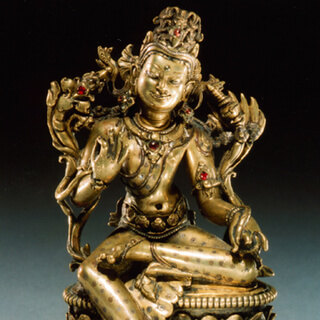
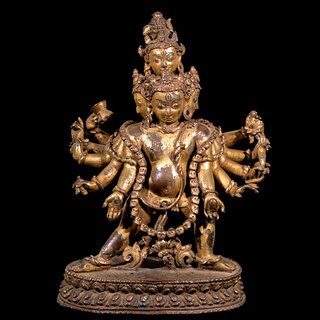
Including an image of a related artwork chosen from the Rubin Museum's permanent collection.
And now,
Please enjoy your practice.
Welcome to the Rubin,
Everybody,
And to our weekly mindfulness meditation session.
My name is Dawn Eshelman.
I'm head of programs here.
And welcome,
Welcome.
We have been talking about impermanence this month,
And this is an idea that is very central to Tibetan Buddhism,
And it is this idea that everything changes.
And that is embodied in the exhibition that we have up on the sixth floor and really throughout the entire museum called The World is Sound.
And that exhibition is,
In many cases,
An example of something coming into being and going away,
Listening to something as it fades away.
And we're looking at an object that comes from that exhibition here today behind me.
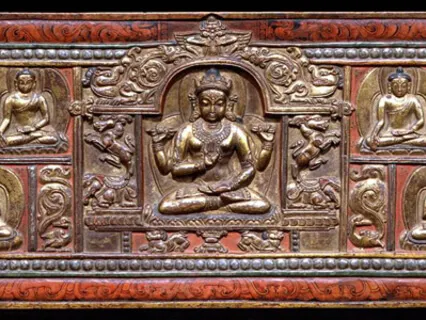
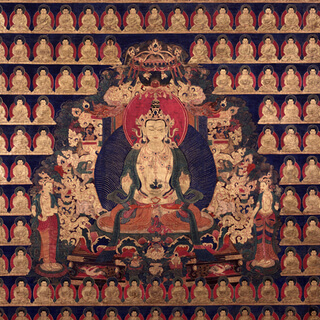
We have a beautiful book.
This is the cover of a book.
And whereas in many cases you might decide not to judge a book by its cover,
Today we're going to be taking a closer look at this one.
And pictured in the very center of this book is Prajnaparamita.
And she is the goddess of perfection of wisdom.
She is really the personification of the perfection of wisdom.
And that is the name of the book,
Prajnaparamita Sutras.
And this is a critical text in the Mahayana Buddhist tradition that spells out this doctrine of emptiness.
So there is this intricate link between the ideas of wisdom and emptiness and impermanence as well.
So it's through our experience we have this illusion that reality is stable.
This doctrine of emptiness states that all phenomena are empty of inherent existence,
Meaning that nothing exists by itself and nothing is permanent.
And it's through this realization that of course,
From the Buddhist perspective,
Enlightenment is possible.
So I think we'll just turn it over to our teacher.
Sharon Salzberg is back with us today.
And as always,
It's a delight to have her here.
She is a renowned teacher and author of meditation and is the author of fabulous books on meditation.
If you're looking to go a little deeper,
Check out one of her books.
Her most recent is Real Love.
And it's always a pleasure to have her here,
Sharon Salzberg.
Welcome.
At first I grew up in New York City,
But when I first came back here as an adult,
Maybe like 12,
13,
14 years ago,
Something like that,
People would say,
Did you read the paper?
And I'd say,
Which paper?
Because I thought there might be more than one.
So impermanence,
Emptiness,
And I told Dawn I wanted to talk about compassion.
Emptiness can sound a little bleak,
Of course.
It sounds like a giant void or something really blank or unalive,
Not very fulfilling.
But what it actually means,
It means two things.
One is kind of an insubstantiality,
Which has a lot to do with change.
Everything is so transitory.
The Buddha talked about life very poetically.
He said,
Life is like an echo,
Like a dream,
Like a flash of lightning in a summer sky,
Like a rainbow,
Like a drop of dew on a blade of grass.
It exists.
It's true.
It's so fragile.
It's so transitory.
We hold on so mightily,
Like we can keep something.
Anything from changing never works.
And there's everything in those examples.
There's the beauty and the poetry and the delicacy and the evanescence and the poignancy.
Like wait,
Did you ever wish,
I say this sometimes,
I just want to pause button.
For a little bit of time,
Like when you're going through something,
It's never just one thing,
It seems.
It's like all these things start happening also.
I think,
Wait a minute,
Now I have a leak under my sink?
Wait a minute.
I don't know.
Yeah.
You know?
And I just think,
I just want to rest.
Like give me five minutes,
You know,
When nothing is happening.
But it's not like that.
Right?
Life is moving and changing and evolving and there's always something happening.
So there's a certain insubstantiality because we can't make it stop.
Right?
And everything has that nature of that fragility.
It happens,
It's impactful,
We enjoy it or we don't like it or whatever and it's all the time slipping away.
Life is just slipping away.
I had a Zoom thing this morning and somebody who was interviewing me said something like,
Basically,
I understand you've been doing this since before it was cool.
And I said,
Oh yeah.
And also I don't know that we say cool anymore,
You know,
But I started saying dope because somebody taught it to me and a young friend said,
Don't say that,
You sound really stupid.
I don't say that either.
So I used to say cool and I said,
Yeah,
I've been doing this long before it was cool.
You know,
Where did those years go?
And it's just like,
That's emptiness,
Not blankness,
But that insubstantiality,
You know,
There's nothing that's like static and solid and could be held onto.
And the other meaning is everything is contingent.
This is what Don was saying,
Nothing exists in itself.
Tibetans would say nothing exists from its own side.
Everything is a combination of conditions coming together and coming apart.
And this is both the poignancy,
The great poignancy of life that we're not in control and it's also a call,
It's like an entryway to compassion.
So for example,
If you want lunch,
You need some money in order to get some food,
Either to buy the food.
Somebody has to have grown it and harvested it and transported it and cooked it for you and now selling it or you need to buy the food,
Which has been grown and harvested and transported and you need money most likely in order to get the food and you may need a job in order to have the money.
Maybe you need means of transportation in order to get to work every day.
You know,
It's like a lot of things have to come together.
Nobody has the power to kind of look at their table and say,
Poof,
There's lunch.
Right?
Everything is born out of a combination of conditions coming together.
That doesn't mean we're helpless.
We can definitely affect the conditions,
But we can't like determine the conditions because things change all of the time.
And so you might set the wheels in motion,
For example,
So that you're more likely to be patient than angry at a certain kind of stimulation or trigger,
But that doesn't mean you will be assured you will never ever get angry because something else may shift and then you're not feeling well.
You didn't sleep.
It's too hot in the room.
It's too cold in the room,
Whatever it is,
And the anger comes forth.
So our ultimate goal in a way is to be able to know what we're feeling quickly and have enough balance so that we can choose.
Yeah,
I want to go with this reaction or,
You know,
It didn't work out that well last time I did it.
Maybe I won't send that kind of email again or whatever.
So we have that kind of power.
But you know,
So dinner or lunch is a very innocuous example,
But you look at the nature of life.
Maybe you have a friend who's really suffering mightily and you have a pretty big clue about how they might make some different choices and be a whole lot happier.
And it's not just because you're nosy.
It's because you're really smart.
It's like you see it,
But you can't make it so.
That's like wanting to say,
Poof,
There's lunch.
All these conditions have to come together for someone to make a decision to make a change,
Right?
And thus far,
No one has invented the chip as far as I know that we can implant in someone else's brain and we have the remote control and we say,
Cheer up,
Okay?
Good that it were so,
But it's not so.
And realizing that's another meaning of emptiness.
It's conditionality,
It's contingency.
Not blankness again,
But realizing nothing exists from its own side.
Everything exists in relativity as a combination of conditions.
And this is also our clue.
If you want to make a change,
You'd start looking at those conditions.
On every level,
If you want to make a change in society,
See if you can look more deeply into conditions.
I was once in Bari where the Insight Meditation Society is.
We had a visit from Thai activist,
Sulak Sivarastra.
His books are probably upstairs as well.
And he said something I found really powerful.
He said,
You know,
If you want to start changing the sex trade industry in Thailand,
He said,
Look at Thai agricultural policy.
Look at why those farmers are starving.
Look deeper.
Look at causes and conditions.
And when we want to change something in our own lives,
We look for causes and conditions.
Is it really that I need to do that or is there a whole lot of fear cooking,
As an example,
That I feel uneasy about just sitting and being with?
So we're always looking toward causes and conditions because here,
Too,
We're very empowered to actually start making some changes within or without.
And the very fact that everything is so contingent,
It's so interdependent,
Nothing stands alone,
No one stands alone.
We're all kind of part of this greater picture of life.
That is also the doorway to compassion.
It's not just poignancy and kind of emptiness and wisdom and that flavor of things.
But President Parmeeta is actually,
It's her womb that is actually where compassion is born.
It's born in the center of understanding emptiness,
Conditionality,
That we're not alone.
That we're all part of this greater picture of life.
That we all face this uncertainty,
This fragility,
And that even though certainly we don't share the same measure of pain,
All of us,
People's lives can be very,
Very different,
We all do share this vulnerability,
The fact that everything is changing all the time.
And so that should be the reason that we do feel,
Oh,
We're kind of in this together,
Can I help take care of you and can I let you help take care of me,
Which is another whole thing.
And realizing it is an interdependent universe.
And I was saying earlier that I wanted to talk about compassion because a lot of times if you just think about something like impermanence or certainly emptiness,
But even impermanence,
It's so dire.
People say that all the time,
Like,
OK,
I can get it's a little bit of a relief that the times of adversity and the times of fear and so on,
They're not going to last,
But the good times aren't going to last either.
That's supposed to be good news.
I don't think so.
And it's very,
Very easy to fall into a kind of nihilism.
Nothing matters,
Nothing counts,
Why do anything?
It's not going to last anyway.
The kind of Buddhist version of that is it's all empty,
Why do anything?
But compassion is the answer to that.
That's the resolution because we're not just developing the wisdom into seeing impermanence,
We're also deepening and developing compassion,
Which is about how our lives have something to do with one another.
And it's the active expression of that understanding of interdependence.
It's taking that understanding and breathing life into it when we're on the subway or we're buying something or when we've made a mistake,
You know,
When we use some electronic device incorrectly and we're very frustrated at ourselves.
It's compassion that leads the way into not having us just fall into that pit of nihilism,
But realizing,
Oh,
Things do matter because it's the expression of my heart and taking the values that I hold and making them real.
That's compassion's role in action and every day.
So we find both the kind of ability to let go and relinquish that comes from seeing impermanence and seeing emptiness and we also find the energy and a sense of connection and a sense of caring that comes from compassion.
So why don't we sit together and to start we can go back into my favorite reflection,
Which I think I haven't done here for a while,
Which is just as you begin,
See who comes to mind if you're reflecting on who always played any role at all in your being here in this room right now.
Maybe you were just upstairs and decided on a whim to see where everyone was going.
Doesn't usually happen that way.
This greater intentionality,
Somebody told you about meditation or their meditation or you read a book or you read the New York Times on Sunday or just see who comes to mind just having played any role in your being here right now.
As I say when I do this reflection,
I sometimes think of the Board of Regents of the State of New York,
Which gave me a scholarship,
Which is how I was able to go to college and it was through a college program that I ended up in India studying meditation.
Is there a reason why I'm here right now?
Sometimes when I do this reflection I think about those people whose actions have really hurt me,
Not just the ones I find annoying or irritating,
But I think of those times where I really felt like I was at an edge and that I knew I had to make a change myself or I just wouldn't be free because they are part of why I'm here also.
We can feel so alone and so cut off,
But the truth is this moment in time is a confluence of interactions and relationships and conversations and connections and so is every moment in time.
Within that context of connection,
See if you can settle your attention on the feeling of the breath,
Just the normal,
Natural breath,
Wherever it's strongest for you or deepest for you.
If you like you can use a quiet mental notation like in,
Out,
Or rising,
Falling,
But very quiet if you use it at all because the main part of your energy should be going toward feeling the breath,
One breath at a time.
And if you find your attention has wandered,
You've gotten lost in thought,
Spun out in a fantasy or you fall asleep,
Don't worry about it.
Once you realize it,
See if you can let go,
Bring your attention back to the feeling of the breath.
Okay.
.
.
.
.
.
.
.
.
.
.
.