Welcome to the mindfulness meditation podcast.
I'm your host,
Dawn Eshelman.
Every Wednesday at the Rubin Museum of Art in Chelsea,
We present a meditation session led by a prominent meditation teacher from the New York area.
This podcast is a recording of our weekly practice.
If you would like to join us in person,
Please visit our website at rubinmuseum.
Org slash meditation.
We are proud to be partnering with Sharon Salzberg and teachers from the New York Insight Meditation Center.
In the description for each episode,
You will find information about the theme for that week's session,
Including an image of a related artwork chosen from the Rubin Museum's permanent collection.
And now,
Please enjoy your practice.
My name is Dawn Eshelman.
Great to be here with you today.
And if you've been coming regularly,
You are familiar with this idea,
This topic we've been exploring,
Power.
It is something that is within us and between us and also upstairs in the galleries all around you.
And often this concept of power,
As illustrated in the galleries,
You will see in the form of something called an empowerment,
Right?
And this comes from the Vajrayana ritual of—really as a form of learning,
Of moving up in your practice.
It is a practitioner-oriented experience,
A ritual that is often given by a teacher to a student in order for them to make progress.
And often—the reason I mention the galleries is because often there will be a tool,
A tanka,
A deity,
A sculpture,
A,
You know,
A vajra or a bell,
Like we saw last time,
An implement that is used to assist,
And most of the time,
All of the above,
Many,
Many of these objects used.
So we're going to learn a little bit more about that at the end of the month when Lama Aryadroma visits us.
But really right now and for the bulk of the month,
We're taking that idea,
That concept of empowerment and really examining it through a secular lens.
What does that mean to be empowered?
And really the true empowerment is not necessarily—and this is true for the Vajrayana practice as well.
It's not necessarily someone giving you something,
Right?
It is just waking up,
Becoming aware and remembering that there's power within.
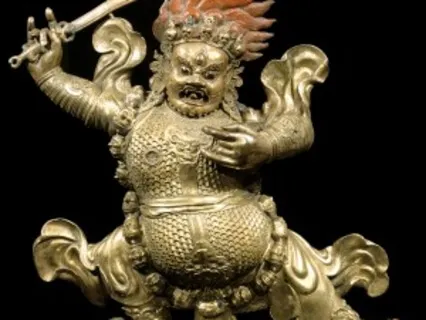
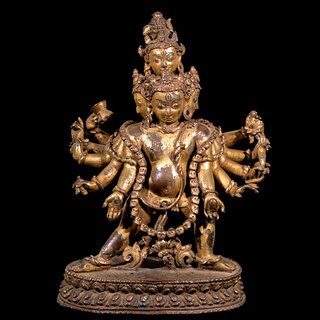
So we are looking at a beautiful,
Fierce artwork today.
This is the protector,
Begetse.
This is from Outer Mongolia,
18th century,
And you can find this in our Masterworks exhibition on the third floor.
Begetse is one of the main protector figures in the Gaelic school of Tibetan Buddhism,
And if you take a look here,
You can see he's in fact a very fierce,
Wrathful protector with some pretty impressive fangs and a kind of a yell or a growl there,
And of course has these five skulls and a crown on his head right below his kind of fiery hair there.
And it's really kind of this interesting kind of scaly torso,
And then around that,
Around his big belly there,
We see this long garland of skulls.
So as with many of the protector deities,
We're looking at what we're being asked to confront very clearly there is our own mortality and a kind of waking up to really live the kind of the most aware life that we can.
And the sword here being held in his right hand is something that is being yielded or wielded as a tool that can kind of sever the ego,
Really cut through,
Cut through all of the constructs that get in our way of being our most empowered self.
So Sharon Salzberg is here with us today,
And she is the co-founder of the Insight Meditation Society in Barre,
Massachusetts,
And just a beloved teacher here and all over the place,
All over the world.
And we're very lucky to have her here with us today.
And also just want to say she is such a great author.
If you're looking to just take a next step with your own practice or you need a tool,
Her books are so approachable and fun,
And I highly recommend them.
Real Love is her most recent.
Please give her a warm welcome back.
Sharon Salzberg.
Hello.
Hello.
So power.
It's been kind of amazing just looking at this figure because we might associate that look with anger,
With meanness,
With.
.
.
And it's not meant to convey that at all.
It's like intensity,
But intensity of what?
There's a concept in the Buddhist teaching about every being having innate dignity,
Right,
Which also has some association with power.
It's like,
All right,
You don't have to be there all crumbled up like you don't deserve to take up any space.
Stand up and have the force of your convictions or the sense of presence that's really very powerful.
And there are a couple of things that are actually designed within the teaching to increase that sense of power.
And power in a way is morally neutral because it depends on what.
.
.
This sort of moral valence or ethical valence depends on what it's associated with.
We may have a powerful intention to hurt somebody or a powerful intention to do good in this world.
And so the power itself is not necessarily positive,
But when it is associated with positive forces,
Intentions,
Values,
Convictions,
Then it's so much more effective,
Right?
And so that's its great gift to us.
It's the concentration of energy instead of being scattered and distracted.
You know how if you try to get something done and every little disruption just takes you away,
You don't emerge from that period feeling like you were really there at all.
You don't feel that sense of powerful presence.
And that's very different than when we gather our energy together and we are really there.
So there are a couple of things that really are said to increase just the sheer possibility of that sense of power.
One is concentration.
It's an actual practice.
It's largely a practice of letting go of distractions because distractions will arise,
But not getting so wrapped up in them when they do.
And so it reminds me of.
.
.
I don't know if this is apocryphal or real,
But they say that when Michelangelo was asked how he would carve,
Say,
An elephant,
He said he would take a block of marble and let go of everything that was not the elephant.
So we have an intention,
We have a purpose,
And a million other things will arise.
And we just let go and we let go and we let go.
We don't have to disparage ourselves for the very arising of these things.
We just want a certain relationship to the various distractions that come up.
We don't want to get embroiled in them and try to figure it out right now.
We don't want to analyze like how in the world did I end up thinking about what I ended up thinking about.
But we also don't want to pile on a tremendous amount of judgment or self-hatred because that's also distracting,
Right?
That also is like a waste of energy.
So to learn to be more concentrated,
More focused,
To let go of distraction is said to be the path of power within the Buddhist tradition.
It's not necessarily the path of wisdom or the path,
Which I hear is next month's topic,
It's a spoiler,
Or the path of love,
Right?
Although it could be,
Depending on what we use that power for.
But for the sheer force of the power,
Its focus,
Its concentration,
Learning how to let go of that,
Which is sort of inessential to our purpose.
We have that tremendous,
It's like taking a very diffuse light and making it into a laser.
We have that capacity,
Any of us can do that if we practice.
There's also a kind of power that comes that is almost like inherently positive that happens when we have a life that is more ethical,
That's more compassionate toward ourselves and to others because the consequence of,
Say,
Telling a lot of lies or using speech in a way that's really reckless is that we end up kind of drained of energy even if we're not astute enough to pick it up right away,
Ultimately we will feel that.
You know,
If you,
We can do a little thought exercise right now.
Think of a time,
Or make up a time if you've never done this,
Where you've said something really nasty about somebody and then they walked into the room.
What does it feel like?
You know,
The feeling is one of like,
Uh-oh,
You know,
What if they find out and how loud was I and when did they come in and like,
You know,
That's losing a lot of energy.
Or you say something that isn't really true.
Putting that up,
Even if it's imaginary.
What does that feel like?
What if they find out?
Did I lie enough?
Did I lie to all the right people?
Maybe I have to go do another round,
You know,
To bolster that,
You know,
And just feel what happens.
And what's interesting is that this is not even the harm that may be caused to others or the break in harmony or the consequence in fractured relationships or whatever.
This is the internal consequence of living in a way that's not quite aligned or in harmony.
Because they're internal consequences and part of us gets caught up,
You know,
What if they find out?
What if this?
What if that?
And so we lose a lot of energy.
It tells a story in my most recent book,
Which I try not to call my last book,
My most recent book,
Which is a very New York story.
It's a real estate story.
And I have to think how I told it because I sort of told it to disguise the innocent.
Someone told me that,
I think you're probably all familiar with New York real estate.
Somebody told me that they had an opportunity to rent an apartment and it was a beautiful apartment.
It was in the area that they more than anything wanted to be in.
There was a rent they could afford.
And so it was perfect,
Except it turned out to be an illegal sublet.
So in further conversation with the owner,
There were these comments like,
Well,
If something breaks,
There's only this one doorman you can go to.
Or,
You know,
Tell everyone you're my cousin and you're just there for whatever.
And the person who had the opportunity put themselves in their imagination in that lobby every day thinking,
I have a secret.
What if they find out?
And he realized,
Like,
I just can't do it.
I actually can't live that way because the toll would be so not worth it.
And then he told me,
It was very funny,
He said he told a bunch of friends that he decided no,
He turned down the apartment.
And they said,
Are you crazy?
Everyone in New York lives that way.
But what's the consequence?
And so this isn't like holy law or,
You know,
This is kind of like a victimless crime.
But still,
We know something inside of us knows something is off,
That we've got a secret.
We have something to hide.
This is,
You know,
We can't be that honest.
What if we make a mistake,
Go to the wrong doorman?
You know,
It's like,
And you just feel all our energy is just pouring out of us rather than collecting and sustaining and holding us up.
So it's largely those two things.
It's a practice of concentration and kind of having a life that supports one's ability to concentrate and be focused and to gather energy rather than just disperse it that really give us a very different sense of power.
Okay,
Let's sit together.
If you like,
You can just focus on the feeling of your breath.
Here's the concentration part.
Many,
Many things may come up as you settle your attention on the feeling of the breath at the nostrils,
At the chest,
At the abdomen,
Wherever it's strongest for you.
Thoughts,
Feelings,
Desires,
Whatever they may be,
It's okay.
The point isn't to try to stop that process but not to get so entangled in it.
See if you can let all of these things just come and go as you stay in touch with the feeling of the breath.
And if you can't,
If you get lost,
If you fall asleep,
If you get overcome,
That's okay too because there comes a moment when you realize that.
You can let go and you can begin again.
Okay.
Thank you.
.
.
.
.
.
.
.
.
.
.
.
.
.
.
.
.
.
.
.
.
.
.
.
.
.
.