Welcome to the mindfulness meditation podcast.
I'm your host,
Dawn Eshelman.
Every Wednesday at the Rubin Museum of Art in Chelsea,
We present a meditation session led by a prominent meditation teacher from the New York area.
This podcast is a recording of our weekly practice.
If you would like to join us in person,
Please visit our website at rubinmuseum.
Org slash meditation.
We are proud to be partnering with Sharon Salzberg and teachers from the New York Insight Meditation Center.
In the description for each episode,
You will find information about the theme for that week's session,
Including an image of a related artwork chosen from the Rubin Museum's permanent collection.
And now,
Please enjoy your practice.
Good afternoon.
Hello and welcome to the Rubin Museum of Art.
My name is Dawn Eshelman,
Head of programs,
And it's great to be with you on this beautiful summer's afternoon.
Thanks for being here with us.
And if you've come regularly,
You know that we are in the middle of a year-long conversation all about power and the nature of power.
We are talking today about wisdom,
And we'll be talking about wisdom throughout the course of this month because it is an essential component to real power,
True power,
And interconnected power.
And from the Buddhist and Tibetan Buddhist perspective,
Wisdom and compassion go hand in hand.
They are partners,
Tools that are essential in a path towards enlightenment.
And we've talked earlier in the year about compassion,
So we wanted to spend a little time with wisdom.
And wisdom in a kind of secular Western point of view,
I think has this connotation of knowledge that is accumulated throughout experience and considered perhaps more practical and functional.
Whereas in Buddhism,
Wisdom is insight into the true nature of reality,
And particularly with reference to impermanence and suffering and emptiness.
So this sense of wisdom being attuned to this essence of reality that is really linked to this core idea of emptiness,
Which does not have a negative connotation whatsoever in Buddhism.
And today we're looking at this beautiful artwork that is often visited by school groups who come in.
So often this is the first stop for them on their tour.
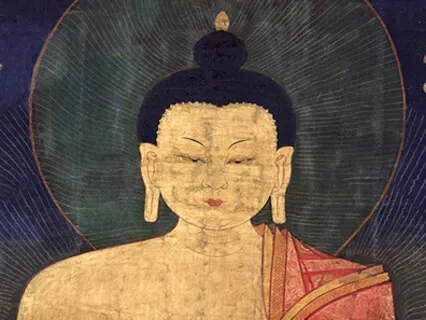
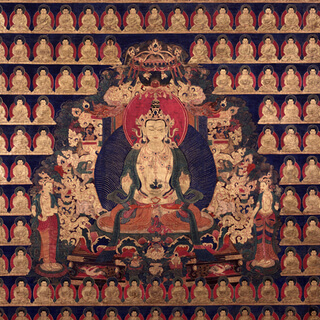
This is a Shakyamuni Buddha,
Historical Buddha.
And this is created in eastern Tibet,
16th century.
And you can find it on the third floor.
We have a few tankas similar to this.
So if it's not this particular painting,
It's often this type of painting that school groups visit together.
And it's really quite amazing what they can learn about Buddhist culture and religion through just one painting.
And today,
Of course,
We're looking at Shakyamuni Buddha because he really exemplifies wisdom and the expression of wisdom and compassion.
And we're seeing him here in this very pivotal moment in his life,
Where he is seated in meditation and he's making with his right hand the earth-touching gesture.
And this is the gesture that he makes right at the moment of his enlightenment when he kind of refuses to engage with Mara and these distractions and really asks the earth to witness him on his path,
To really understand suffering and move beyond it.
And so that is called the earth-touching gesture.
And below him,
He's seated on his lotus throne.
And there are wrathful figures on either side of him with lots of fire and a table with offerings.
And then as we move up,
We see the landscape that surrounds him,
This kind of beautiful greenish blue.
And then,
Of course,
The mountains,
The Himalayan range.
And then above that,
This intense blue sky.
And at the top,
We see him featured with two of his disciple monks,
One in each corner.
And then below that,
If you were taking a look earlier as you came in,
You will have seen a little detail here of these.
But it looks like maybe they're birds from far away,
But those are flying monks,
Just to give us a sense of what's possible with enlightenment,
Right?
And then below the flying monks are two orbs.
And those are the sun and the moon.
And Tibetan literature suggests to us that when these celestial orbs appear together in one painting,
That they suggest a number of concepts,
Including transcendent wisdom.
So Lama Arya Drolma is here with us today.
So nice to have you back.
She studied and practiced Tibetan Buddhism for over 10 years,
Trained in the Dharma Path program offered by Kagyu Tipton Choling Monastery,
And is a graduate of the traditional Tibetan Buddhist retreat spanning three years and three months.
She is a graduate of Mumbai University with a BA in sociology and is trained in computer programming from NIIT India.
And she actively volunteers as a fundraiser for breast cancer research and supports several nonprofit organizations.
Please welcome her back,
Lama Arya Drolma.
Hello and welcome everyone.
Thank you all for coming in today.
I'm so happy to be with you all.
I can recognize some of the faces now and I feel I'm a part of the community and these are all my friends coming in.
And thank you Dawn for the lovely introduction.
Thank you.
And I also see some newcomers here.
Welcome.
Thank you all for being here.
And I assure you the session is going to be very easy to follow and we have Q&A after the meditation.
So feel free if you have any questions,
Any thoughts to share during the Q&A.
So today's image and artwork is Shakyamuni Buddha and who was Buddha?
Buddha is not a name but it's a title.
The term Buddha literally means enlightened one.
The Buddha is the one who attained Bodhi and Bodhi means wisdom.
And wisdom is the theme of this month July.
So after attaining enlightenment Buddha spent his next 45 years or so of his life teaching how we can attain the same wisdom of enlightenment.
And I want to share with you all some of his teachings of wisdom and one of the most important teachings of Buddha is the Four Noble Truth.
And the Four Noble Truth is the foundation of all of Buddha's teachings.
If you understand the Four Noble Truths you get the whole picture.
So the first noble truth is the truth of suffering.
Life is suffering.
And suffering is known as Dukkha in the Pali language.
The word Dukkha does not translate well into English.
So the word Dukkha can commonly be translated as suffering,
Pain,
Unsatisfactoriness or incapable of satisfying.
So the word Dukkha or Dukkha is still used in most of the Indian languages.
The opposite of Dukkha is Sukkha which means happiness,
Peace,
Bliss.
So Buddha was giving us an insight that our lives are a struggle.
We spend our lives in the pursuit of happiness,
Looking for whatever we believe will satisfy us be it wealth,
Success,
Love,
A higher position,
A high paying job.
And too often we either fail to achieve it or when we achieve it we don't find the ultimate happiness or satisfaction.
And so life is a challenge.
Our physical bodies,
Our relationships,
Our life circumstances are fragile.
You know there's death in our families,
There's people who get sick,
We turn from young to old.
And so there's this constant change and so that's why life is fragile as well.
For instance how many of us each day experience irritation,
Impatience,
Annoyance,
Frustrations,
Disappointment,
Dissatisfaction,
Aggravation,
Tension,
Stress,
Anxiety,
Pain,
Sadness,
Suffering,
Misery,
Agony and pain.
So that is Dukkha.
But at least all of us we can laugh.
But how profound is this knowledge,
You know this very first noble truth if we knew.
If my parents sat me down and said,
Okay Arya we have something to tell you.
We want you to be a national tennis champion,
We want you to be a swimming champion,
We want you to study to become a doctor or a lawyer,
That's like you know what they want you to become or an engineer.
We want you to find the perfect man,
We want you to have that two lovely kids and then we you know the perfect marriage,
The kids.
But we want to tell you something what Buddha thought.
Life is dissatisfaction.
You may find the perfect husband,
You may find the perfect job but underneath all that there's a dissatisfaction.
So acknowledge that but strive on.
Won't that be a good you know advice to me when I'm growing up.
So that's the first noble truth.
Now it's very very important to note the notion of suffering because Dukkha can't be translated you know it's literally translated to suffering in English.
It's not intended to convey like a negative connotation of the world.
It's like a pragmatic perspective that's what it is.
Life is that.
So that's what the first noble truth is.
Now the second noble truth is the cause of suffering.
The noble truth is the cause of suffering.
We experience life in a narrow self-centered way you know craving things we think will make us happy but we find satisfaction only briefly and then the anxiety and craving start again you know we find we go after happiness we think this is going to give us happiness as soon as we find that we attain that and again it doesn't give us a lot of satisfaction.
So he's telling us what the causes of suffering the causes of suffering are greed desire attachment.
So he's giving us the cause.
Now the third noble truth is how to end your suffering and this is where it gets interesting.
This is where it gets positive.
He's giving us this formula.
Yes you can end your suffering and the good news is that our obscurations are just temporary.
They're like passing clouds that obscure the sun of enlightened nature.
Therefore suffering can end and we too can become enlightened.
So this is the third noble truth.
Now the fourth noble truth is the path that frees us from suffering.
So here the fourth noble truth is telling us is the eight fold path that we can learn and you know end the suffering.
So he's giving us the path and after his enlightenment the Buddha spent about 45 years teaching us the fourth noble truth the path.
He had many many skillful ways and the highest teachings and sometimes the most simple teachings for the fourth path.
So what are the noble eight fold path that he gave?
So these are the eight fold path.
The first one is right view to keep ourselves free from prejudice superstition and delusion to understand what delusion is.
Right resolve the aspiration to act with correct intention not to harm and doing no harm.
Now these are the moral three fold path.
Right speech you know telling the truth and not abusive speech.
Right action these all model conduct acting in a way that does not cause harm to anyone not taking life not stealing and not engaging in sexual misconduct that was thrown in there.
Right livelihood making an ethical living being honest in business and all your dealings.
Now the sixth seventh and eighth fold paths are all about meditation and concentration the right mindfulness.
So there's the right effort giving skillful thoughts words deeds and announcing unskillful ones right mindfulness being mindful of one's body feeling mind and mental qualities right concentration practicing skillful meditation and gaining wisdom.
So this is the right concentration that's right meditation he talks about.
So the mental discipline that's the mind you know and in the last three paths the mind is trained and disciplined and developed through the right effort right mindfulness and right meditation.
So these are the path that can you can have a wonderful life you can have a life of ease and this is what the eight path fold is.
So now we'll come back to the mindfulness meditation and we will practice guided mindfulness meditation.
So for the newcomers I'll give you a little bit of insight when we practice mindfulness we need an anchor or a support to focus our mind's attention because the mind is jumping from one thought to the other and this anchor or support to focus our mind's attention can be an object it can be sound it can be smell it can be a tactile sensation or a breath or a mantra.
So that's why you'll find different techniques for mindfulness and they're all right and today we will be using a breath as an anchor to focus our mind and then combined with the mantra Om Ah Hung.
Last time I said Om Ah Hung this time I've added another word which is A H O N G just to give you a little bit challenge it's O M A H Hung and I will explain this later and what is a mantra?
A mantra or a sound is just a phrase something very profound and sometimes very simple just to concentrate our mind.
So when we actually meditate there are two essential points and the first essential point is the body the posture so all of you are sitting on the chair it's fantastic try to have your back straight and I'll go through these seven steps of posture which is very important apparently volumes can be written with the posture itself because the posture is the key it will stabilize your mind and it'll it's conducive for your mindfulness.
So if all of you can sit up straight if you if you want to lean a little forward that's fine as well it's best not to lean on your back on the backrest and so your feet are firmly placed on the ground like that you know it's best not to cross your legs and if it's the reason to sit upright is the central channel so the central channel inside is straight so then when the central channel is straight the wind flows the wind flows properly and that stabilizes your mind that's one of the reasons for you to sit up straight those shoulders are not slumped they're squared the hands should be resting in the meditative equipoise and I'll show you how so your hands you can have two positions one is just stretch them straight up with your palms down and you can put them put it on your knees or you can have your hands up like this with the palm up right or your left your thumbs touching and just place it on your lap wherever it falls so you can even just have it like this stretch it out put it on your lap and then just square your shoulders the neck it should be slightly bent so the chin is tilted a little bit like this and mind you with all these postures I want you to be comfortable the most important thing of mindfulness meditation is for you to be comfortable and so I'm just going through these seven postures so you will have some insight then lips should be resting naturally the tongue should be touching the upper palate your eyes should be slightly open so your neck is a little bent from the tip of your nose just gaze gently forward and wherever the gaze falls you can place your gaze there you're not studying anything you're just putting your gaze there again keep your back straight so all your senses are open nothing is closed so but it's unengaged now let's not sit in that posture for a moment just to feel comfortable your spine straight your shoulder squared your next slightly tilted your eyes gazing just to be comfortable now we come to the essential point of the mind and the mind is very important because that's your mind is the one that will meditate and the mind needs something to focus on the mind so the mind can gradually become still so for today's meditation as I mentioned we'll focus our mind's attention on our breath combined with om which is the mantra o-m is o-m sorry a-h is r and then it's hong h-o-n-g so I will explain how it's done so breathe naturally and normally with your own rhythm so let's all put our mind's attention on a breath feeling each breath as it comes in and goes out letting the breath be just as it is without trying to change or regulate it in any way allowing it to flow easily and naturally so let's count to seven breaths just inhale and exhale breathe normally inhale and exhale and now we will combine the mantra om a-hong with your breath like so when we breathe in mentally recite and when the breath is inside mentally recite a-hong and as you breathe out just mentally recite hong and note as you breathe out let your breath fill the entire space in front of you and just rest in that present moment of awareness all these three cycles should be natural and not forced breathe normally and breathe naturally so just to practice let's recite om a-hong about five times loudly and we'll all do it om a-hong om a-hong om a-hong om a-hong om a-hong wonderful you all did an excellent job so now i'll give you a guided meditation so let's all sit up straight as straight as you can and if your back hurts just ease into it i'll hit the gong and when we finish i'll hit the gong again check your posture as you breathe in mentally recite om and when the air is inside mentally recite a-hong and as you breathe out mentally recite hong and as your breath comes out let it fill the entire space in front of you and just relax in that present moment of awareness mentally recite o as you inhale and when your breath is inside mentally recite a and as you breathe out mentally recite hong and let your breath fill the entire space in front of you and just relax in that present moment of awareness letting all your worries go anytime you catch yourself thinking just say thinking drop it don't follow it don't engage in it and just come back to your breath put all your mind's attention on your breath inhale hong as you exhale hong breathe normally breathe gently do not follow your past the past is finished do not follow the future the future is not here yet just put your mind's attention at the present moment and rest in that present moment of awareness attention makes you look inward you'll see a lot of thoughts come in and come in and go that's natural for the thoughts to come don't stop your thoughts just acknowledge them and drop it let it go and come back to your breath inhale and exhale breathe normally breathe gently hong ah hong okay relax a little bit now and then you can sit up straight and stretch a little bit i know it's really lovely to be inside it's cool and some of us are feeling a little sleepy but that's when you straighten up straight your back up and put all your undivided attention on your breath you know breathing in naturally feeling every breath as you inhale and as you exhale and it's lovely to do short little meditation you can even do one minute meditation if you're in a hurry and this mantra oh ah hong is so wonderful for that one minute one minute meditation or especially when you have a lot of thoughts and you have you you want to quieten down very quickly you can anywhere you are you're sitting or you're standing you can just do oh ah hong and you do it with your own rhythm of breathing you know so you don't have to do it in any different way you know you do it according to your rhythm how you breathe oh ah hong as i mentioned last time we do the same thing in the monastery i go around the little stupa and then i have my this wonderful beads here the mala and i do oh ah hong which is one oh ah hong and you can do it at work if you're sitting in the desk for that five minutes one minute two minutes whatever you can start with one minute then two for two minutes and then so now we'll continue again you're doing so wonderfully i didn't want to disturb you but i want to tell you all that you know you short uh uh mindfulness meditation is very helpful so let's do for some more minute i'll hit the gong again sit up straight check your posture breathe in naturally as you breathe in mentally recite oh as you breathe out and let your breath fill the entire space in front of you and just rest in that present moment of awareness inhale and exhale breathe normally breathe gently and as you breathe out breathe out let your breath fill the entire space in front of you and just relax rest in that present moment of awareness put your undivided attention on your breath inhaling all the way in and as you breathe out let your breath fill the entire space in front of you and just relax let all your worries go and rest in that present moment of awareness oh when a thought emotion or sensation arise as soon as you recognize your thought simply say acknowledge it it's a thought or that's an emotion do not follow the content and come back to your breath putting your undivided attention on your inhalation and exhalation oh ah breathe normally breathe naturally inhale and exhale breathe normally at your own rhythm and space as soon as you catch yourself thinking again acknowledge thinking drop it and come back according again to your breath do not lock your thoughts the nature of your thoughts is to come and go put all your attention mind's attention on your breath inhale and exhale oh okay please relax so the idea of this formal meditation is that you'll observe your thoughts they come and go they don't have a grasp on you so every thought may can bring it bring an emotion sometimes it's unhappy emotion or sometimes it's happy but when it is unhappy or it's you know anger or sadness arises just don't cling on to that thought because this is a practice where you do you feel thoughts and as soon as you recognize your thinking you'll say thoughts and let it go drop it don't grasp what we tend to do is we grasp on those thoughts and we make it a habit and that's what you're when you sit down for formal meditation this is what you're learning let the thoughts come and go and you just put all your attention on your breath so like when you go back into your ordinary lives you're walking you're working and when thoughts are very disruptive and you're constantly thinking you can do two things you can just sit down and even stand up and you can just do oh ah and you'll slowly see all your mental anxiety everything dropping down and you did so wonderful all of you all looked like this perfect buddha there's a picture there i promise you all you're so serene and so lovely thank you that concludes this week's practice if you'd like to attend in person please check out our website rubinmuseum.
Org to learn more sessions are free to rubinmuseum members just one of the many benefits of membership thank you for listening have a mindful day