You are listening to The Adventures of Saraputa and Mogollana.
I'm your host,
Morris Sullivan.
In the cosmology that prevailed in India during the Buddhist time,
And to a great extent still does,
There were different realms of deities,
And the highest level were the gods known as the Brahmas.
At one time there was a Brahma who had this thought,
No recluse,
No ascetic or monk,
It was powerful enough to reach my realm.
In other words,
Despite the practices of the holy man,
None could rise to his level,
He thought.
The Buddha,
Because of his highly refined awareness,
Read the Brahma's mind.
So he decided he would help him learn the truth,
And he appeared in the Brahma realm,
Sitting in the air over his head,
With a halo of flames illuminating his entire body.
Well,
This was quite a display of supernormal powers,
But four of the Buddha's advanced followers,
Including Mogollana,
Perceived what was going on,
And to show their support for the Buddha's teaching,
Appeared alongside him in the Brahma realm,
Floating just a little below him.
Sitting in the air,
Radiating a halo,
Mogollana asked the Brahma,
Now do you still hold that same view,
Or do you see a radiance now that surpasses even that of the Brahma world?
The Brahma answered that his view had indeed changed.
I now see a radiance that is unsurpassed anywhere,
And seeing this I could no longer assert that I am eternal.
Now that he recognized his own impermanence,
The Brahma was able to receive the Dharma with a clear mind,
And as the Buddha began to instruct him,
He quickly reached the first level of awakening.
When the Buddha and the others returned to the monastery,
The Brahma wanted to know more,
And he sent one of his attendants to talk with Mogollana and ask were there other monks who could also do such supernormal feats?
Mogollana answered yes,
There were others with such powers,
But more important,
Many had become fully awakened,
Freed from the cycle of coming and going altogether.
And with that knowledge,
The Brahma was encouraged to continue practicing the Buddha's teachings.
Well,
Most of us won't develop the ability to float around in the Brahma realms,
And honestly,
We don't need to,
It wouldn't benefit us really,
But the kind of superpowers that we need are those that help us move through daily life with wisdom and compassion.
I talked about this one recent Sunday morning to a Unitarian Universalist church.
So I'm going to say something that will might surprise you.
So I believe in Buddha.
You don't hear a lot of American Buddhists say that.
It's kind of unfashionable in some American Buddhist circles to talk about faith,
But Buddhism is my religion.
But I want to talk about what that means and what is Buddha and how that might actually help you with your own spiritual life,
Whatever that means to you.
So you may know that the word Buddha isn't a name,
It means awake.
It was applied to a man named Siddhartha Gautama,
A prince of the Sakya clan who lived in India about 2500 years ago.
And he's sometimes referred to as Sakyamuni,
The Sakyan sage.
He practiced,
He attained wisdom,
And he passed that path along to others.
And so that path is available to us because of what he taught.
There's archaeological and historical evidence for his life,
By the way.
You can visit the ruins of monasteries that were established during his lifetime.
There's even been carbon dating done at the site where,
According to tradition,
He was born.
And there was remains of a tree there marked the site where he was born.
And it carbon dated at 2500 years old or so.
But even if there were no historical Sakyamuni Buddha,
There would still be Buddha.
The person who founded Buddhism and was called the Buddha was a human being like us,
Who did things that we can do and who achieved things that we can achieve if we follow his instructions.
But Buddha,
In another sense,
Is something else,
Is beyond that.
So the Buddha that I say I believe in is awakening itself.
So when Buddhists assemble to practice together,
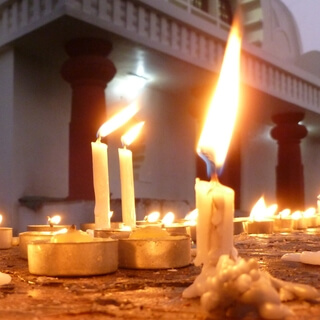
We offer incense to the Buddha.
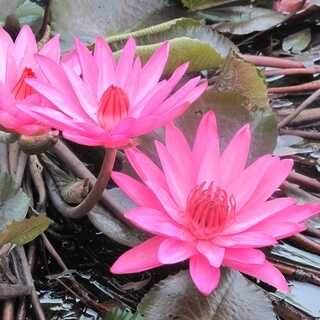
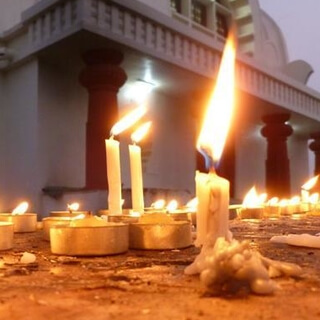
We may offer flowers and candles and water and things like that.
And if you're new to this,
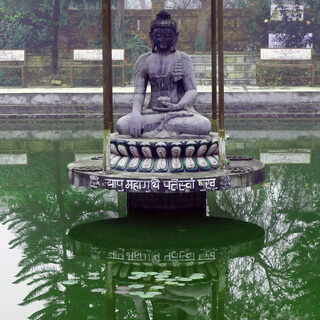
It might look like we're offering these things to a statue.
But a statue is not Buddha.
Buddha is actually the giving.
When we open our hearts to charity,
To generosity,
Things like that,
That is Buddha.
We also chant in an ancient language translated,
We chant words that translate as I bow to the blessed one,
The pure one,
The rightly self-awakened one.
It doesn't really mean much.
But Americans don't much like the idea of bowing.
We're individualists,
We're taught to believe in the supremacy of the self.
And here we are saying there's something better than that.
So what is this Buddha that's somehow higher than my own ego that I have to demonstrate that by bowing?
I imagine most people assume that we're bowing in the same way.
But I think that's the reason why most people assume that we're bowing to Siddhartha,
Godama,
The Sakyamuni,
And assume that blessed,
Pure and awakened is a description of him.
But Buddhism teaches that we are blessed by our own goodness,
By our own good actions.
No deity blesses us.
The blessing is our merit,
Our meritorious action.
Purity is freedom from the habits that lead to harm.
Awakening is what mind is clear enough to let us see deeply into the reality of day-to-day life.
So those are virtues that we hope to cultivate,
But that's not the Buddha.
We don't bow to the Buddha.
The Buddha is the bow.
This is kind of hard to understand,
I'm sure,
If you haven't done it.
But the bow is the realization that the ego that doesn't want to bow is the same ego that returns over and over to stress and suffering.
The act of bowing softens the ego's grip and lets a shaft of light,
A light of wisdom and compassion,
Shine into our heart.
And so when I bow,
That's not only me seeing Buddha or saying that I'm one with Buddha,
This very mind is Buddha.
So your Buddha might look very different than my Buddha,
And that's fine.
Buddhas come in a lot of different forms.
The important thing is to acknowledge that awakening is available.
The important thing is the bowing.
So a lot of people come to my online meetings or they go to White Sands Buddhist Center or Tomoka Correctional Institution where I'm a chapel volunteer.
They want to learn how to meditate and do Buddhist practices that they don't necessarily want to convert to a religion or identify as a Buddhist,
And that's perfectly okay.
You don't have to be a Buddhist to practice Buddhism.
People in a lot of different traditions meditate.
The Buddha probably learned meditation from Yogis and Jain ascetics.
Some other practices associated with Buddhism actually originated before Sakyamuni lived,
And some were co-opted or borrowed or adapted as Buddhism expanded into other areas.
So for example,
When Buddhism reached China,
It became highly influenced by Daoism and Confucian social norms,
And most recently you'll see prominent teachers like Vietnamese master Venerable Thich Nhat Hanh doing things like Christian Buddhist interfaith retreats and others doing programs on Jewish Buddhism.
That's very popular these days.
So one of the key differences between Buddhism and many other religions is that as far as we're concerned anyway,
You can practice Buddhism and identify with another religion too,
Or no religion at all if that's what you prefer.
There's a teacher that I really like a lot,
Father Robert E.
Kennedy Roshi.
So Roshi means Zen master.
So he's a Jesuit priest and a Zen master,
And he once wrote about an encounter he had with a man who would eventually become his Zen teacher,
Yamada Roshi.
And after several days,
He went,
This was during the ecumenical movement probably,
And he went to this meditation retreat,
And after several days in this meditation retreat with Yamada,
Kennedy suddenly realized that this Japanese guy was trying very hard to help him be a better Christian.
So your own Buddha might appear when you notice a profound significance in one of your seven principles,
For example,
Or maybe when you recall a line from the Bible or some other sacred text,
And you feel connected to something greater than yourself.
So you're welcome to use Buddhist practice to become a better Unitarian Universalist or otherwise deepen your spiritual life.
But I wanted to offer you a few basics of what the Buddha taught and some thoughts on how you might use those as tools for your own awakening.
You may have heard Buddhism described as the middle way.
A few weeks after the Buddha's enlightenment,
He gave his first talk in which he spelled out what was referred to as the middle path.
This phrase,
The middle path,
Causes a little confusion.
It's not a compromise.
It doesn't mean moderation in all things.
But the Buddha was born a prince,
Basically.
He spent most of his early life in luxury and ease,
And then he recognized that that wasn't a path to real peace,
To real freedom,
To real happiness.
And so he then spent six years immersed in the most extreme forms of asceticism.
And then he saw that that also didn't lead to transcending suffering.
It didn't lead to true peace.
It didn't lead to true happiness.
And so the middle way recognizes that the problems inherent in both of those extremes and transcends them both.
So it's not a path of indulgence.
It's not a path of deprivation.
It's its own path,
The middle path.
So in this first discourse,
The Buddha talked about the first seal of the Dharma.
There are four seals of the Dharma.
And these are the foundations on which all the other teachings are laid.
And the first one is the truth of Dukkha.
So Dukkha is an ancient Indian word that is usually translated as suffering.
So you'll hear the first noble truth is that all life is suffering,
Which is not exactly what the Buddha said.
But there's not really a good one word translation of it.
Dukkha encompasses everything from petty annoyance to the full-blown existential angst.
And so we can just call it stress.
So when we get stressed,
We usually think that the cause is a person or situation that we're stressed about.
But the Buddha actually said that the real cause of stress is craving for the situation or person to be other than it is.
It's hard to see this when we're looking at our own cravings because we tend not to want to let our cravings go.
But often we create,
We crave things that create affliction that will ultimately lead to difficulties or at least disappointments.
And so in this case,
The solution to the problem is the craving,
To let go of the craving.
So I'll give you a personal example of this.
So about 30 years ago,
I came to the realization with some help that my drinking was causing a lot of trouble.
And so I committed to giving up alcohol.
Well,
A few days after I made this commitment,
I went to the opera with some family members and it happened to be a performance of Faust.
So during the intermission,
I went out to the lobby and there were a lot of people standing around in the lobby with glasses of champagne.
And I really wanted one.
And this initial craving,
Craving is often a physical urge that's accompanied by a bunch of thoughts and impulses.
This led to a bunch of thoughts arising,
One glass of champagne won't hurt,
I can quit drinking later,
It'll be better to do it on a Monday anyway.
All these thoughts are arising.
But I recognized what was going on.
And I started letting those thoughts pass unheated.
I let go of the craving.
And so after intermission,
I went back in and sitting in the dark listening to Faust wrestling with his own demon,
I watched craving after craving arise and pass.
One by one,
I let them go.
And by the end of the show,
I felt an incredible sense of freedom.
Of course,
That wasn't the end of it.
Similar urges arose later on.
But having let them go in the past,
I recognized that they weren't real.
They were just fragments of thought and sensation that would pass if I didn't give in to them.
And eventually they stopped arising.
So this brings us to the second seal of the Dharma,
Which is impermanence.
Everything passes,
Things that we like,
Things we don't like,
Everything that's made up of other things,
Which includes us and all the forms around us and stuff like that,
Thoughts and all those kinds of things,
All eventually change.
Even our own life is impermanent.
And if we expect things to be otherwise,
Then we're going to be disappointed.
So the third seal is the doctrine of not self.
And this one is really causes a lot of confusion,
But it follows from this.
So sometimes people say that Buddhists believe there's no self,
But that's not entirely accurate.
In fact,
I can see mine right there on the zoom screen in front of me.
And I recognize what I'm looking at as something I consider me.
So of course there's a self,
But our existence came into being with no help from us.
We owe our life to a lot of things,
Our ancestors,
Other living things that we have consumed,
Air and water that flows constantly through us,
Support from the society we share with others,
Cultural and social,
And we have a lot of things that we share with others,
Cultural stuff,
All these things.
We can't make ourselves a certain way.
We can't decide what we're going to feel with our senses or what we're going to perceive.
I can't decide,
Well,
My senses are mine,
So I'm only going to smell roses.
I'm not going to smell compost.
We can't force thoughts to stop arising.
Anyone who's ever tried to meditate knows that thoughts come up.
You don't have to do anything to get them.
So they're not yours to control.
We can't decide we're only going to have good memories.
We're not going to experience anything unpleasant.
So,
You know,
This can sound a little bleak,
But the final seal of the Dharma is Nirvana.
If you can understand that there's something to be gained by transcending craving,
Then you have begun to understand Nirvana.
So to approach the freedom of Nirvana,
It's not enough to know about it or believe in it.
We have to practice it.
People think of Nirvana as something you attain.
It's a place you go when you die or something like that.
It's really something you practice.
We try to stop blaming our stress on externals,
For instance.
We're understanding that if we're looking outside ourselves for inner peace,
We're looking in the wrong place.
We're no longer turning to refuges like alcohol or work or material wealth or relationships or whatever we've been identifying with as ours and trying to entangle ourselves with.
So there's a little mnemonic device that's kind of helpful for this.
It was suggested by a colleague of mine,
A Buddhist priest and Buddhist studies professor named Kenneth Tanaka,
And he tells his students to remember that this way,
That life is big.
B-I-I-G.
The B stands for bumpy.
Life is a bumpy road.
Obstacles and discomforts are inevitable.
And that's the first seal,
The Buddha's first teaching.
If you're born,
You're going to experience some stresses.
The first I stands for impermanent,
And the second one stands for interdependent.
Everything that we experience with our senses is unstable because it's made up of other things.
If we believe that something like that is going to be an enduring source of happiness,
We're going to be let down.
So because there's no self that's truly ours,
Everything is interdependent.
So we can't change the past or predict the future.
We can't change the past or predict the future or control other people.
The only thing we really own is our karma,
Which is our actions and their results.
So if we focus on what we do and don't try to judge and control circumstances,
We're going to experience a happier life.
If we try to control things that are outside our control,
We're just going to create frustrations for ourselves.
The G stands for good.
Life is ultimately good.
We talk about Buddha nature,
Which is the innate capacity for awakening that we all possess.
And that's really our fundamental goodness.
And our experience of life and whether it's pleasant or unpleasant has relatively little to do with what happens to us.
It has a great deal to do with how we use our attention.
One of my famous teachers from history,
Zen Master Dogen,
Said to study the Buddha way is to study the self.
And then he goes on from there and eventually says,
When you're awakened,
The trees and rocks and clouds are awakened too.
So in other words,
When we open up our minds to our Buddha nature,
We recognize the Buddha nature and everything around us.
When we accept difficulties,
When we accept that we can't control everything,
We start paying attention to the ways that we're supported by the world around us.
Our experience of life is greatly improved.
So you have some interesting experiences when you start working on your attention,
When you start trying to wake up,
Actively cultivating compassion,
Practicing mindfulness,
For example.
So at one time when I was doing the Buddhist minister training,
I'm ordained in multiple traditions,
And one of them is as a Jodo Shinshu minister.
And my teacher there had us do a period of time where we were working through sort of in-life day-to-day practices.
And so one week,
Whenever I turned on a water faucet or a light switch or something like that that made something flow,
I was to take a few deep breaths and gosho,
This is gosho,
Putting your hands together like this.
So one day during that week,
I stopped at a gas station that fell out my car,
And I got out and I was going through all of this stuff with the debit card and all of that kind of thing.
And there was a car on the other side of the pump,
And it had stereo playing.
Doors open,
Stereo blasting.
That big thumping bass,
Boom boom boom stuff,
Right?
And all this kind of thing.
And the driver wasn't in the car.
I guess he'd gone inside to pay.
And so as I'm reaching for the gas pump,
He comes out.
He's this kind of thuggish looking guy with a lot of tattoos and pants down around his thighs and all that kind of stuff.
So I started to pull the lever on the gas pump to put gas in my car,
And I remember,
Oh,
I got a gosho.
So I gosho.
That sort of threw my mindfulness switch to on.
And I suddenly see where my mind is and where it has been going.
And his mind's will,
It had gone to judgments about people with loud stereos and people who listen to that kind of music and dress that kind of way and that sort of thing.
And as I noticed this,
As I goshoed,
And I noticed what my mind was doing,
That stopped.
And I realized this guy likes music.
I like music.
Some of the music I like has probably annoyed a lot of the people around me over time.
And as I saw the judgments I'd been making,
I realized I'd been judged like that too because I'd dressed a certain way or looked a certain way.
And I knew how that felt,
And I knew it was unpleasant.
And so suddenly,
Instead of judging this guy,
I feel the surge of compassion arising and accompanied by this desire,
The really deep desire that he'd be free from suffering.
And so I looked over at him and smiled.
And he didn't smile back,
But that was okay.
He probably really didn't even notice,
Had no idea what I was doing,
But it didn't matter.
At that moment,
I had seen the Buddha.
So Buddhist practice doesn't necessarily mean doing special rituals like goshoing while you're pumping gas.
You know,
You can do it without all of that stuff.
I spent a three-day weekend once at a Zen retreat that had been organized,
Actually organized,
By a Yuyu church in Gainesville.
And the church's pastor was a Zen student,
And he had arranged to bring in a Zen master from Texas.
And the pastor himself played the role that basically would be played by the head monk at a monastery.
So he was kind of handling all the management of the day-to-day stuff and explaining to people what to expect.
Because most of the people who were there were new to Zen,
And so the retreat started at dinnertime on a Friday.
And after dinner,
The pastors talked about how things would run.
So in Japanese Zen retreats,
There's typically a work period every day.
And so we would all be assigned some work duties,
And we were also each given an opportunity,
An assignment of washing the dishes.
And so he explained that in Zen,
The work isn't something that you do because you have to do it.
It's actually an extension of your meditation.
It's a spiritual practice.
And he quoted Vietnamese Zen master,
The variable Thich Nhat Hanh,
He said,
Thich Nhat Hanh says,
We don't wash the dishes to get the dishes clean.
We wash the dishes to wash the dishes.
Which is not really what Thich Nhat Hanh said,
But it kind of sort of close.
His point was,
Instead of rushing through whatever tasks we were assigned,
We were to use this as another way to meditate,
As a way to continue our mindfulness beyond the point where we were sitting on cushion breathing,
To the point where we were living our lives and living our lives mind-proof.
So my turn to wash dishes came a couple of days into the retreat,
And there was this big dish pan full of water,
And my dishwashing partner,
We were working together,
Was loading dirty dishes into the water.
And so I reached in to grab a dish and wash it,
And I came up with a handful of spaghetti noodles.
We'd had spaghetti about four meals earlier,
So I told my partner that I was going to go get some fresh water.
She says,
Oh no,
We're supposed to conserve water.
I said,
Yeah,
I understand that,
But I don't think we can get the dishes clean with water this dirty.
And she goes,
Oh yes,
But remember Thich Nhat Hanh says,
We don't do the dishes to get them clean.
We wash the dishes to wash the dishes.
So I'm standing there trying to figure out a polite way,
You know,
To explain that the famous Zen master didn't mean that we didn't also need to get the dishes clean,
But the pastor came over and said that dish water is filthy.
Go get fresh water.
So that got me off the hook there.
But during that retreat,
I spent about 30 hours meditating,
Had one-on-one meetings with the teacher,
Listened to several Dharma talks and all that kind of stuff.
The teaching that I got from the exchange about the dishwater stuck with me more than anything else.
It reminded me that your life is your spiritual path and its mundane tasks are your spiritual practice.
You don't have to turn them into something special.
Life is already special.
So I hope that this has given you some ideas about how you might apply Buddhist practices to your own spirituality,
Whatever that is.
And thank you very much for your attention.
Thank you for joining me for episode 22 of the Adventures of Saraputa and Mogulana.
I want to thank the Unitarian Universalist congregation of Ormond Beach for inviting me to spend a sunny morning with them.
I hope my discussion of practical practice has been useful to you.
Now go save the world.