Hi,
This is Stefania,
And let's move on with our story,
The Wind in the Willows.
We're on part five now,
And Mole is going to finally meet Badger.
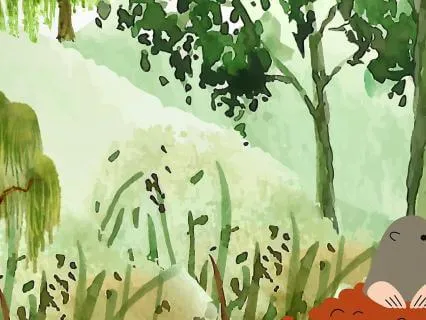
The Wild Wood The Mole had long wanted to make the acquaintance of the Badger.
He seemed by all accounts to be such an important personage,
And though rarely visible,
To make his unseen influence felt by everybody about the place.
But whenever Mole mentioned his wish to the Water Rat,
He always found himself put off.
So right,
The Rat would say,
Badger will turn up some day or other,
He's always turning up,
And then I'll introduce you.
The best of fellows,
But you must not only take him as you find him,
But when you find him.
Couldn't you ask him here for dinner or something?
Said the Mole.
He wouldn't come,
Replied the Rat simply.
Badger hates society,
And invitations,
And dinner,
And all that sort of thing.
Well then,
Supposing we go and call on him,
Suggested the Mole.
Oh,
I'm sure he wouldn't like that at all,
Said the Rat quite alarmed.
He's so very shy,
He'd be sure to be offended.
I've never even ventured to call on him at his own home,
Myself,
Though I know him so well.
Besides,
We can't,
It's quite out of the question,
Because he lives.
.
.
.
.
.
In the very middle of the Wildwood.
Well,
Supposing he does,
Said the Mole.
You told me the Wildwood was all right,
You know.
Oh,
I know,
I know,
So it is,
Replied the Rat evasively.
But I think we won't go there just now,
Not just yet.
It's a long way,
And he wouldn't be at home at this time of year anyhow.
And he'll be coming along someday,
If you'll wait quietly.
The Mole had to be content with this,
But the Badger never came along,
And every day brought its amusements,
And it was not till summer was long over,
And cold,
And frost,
And murrayways kept them indoors,
And the swollen river raced past outside the window with a speed that mocked at boating of any sort or kind,
That he found his thoughts dwelling,
Again,
With much persistence on a solitary gray Badger,
Who lived his own life by himself in his hole in the middle of the Wildwood.
In the wintertime,
The Rat slept a great deal,
Retiring early and rising late.
During his short day,
He sometimes scribbled poetry,
Or did other small domestic jobs about the house.
And of course,
There were always animals dropping in for a chat,
And consequently there was a good deal of storytelling and comparing notes on the past summer and all its doings.
Such a rich chapter it had been when one came to look back on it all,
With illustrations so numerous and so very highly colored.
The pageant of the riverbank had marched steadily along,
Unfolding itself in scene pictures that succeeded each other in stately procession.
Purple loose strife arrived early,
Shaking luxuriant tangled locks along the edge of the mirror whence his own face laughed back at it.
Willow herb,
Tender and wistful like a pink sunset cloud,
Was not slow to fallow.
Comfrey,
The purple hand in hand with the white,
Crept forth to take its place in the line.
And at last,
One morning,
The diffident and delaying dog,
Rose,
Stepped delicately on the stage.
And one knew,
As if string music had announced it in stately chords that strayed into a gavotte.
The June was at last here.
One member of the company was still awaited.
The shepherd boy for the nymphs to woo.
The knight for whom the ladies waited at the window.
The prince that was to kiss the sleeping summer back to life and love.
But when metal sweet,
Tabernare and odorous and amber jerkin moved graciously to his place in the group,
Then the play was ready to begin.
And what a play it had been.
Drowsy animals snuck in their holes while wind and rain were battering at their doors.
We called still keen mornings,
An hour before sunrise,
When the white mist,
As yet undispersed,
Clung closely along the surface of the water.
Then the shock of the early plunge,
The scamper along the bank and the radiant transformation of earth,
Air and water,
When suddenly the sun was with them again.
The gray was gold and color was born and sprang out of the earth once more.
They recalled the languorous siesta of hot midday,
Deep in green undergrowth.
The sun striking through in tiny golden shafts and spots.
The boating and bathing of the afternoon,
The rambles along dusty lanes and through yellow cornfields.
And the long,
Cool evening at last,
When so many threads were gathered up,
So many friendships rounded,
And so many adventures planned for tomorrow.
There was plenty of talk on those short winter days when the animals found themselves around the fire.
Still,
The mole had a good deal of spare time on his hands.
And so,
One afternoon,
When the rat in his armchair before the blaze was alternately dozing and trying over rhymes that wouldn't fit,
He formed the resolution.
To go out by himself and explore the wild wood and perhaps strike up the acquaintance with Mr.
Badger.
It was a cold,
Still afternoon with a hard,
Steely sky overhead when he slipped out of the warm parlor into the open air.
The country lay bare and entirely leafless around him.
And he thought that he had never seen so far.
And so intimately into the insides of things as on that winter day when nature was deep in her annual slumber and seemed to have kicked the clothes off.
Copses,
Dells,
Quarries,
And all hidden places which had been mysterious mines for exploration in leafy summer now exposed themselves and their secrets pathetically and seemed to ask him to overlook their shabby poverty for a while till they could riot in rich masquerades before and trick and entice him with the old deceptions.
It was pitiful in a way and yet cheering,
Even exhilarating.
He was glad that he liked the country undecorated,
Hard,
And stripped of its finery.
He had got down to the bare bones of it and they were fine and strong and simple.
He did not want the warm clover and the play of seeding grasses,
The screens of quickset,
The billowy drapery of beech and elm seemed best away.
And with great cheerfulness of spirit he pushed on towards the wildwood which lay before him low and threatening.
Like a black reef in some still southern sea.
There was nothing to alarm him at first entry.
Twigs crackled under his feet,
Logs tripped him,
Funguses on stumps resembled caricatures and startled him for the moment by their likenesses to something familiar and far away.
But that was all fun and exciting.
It led him on and he penetrated to where the light was less.
And the trees crouched nearer and nearer and holes made ugly mouths at him on either side.
Everything was still,
Very still now.
The dusk advanced on him steadily,
Rapidly,
Gathering in behind and before and the light seemed to be draining away like flat water.
Then the faces began.
It was over his shoulder and indistinctly that he first thought he saw a face,
A little evil wedge-shaped face looking at him from a hole.
When he turned and confronted it,
The thing had vanished.
He quickened his pace telling himself cheerfully not to begin imagining things or there would simply be no end of it.
He passed another hole and another and another and then,
Yes,
No,
Yes,
Certainly,
A little narrow face with hard eyes had flashed up for an instant from a hole and was gone.
He hesitated,
Braced himself up for an effort and strode on.
Then suddenly,
As if it had been so all the time,
Every hole,
Far and near,
There were hundreds of them,
Seemed to possess its face,
Coming and going rapidly,
All fixing on him glances of malice and hatred,
All hard-eyed and evil and sharp.
If he could only get away from the holes in the banks,
He thought,
There would be no more faces.
He swung off the path and plunged into the untrodden places of the wood.
Then the whistling began.
Very faint and shrill it was and far behind him when first he heard it,
But somehow it made him hurry forward.
Then still very faint and shrill sounded far ahead of him and made him hesitate and want to go back.
As he halted in indecision,
It broke out on either side and seemed to be caught up and passed on through the whole length of the wood to its farthest limit.
They were up and alert and ready,
Evidently,
Whoever they were.
And he,
He was alone and unarmed and far from any help and the night was closing in.
Then the pattering began.
He thought it was only falling leaves at first,
So slight and delicate was the sound of it.
Then as it grew,
It took a regular rhythm.
And he knew it for nothing else but the pat,
Pat,
Pat of little feet,
Still a very long way off.
Was it in front or behind?
It seemed to be first one,
Then the other,
Then both.
It grew and it multiplied till from every quarter as he listened anxiously,
Leaning this way and that,
It seemed to be closing in on him.
As he stood still to hearken,
A rabbit came running hard towards him through the trees.
He waited,
Expecting it to slacken pace or to swerve from him into a different course.
Instead,
The animal almost brushed him as it dashed past,
His face set and hard and his eyes stirring.
Get out of here,
You fool,
Get out.
The mole heard him mutter as he swung round a stump and disappeared down a friendly barrel.
The pattering increased till it sounded like a sudden hail on the dry leaf carpet spread around him.
The whole wood seemed running now,
Running hard,
Hunting,
Chasing,
Closing in on something or somebody.
In panic,
He began to run too aimlessly,
He knew not whither.
He ran up against things,
He fell over things and into things,
He darted under things and dodged around things.
At last,
He took refuge in the deep,
Dark hollow of an old beech tree,
Which offered shelter,
Concealment,
Perhaps even safety,
But who could tell?
Anyhow,
He was too tired to run any further and could only snuggle down into the dry leaves which had drifted into the hollow and hope he was safe for a time.
And as he lay there,
Panting and trembling and listening to the whistling and patterings outside,
He knew at last,
In all his footness,
That dread thing.
Which other little dwellers in the field and hedgerow had encountered here and known as their darkest moment.
That thing which the rat had vainly tried to shield him from.
The terror of the wild wood.
Meanwhile,
The rat,
Warm and comfortable,
Delves by his fireside.
His paper of half-finished verses slipped from his knee,
His head fell back,
His mouth opened,
And he wandered by the verdant banks of dream rivers.
Then a call slipped,
The fire crackled,
And sent up a spurt of flame and he woke with a start.
Remembering what he had been engaged upon,
He reached down to the floor for his verses,
Pored over them for a minute,
And then looked round for Mole to ask him if he knew a good rhyme for something or other.
But the Mole was not there.
He listened for a time,
The house seemed very quiet.
And then he called,
Mole,
Mole,
Several times,
And receiving no answer,
Got up and went out into the hall.
The Mole's cap was missing from his accustomed peg.
His galoshes,
Which always lay by the umbrella stand,
Were also gone.
The rat left the house and carefully examined the muddy surface of the ground outside.
Hoping to find the Mole's tracks.
There they were,
Sure enough.
The galoshes were new,
Just bought for the winter,
And the pimples on their soles were fresh and sharp.
He could see the imprints of them in the mud,
Running along straight and purposeful,
Leading direct to the wild wood.
The rat looked very grave and stood in deep thought for a minute or two.
Then he reentered the house,
Strapped a belt round his waist,
Shoved a brace of pistols into it,
Took up a stone cudgel that stood in the corner of the hall,
And set for the wild wood at a smart pace.
It was already getting towards dusk when he reached the first fringe of trees and plunged in without hesitation into the wood,
Looking anxiously on either side for any sign of his friend.
Here and there,
Wicked little faces popped out of holes,
But vanished immediately at the sight of the valorous animal,
His pistols,
And a great,
Ugly cudgel in his grasp.
And the whistling and pattering which he had heard quite plainly on his first entry died away and ceased,
And all was very still.
He made his way manfully through the length of the wood to his furthest edge,
Then forsaking all paths,
He set himself to traverse it,
Laboriously working over the whole ground,
And all the time calling out cheerfully,
Molly,
Molly,
Where are you?
It's me,
It's old Rat.
He had patiently hunted through the wood for an hour or more,
When at last to his joy he heard a little answering cry.
Guiding himself by the sound,
He made his way through the gathering darkness to the foot of an old beech tree with a hole in it,
And from out of the hole came a feeble voice saying,
Ratty,
Is that really you?
The Rat crept into the hollow,
And there he found the Mole,
Exhausted and still trembling.
Oh,
Rat,
He cried,
I've been so frightened,
You can't think.
No,
I quite understand,
Said the Rat soothingly.
You shouldn't really have gone and done it,
Mole,
I did my best to keep you from it.
We river bankers,
We hardly ever come here by ourselves.
If we have to come,
We come in couples,
At least,
Then we're generally all right.
Besides,
There are a hundred things one has to know,
Which we understand all about,
And you don't,
As yet.
I mean,
Passwords,
And signs,
And sayings which have power and effect,
And plants you carry in your pocket,
And verses you repeat,
And dodges and tricks you practice,
All simple enough when you know them,
But they've got to be known if you're small,
Or you'll find yourself in trouble.
Of course,
If you were Badger or Otter,
It would be quite another matter.
Surely,
The brave Mr.
Toad wouldn't mind coming here by himself,
Would he?
Inquired the Mole.
Oh,
Toad!
Old Toad,
Said the Rat laughing heartily,
He wouldn't show his face here alone,
Not for a whole hatful of golden guineas,
Toad wouldn't.
The Mole was greatly cheered by the sound of the Rat's careless laughter,
As well as by the sight of his stick and his gleaming pistols,
And he stopped shivering and began to feel bolder and more himself again.
And that's the end of this chapter.
Mole really got himself into a fright,
Didn't he?
But Ratty came along,
And the Mole was okay again.
Mole will always be okay in the end,
So don't get frightened or worried.
He'll always be okay.
We'll be back again soon with the next part of The Wind in the Widows,
Which was requested by an Insight Timer listener.
Bye for now.