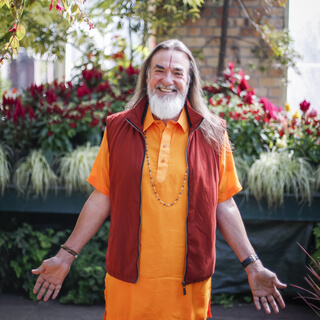
Namaste.
Welcome to Chats with Swamiji.
For more information,
Log on to www.
Swamigovindananda.
Com We are back here today,
Chats with Swamiji.
Namaste,
Swamiji.
Namaste.
Today's topic is quite an interesting one.
They're quite curious to understand the parallels between religion and science.
And I'm adding my own one,
Spirituality.
So I feel that they're quite different topics but still intermingled.
So how would you perhaps describe the connections or maybe the disconnections between the three?
Ooh,
It is an interesting question.
I haven't always thought of myself as a religious man.
Because religion to me is often human-made.
It's a collective where people have a set of beliefs.
And often it's not the one who's leading that education is not really advanced.
And they're understanding,
Shall we say,
And therefore they can often,
It's not always,
But they can resort to ritualism,
To tradition.
They just do it because that's how they've always done it.
So I like to avoid the word religious.
Science,
When we talk about science,
I think science is an absolutely essential part of our community.
But science keeps changing its mind.
My parents,
My mother,
She used to read the New Zealand Women's Weekly.
And,
You know,
On one week it would promote milk,
You know,
And give all the reasons why you should have milk.
Two weeks later there'd be another article saying that milk creates cholesterol,
You know,
And you shouldn't have milk,
Etc.
And then,
So she used to put it on the table and take it off and put it on and take it off,
Because so-called research and science keep changing their mind.
Nevertheless,
Having said that,
According to the Vedas,
This planetary system works on spiritual law.
There are rules,
Just like,
For example,
We have the four seasons,
Depending where the country is on this globe.
But we have,
Let's say,
The four seasons and you get,
You know,
Autumn,
Winter,
Spring,
Summer.
You have species that can only live in the water.
You have species that can only live on the earth,
On the air.
You have species that can fly and those that can't.
You have the power of thought and thought creates consequence.
You know,
The saying,
As you think,
So you become,
As you sow,
So you reap.
I mean,
These are famous quotations.
So the power of thought,
You know,
We have from living in mud houses to pent houses on 50,
60 levels above the ground.
We have the Hubble that goes up into space to take photographs.
We've approaching Mars and all these kind of extraordinary things.
This is a manifestation of the power of thought.
And scientists,
They never invent anything new per se.
What they tend to do is that they discover what already is there.
They just reorganize.
OK,
So if we take what is already there,
Which is this,
And we put it over here,
Which is already there,
And we merge the two together,
Then these two laws create this.
So A with B creates,
Like,
Let's say,
C.
So science,
You know,
The Vedic philosophy really does lay out about the age of the Earth and not only the four seasons,
But it talks about four yugas,
Great ages,
And the qualities of these different ages.
And just as the seasons roll on,
So do these ages.
And it talks about infinite planetary systems,
Et cetera.
And every now and again,
You know,
Science will concur.
They'll say,
Well,
You know,
We've just discovered a new planet,
Et cetera.
Evidence in the sense that,
You know,
You could say you have physical evidence of how things work.
You have perceptual evidence just by logic and thinking.
But the spiritual evidence of what the Vedas and the sages and the rishi and the wise men and women,
The guru,
What they have to say,
It takes time for an individual to spend in their company and put into practice what they're advising on the basis of these great writings like the Gita,
The Vedas,
And so on,
And find out for yourself by your own research how that applies to you in your life.
So I tend to think of myself as a spiritual man.
But which ears are going to hear me say I'm a spiritual man?
Because some people will interpret a spiritual person who goes to a psychic,
Who goes to the I Ching,
You know,
Who goes to knuckle bones.
You know,
We all have different understandings of what words mean.
The letters compose the word spiritual as the same.
But our ability to understand what that means,
And you're asking me to explain.
So when I talk about spiritual,
I am talking about the soul within the body and its purpose.
I'm talking too about this material phenomena in which we live,
This world and other world regions,
Which according to the Vedas is called maya,
M-A-Y-A.
This is the material phenomena.
And then I'm talking about yogmaya and yogmaya.
This is the spiritual or the divine nature of humanity.
And how they all mesh together.
My guru many years ago,
He gave a series of talks,
Which in fact,
That very series is what his swamis and swaminis model their education on with his guidance.
And he started a series with the verse,
Tumavah Viditwati Murit Tumeti Nanyah Pantah Vidyateyya Naya.
And he explained over a series of talks what that one verse means.
In essence,
It says,
By knowing him,
Her,
It,
One can cross it.
There's no other way.
And he says,
Well,
Who's the one that has to do the knowing?
What is that which has to be crossed?
And who or what is that which has to be realized?
And so here he talks about three eternal powers.
The one that does the knowing is the jivatma,
The individual soul that's within your body and mine rishi and the heart region,
The spiritual power.
That which has to be crossed is this maya,
This material energy.
The one who has to be known is known as the paratma,
Or pronounced paramatma.
Just as we are jivatma,
Which means individual soul,
Paramatma is the collective.
All souls are included in the word paramatma,
The divine that is the soul of souls.
In other words,
Bhagavan,
God,
The divine one.
So in this series,
He talked about your soul power.
He talked about this material phenomena,
Including your body,
Including your mind,
Including the world at large,
Including how you relate to others,
Including about the different species from bird life,
Plant life,
Fish,
Animal,
Human,
Celestial,
Spirit realm.
He talks about all of this.
Then he talks about the cycle of life and death known as the wheel of samsara.
He talks about the mind,
What does it want,
And he distills it down to a verse,
Saravesha mappibhutanam niripasvatmaiva vallabha.
This Sanskritan verse explains,
Everybody wants to be joyful.
Everybody wants to be happy.
Nobody gets up and says,
I think I just want to be so unhappy today.
You might take a very strange way to try and be happy,
But that's the aim if you really,
Really think about it.
And then he says,
Well,
How will you achieve this?
And so he talks about the material nature and the world and the spiritual.
That's why I use the term spiritual man.
He talks about our spiritual nature.
Spiritual woman,
Don't get gender bias here.
Our spiritual nature and how we can actually move through this sea of ignorance in Sanskrit known as ajnan,
Ignorance.
How we can move from a state of unknowing to a state of knowing.
How we can move from I am this body and when my body dies,
That's it,
I'm dead.
The Vedas said,
No,
No,
No,
You're not dead.
The soul cannot be killed.
The body,
That's another thing.
It's made of the five elements of earth and water and air and fire and ether,
Etc.
That's going to transmorph into,
You know,
Earth to earth,
Dust to dust,
Etc.
You're a spiritual power.
And so to cross this Maya,
The sea of ignorance is to know yourself.
And what does know yourself mean?
It's to understand when you hear the word yoga,
The root word of yoga is yuj.
And yuj means to unite your spiritual power,
The individual soul,
With the pada atma,
The divine nature to unite it through realization and an experience.
So therefore,
The categories between religious,
Which is ritual and there's a verse,
Yasya matam yasya naveda saha,
Will not the blind lead a blind person into the ditch?
Means if you don't know and you're trying to figure it out with your own intellect,
You'll fail.
So religious often is just,
I've got to be careful here because people do use that word with great reverence,
So it's no disrespect to the listeners when I say this.
It's just you asked what my understanding is.
So religious is often ritualistic.
It's not really led by the profound who has truly understood.
And then you talk about science.
Well,
Science is an ever-evolving thing and sometimes it's a devolving thing.
They change their mind.
They think they've understood when they haven't.
And sometimes they really do get it right.
They really do understand about the laws of physics and how it works and how to utilize those laws in a way to create,
Which is a wonderful,
Wonderful thing.
Without science we'd be in real trouble.
And then there's a spiritual nature,
Which is about the soul,
The jivatma,
And the padamatma,
The soul of souls.
And it helps us just to repeat,
To understand the physical phenomena in which we live,
To understand the spiritual nature of this environment in which we live,
To understand how to go through the sea of ignorance to realize our true self,
Which has uncountable names.
There are verses,
Hari nama anantana muru paya.
It means the divine one's uncountable names.
Uncountable because there's nothing about the divine one,
The divine nature that is finite,
That's limited.
So uncountable names,
Uncountable forms,
And they,
Oh,
That's too confusing.
Well,
Of course,
In the beginning when you don't know much,
It is.
But if you happen to have the good fortune to meet a genuine guru,
They'll explain all of this to you in a way that you can put it into practical use every day and grow and find the joy and the beauty which we all want.
And while you're doing that,
It's not that you've got to grow an extra head or an extra arm or be a pariah from the rest of community because you're spiritual.
It's not about outer manifestation of dress or habit or superiority or inferiority or intelligence or stupidity.
It's about understanding.
So you do your activities in the world like everybody else,
But there's an internal evolution,
Revolution,
You could say,
As private,
As personal.
So I'd say,
Wow,
That was a vast knowledge and deep philosophy and almost poetic.
I'm going to take one part of what you've said to try and go deeper.
And this is the notion of soul because you've mentioned it quite a few times.
So could you maybe explain the notion of soul from a religious versus scientific versus spiritual perspective?
And if I don't have a religion,
You know,
I made this too,
I don't believe in science,
How would you describe it?
Well,
If we go with science,
They can't see the soul,
They've never seen the soul.
You can,
Through inference,
Say,
Well,
There must be some power that keeps the body going because nothing can have energy without a source.
You can't have energy without the source of the energy.
So we know the body's got energy.
It's a standalone power,
So we believe.
So science can't measure that.
There is an example that if you took a single strand of your hair and divided it a million times and then you took that millionth slice of a single strand of your hair,
Divided another million times,
If you could find the millionth,
Millionth slice of a single strand of your hair,
The soul is more subtle than what you have in your hand.
That's how subtle a soul is.
So science,
I suppose you could say the jury's out.
They can't physically prove its existence.
So science is definitely behind the eight ball on this one.
Religious nature,
Well,
They do acknowledge the soul.
We do say you're a soul brother,
My soul mate,
You know,
I'm a soul of Jesus.
These terms are used depending on the culture and where you grew up,
Et cetera.
But how much you understand of that language,
For example,
I've given many talks and if I say to someone,
Do you know why you have eyes?
And people say,
Of course.
Do you know why you've got ears?
Yes.
Do you know why you've got teeth?
Yes.
What are you,
Silly Swamiji?
And then if I say,
Do you know why you have a soul?
That's where there's silence.
People go,
Ah,
Have I got one?
Or they'll say,
Well,
Look,
I've got one,
I've got one.
So why do I need to overthink this?
You know,
Yeah,
I've got a soul,
So what?
Whereas the spiritual philosophy of the Vedas,
They drill down very,
Very deep about the soul,
The atma.
And it is an extremely complex science.
When you hear my Guruji Sri Maharaj speak about it,
You just go,
Whoa.
So what I share is really the essence of it.
It's not different from what he says.
It's just not as complicated as how he explains it because he is a master of the subject.
But the soul,
You see,
The atma is described by three terms.
One is sat,
S-A-T,
Sat,
Sanskrit.
The second term is chit,
C-H-I-T.
And the third word is anand,
A-N-A-N-D-A,
Anand.
So these three names,
Sat,
Chit,
Anand,
If you roll them together.
What is sat?
There is a verse,
Nasato vijitabhavo,
Na bhavavijitai,
Sat,
Taha.
It describes the soul as an eternal power.
It was never made.
It's not that your mom and dad through an expression of passion decided,
Let's build a soul,
Let's make a soul.
I haven't got a clue how to make a soul.
You could say,
Well,
The body did it.
I didn't.
I just was amorous and the body knows what to do.
Something as profoundly complicated as an individual is just made by the body.
No,
No,
It's much deeper than that.
So the verse says the soul is sat.
It was never made.
It will never be unmade.
It's an eternal power.
Well,
That means before the birth of your current body,
It existed.
It means that the death of your current body,
It will continue.
So here's the beginning of,
Well,
What do you mean by that?
Where was I,
The soul before this body?
Where will the soul be at the death of this body if it's continual,
Eternal?
Well,
Bookmark that.
We probably need to get back to that later.
And the second name of the soul is chit,
Chit.
It has two meanings,
One is knowledge,
But this one,
Which is important to us,
It is called chit-shakti.
It is a conscious giving power.
That means that when a body,
We say you're alive.
How do you know you're alive?
Well,
Because I'm seeing you,
I'm talking,
I'm moving,
I'm catching a cricket ball,
I'm doing this,
I'm doing that.
Everything's functioning.
Why is it functioning?
It's functioning because of the presence of the art and of the soul.
And the middle name of that is chit.
It means it is conscious giving.
It means it empowers the body to work,
Which means it enables your eyes to see,
Your ears to hear,
Your nose to smell,
Your tongue to taste,
Et cetera,
Et cetera,
Et cetera.
And what we call death is the absence of this chit,
This conscious giving power,
Meaning the soul has left an individual's body and now the body is just reverting back to the five elements.
Or if you burn it,
It reverts to light and energy.
But the soul endures.
And now we come to the third name.
In brief we're talking anand.
Anand means blissful.
It's the Sanskrit word for bliss,
Joy,
Love.
And of these three names,
The sat,
The eternal power,
Chit,
The conscious giving power,
Those two terms are actually adjectives of this third name,
Anand.
What is the nature of anand?
Eternal.
It always exists,
The blissful nature.
And it is conscious.
It's a conscious power.
It's not inanimate.
It's not unconscious.
It's not insentient.
This blissful nature,
It has always had an energy.
Okay.
So we have this power in the body.
And what does that mean to you and I in our day by day?
I gave a verse in a previous talk that you and I had a chat.
The verse was saying that we all want to be joyful.
Everything that we do,
The deepest motive is to be happy and joyful.
So when you wake up in the morning,
The only reason you get out of bed is because you have the hope that today,
Today I'm getting married.
Today I start my job.
Today I'm going to earn money to pay the mortgage so I'm not thrown out on the street and I don't want to live on the street.
So I'm earning money to pay the mortgage so I can remain at least comfortable and happy in that circumstance.
So in other words,
The motivation to be joyful and happy is with us at all moments.
And where does that motivation come?
It comes from the presence of the soul because it's ananda.
It's blissful,
Joyful.
So it radiates onto your intelligence,
Show me the happiness.
We feel it.
We feel the presence of the soul.
Show me the joy.
So we get up.
And by the way,
If somebody doesn't feel that,
If they're so depressed and they're still in bed at three o'clock in the afternoon and you say,
Get up and they say,
What for?
Get up.
What for?
There's no spark of hope of happiness.
I choose not to live.
Even suicide,
Misguided though it may be and sad and unfortunate,
Even suicide is a search for a state that is better,
Better,
Joyful,
More happier.
So the mind feels the impulse of the presence of the soul.
Show me the joy.
Now,
If you believe that you are only the body,
You will go through the five senses.
You'll want to see things that you like.
You'll want to hear things you like.
You want to smell things you like.
You want to eat things you like.
You want to touch things you like.
You will move through the five senses to try and satisfy the sense for joy and happiness.
And that is a fully materialistic approach.
However,
If you begin to understand that you are the eternal soul that is temporarily residing in this temporary body and the soul is blissful,
You will ask the question,
Well,
Where can I find this joy then if going to a movie gives me a little bit of happiness and then the next day I'm back into the grind of going to work?
Or if I,
You know,
I say I like alcohol and I get so drunk that I have to throw up.
Or I say this person I'm going to marry because she or he is the source of my joy only to find I made a mistake.
I need to change my partner.
I mean,
We keep changing because it doesn't satisfy.
Nothing satisfies because it's to do with the soul,
The ananda,
The blissful nature of the soul.
So then you open up another door.
What door is that?
Well,
There are many verses,
Rishi,
To talk about the nature of the soul.
One is ancio nana vyapadeshat.
This Vedic verse says,
The soul,
It is a part of the infinite nature,
Anci,
The whole,
The complete.
The soul is a natural part of that.
Another verse about the soul,
Ya atmani tishtati.
The Sanskrit verse says,
The divine lives with the soul in the heart and the soul also lives within the divine.
They live in each other.
It's an eternal,
Spiritual,
Infinite blissful joy.
Another,
Yau pranasyaprannaha.
It explains that the soul makes up the life's breath of the divine,
Poetical as it may be.
Then there's another,
Loke nahi sabidhye na yonorama manuvrataha.
This Vedic verse says,
We are a part of this infinite joy.
Infinite,
Infinite?
How's that possible?
Well,
The joy that you have here when you go through the five senses is limited.
It starts and it goes.
By what?
You're thinking,
Oh,
I like chocolates.
You have too many chocolates.
Oh,
Don't show me another chocolate.
It'll kill me.
You like it or you don't like it.
I love you.
Now I hate you.
What?
What is it?
Do you love or hate me?
Depends how I feel.
And feeling is dependent on the way I'm thinking.
Whereas the ananda,
The spiritual nature of the soul is a genuine power of bliss.
So when we say infinite,
There is a verse,
Yau vai bhuma tat sukham.
It says this blissful nature is ever increasing and ever new.
It is to do with the yog,
The yuj,
The union of the individual soul that's in your heart with this infinite divine nature whose name is Anand,
Blissful.
Anando brahmameti vijanat.
It is a love that is infinite.
Now you could say Elvis has left the building.
You could sit here and say,
Wow,
That's out there.
You know,
I mean,
I can kind of follow the thread of that.
But it's like all things,
It's incremental.
Imagine if the baby came out of the mother's womb and was told that you have to go through university to get a degree that's,
You know,
Then you've got to get an honors degree before you can even start to earn enough money to pay for your rent.
The little child will just turn around and try to go back in the mother's womb.
That looks terrible.
There's so much to do.
And spiritual development or spiritual growth,
First you get an overview,
Which is what I'm sharing with you now.
Like,
For example,
If you want to go to Melbourne from Sydney,
We talk about the qualities of Melbourne.
We talk about the ways to get to Melbourne.
You can go by plane.
You can go by train.
You can go by car.
You can walk.
You can go on a horse,
A horse in a cart.
You can hitch a ride.
But you've got to get there,
And to get there you need these resources and you need this understanding and you need the map.
You need all of these things in order to arrive eventually in Melbourne.
Plus,
Of course,
You need the desire and the interest to want to go there in the first place,
Which started all this.
So when we talk about the nature of the soul and the sat,
The eternal,
Chit,
The conscious giving power,
Ananda,
The blissful nature of the soul,
That it is a part of this infinite ananda,
Blissful nature.
It's kind of like Melbourne,
Except it's called yogma,
Your spiritual dimension,
Your divine qualities.
So we're just painting a picture here.
You don't need to hang on to this and make huge changes.
Like,
For example,
Well,
After hearing Swamiji,
I used to walk forwards,
But I think I'll just walk backwards now.
I mean,
You don't have to do that kind of dramatic change.
It is incremental as a child,
A baby,
Grows into a youth,
Which grows into an adult,
Which grows into an older person.
This growing process,
Which is natural,
As you feed understanding into your own mind,
As you start to comprehend these things,
Then you grow spiritually.
You don't need to think that far ahead,
Except one's giving just a blueprint.
It is a blueprint,
But it does sound quite deep and vast,
So I'll actually go a few steps backwards right from the first episode.
You yourself mentioned that,
You know,
You didn't come from this background.
Did you actually believe that there was a soul prior to actually meeting your guru?
Did you have an inkling that you had something like that?
If you were to ask me,
I could not articulate it.
I just knew that I was out of focus with what I could be.
There was a sense,
And I think we all have the sense,
That I am something more.
I don't know what it is.
I don't know how to touch it,
How to express it,
How to bring it forward.
But I think we all sense that we are on a remarkable journey called life,
That life is going somewhere.
It's on the road to something.
And I would say probably the most pessimistic you could ever be about yourself is,
When I die,
That's the end of me.
I'm finished.
I no longer exist.
That's it.
Done.
Toast.
Finished.
I don't think that many of us actually do think that's true.
We may not have an idea of what is the transition from death to where.
We don't know.
The Vedas do.
These spiritual powers,
The masters,
The gurus,
They know and they express it.
And if people say yes,
But that's their opinion,
Which is why in previous discussions I've had with you,
This is not about a soapbox.
It's a collective wisdom.
It's something that's tested in the annals of time.
It's been tempered by the fire of realization and experience.
And that's what I love.
You hear about the yogis and the rishis and the aesthetics and the guru and the wise men and women who sought and realized the true nature of the I,
The self.
And then they say,
Look,
This works.
And it works for this reason.
And this is what you should do too if you want to find out,
If you want to.
And the longer I follow this pathway and experience the fruits of it,
I think it's a Hobson's choice.
I think we're on this journey whether you acknowledge it or not.
And the sooner you acknowledge it,
Then you can actually sharpen it and focus it and bring the benefits and the results quickly to you.
Whereas if you don't understand,
You've got to make an awful lot of mistakes before you get the impulse to want to learn.
You know,
There are people who steal.
There are people who lie all the time.
But their lives don't turn out well at all.
The one who lies all the time wonders why they've got no friends.
The one who steals wonders why their life,
You know,
They're agitated and they're not at peace with themselves.
There are consequences for the way you use your mind.
And when you start to realize how to take the same power that a thief or a liar would use,
Take the same power,
The mind and the soul power combined,
And move it into a positive direction and see where it takes you.
You know,
People,
You asked me about arguing for your limitations.
You know,
We just,
Where you grow up,
You know,
This is the family you're born into.
This is the culture you're born into.
These are the friends that you have.
This is the education you get.
These are the programs you watch.
It shapes the expectations that you have on your life.
And for many,
That expectation is purely family,
House,
Car,
Holidays,
Trying to be at least sane in this life.
But when you meet these great ones,
These embodiments of wonder,
Joy,
Love,
And depth,
And they say,
Look,
Open up your horizons.
You are much more than this.
This is what you can become.
Then you would be well advised to listen.
You can't compel anybody to do anything.
But to change and to grow is a natural disposition of who we are.
So we have to be careful about our habitual behavior.
I like this.
I don't like that.
Sometimes what you don't like is good for you,
Like healthy food.
I don't like going and getting all that vegetable stuff.
Just take me down to McDonald's,
You know.
So what you don't like could be good for you,
And what you like could be bad for you.
So we have to grow beyond that.
Open our horizons,
Beyond our habitual way of thinking.
That is why I'm saying take incremental steps,
Small steps,
Baby steps,
Go at the pace that you're comfortable with.
But grow,
Open your horizons to the depth of truly who you are and benefit accordingly.
Well,
Swamiji,
This channel is for those that are really,
Truly seeking truth and spiritual truth.
And I think there's something that you mentioned about that inkling that you had,
You knew.
It's that you know something,
But you want to know more.
And you've kind of ignited this idea about the soul today.
And obviously there is,
You've mentioned things like,
It's forever there.
Where is it going?
We would want to actually go deeper into that,
Both from a spiritual and a religious,
I guess,
Idea because with religion,
Obviously,
Sometimes there's a belief system that it actually stops.
There's no afterlife or you go to a particular heaven,
Etc.
So we want to understand this in a deeper way.
What would you advise to the listeners?
Should they actually contact you or should they follow your membership or should they actually start off with just the seven steps of self-understanding first?
I use the example like you put a huge jigsaw piece of a thousand pieces and you put the first piece on the board and you've got no idea what it is.
So you hunt around to find the piece that goes with it.
Eventually the picture does emerge.
Similarly,
When you start with this,
You've got one jigsaw piece and you say,
It was interesting,
But that doesn't give me the whole story.
So those videos on demand,
The seven steps,
That is like the person who understands how the pattern works,
Puts the pieces together until you can actually see the picture emerge,
Which is the understanding of it.
Coming to me on a,
Like I do a Tuesday morning,
A Thursday night,
And a Saturday morning,
This is an adjunct to that.
It's a way to hear the similar teachings,
But perhaps in a little bit more topical way.
Combined,
You definitely get the picture that you need.
And if I'm a novice and I don't know,
What's the flavor of your students?
Are they coming from scientific backgrounds or are they religious?
Do I need to know a little bit about the soul or can I just be somebody that has no clue and how do I feel part of this and not alienated and coming into the deep end because he feels like that,
You know,
Whatever you're explaining is quite deep and vast.
Yes,
It is,
But the background is irrelevant.
In fact,
Sometimes when you have a bit of understanding,
You know,
That gets in the way.
So I would say if what you're hearing has some kind of appeal to you,
Just start.
Don't overthink it.
Don't say,
But I don't know this and I don't know that.
It's just association and over time the knowledge will land over time.
And if when I quote Sanskrit that just spins your mind,
You go,
Oh,
What's he talking about?
I don't want to change.
But you know,
A lot of the great masters in our history,
They didn't all come along from Australia.
They didn't all speak English.
They spoke Hebrew.
They spoke Chinese languages.
They spoke in Sanskrit.
I mean,
They spoke in Hindi.
They spoke in all kinds of different languages.
We should not say,
Look,
Until you come and speak in my language,
I'm not coming near you because that's the only thing I'm comfortable with.
That's like saying I live in a small,
Small town in the middle of Australia and I'm not stepping outside of the boundaries.
I'm not going to grow.
I'm not going to learn.
I'm not going to change.
So come,
Start.
Absolutely.
Well,
I'm glad that,
You know,
This deep philosophy can be taught in simple English with a little bit of Kiwi twang that I enjoy listening to.
So thank you so much again for today's session.
And I'm again going to encourage the listeners to give us your questions because the answers are here and they're quite unique and diverse and deep.
Until then,
See you next time.
Namaste Swamiji.
Namaste.
Thank you everyone.
Your contributions help Swamiji continue his work.
To learn more about Swamiji's charity work,
Retreats,
Live and virtual satsangs,
Or for mentoring opportunities,
Go to www.
Swamigovindananda.
Com