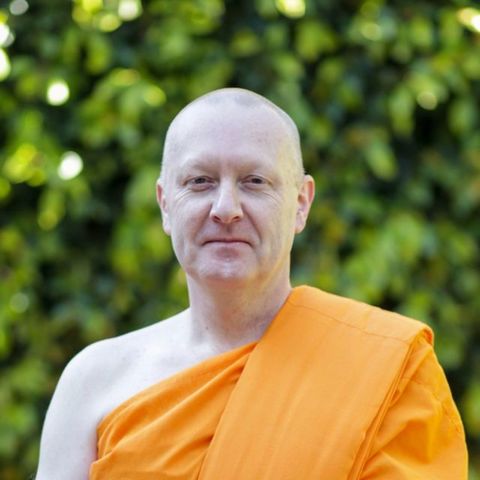
Last time you saw me,
We looked at blessing number 23 on humility.
With the Dharma talk today,
We'll continue in our series on enlightened living to the third blessing in the instilling oneself with basic virtues subsection,
That is number 24 on contentment.
Before starting to discuss the 24th step on the theory of Buddhist practice,
Let us take stock of the place of blessing 24 in the seventh group of blessings cultivating basic virtues,
So that we can see how they integrate.
In our pursuit of basic virtues,
We started by opening up the channel by which we can transfer the virtues of others into our own heart.
The respect of blessing 22 helps us overcome the tendency to find fault with others,
Allowing us to appreciate others' virtues and strengths in order to learn from them.
The humility of blessing 23 helps us to avoid overestimating ourselves so that we don't look down on others,
And so that we can keep the flexibility of mind necessary to avoid becoming complacent about further improving ourselves.
However,
There is one more virtue that we need to acquire for ourselves,
Owned to the elusive nature of the habits that we're trying to instill in the mind.
It is a virtue that is a stranger to our normal mundane skill set,
Where,
For example,
In our working life we often have to rush and compete to achieve our ambitions where we are often goal-orientated and transactional.
For worldly phenomena,
It's always with an eye on the outcome that we invest the necessary effort.
However,
For spiritual phenomena,
It's a very different approach.
Often the more we hanker after results,
The more elusive they become.
Spiritual phenomena are like trees where you must add the water and the fertilizer at the roots,
But the blossoms and fruit for which we wish will appear in another place altogether,
Which is high above our head.
However,
If we spend the whole day gazing into the branches,
To the neglect of our watering,
We will never get the fruits and blossom we wish for.
For meditation too,
We have to do our daily practice without undue interest in what the results will be.
Although in the long run we would like to make a breakthrough in our meditation,
If we sit for meditation worrying about when the breakthrough will be,
Such expectations will only impede our progress.
Not only for personal virtues,
But also for social virtues,
We have to concentrate on our cultivation and not worry about the results.
If you imagine a person who whines incessantly all day long,
How come no one ever listens to a word I say?
Do you think their protests will solve their situation?
If they were instead to ask themselves how they could make themselves into the sort of person people would want to listen to,
And to get down to cultivating those virtues instead of complaining,
Their effort will be much better spent.
In this respect,
The cultivation of virtue is like a tennis trainee who concentrates their attention on their technique rather than on the results.
Some tennis players make the mistake of worrying constantly where on the opposite side of the net the ball is going to land.
However,
Instead of projecting their anxieties over the net,
Tennis coaches often recommend their students to concentrate instead on how they hit the ball.
If they hit the ball correctly,
Then the ball will go where it is meant to,
Whether the player worries about it or not.
This is why instead of getting caught up in expectations and comparing ourselves to others,
We need to cultivate the quality which will allow us the acceptance and enthusiasm to work on ourselves as we really are,
Instead of wasting our time daydreaming about how we want to be.
That quality is contentment,
A key aspect of our personality which apart from being important for self-development,
Also has a social role in allowing people to pool their strengths instead of competing against one another.
The Pali word from which the word contentment in this blessing is derived is santutti,
Which can be broken down into the syllables san,
Which means oneself,
And tutti,
Which means happy.
Thus,
In its entirety,
The word means happiness with oneself and one's possessions,
In other words,
Knowing moderation or knowing enough.
Outside its Buddhist context,
Contentment is a concept that is much maligned because people blame the idea of contentment for standing in the way of economic progress,
Or claim it makes people too lazy to change or to improve themselves and their situation.
They think it means being content to do nothing,
Or being content to remain in isolation from others.
In fact,
These less desirable qualities are referred to by separate words in the Pali language which are different from the word santosa,
Which is used to refer to contentment.
For example,
A person who is content to do nothing is referred to as lazy or causatta.
In the Pali language,
Similarly,
Being contented,
To be alone,
Or seclusion is referred to as pavivitta.
In the Pali language,
The Buddha was never one to teach his disciples to be lazy,
Backsliding,
Or to avoid work,
Or to be inert or unresponsive in a way that impedes progress and prosperity.
On the contrary,
The idea of contentment in this blessing is that when each person accepts their own strengths,
Weaknesses,
And place in society,
They will be in a better place to work on themselves spiritually.
Such contentment can be applied to what people have,
What they receive,
And what is appropriate to them,
In such a way that the tendency to fight over luxuries will be reduced,
And along with it the jealousy and infighting that is often common between those of influence in society.
Accepting yourself as you are has three different facets.
Contentment with what you have,
Contentment with what comes to you,
And contentment with what is appropriate to your status.
In regard to contentment with what you already have,
Or as it's known in the Pali,
Sattkhena santosa,
The Buddha said at Dhammapada verse 365,
Using the Pali words,
Tala-pham na-ti-man-yaya,
That you should never look down on what you have,
Which may mean being content with your parents,
Your spouse and your children,
Your job,
Your appearance and your nationality.
Even if there are faults with these things,
It's still necessary to be okay with them,
Not exactly arrogantly proud of these things,
Since we already dispensed with that in the previous blessing,
But proud enough of ourselves that it seems worthwhile for us to gradually make the necessary improvements,
Rather than attempting to solve our dissatisfaction by stealing away something we envy from someone else.
Even the humblest of shoemakers working in the gutter,
Although they might not like it much at first,
If they can manage to take pride in their work,
Have the chance of one day building up a prospering shoes business.
If a person is contented with something,
They tend to give attention to that thing,
Because contentment,
Properly understood,
Gives us the encouragement to expend effort on the things we come into contact with.
This is why contentment,
In our meaning of the word,
Is something which helps us to vanquish laziness rather than encourage it.
If you can truly accept how you are,
It enables you to apply yourself to the very best of your ability.
It's not like a person who thinks,
My parents are uneducated,
What hope do I have of doing anything worthwhile in my life?
Or people who blame their parents for not being better off.
So it's no use wasting your energy on being discontent,
You would be better re-channeling your energy into improving the situation.
With regard to the second component of being content with what you get,
Or as it's known in the Pali,
Santena santosa,
The Buddha taught in the Suvarnahana Sajjataka that,
Yang lat hang tena puttap hang,
Which translates as,
You should be content with whatever you receive.
In practice,
What this means is that whatever task we are working on,
We need to be able to accept the outcome.
Sometimes the results don't reach our high expectations,
But if we can be content instead of losing sleep over it,
We won't despair before being able to make the necessary adjustments for the next time.
Those who lack this sort of acceptance end up assuming they are doomed to misfortune.
Obsessing over all the things that went wrong.
By contrast,
Someone who is contented will be happy with whatever comes to them,
Instead of always envying their neighbor's better fortune.
If someone gives you a small plot of land,
Then you can build only a small house,
But you should still be thankful that you don't have to waste money renting for many future years.
At the same time,
You should work diligently building up your financial position so that you can expand the house to your full requirements at a later date.
In conclusion,
If you can find it in you to be content with what you have or what you're given,
Then it creates a space in your heart by which you can make lasting changes in your life in a leisurely manner.
Lastly,
We come to the slippery topic of contentment with what is appropriate to you,
Or as it's known in the PIE language,
Sam-me-na-san-to-sa.
This aspect of contentment is to guard against things which seem like a great idea at the time but which will cause problems in the long term.
Assuming a monk is enjoying a simple light of reflection in his humble temple,
And someone comes along and offers to install a solid jade or gold Buddha statue in his temple.
On the face of it,
Sounds like a great idea because it will attract lots of pilgrims to his temple,
And he won't need to worry about the temple's income anymore.
However,
Since he is a monk and not a property developer or a security guard,
It might be better to turn down that person's well-intentioned offer,
Otherwise he might lose the serenity he was originally seeking in becoming a monk.
Again,
Reflection on what is personally appropriate may be a useful way to prevent giving a homeless guy a heart attack when he wins the first prize in the lottery.
In fact,
It touches on the whole discussion of what the homeless guy really did need if it wasn't a ton of money.
In other words,
What would have been appropriate to him.
And to stay on the subject of lottery winners just for a moment,
Many winners who lack experience with money management may get into really ugly quarrels with purported friends or relatives,
All of whom feel entitled to a slice of the winner's money.
These are all possible examples where the contentment teaching on what is appropriate could have saved the day.
When considering what is appropriate for oneself,
There are three perspectives,
Whether it is appropriate to our status,
Whether it is appropriate to our potential,
And whether it is appropriate to our level of virtue.
As for whether something is appropriate to our status,
Or as it is known in Pali,
Yat this mostly refers to the socioeconomic status of our recipient.
For example,
The appropriateness of receiving something may be influenced by whether we are a monastic,
A householder,
A senior,
A subordinate,
A teacher,
A student,
A military personnel,
An academic,
Or an odd job man.
The things we use and consume ought to be appropriate to the socioeconomic status that we occupy instead of being pretentious.
As mentioned in the previous blessing,
This might pertain to things like the way we dress,
The car we drive,
The way we furnish our home,
The opinions we express,
Or our claims on the ownership of ideas.
At the same time,
We shouldn't go comparing ourselves to others out of our league,
Thinking that just because we've chatted with celebrities or know their names,
That somehow we deserve the same treatment as them.
Although this may sound a bit antiquated,
Especially in a so-called egalitarian society of high social mobility,
Perhaps it's easier to think of this sort of contentment as having a sense of where you feel you belong,
Even if that place may not be very spectacular.
The Buddhist point is that if you don't feel you belong at all,
It's very hard to use social attraction as a means to improve yourself.
If you feel you have somewhere where you belong in society,
It will prevent you from wasting your effort being pretentious or hankering after a place where you might feel out of place.
Even if you don't like your place in society,
You need to start by accepting where you stand,
But through the principle of social mobility,
Your enthusiasm and sense of willing will allow you to gravitate to a place where you have an even stronger sense of belonging in a natural and organic way.
As to whether it's appropriate to our potential,
Or you might like to think of it as your personal status,
Or as it is known in Pali,
Yatthapala,
If one knows and accepts the level of one's own potential,
One will be better able to know what is appropriate for one.
One should not over or underestimate oneself.
You should look at yourself deeper than the surface appearances such as gender,
Height or attractiveness.
As we've mentioned when embarking on our career of spiritual transformation,
When cultivating ourselves,
We have a certain number of strengths and weaknesses,
And through our cultivation,
We hope to further the strengths and diminish the weaknesses.
In order to know where we stand,
In other words our potential for change,
Then we have to consider ourselves in terms of seven factors which will lead you to look much deeper than the surface,
Adapted from the Vatisutta of the Angotra Nikaya,
Namely,
Inspiration,
Integrity,
Experience,
Generosity,
Wisdom,
Quick-wittedness and strong health.
By accepting how ambitious you are,
Likely to be in your potential for change,
It will be the space to get down to making the necessary improvements.
This is why contentment in the context of personal development means accepting the reality of yourself as a catalyst which will eventually inspire you to make the necessary improvements.
Finally,
With regard to whether something is appropriate to our level of morality,
Or as it's known in Pali,
Yatthā sarūpā,
Even if something is appropriate to our status and potential,
If it is something inappropriate to the level of precepts we have set for ourselves,
Or if it will ruin our reputation by receiving it,
Then we should be contented to forego that thing.
For example,
We should not accept goods that we know to be stolen,
Or salary earned by illegal employment,
In order that our wealth doesn't become more important to us than our conscience,
And so that we don't become a puppet to the accumulation of more and more possessions without end.
Originally,
I had a really short and glib listing of things that are objects of discontent which included power,
Money,
Food and sex.
However,
It's pretty obvious that these are only the external pull factors that tempt us towards discontent.
Discontent itself is something much subtler on a psychological level,
And could be triggered by many of the internal push factors,
Whether it be mistaking wants instead of needs,
Forgetting impermanence,
Boredom,
Fear of the future,
Disappointment with oneself,
Or just loneliness.
Discontentment sometimes happens when we mistake wants for needs,
When eating candy doesn't satisfy the body's needs for protein or vitamins,
When alcohol and coffee don't rehydrate our body,
When watching other people's dramas on TV doesn't bring excitement in our life,
When sitting around never leaves us feeling rested,
When putting off important tasks doesn't satisfy our need for closure,
And when being selfish fails to make our life more meaningful.
Discontent sometimes happens when we forget the truth of impermanence.
Change is the one constant thing on this planet.
We forget that there are only going to be a certain number of times that we'll be satisfied to hear that catchy tune before we get bored with it.
There will only be certain times that you will be satisfied to wear that beautiful item of clothing before it goes out of shape.
Boom times alternate with recession and unemployment.
Everything we are proud of about our body fades with age.
Woody remarks wear thin.
The reputations of people and organizations that we used to look up to get tarnished,
So we are left wondering whether our original contentment with these objects was old in the mind from the start.
Even boredom is a sort of discontent.
When we already have green grass on our side of the fence,
The grass on the other side of this fence still looks greener.
Sometimes it's just our tendency to find fault with the good things that we already have.
Fear for the future can lead us to indulging in escapist activities such as roads to ruin or other compulsive behaviors.
Poor decisions such as impulse buying or being duped by promises of quick solutions.
Disappointment with oneself or lack of compassion may mean that we fixate on our faults instead of going slightly easier on ourselves to build up the acceptance and motivation to work around to actually doing something about it.
Loneliness often comes back to haunt a person until they can find satisfaction in healthy relationships with family or friends that are founded on love and giving.
Once you have identified which of these causes affects you the most,
Then you can start to look at the emotion behind the discontent.
Sometimes it's a question of engaging with the opposite of the discontent,
For example.
The opposite of fear is optimism.
The opposite of fault finding is counting your blessings.
The opposite of being let down by impermanence is accepting change.
The opposite of indulging once is first to become aware of the nature of your needs.
Trouble with discontent is that it develops from insignificant emotions in the mind into more and more serious attachments until it becomes a bottomless pit.
The point of studying about the symptomology of discontent is that you can more easily learn to catch yourself before the symptoms get too serious.
From someone who prefers something,
We become someone who is attracted to it.
From being attracted to it,
We want to own it.
From wanting to own it,
We want to own it so strongly that we are not interested in anyone else's feelings concerning the way we get it,
Until we abandon all our scruples in order to get to that thing.
This is how something seemingly benign like discontent deteriorates into serious personal damage.
Even on a social level,
When contentment is lacking,
Economic competition becomes more aggressive as people try to discredit one another or cut corners in amassing wealth instead of cooperating with their skills and influence for the greater good.
So-called enlightened self-interest devolves into flagrant profiteering without any thought of the negative repercussions for others in society or the harm brought by fanning the flames of greed.
When materialists cannot earn money fast enough by scrupulous means,
Then they will soon resort to dishonest ones,
All because of the lack of contentment.
By contrast,
The mind of someone who has burst in contentment will always be ripe for the fruition of other higher virtues without risking burnout,
Virtues cultivated with the most honest of intentions.
When society fails to make progress or progresses slowly,
It's not because people are content,
But on the contrary because of those lacking contentment who constantly undermine a fair economic system.
So now we have time for a quick story from the Dhammapada commentary.
In the town of the Buddha,
There was an outbreak of a plague in the city of Rajagaha.
In that city was the home of a millionaire where two aging parents lived with their 12-year-old son called Gumbakosaka.
The parents decided they were too old to escape the infection,
But they told their son to run away as far as he could to save his skin.
Before the son went,
The father pointed out where all the family treasure was buried.
The son cried to think that he had to abandon his parents to die,
But nonetheless he fled alone despite his tender age.
Ten years later,
He returned to his hometown.
The infection by this time had long subsided.
He thought of digging up the treasure,
But he decided that it was not yet an appropriate time for him to obtain fortune.
He thought that if anyone saw him in possession of a fortune,
They would assume that he had stolen it and he might be arrested by the police.
He also reflected that he had nowhere to store the fortune even if he did get it,
Because he still had no house of his own,
So simply being in possession of the fortune would put his life in jeopardy.
So he therefore bided his time and took a job working as a guard in a house of a wealthy family.
His job was to wake everyone up early in the morning and to go around announcing when it was time to prepare the food,
Fetch the carts,
Yoke the bullocks,
And other similar chores.
He was a kind of town crier whose services were necessary in the absence of clocks and alarms.
One day,
King Bimbisara heard the sound of the man's voice in the morning and could tell at once that the voice belonged to no ordinary person,
But to a rich man.
The king sent a courtesan to observe the man,
And she returned to the king reporting that the town crier was no rich man,
But just a laborer employed in a rich household.
The king didn't believe her,
So he had the courtesan find ways to inveigle the family history out of the man until she found out that he was indeed the heir to a fortune.
At this point,
King Bimbisara summoned the man,
Curious to find out why he lived like a pauper even though he was the heir to riches.
The man told the king that he was waiting for the appropriate time to publicly claim his fortune.
The king told him that the time had now come to dig up the treasure.
The young man dug up his fortune and the king appointed him treasurer to the kingdom as a reward for the wisdom and patience he'd shown in the use of his savings.
The story has a lot to teach us about the words appropriate and status in relation to contentment because it would seem that the man's conduct concerning contentment in the story was exemplary.
So to return to our subject matter for today,
Having earlier defined the various sorts of contentment and discontent,
We now turn to look at secular and spiritual ways to cultivate contentment.
The usual way of understanding contentment is that since we are restless by nature,
We tend not to enjoy the same thing or situation for very long.
We need to keep changing things around to keep ourselves interested or else we might need a completely fresh start if we have previously undergone some sort of traumatic experience in life.
This explains why having money doesn't necessarily make us content with what we have.
We get a shopaholic rush for a short time when we splurge on impulse buys,
But then that feeling soon wears off,
Dropping us right back where we started.
In other words,
Contentment is not the automatic by-product of money or success.
However,
If you are content,
You can derive pleasure from simple things in life like a walk with a loved one,
A meaningful conversation,
A cup of coffee,
Or just a breath of fresh air.
When we start to be able to appreciate the small things in life and take pleasure in simplicity,
It is an indication that we are on the way towards mastering authentic contentment.
We may discover that owning more than we need makes us restless and sometimes unsatiated or dissatisfied.
But that doesn't mean money is not important in life.
Financial stability is one thing that facilitates contentment in life,
But there's much more to contentment than just having a secure financial future.
A person might be very rich and successful,
But might not be content.
So to learn how to be satisfied in life despite the things that we may lack,
There are some suggestions for ways to be content with what you have.
The first of which is to explore the triggers underlying your discontent.
If you're unhappy or depressed,
You need to start observing yourself to find out what might be causing those feelings.
Be observant and start listening to yourself.
Once you identify the impulses that trigger you,
You'll be able to select more productive things to focus on instead of wasting your time in frustration.
Secondly,
You need to align your goals and actions with your values.
If you don't believe in anything,
Then you're unlikely to be satisfied no matter how knowledgeable or wealthy you become.
Since we tend to be defined by our values,
If we are clear about what they are,
They can help us define what we're feeling while separating out the restlessness or despair.
So never undermine your own values if you truly want to be content with life.
Thirdly,
You need to look for your feelings of belonging.
This might refer to a sense of family you have or pride in being part of a certain like-minded community.
The moment you realize that the people you spend all your time with don't seem to be your people,
It would probably be better to connect instead with a place you feel that you truly belong,
Where the community appreciates your worth or helps you to discover your strengths.
When you feel more productive,
A sense of fulfillment will come naturally.
Fourth,
You need to let go of your past.
Feelings of regret and disappointment often haunt us,
Especially at a time when we want to move on.
If necessary,
You might need to be prepared to leave your past behind completely and rebuild your life from scratch to give firm foundations to an authentic sense of contentment.
Fifth,
You may need to learn to be grateful,
And it's a topic that we'll return to in more detail in the next blessing number 25.
But for now,
In brief,
We can say that we tend to lose interest in people and things when we fail to treat them with gratitude,
And that ultimately leads to discontent.
So we need to learn to appreciate what we have.
Sixth,
You ought to avoid comparing yourself with others.
Everyone has their own share of accomplishments,
But you will not be able to enjoy yours if you spend all your time using others as your benchmark.
The only valid comparison you should make is between you today as compared with how you were yesterday.
Seventh and last,
You should always try to think positive.
Even the bad things in life happen for a reason,
But if we can learn the lesson and move on,
Then we come out better for the experience on a certain level.
No one expects life to be a bed of roses,
But if we find we are continuously dwelling on the negative feelings,
We need to be more selective in focusing on the positive aspects of our life,
At least for our own peace of mind.
It's not that difficult to let go of habits that stop us from being content in life,
And you notice that most of them don't even cost a penny.
Even without being fully invested in spiritual practice,
There's already a lot we can do to become more satisfied with the little we already have in life.
At the heart of the Buddhist understanding of contentment and discontent is the distinction between two sorts of happiness.
It is a distinction that underlies the Buddhist claims that certain sorts of happiness are subjective and down to our choices.
The teaching in the Angotrainic Aya distinguishes between happiness dependent on external stimuli or sami-sasukha in the Pali language,
And happiness independent of external stimuli or nirami-sasukha in the Pali language.
The first conventional sort of happiness,
Which depends on external stimuli,
Relies on sense pleasure coming to us via our eyes,
Ears,
Nose,
Mouth,
Or by our sense of touch.
It also includes daydreaming about desirable things.
This sort of happiness tends to be unreliable because it's mixed up with suffering,
And its objects tend to be obtained only as a result of considerable effort and difficulty.
Such mundane happiness leads to possessiveness,
And if we ever lose our prized objects or are presented from accessing them,
Then the happiness can be instantly transformed into feelings of loss,
Aggression,
Or even vengeance.
By contrast,
The second spiritual sort of happiness derives its energy from within and can be thought of as inner happiness.
Because such happiness is independent of external stimuli,
It has more reliable characteristics of being pure,
Peaceful,
Liberating,
Radiant,
And fulfilling.
Buddhism regards inner happiness as the true happiness because it is happiness that creates no conflict of interest and which helps to diminish other problems.
However,
Finding such inner happiness means first cultivating a state of mind that is peaceful and free from discontent.
The more one can insulate oneself from the unreliable happiness of external things,
The easier it will become to touch instead upon inner happiness.
In keeping with the words of the proverb at Dhammapada verse 331 that utthi sukha ya itharittarena contentment with the requisites you have and those that you receive will bring you happiness.
Just as there are two sorts of happiness,
The lack of such happiness is at the root of two distinct sorts of poverty.
Firstly,
There are material paupers.
Such people suffer from lack of resources because they really lack the wherewithal to earn enough to keep themselves afloat.
Such people are said to be poor only temporarily because,
If they find an appropriate way to earn their living,
Before long,
They will be able to get themselves back on track again.
These people are in contrast to a second sort of poverty that is a domain of spiritual paupers.
Such people suffer from a lack of resources because they spend more than they earn.
Their problem is not a lack of resources but one of attitude because they know no moderation in their spending.
Such people can be counted amongst the permanent poor because,
Even if they inherit a fortune,
They will not be able to stay out of debt until they die unless they can learn contentment in the meantime.
This also includes the mega-rich of the world who already have a net worth in the tens of billions but who,
If asked whether they would like to double or triple that sum,
Would always say yes.
According to Buddhists,
Therefore,
The word contentment means knowing moderation.
It is a miraculous virtue which can stop people from competing mercilessly with one another,
Can reduce extravagance and pretentiousness,
Can stop wars while making people self-sufficient in happiness irrespective of their position in society.
It can even allow the rich to be satisfied with what they have because,
In the words of the Buddha,
Dhammapada verse 204,
Santuti paramangtanam,
Or contentment is the ultimate wealth.
To illustrate the difference between the two sorts of poverty,
Our Venerable Dattajiwo used to tell a story about the experience of a Thai Minister of Commerce.
The minister came from a wealthy family and he shared two events he encountered on the same day which highlighted the importance of contentment.
He left his home early one morning and passed a beggar on the street.
In his family,
There was a tradition that they would never turn away a requester for help.
Of course,
How much they helped someone in need depended on the situation,
But they would never refuse another person downright.
He would normally not think twice about giving a beggar a few pennies,
But that day in his pocket he had no loose change.
He had to open up his billfold where the smallest note was a fiver.
He gave the five dollar bill to the beggar and the beggar was so happy that he bowed down on the sidewalk at the feet of the minister.
The beggar exclaimed that he had been begging since he was a child,
But today was the first time he'd met someone generous enough to give him five dollars.
The beggar's eyes shone with appreciation and the beggar's delight filled the minister with a cheery start to his day.
When the minister reached the ministry,
However,
He met a bank manager with a pained expression on his face.
The minister asked whether the bank was ill and the banker confessed,
I am so upset I haven't slept all week.
I told my son early in the year to order a product that was bound to be scarce on the market,
But my son didn't believe me and at first he delayed the order.
Only the first order ended up being ahead of the competition.
For the second and third lots,
We lost our market share.
My son should have had a profit of a hundred million this year,
But because he hesitated,
He only managed a profit of sixty million.
So we've lost forty million we could have had.
The minister expressed his condolences and went into his office,
But that day he could hardly get any work done because he was busy musing about the ways of the world.
A beggar who was happy all day with a five dollar bill and a banker who cannot sleep because he only got a profit of sixty million.
He sat and wondered whether even if he managed to achieve miraculous reforms as the minister of commerce,
Whether anyone would actually be happier as the result.
So Buddhism doesn't just concern itself with transcendental level contentment,
But starts with sound advice for our mundane finances to allow us to put our life in a place where financial hardship doesn't encroach on our peace of mind.
The most basic piece of advice,
Which is by no means exclusive to Buddhism,
Is to avoid spending beyond our means.
Just as Mr.
Mokoba advised in the classic David Copperfield,
If your income is twenty bucks but your expenditure is nineteen ninety nine to use decimal currency,
The result in your life will be your happiness.
However,
If your income is twenty bucks and your expenditure is twenty bucks and a penny,
The result will be your misery.
So to move from the Victorian era to modern times,
The TV financial analyst Paul Clitheroe also reiterated that there are plenty of ways to get ahead in life.
The first is so basic that I'm almost embarrassed to say it.
Just make sure that you spend less than you earn.
The British touchstone for earning contentedly,
Of course,
Is the four chambers of the millionaire's heart that we met back in Blessing 15.
As a quick reminder,
Diligent acquisition means that we work hard to do what we do without forgetting that the purpose of earning one's living is nothing more than to procure sufficient basic requisites in life to support one's physical needs so that one can use one's time,
Strength and ability to do what is really important in life,
Namely to cultivate the maximum possible virtues in the space of one's life.
Buddhism has never seen the working life or the accrual of material assets as an end in itself.
Secondly,
By careful stewardship,
We should take good care of what we've earned.
Thirdly,
By association with sensible friends,
We can avoid associating with waste rolls.
As mentioned before,
We should not spend beyond our means.
This doesn't mean that you have to live like a monk,
But if you have something you really want then you just save up and buy it rather than buying it on the never never.
And even on a collective level,
Buddhism has always understood the true prosperity of a country to be in inverse proportion to the number of people on the poverty line rather than in proportion to the amount of money in the national treasury.
In keeping with the saying,
The absence of poverty is a better measure of a nation's success than the number of wealthy people.
In addition to this Buddhist advice on mundane contentment,
If we turn to the inner quality of contentment,
We are given six further pointers for our happiness.
The first is to chant the habitual reflections on a daily basis.
The words of the habitual reflections contained in the evening chanting go,
We are of a nature to age,
We have not yet gone beyond aging.
We are of a nature to sicken,
We have not yet gone beyond sickening.
We are of a nature to die,
We have not yet gone beyond dying.
If we think of it truly of the limited nature of our life,
It will help us to reduce the time we waste greedily chasing after desires for things that are ultimately unimportant to our real well-being.
The second piece of Buddhist advice that will help us access that inner contentment is to eat moderately and to protect our health more generally.
We need to train ourselves to eat to live rather than to live to eat.
If you can appreciate moderation in simple things,
It will be easier to know contentment in more complex ones.
As for our health more generally,
If you are in good physical health,
You are more likely to be content with what life throws at you.
So don't neglect to nourish your body through proper diet and exercise while occasionally pampering yourself as well.
The third piece of Buddhist advice that will help us to access that inner contentment is to be generous by practicing compassion and serving others more generally.
Learning to be of service to others brings to mind the example of parents who accompany their spoilt and dissatisfied kids to deliver care packages to an orphan home as a way to bring home to the children the reality that there is always someone worse off than you are.
As for practicing compassion towards others,
This is a sure way of increasing our own self-esteem and it will add to our capacity for contentment.
There's nothing more fulfilling in life than being responsible for putting a smile on another person's face.
Fourth piece of Buddhist advice that will help us to access that inner contentment is the practice of keeping eight precepts.
Especially the third precept that concerns abstention from sexual relations.
This practice will cause us to face up to our discontent concerning our romantic attachments.
Meanwhile,
The sixth precept of not taking food in the evening will help us to overcome our gourmandizing tendencies.
The seventh precept of not wearing jewelry or makeup will train us to be content with ourselves as we are.
While the eighth precept of not sleeping on a luxurious bed will train us not to be overattached to comfort.
A fifth piece of Buddhist advice that will help us access that inner contentment is to find time to meditate every day.
When the mind becomes more refined,
Our temptation to hunger for power and fame will be reduced.
Nourishment of the soul is just as important in life as nourishment of the body.
And there are ways to feed your soul in order to feel that inner peace,
One of which is to meditate regularly.
Finally,
And this sixth and last piece of advice,
Which comes from ancient times,
Is to spend time undergoing monastic training from time to time.
In Thailand,
There is an ancient tradition of temporary ordination where young men take temporary ordination as a monk at the age of around 20 years old.
Usually the ordination is no longer than three months.
However,
It gives the ordinance the chance to experience inner happiness firsthand and especially a happiness that comes from knowing contentment.
Those who ordain as monks are allowed to use only the bare minimum of material requisites,
Namely three ropes and a bowl.
Once living is simplified down to going on arms round,
Such a simple life without worries about material wealth easily facilitates the freedom of mind which gives rise to the subtle states of inner happiness,
Allowing those with the chance to ordain an understanding of how inner happiness is at the root of attaining contentment in life.
So to finish off with a quick story today about when monastic training and contentment manages to backfire,
I'd like to tell a story about a Buddhist nun who let her food cravings get the better of her,
And in this case it seems to be the original tale behind the Brothers Grimm's tale of the golden goose.
So once upon a time there was a Buddhist nun called Tulanantha who loved to eat garlic.
One day she was very glad to meet up with a farmer who farmed garlic for a living.
The farmer assumed that the nun would know moderation in eating,
So he pointed to the garlic field saying,
Whenever you want any garlic,
Just go to the field,
Caretaker,
And tell him I gave you permission to help yourself.
The nun started with a few cloves of garlic,
But once it started she couldn't stop.
She continued picking garlic until she had picked cartloads of it.
By and by her greed did not go unnoticed,
And the neighbors started to gossip and spread it about that the nun was shameless.
The farmer himself also didn't know what to say.
The news reached the Buddha and his response was to make the simple rule that nuns may no longer eat garlic.
The Buddha looked at the past lives of the nun and caused pictures of her previous lives to manifest themselves for the nun and others to see.
It turned out that Tulanantha had been a female Brahmin with a husband and a daughter in her previous life.
The Brahmin died,
But because of not understanding the working of merit,
Had done both good and bad deeds during his life.
The Brahmin was therefore born as a golden goose.
The goose was able to recognize his former wife and daughter in their poverty and shed its golden feathers for them to ameliorate their poverty feather by feather.
In that lifetime,
Tulanantha had also been greedy.
She wanted more than just a few feathers,
And a few days later plucked the whole goose bare and shut the goose away in an enclosure.
From that day forth,
The goose could no longer produce golden feathers.
When its new conventional plumage grew back,
The goose flew away and did not return.
The mother and daughter were thereby reduced to poverty and starvation.
The moral of the story is that when you recognize that you are on to a good thing,
You should allow contentment to teach you to enjoy it in a sustainable way.
So this session I have introduced to you,
With blessing 24 on contentment.
For my next session we will continue in the seventh group of blessings,
With blessing 25 on gratitude.
Hopefully as a result of today's session,
You will better understand contentment and discontent,
And better equipped with the secular and spiritual strategies I have mentioned,
To cultivate contentment more and more in every aspect of your life.
So for today,
This is me,
Pratt Nicholas,
Tannis Roe,
Signing off for now.
So long folks,
And stay safe.