One of the things that people first notice about yoga nidra is the relief of being told to lie down to meditate.
How wonderful is that?
And then you add a blanket for coziness.
It sounds like a meditation pajama party,
Right?
Seriously though,
If you're sitting upright and you're trying to keep your spine straight and you're battling with your posture or your knees while you're also trying to meditate,
That can be quite challenging.
And so with yoga nidra,
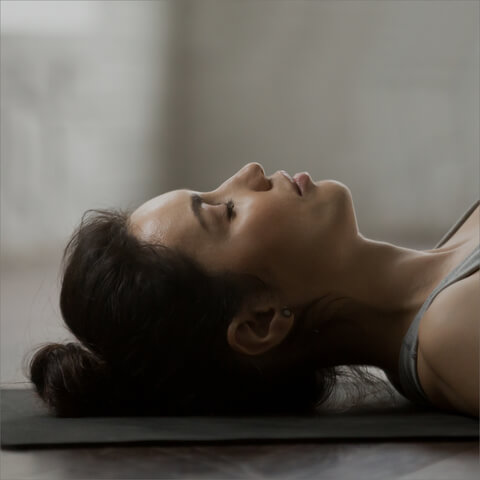
You simply lie on your back.
And you let the body do what it already knows how to do,
You let it rest,
Truly a deep rest.
So this is a guided meditation where you don't have to do anything.
You simply follow a voice.
And for many of us,
That's already easier than any meditation we've tried before.
So,
A few simple things before you begin.
This will help the body settle in more comfortably.
You don't have to do them,
But I like to think of these options as small acts of care as you set up for the practice.
If you can,
Set time aside so that you won't be interrupted.
And if you don't intend to fall asleep,
Then set an alarm just in case you do fall asleep.
Definitely have your phone on do not disturb.
And then lower the lighting if you can.
These are all just signals to your nervous system that nothing urgent is happening.
That this is your time for deep and undisturbed rest.
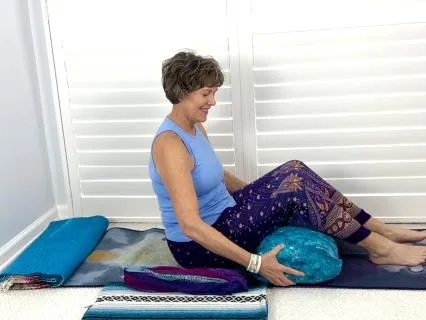
Karen will be showing you how to set up for yoga nidra.
You'll be lying on your back on a mat or your bed or a sofa.
Comfort is non-negotiable in yoga nidra.
An uncomfortable body is a distracted body.
So try these suggestions,
Adjust as you wish,
And you can also sit in a comfortable chair.
If your lower back is sensitive.
Try a pillow or rolled-up blanket under your knees.
Or a yoga bolster like the one we're using.
Then some light support under the head can feel really relaxing.
And then perhaps a blanket on top of you.
Because your body temperature will drop.
As you become still.
And then something to cover your eyes is quite nice as well.
Again,
These are all optional,
Like an eye pillow or a light scarf,
Especially if the room is bright.
This signals safety to your nervous system and it quietly closes off the world for now.
Arms resting by your sides,
Palms facing up,
Legs relaxed.
Ah,
Now this looks like somebody ready for yoga nidra.
The next thing to expect is sankalpa,
Or intention.
So you'll most likely be invited to begin your practice with your intention.
Just a short,
Heartfelt phrase in the present tense.
Something like,
I am calm,
Or I am happy.
And on days when nothing particular comes to mind,
That's okay.
A simple intention is to be here,
To do the yoga nidra.
I am present.
That's more than enough.
When do you practice yoga nidra?
At any time of the day.
Just avoid a very full stomach.
Morning practice tends to be fresh and clear.
Evening tends to be deep and restorative.
And a mid-afternoon rest can be surprisingly effective because this is when the body is primed to relax at this time of the day.
Even 15 to 20 minutes can be a complete practice.
Shorter versions,
Like what I call nano-nidras,
Those can be wonderful ways to top up and keep a daily practice in between the longer sessions.
For the most benefit,
A 45-minute yoga nidra practice tends to be a wonderful thing to indulge in and enjoy once a week.
And then a few other things.
You might fall asleep.
And that's not failing at yoga nidra.
It just means your body probably needed some sleep.
As the practice becomes familiar and you repeat it often,
You'll be able to rest in that aware and awake state of yoga nidra,
Of the yogic sleep.
And you won't necessarily hear everything,
And that's okay.
You might emerge afterwards feeling like nothing happened or that you weren't really paying attention.
Where did you go?
And then you feel surprisingly refreshed afterwards.
The practice works below that surface level of conscious effort.
So you may also notice unusual sensations during the yoga nidra meditation.
Your arms and legs might feel very heavy or light or you might imagine colors or drifting imagery.
All of this is normal.
Just notice and keep following the voice.
That's the whole practice.
Every session is different,
So don't judge Yoga Nidra by a single experience.
Some feel profound and some feel quite ordinary,
But they're all doing something.
And perhaps,
Most importantly,
Release expectations of how you think it should feel.
You don't need to evaluate the experience while it's happening.
You're here to simply receive it.
If you'd like to understand the practice more deeply,
I'd love you to join me on my yoga nidra course here on Insight Timer.
It's time for yoga nidra.
Lie down.
Settle in.
Then follow the voice.
And trust that the practice knows where it's going.
Happy meditating.