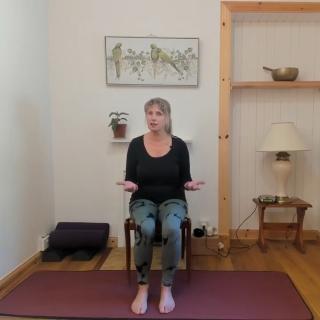
Hello everyone,
Welcome to our Yoga Nidra session.
Thank you for being here.
Today I'm going to guide you through Yoga Nidra practice.
In today's session our focus will be on nourishing the nervous system in particular,
Releasing anxiety and fear,
And cultivating a sense of safety and ease.
Please take a moment now to make yourself comfortable using any props you need.
I highly recommend covering yourself with an extra blanket.
The body tends to cool down quickly as you enter a deeply relaxed almost sleep-like state.
Take your time,
Settle in,
And allow yourself to arrive fully.
First,
We'll start with little eye movements to stimulate the vagus nerve.
Try to keep your head still with the nose pointed forward,
And let your eyes very slowly and gently look to the right and pause,
Then bring your gaze back to center,
And slowly turn your eyes to the left,
Pause,
And slowly back to center.
We'll do this once more.
Turn your eyes to the right,
Take a short pause here,
Bring your gaze back to center,
Then turn your eyes to the left,
Pause,
And bring your gaze back to center.
And then close your eyes if that feels comfortable for you,
Or take a soft gaze over your nose at a point about two meters before you,
On the floor.
Then take a slow inhale through the nose,
Allowing the belly to rise,
Then gently exhale through the mouth,
Allowing the belly to fall.
We'll do this again.
In through the nose,
And feel the cold air passing your nostrils,
Down into your throat,
Filling your lungs.
Pause for one count,
And breathe out through the mouth.
Again,
Breathe in through the nose,
Feel the sensations of the cold air entering your nose.
Pause for one count,
Then breathe out through the mouth.
Feel the warm air softly leaving your body.
Then we start to breathe in through the nose,
And out through the nose as well.
And by doing so,
Feel the cold air passing your nostrils,
Down into your throat,
And filling your lungs.
Pause for a moment,
And then breathe out through the nose as well,
Feeling the soft sensations of warm air floating over your upper lip.
Repeat this one more time.
Breathing in through the nose,
Pause at the top,
And breathe out through the nose as well.
This deep breathing is stimulating your vagus nerve.
By focusing on the sensations of the breath,
You train your body to come out of fight-flight,
And to relax more easily.
We're now going to focus on setting our sankalpa,
Which means we'll plant a seed of intention.
Repeat silently after me.
My yoga nidra practice begins at this moment.
I open myself to the practice.
I will stay awake,
And I will receive whatever I need today.
We repeat our sankalpa three times.
And our sankalpa for today is,
I welcome softness and ease into my life.
I welcome softness and ease into my life.
I welcome softness and ease into my life.
We will now move through a rotation of awareness through your physical body.
I will name different areas of your body.
Just bring your attention to that area.
Become aware of them,
And bring a global awareness to that area.
So no details or narratives.
Move your awareness to your mouth.
Become aware of your tongue,
Your jaw,
Your teeth,
Your gums.
Feel your lips and the space between your lips.
Become aware of your right cheek,
Your left cheek,
And both cheeks.
Feel your right ear.
Feel your left ear.
And then feel both ears.
Become aware of your forehead,
Temples,
The back of the head,
And the top of your head.
Feel the tip of your nose.
Feel your right eye.
Feel your left eye.
And feel the space between your eyes.
Bring your awareness to your right hand.
To your right thumb.
Second finger.
Third finger.
Fourth finger.
And little finger.
Bring your awareness to the back of your hand.
The palm of your hand.
Feel your wrist.
Your forearm and elbow.
Feel your upper arm.
Your shoulder.
And your right armpit.
Become aware of your ribs.
Your waist.
And your hip.
Bring your awareness to your left hand.
Left hand thumb.
Second finger.
Third finger.
Fourth finger.
And little finger.
Bring your awareness to the back of your left hand.
The palm of your hand.
The wrist.
Forearm.
Elbow.
And the upper arm.
Bring your awareness to your shoulder.
Your left armpit.
Ribs.
Waist.
And hip.
Go to the right big toe.
The second toe.
Third toe.
Fourth toe.
And little toe.
Bring your awareness to the sole of your foot.
And the top of your foot.
Then bring your awareness to your heel.
Your ankle.
Calf.
Go to the left big toe.
Second toe.
Third toe.
Fourth toe.
And little toe.
Bring your awareness to the sole of your foot.
And the top of your foot.
Bring your awareness to your heel.
Your ankle.
Calf.
Knee.
Thigh.
And hip.
Bring your awareness to your lower back.
Your mid back.
Upper back.
And then your whole back.
Then move your awareness to your right shoulder blade.
Your left shoulder blade.
And the back of your neck.
Bring your awareness to the roof of your mouth.
Your throat.
Right collarbone.
Left collarbone.
Right chest.
Left chest.
And then to the whole chest.
Move your awareness to your upper abdomen.
Lower abdomen.
Navel.
And pelvis.
Feel the whole spine.
The whole head.
The right arm.
The left arm.
And both arms together.
Feel the right leg.
The left leg.
And both legs together.
Feel the front body.
The back body.
And the whole body.
Be aware of the whole body.
We now begin with observing our natural breath.
You don't need to change anything.
Just observe.
Where can you feel your breath in your body?
Then bring your attention to your belly.
And breathe into your belly.
Breathe in through the nose.
And out through the nose,
If that's okay for you.
We stay here for a few breaths.
Then bring your attention to your ribcage.
Now follow your breath into your ribcage.
And you might feel your ribcage expand on an inhale and contract on an exhale.
We'll stay here for a few breaths.
And bring your attention to your collarbones.
And direct your breath to your collarbones.
You might notice that your breaths become more shallow by doing so.
We stay here for a few breaths and observe.
We then bring our attention back to our belly.
And follow our breath into our belly.
We stay here for a few breaths.
You might have noticed a difference by shifting your focus to different parts of your body.
Then let your breath take its natural flow.
When you found your natural breathing rhythm,
Start to observe where your breath shifts from inhale to exhale.
A moment where your breath takes a short pause,
The void.
Just be aware of that moment.
Be careful with your in-breaths.
They still need to feel natural,
Without an excessive intake of air.
You can make your exhales slightly longer,
If that feels right for you.
And observe the transition from exhalation to inhalation at the end of the exhale.
You also might notice a short pause at the end of your exhalation.
We do this twice more.
So inhale through the nose.
Observe the transition from inhale to exhale.
And a tiny pause at the top.
And exhale through the nose.
And observe that little pause at the end of each exhalation.
Do this once more on your own.
Then allow your breath to return to its natural rhythm.
And observe any feelings or sensations that might come up.
I'll now invite you to notice opposing sensations or feelings,
Such as heaviness and lightness,
Warmth and coolness.
You don't need to force anything or imagine it strongly.
Just notice whatever is present for you.
The purpose isn't to change how you feel.
But to observe that sensations and motions naturally come and go.
By experiencing both opposites with ease,
The body and mind learn to balance and to relax.
If you don't feel anything,
That's perfectly fine as well.
Feel your body becoming rigid.
Feel your body becoming flexible.
Feel your body becoming energized.
Feel your body becoming exhausted.
Feel your body experiencing lightness.
Feel your body experiencing darkness.
Experience joy.
Experience sadness.
Feel your body becoming tight.
Feel your body becoming spacious.
Experience your body becoming hard.
Experience your body becoming soft.
Feel your body becoming restless.
Feel your body becoming calm.
Now imagine that you're sitting on a sandy beach.
The sun is shining bright.
And the sand is warmed by the sun.
You feel the support of the earth.
In the distance,
You hear the sounds of rolling waves and the calls of seagulls echoing along the shore.
Now in your mind's eye,
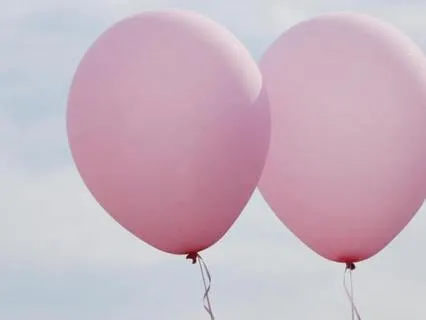
Picture a beautiful balloon in front of you.
It can be any color,
Any shape you like.
There's a long velvet ribbon attached to it.
Next to you is a basket with small,
Colorful pieces of paper with a thread pinched through each corner and a pen.
Begin writing down each thought that is holding you back.
Each emotion.
Each worry.
Fear.
One on each piece of paper.
As you write,
Fold the paper gently and attach it onto the ribbon with a thread.
Feel the small weight of each folded note,
Like tiny burdens acknowledged and named.
Once you've attached them all,
Look at the balloon.
It holds everything you're ready to release.
Then gently lie down on your back and feel your body thoroughly warmed by the warmth of the sun and the sand.
Feel the warmth spreading all through your muscles and joints.
You're experiencing calming and soothing sensations.
Hold the ribbon lightly in your hand.
Feel the balloon gently wants to move upward.
And when you're ready,
Let it go.
Watch the balloon begin to rise.
Slowly at first,
Then gently,
Then lifting higher and higher.
Watch it flutter and float upward into the sky.
With each breath,
It gets lighter.
And so do you.
Higher and higher it goes,
Until you can't see it anymore.
There's just space.
A quiet openness inside you.
Room to grow.
Room to breathe.
Take a few breaths here in this stillness.
Breathe in clarity.
Breathe out anything that tries to linger.
Know that you've made space.
You've honored what's been holding on.
And you've let it go.
Now tell yourself three times,
I welcome softness and ease into my life.
I welcome softness and ease into my life.
I welcome softness and ease into my life.
Let these words ripple through your body.
Feel them reaching every cell of your body.
Now bring yourself back into the space you're in.
And feel yourself lying here cozy and warm under your blanket.
Feel the earth is holding you.
Then observe the places where your body is in contact with the floor.
And then observe what feelings are coming up for you.
Then start to notice your breath.
Where can you feel your breath in your body?
Does your breath feel the same as when you started to practice?
Or can you feel a difference?
A different sensation?
A different location or anything else?
Just observe.
Gently bring your awareness back to your body.
Wiggle your fingers and toes.
And then on an inhale,
Bring your arms up and overhead.
And stretch your body.
Feel the sensations by doing so.
Maybe your body is longing for a big yawn.
Which could be a sign that your parasympathetic system is turned on.
And that your body feels safe and relaxed.
Take your time and stay here for a few more breaths.
Bend your knees and gently roll over onto one side.
You'll stay here for a few breaths.
And then slowly push yourself up and come to sit.
We've come to the end of this practice.
Thank you for joining me today and having this experience with me.
Namaste