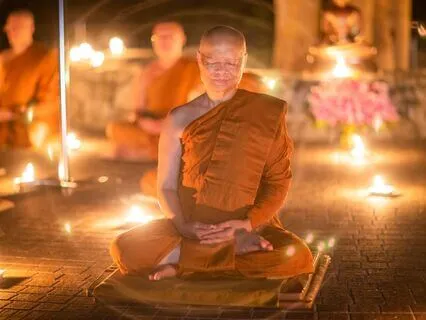
So we sit in meditation now,
Bringing our minds to the state of collectedness,
Of samadhi.
But in order to do this,
It can take some time,
Because the nature of our minds is that they have objects,
They're in these sensory experiences that they meet with,
And our minds have become intertwined with these objects.
So we should try to bring a lot of mindfulness to our minds,
To be very,
Very mindful.
In our present day societies,
We meet with so many of these sensory experiences,
Too many of them,
That our eyes see too many forms,
And we hear too many sounds,
Coming to contact with too many tastes and odors.
The body meets with all these different sensations,
Heat and cold and soft and hard.
And through all of this,
Then,
Our minds give rise to so many creations,
They proliferate too much,
And this creates great agitation and chaos,
Due to all of these sensory experiences.
So what we need is the wisdom to not attach to any of these,
And the mind that isn't given into liking or disliking,
Joy or sorrow.
But our minds don't yet have this kind of wisdom.
They don't yet know nature in line with its reality,
This reality that the Buddha taught to Gaudanya Brahman,
That all things that are of the nature to arise,
They have this rising nature,
That it's their current state to be like this.
All things that have arisen,
They will need to cease,
To pass away.
So they have this arising and ceasing,
But due to the delusion that we have,
Avijja,
This not knowing in our hearts,
We attach to all physical things and mental things as being me,
Or belonging to me.
And we don't see the changing nature of sankharas,
Of conditioned phenomena,
How they arise and cease.
And when things have arisen,
We don't want them to pass away,
And once they're born,
We don't want them to get old,
To go frail or sick and die,
But we attach to these things.
So having been born,
We have a mother and a father,
We have brothers and sisters,
We have friends,
And so there are many beings that we like and love,
But if we become separated from them,
Then suffering appears,
This noble truth of suffering arises.
We are of the nature to be separated from the things that we like and love,
But when our minds don't have wisdom,
When that separation from what's dear to us occurs,
Then we experience pain and anguish.
If we wish for something but we don't get that,
Then we suffer.
So we wish to not grow old,
To not experience illness or pain,
To not die,
But when we meet with those things,
Then we suffer.
We suffer due to our delusion.
So Venerable Ajna Kundanya,
He understood clearly through wisdom this nature,
That his sila,
His virtue,
Was already full and complete,
His samadhi was settled and firm,
And so when his mind gathered together,
Then the wisdom arose,
Which took him to seeing the Dhamma.
And he attained to the Dhamma of anatta,
Of not-self.
And how,
Seeing how all physical and mental things,
There isn't a true reality to them.
But for us,
Through the delusion in our minds,
That we think that everything,
It's me and mine,
It's just me and mine,
Me and mine,
Me and mine,
To everything.
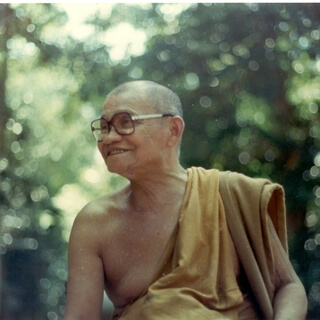
And Ajahn Chah,
He gave an example,
It's like birds that come into a tree and they say,
This is mine,
It's mine,
It's mine,
It's mine.
But really that tree,
The things in the tree,
It's just nature.
But our minds,
They don't know that,
They don't understand it.
But since it's just nature,
It already is this way,
Then why is it so difficult to understand this?
Its nature is to be like this,
That it really doesn't belong to us.
But our minds are deluded,
They have this darkness to them,
Through their delusion.
So this is why we need to train our minds,
To bring them to peace.
And so we have sila,
This virtue,
And if that's already been developed to a good level,
Then we come to train in samadhi,
And we develop our sati,
Our mindfulness,
So that it steadily gets better and better.
You can use the means of a mantra,
So reciting buddho,
Dhammo,
Sankho,
To be doing this a lot,
And we can recite that very,
Very quickly,
So that there isn't the space for other thoughts to interrupt that.
Or we can recite arahantsamma sambuddho,
And do this very fast as well.
So when we do that quickly,
Then it doesn't give the opportunity for other thoughts to enter into the mind.
And for monks especially,
We have a good opportunity to be able to do this,
And so it's something that we can do a lot.
And for laypeople as well,
When you're working,
You can also be meditating too,
Because meditation is something which happens in the heart.
So when you're working,
You can also be reciting buddho,
Dhammo,
Sankho.
But for monks,
We should be especially doing this,
That these are things that we need to come to study and to learn and to know.
So we study,
For example,
How the body is something which is unattractive.
But our minds still take the body to be something beautiful,
To be something desirable.
And why is that?
Because we have been deluded for such a long time already.
And it's not just a delusion from this life only,
It's something that's come from all the births that we have taken.
It's not just one life.
And so it's something which is quite difficult to overcome that delusion of taking the body to be beautiful.
But the thing is that we've also been practicing before as well.
We've practiced already,
We've contemplated already.
And so we further this.
So we use sannyā,
We use our memory or perceptions.
So asubha sannyā,
Bringing up the memory of asubha,
Or the perception of asubha,
Or the perception of death.
Thinking of how our lives must come to the point of death.
How when we die,
The body turns a green tinge,
It becomes bloated,
Eventually becomes filled with maggots,
And different animals,
Large and small,
Come to feed on it.
And in the end,
The bones all get separated and scattered about.
So where within that is there anything that is beautiful?
This body is kind of like a single bag,
And there are things that enter into that bag,
And there are things that come out of it.
But once something comes into that bag,
It's not beautiful anymore.
It's kind of like the food that we eat,
No matter how delicious it may be,
It goes all into the same stomach.
No matter whether it's rice,
Or curries,
Drinks,
Desserts,
It all goes into the same stomach,
And none of it's beautiful.
So the food that we eat,
No matter how delicious it may be,
Once it enters into this body,
It doesn't have any value.
And other things which may be valuable before,
Once they come into contact with this body,
They lose their value.
And so we should train ourselves,
Use our effort in this training,
In contemplating in this way,
Using our thoughts first,
Bringing up these thoughts until the mind feels at ease,
It feels like it's comfortable,
Thinking back and forth,
Back and forth in this way.
Like how when the breath leaves the body,
Then it dies,
And then it's something that's really not attractive at all.
It bloats,
It becomes a green tinge.
So these are things which we've read before in the scriptures,
These ten Asuva contemplations.
And we pick these up and we put them into practice,
Use them to cultivate the mind until our minds feel at ease.
And then once they're at ease,
We can come back to the breath,
And know the in-breath and the out-breath,
And it's easier for us to stay with that.
So moving the mind away from liking,
Because when the mind is in a state of liking,
Then this is kamasukali kaniyoko.
So it's attached in a way of liking.
And if it's like that,
Then we're on a path that isn't going to take us to seeing the Dhamma.
But also if we're torturing the mind excessively,
If it's in too much of a state of difficulty,
Then that's also not the path to seeing the Dhamma.
So we need to bring our minds to peace instead.
And when they're in a peaceful state,
Then we'll be able to see and understand.
So we'll be able to see how this body is just composed of natural elements.
It's something that arises,
Stays for a while,
And ceases.
And it's of the nature to be that way.
When we see that,
Then we see the Dhamma.
But for that to happen,
We need a state of samadhi in the mind,
Bringing the mind to balance.
Because what normally happens is that our minds follow all of the sensory experiences that they meet with.
And when an object like this comes into the mind,
Then it starts creating,
It starts concocting many things.
And it's been our mind's nature to do this for a long time,
So therefore we need to put in our effort in order to practice to bring our minds to a state of peace.
It's something that we need to be sincere in,
We need to persist in.
If we're feeling drowsy,
Then we can get up and walk.
If we're very drowsy,
Then walk backwards.
And do this until our minds come to a state of peace.
And once they are peaceful,
Then the knowing within them becomes more and more clear,
Little by little.
So this is something that can be quite hard for us to do.
And so therefore,
In the beginning,
We need to depend upon a lot of forbearance.
So may all of you set your hearts on this.