This year,
On the 3rd June 2023,
Is the annual commemoration of the full moon day of Vesaka Puja.
And we know that it is the day that the Sasadha,
The Sammasambuddha,
The perfectly self-awakened Buddha was born,
Enlightened,
And passed away into final nibbana.
So on this occasion,
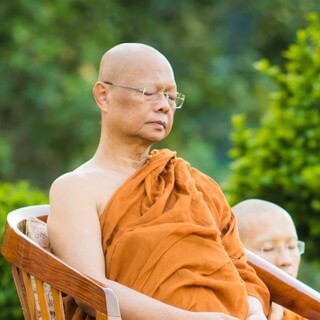
May we practice meditation,
Make the mind concentrated in a continuous way by having mindfulness,
Recollection,
And sampajjhāna,
Clear knowing.
We practice having a kamatthāna,
A meditation method,
Which is the way to make the mind peaceful.
We know the in-breath and the out-breath.
With the in-breath,
Bhut,
And the out-breath,
We recite internally,
Do.
This is the method to make our mind peaceful,
And then we listen to the Dhamma.
When our mind is peaceful and we listen to Dhamma,
Then we will understand clearly.
We contemplate following the content of the Dhamma,
And we may see Dhamma and attain to the Dhamma.
And in the Buddha's time,
There were many laymen and laywomen and the Sangha who listened to the Dhamma and gained knowing and saw the Dhamma.
So today is the day when the Buddha was enlightened.
He used anapanasati kamatthāna,
The in-and-out-breath,
As the meditation object.
Because when the Buddha was a child of just seven years old,
He sat meditation underneath the rose apple tree.
He used anapanasati as the meditation object and could enter first jhāna,
Mental absorption.
And it was amazing that it was in the afternoon,
But the shadow of the tree remained directly down.
King Suddhodana and the royal relatives paid their homage to a miraculous occurrence.
This may have the meaning that the samādhi concentration of the Buddha was firm,
Solid,
And not wavering.
It was not leaning to the left or right.
It is like the shadow of a tree that does not move following the time.
The mind of the Buddha was peaceful and could enter the first jhāna.
The Buddha was born as a young child and after being born walked seven steps and exclaimed that he was the most supreme in the world,
The most superior in the world,
The foremost in the world.
There was no one who was more superior,
Foremost,
Supreme in the world,
Within the three world systems.
If this event is seen in terms of dhamma,
It meant that the Buddha would spread the sasana,
His dispensation,
To the seven kingdoms in India and Nepal.
Before,
At that time,
It was the rose apple continent.
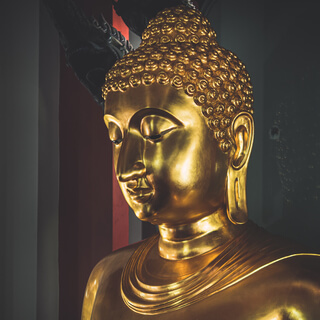
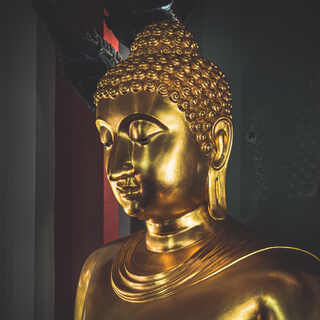
So today is the anniversary of an important day and we recollect the virtues of the Buddha.
Starting from when the Buddha had built barami,
His spiritual perfections,
For sixteen asankhāyas,
Immeasurable amounts of time.
In these sixteen immeasurables,
He had not yet received a prediction from a past samāsambuddha.
Only until his barami was full already,
Then a past Buddha made the prediction that our Buddha would become a samāsambuddha named Siddhārtha,
The Samana Gautama,
A Buddha in the future.
Then our Buddha had to continue to build barami for another four immeasurables and one hundred thousand kalpas,
Aeons.
And this is not something easy at all.
Even one immeasurable aeon is so incredibly difficult and troublesome,
Of which he met an uncountable number of Buddhas.
Each Buddha has to build barami for a long time.
We reflect that the Buddha had to go around cycling through birth and death,
Born and dying,
Born and dying.
And not just born and dying as a human and deva,
Divine being,
But sometimes he had to be born lower than the human realm,
In the animal realms,
Or even hell realms.
But even though he was born in a lower realm than humans,
But he still built barami in the realm that he was born into.
So this is the great compassion of the samāsambuddha that sacrificed his own personal happiness for the benefit of all sentient beings.
It wasn't for himself at all.
If he wanted to see and attain to Dhamma and become enlightened as an Arahant,
Then he could have succeeded to that without difficulty.
And here he sacrificed himself for all of humanity,
For all sentient beings.
We can see that parents have love for their children.
They have self-sacrifice to their children.
They nurture and care for them,
Send them to study,
To succeed in gaining an education,
So that they will be able to support themselves.
And this is very difficult and troublesome.
Some people don't want to have children at all.
But those who have children,
Many will know deeply of how difficult it is.
But the samāsambuddha saw that,
Though it is true that nurturing a child in one life is difficult,
But it is very small.
The Buddha built Barami to assist and help all sentient beings to be free from suffering,
To be free from the cycle of birth and death.
This takes the utmost difficulty and trouble.
He wanted to help all the citta-vijñāna,
The minds and hearts of sentient beings,
Because they all have just suffering constantly.
So this was the great compassion of the Buddha,
That before he could attain to enlightenment,
He had to build his Barami.
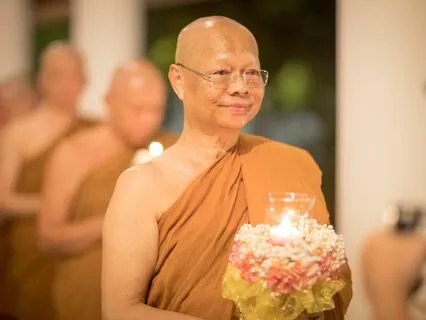
And we come to do a candle circumambulation around the Buddha image in the Uposatha Hall.
Or at home we set up our minds to recollect this important day.
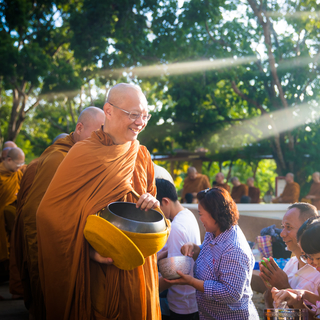
We may have had the chance to give alms,
And undertaken ourselves to keep sila,
The moral precepts,
At home.
At home we may give dāna according to our means and faith,
With what we have saved up,
And then,
When it's appropriate,
We can give at various monasteries.
And we undertake to keep sila.
When we patipadā pūjā,
Give our dhamma practice as homage to the Sama Sambuddha,
We sit meditation and bhāvanā,
Develop the mind according to our strength.
Some people who have strength can sit for one hour,
For some,
Two,
Three or five hours.
So this way is important.
It is giving pūjā to the metta,
Goodwill and compassion that the Buddha had for all sentient beings.
And by giving patipadā pūjā,
We ourselves will get the results.
The Buddha doesn't receive our pūjā.
He doesn't receive our merit and goodness.
But we are determined to offer it to him as buddha pūjā.
And this is goodness that is great and massive.
So may we prepare flowers and fragrant objects,
Incense and candles to give pūjā to the Buddha.
And this is our pūjā through material offerings.
But the important foundation for our minds is that we must patipadā pūjā.
We do it fully and to our utmost strength.
We recollect the virtue of the great wisdom of the Buddha.
The Buddha was able to contemplate and see all dhammas arise from certain causes,
Which we call iddhāpacchayatā,
Or the specific conditionality of all twelve links,
Which dependently arise.
There is no self,
No I,
In it.
There was no one who was able to know it by themselves,
Because it was very deep.
It was only the wisdom of the Buddha who could know it by himself.
So unless one had built their bhārami to the fullest,
To be a sammasambuddha,
Then they would have no way to know that avijjā,
Ignorance,
Is the cause for sankhāra,
Karmic formations to arise,
That sankhāra is the cause for viñjāna,
Consciousness to arise,
For nāma-rupa,
Name-form to arise,
For pāsa,
Contact,
Vedana,
Feelings,
Tanhā,
Craving,
Upadāna,
Clinging.
There was just the sammasambuddha who knew of it.
And he could cut off all the kilesas,
The mental defilements,
Completely.
His mind was pure.
This is called the virtue of the great purity of the sammasambuddha.
So we learn from the teachings that whatever has the nature to arise has the nature to cease.
Then we will see and know the Dhamma,
Following the Buddha.
Here we see the Buddha in our hearts.
So this faith that we have,
Our effort and diligence,
The establishing of mindfulness and making samādhi firm and progressing it to wisdom,
These we call as bhāla,
Spiritual powers.
They are noble virtues that will bring us to see the Dhamma.
Seeing these five khandhas,
The aggregates,
As emptiness.
The rūpa,
Vedana,
Sannyāsa,
Saṅkhāra,
Viññāna,
Form,
Feelings,
Perceptions,
Mental formations,
And sense consciousness,
That is,
Rūpa,
Materiality,
And nāma,
Mentality.
We can see our ancestors,
The kings of Thailand,
With their faith in the Buddha sasana,
The dispensation.
They have supported,
Maintained,
And promoted the Buddha sasana till the present day.
They have built monasteries and supported it in all ways and aspects,
So that we could have a chance to practice Dhamma.
So here we can see the virtue of the land,
The virtue of the Buddha sasana,
The virtue of the king.
And all the laypeople of the Buddha sasana,
Who carried on the faith in the Buddha sasana from generation to generation until the present day,
So that we have a chance to come to the monastery and to listen to the Dhamma.
And when the sangha receives strong support from the king as the head,
His retinue,
And the faith of the laypeople,
They all help to support the Buddha sasana.
And we have the sangha that has continued from generation to generation,
In this era having Venerable Ajahn Man and Venerable Ajahn Chah,
Who has promoted the laypeople to have more faith in the Buddha sasana,
Because they are true monks,
Arahants,
And who taught us Dhamma to reduce our suffering.
So on the night of Visakha Puja,
We have since early morning made merit and offered dharma.
We come and practice and listen to Dhamma,
Increasing our faith to be more firm.
Then one day when our faith is full,
We have the effort and determination to practice Dhamma.
We see that we have the faith and sealer of ours already,
And we are ready.
We want to have the quality of samadhi,
The quality of wisdom,
The quality of mindfulness.
We are determined to try to train and develop our minds by having the meditation words,
Bhutto,
Dhammo,
Sankho.
That which arises with the mind,
There is just rupa,
Materiality,
And nama,
Mentality.
The eye sees form,
Ear hears sound,
Nose smells odors,
Tongue tastes flavors,
Body contacts tactile sensations.
The mental objects are known by the mind.
There is rupa and nama arising.
There is rupa,
Vedana,
Sanya,
Sankhara,
Vinyana,
That arise,
Persist,
And cease.
Sanya,
Memories and perception,
Arise,
Persist,
And cease.
Sankhara,
Mental formations,
Is the same.
The various vinyana,
Sense consciousness,
That arises through the eyes,
Ears,
Nose,
Tongue,
Body,
And mind is the same.
The happiness and suffering that arises in the heart also arises,
Persists,
And ceases,
The same.
There is nothing that stays at all.
We have happiness,
We have suffering,
It arises and ceases.
Whatever we can remember is all about self.
Can we see this?
Rupa and nama arise.
We say it is a self and an eye.
It is a cause for suffering to arise.
So the Sama Sambuddha has become enlightened.
And he was enlightened just to rupa and nama being aniccaṁ,
Dukkhaṁ,
Anatta,
Impermanent,
Unsatisfactory,
And not-self.
So from the faith we have,
And the effort that we are determined to put forth,
We will see the Dhamma.
The Buddha taught for all his 45 years,
And all gathered together,
There are 84,
000 Dhamma teachings.
They are about form,
Feelings,
Perceptions,
Mental formations,
And sense consciousness,
Being impermanent,
Being unsatisfactory,
Being not-self.
So we have come to this day,
And we remember the Buddha's birth,
Enlightenment,
And passing away into final nibbāna.
He gave the teaching for us to be established in heedfulness,
That all the sankhāras,
Conditioned phenomena,
Formations,
Are impermanent.
It is like this.
Even the Buddha's formations were not permanent.
The Buddha had ceased formations,
Which is anubbā,
The final cessation of the formations.
Form,
Feelings,
Perceptions,
Mental formations,
And sense consciousness had completely ceased,
With no remainder.
The Buddha's mental defilements had ceased long ago,
But the five aggregates were still there,
Arising and ceasing,
Arising and ceasing.
But ultimately,
On the day the Buddha attained final nibbāna,
He gave a teaching to the ascetic Subbāddha,
Who contemplated the Dhamma and attained to becoming the last noble disciple.
The Buddha,
Out of his great compassion,
Had walked from Vesali city,
With hardships,
Troubles,
And being sick.
But the Buddha had metta and compassion to teach,
To bring up the faith of the goldsmith Chunda and his wife,
Who attained to sotapanna,
Stream-entry,
And Subbāddha attained to becoming an arahant.
And the Buddha taught in his last teaching for us to not be heedless.
So may we recollect the Dhamma of the Buddha and give our patipadā puja on this 3rd of June,
2023.
And we are fortunate that our body is still healthy,
That we can still give patipadā puja to the Buddha.
May the power of the Triple Gem,
The Buddha,
Dhamma,
Sangha,
Give metta to all the faithful laity,
And for all the monks,
Novices,
And laity with firm faith to progress to have Dhamma,
To have effort and diligence,
To have the mindfulness,
Samādhi,
And wisdom to know and see the Dhamma.
If your bhārami is full,
Then may you attain to Dhamma.
But at the least,
In this life,
May you see the Dhamma,
In order to close off the realms of suffering.
Then we won't be born in the lower realms,
And be born only as a human and deva,
Being born in a human realm without an eighth life.
And then we will attain to the state of emptiness that is purity,
Called nirvāṇa.