Making merit and doing goodness is training to develop our minds to be higher.
Because the nature of the mind is that when it has delusion covering it,
It has too much of a sense of self and then selfishly we will only do things for ourselves.
The mind will be darkened.
For the mind to be able to be brighter,
It must let go of that feeling of a sense of self.
The Buddha taught in the beginning on giving,
Giving dana and making merit.
Even when we offer some small things,
But with a heart of faith,
One spoonful of rice or food,
Fruit or things that we have faith to offer,
They all have value to the mind.
Even King Asoka,
When he was a child,
He gathered a pile of dirt to offer to a Pacheka Buddha and he got some good results from that,
Being able to vastly expand his empire from the barami,
The spiritual goodness he had made.
And dana barami is to promote us to see and know the Dhamma.
The Buddha would even give a sermon on giving dana,
To someone with a lot of barami and many who are arahants,
To Venerable Yassa who was from a wealthy family in the city of Varanasi.
The Buddha talked of dana first,
And Venerable Yassa had made a lot of merit practising dana before,
And he was full of delight.
When he listened in regards to giving and offerings,
His mind was uplifted out from his agitation and confusion and his mind was gladdened.
We Buddhists have excellent thoughtfulness in giving.
And we may think that giving dana isn't much,
But it isn't something that arises easily.
How does it arise?
Firstly,
Our minds are imbued with faith,
And we have the time and opportunity to give.
Because sometimes we have the opportunity,
But we have nothing to offer.
At other times we have things to offer,
But no opportunity to give.
But when we have the readiness to give,
And we do it,
Then we have feelings of fullness of heart arising.
Like one lay male disciple in the Buddha's time,
Who,
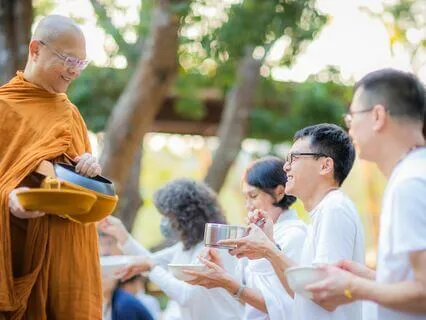
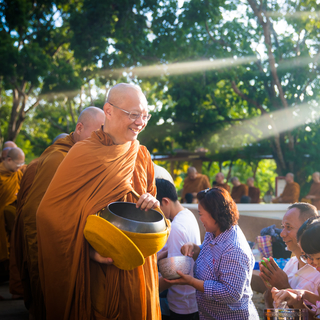
When there was a venerable monk walking alms,
He didn't have anything to give.
On the day he had things to give,
But he didn't meet that monk.
But one day he met the monk and gave dana,
And the good results from that arose.
For us to be able to have faith arise,
We need to listen and learn dhamma,
The teachings of the Buddha,
That have come from the suttas and that have been given by the sangha.
And so gathered together,
We need to have the venerable sangha,
The great teachers who carry on the teachings.
We have venerable Ajahn Chah,
Venerable Ajahn Mun,
Or the venerable senior monks in various countries who continue on building goodness,
Leading dhamma practice,
And giving teachings to the faithful people.
And if there were no dhamma teachings,
Then we would not know about the practice,
About the beginning on giving dana.
So to have the arising of a Buddha is hard and rare to find.
And the faith and confidence we have,
It doesn't arise easily.
So we should be proud of our faith that we have.
Have we thought before that being born as a human being is difficult and rare?
They give us a simile so we can see how truly difficult and rare it is.
It is compared to a blind turtle that is in the middle of the sea,
And once in a hundred years it will come up to the surface.
And there are winds blowing in all four directions.
There is a piece of wood with a small hole.
The chances of that blind turtle coming up once in a hundred years and contacting that piece of wood is the chance of a human birth.
What's the percent chance of this happening?
It's very small.
But these days we see many human beings being born.
So this simile probably means the ones who have a human mind.
The humans that are born of the mind.
There are many people who are born,
Many without sila,
Morality,
And without dhamma.
But those who can be born and can change themselves from being a common person to being a virtuous person are very small.
Even after 25 years of Wat Nong Pa Pong,
I heard Venerable Ajahn Chah give a dhamma talk.
And he asked the laymen and women disciples,
Is there anyone who will be determined to keep the five precepts for their whole life?
Ajahn Chah said that the laymen and women looked around at each other nervously.
There was no one who raised their hands and said,
I will.
Ajahn Chah said,
Eh,
The people who are sitting here are just half people,
Not yet human.
See,
And this is to the level that a great teacher had been teaching them for 25 years,
But they were still unable to commit themselves.
So being born as a human being with the five precepts is hard,
It isn't easy.
And all dhamma practitioners need to have the five precepts.
They may start with keeping the five precepts only on the weekly lunar observance day,
Or those who can already keep the five precepts add to keeping the eight precepts then.
Or on the days off,
On the weekend,
Being determined to keep the five precepts.
Okay,
Today I will be born as a human for one day,
And then being intent to bhavana,
To develop the mind.
The good result of sila is that peace arises.
There is peace in actions and speech.
There is no arguing and disputing.
It's peaceful.
When we have anger,
Greed,
Delusion,
We can bear with it.
One is training in forbearance,
Not acting following our moods,
Not following our thoughts.
Because this thinking proliferates out coming from avijja,
Ignorance.
It's coming from a sense of self.
So we are careful when we take care and we are building goodness.
We have dhana,
We give on the external,
Like giving alms.
And we give on the inner level,
Which is giving forgiveness.
Giving forgiveness is dhamma practice and bhavana on a high level.
We have dhana already and we have sila.
So this is our birth.
On our birthday is when we got a body that is human.
And so we build goodness and remember how fortunate we are that we have been born as a human and we have a chance to practice dhamma.
We are able to see and know the dhamma,
To understand the dhamma.
We have the sense doors of the eyes,
Ears,
Nose,
Tongue,
Body and mind.
So we will experience sense and mental objects,
Which means we can practice with them.
And then our understanding of dhamma will improve by levels.
In brief,
The 84 dhamma teachings are about the five khandhas,
The aggregates of form,
Feeling,
Perception,
Mental formations,
Consciousness.
They arise,
Stay for a while and cease as normal.
If we see this,
Then wisdom arises.
For wisdom to arise,
We need to train the mind,
In dhana,
Sila and bhavana.
We keep the holy life and we see the drawbacks of the mental distractions.
There is a lot of lost time in sensual enjoyment and pleasures.
We lose time from our own bodies.
So we reduce our actions in this,
We reduce our food.
From four or five meals,
To three meals,
To two meals,
We eat less and some take only one meal and just a little bit of evening drink or a bit of fruit and they can get by.
This gives us time to practice.
Because when we eat,
Our mind may be all stirred up and we're not peaceful.
Our mindfulness is not continuous.
So instead then,
We have the time to bhavana,
Time to sit meditation,
To walk meditation.
And so this makes our mind be peaceful and gather together easily.
Samadhi,
Concentration arises.
We see the drawbacks of all the mental distractions.
We see the benefit of having dhana,
Sila,
Bhavana.
The benefit of practicing renunciation,
Of keeping the eight precepts.
We give homage to the Buddha,
Dhamma,
Sangha.
We give homage to the Buddha,
Who is pure,
And we become pure along with the Buddha.
And the Buddha doesn't want anything from us.
He wants us to have a beautiful and good mind.
He has sacrificed his life,
His flesh and body many times over,
For countless lifetimes.
Out of his boundless and supreme compassion.
He wants us to have a good mind,
For living beings to have a good mind.
So compassion like this is hard to find.
Who could be equal to the Buddha?
So after we have recollected the Buddha's virtues,
Then we practice meditation and train the mind to be peaceful.
Following the methods and ways that we have practiced before.
We can contemplate for the mind to have samadhi,
To have emptiness.
So that our mind is empty from any mental objects,
From attachments and clinging.
And this we say is a little bit of nibbana.
There is coolness in the heart arising.
This is the result of the practice.
So they compare it to a mango.
If we have sila,
It is like a small mango.
The mango grows bigger and bigger.
Even though we can eat it,
But it's not sweet,
Not juicy,
Not fragrant.
When we get samadhi,
This is compared to a mango which is bigger and better.
It gets juicy and starts to get sweet.
When we have wisdom arise,
Then that mango is just right.
It is juicy,
Sweet and fragrant.
It's ripe.
It tastes delicious.
And the taste of the dhamma excels all tastes.
So we give dhana and we have joy and fullness of heart arise.
Here we understand that this is our body being a human.
But when we do goodness,
Then our face is bright,
Radiant and full.
This is the heart of a deva,
The heart of a divine being.
It is the heart of a person who has hiri,
Wise shame,
And uttapa,
A fear in the results of wrongdoing.
Sometimes we want to see a deva,
But the deva is our hearts.
We have hiri,
Wise shame,
And uttapa,
Fear in the results of wrongdoing,
And this is a deva already.
There is fullness of heart,
Joy and bliss in giving,
In building goodness,
In building merit,
In building skillful actions.
So we develop from being a human like this to a deva.
They say one who has built barami dies from a human and becomes a deva,
And then from a deva they become a human,
Until their barami is full.
So we make our samadhi firmly established,
And we start to see clearly into the teachings.
We get to the core of the teachings of the Buddha,
A form as simply being form.
We contemplate the bodily form,
That it is just simply form.
It gathers together,
Combines,
And then decays.
But our mind is deluded that it is our self,
That it's ours.
So we take this form to build goodness,
Until we can get to the core of the Dhamma and can see the Dhamma,
And here we will see the true self.
So may we set our hearts on this.
Today is the fourth day of the Dhamma practice retreat.
May you gain peace of mind,
May you have mindfulness and wisdom,
May you grow in blessings.