When we are together with others,
And there is deference towards the elders in the group,
Then there is orderliness arising.
Because if each person has different thoughts and views,
They attach to their own views,
And don't have a foundation of respect,
Then it's hard and troublesome to be together.
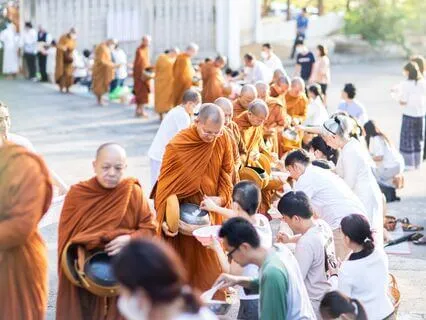
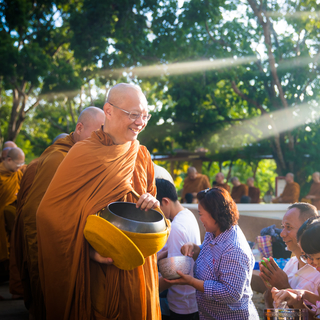
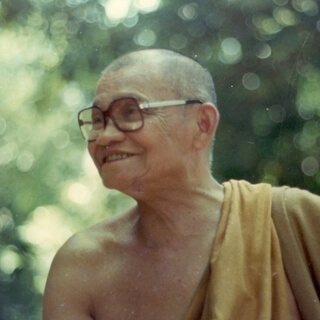
Venerable Ajahn Chah gave a deep teaching of someone who comes to ordain as a monk,
And there are the monks who sit in on the ordination ceremony.
They are gathering in the group who give that ordination.
He taught that those who come to ask for ordination should have respect for those monks,
Because they have given us ordination.
They have guaranteed us to be a monk or novice.
So Venerable Ajahn Chah taught deeply about having a foundation of respect.
And with this,
Humility will arise.
When there is respect,
Then humility arises.
Then happiness arises from being together with others.
The qualities of humility and respect will have some differences.
Humility,
Humbleness,
Modesty.
Its meaning is to be not inflated,
Having no air,
Or being uninflated.
Its Pali word is niwata,
Which means no air,
To not be inflated.
This is controlling ourselves to be at a normal state,
From being like an inflated air balloon,
To being a balloon that hasn't been inflated.
Humility has similar characteristics to respect,
But it has a different meaning.
We can notice that when we have respect,
Like we respect the Buddha,
Dhamma,
Sangha,
This is that we are recognizing the goodness and virtue of the Triple Gem,
Or recognizing the goodness in others,
Of what goodness they have.
Or it can be other things,
Like a tree giving shade.
The Venerable Elder Sariputta saw the goodness of one tree that gave shade to him all the time.
He saw the goodness in Radha Brahman who had given him one ladle of rice,
So that he could maintain his life.
The Venerable Elder Sariputta had beautiful virtues.
He recognized the goodness in others.
So this is a quality that is correct and sincere,
Because this recognition expresses itself in our actions and speech.
Here,
Humility means one has skill,
But one conducts oneself correctly.
Like we have a high level of knowledge,
We have a high skill,
But we conduct ourselves appropriately,
Not being arrogant,
Not boastful,
Not showing off beyond the truth.
Or people,
When they have something good already in themselves,
They may elevate themselves to control others.
This is bad-mannered behavior.
But those who have this virtue of humility will have well-mannered behavior and give honor to others at every time and occasion.
So this is emphasizing on the mind.
When I was in Wat Nong Phra Phong,
Venerable Ajahn Chah said the monks who come to ordain,
They need to put down what they have and have been in the world and leave it in the front of the monastery.
Don't bring it into the monastery.
He taught us not to inflate ourself in the self that we have.
We won't be able to stay in the group thinking,
I am higher,
I have more than others in the world.
If we go stay there being like that,
Then we won't have humility.
There were the group of venerable elders,
Such as Venerable Ananda and Venerable Nanda.
When they were going to go ordain,
Together with Venerable Upali,
Who was the son of a barber,
They saw that if the barber ordained after them,
Then they would hold on to that and have him respect them like before.
So they had Venerable Upali ordain first so that they would bow and respect Venerable Upali.
So they had put down and abandoned what they had,
Coming from the highest family lineage.
They put down the many things that they had.
They raised Venerable Upali to ordain before them so they could give up their own views and conceit.
Venerable Ajahn Chah took this to teach the monks that were coming to ordain and live.
They had different languages and dialects,
Coming from different places,
But not to attach to it.
To enter the moong means to enter the city.
They buy glur means to buy salt.
The words used are conventions,
But the meaning is the same,
Not different.
It's not that we think one language is better,
And then we go boasting about ourselves and look down on others.
And societies in the world are like this.
The rich may look down on the poor.
Those with knowledge look down on those with little knowledge.
Those with a high position and work look down on those who don't have wealth,
Rank,
Praise and happiness.
So having humility will bring up prominent characteristics which are actions,
Speech and mind that is humble.
And then this will lead on to developing a foundation of the mind which has mudita,
Sympathetic joy,
Joy at others' goodness.
This is training the mind to have the brahmaviharas,
The four sublime abidings.
If we have humility and good speech,
Then we have metta,
Goodwill and compassion.
We have a mind that is tender and pliant,
Which is the mind that has sympathetic joy.
If one can develop this,
Then they will enter a very deep samadhi,
Meditative concentration.
So it's not something that is small.
So can we notice the characteristics of those who come to the Buddha sasana,
The dispensation?
Whatever nationality they come from,
Europe,
America,
Asia,
They will have the characteristic of having dhamma arising in the heart.
They will have humbleness.
Their actions are humble,
Their speech is humble,
Their mind is humble.
Humble in giving dhana,
Keeping sila,
The precepts,
And in bhavana,
Mental cultivation.
They are polishing their minds.
They have respect for elders in the dhamma,
For those who have sila and dhamma.
They are not holding on to and measuring through worldly qualifications.
And they don't hold themselves up that,
I am from this country,
From this high family status,
Have wealth and money,
Are attractive and good-looking,
Have skill,
Knowledge,
Position,
Rank,
And many followers.
So we can see that all the laypeople coming to the monastery,
Though in the world they may have a high status,
Wealth,
Knowledge,
Work position,
Skill,
But they put it down when they come to the monastery,
And they feel light and at ease.
Coming from something that is a convention that we have,
We then can enter into the social group that is present there.
Because if we are deluded and attached to what we have,
Then we'll go attaching to it all the time,
And we won't know that these things are not lasting and enduring.
And especially the sankhara,
The bodily form of ours,
Is not lasting or enduring.
When the body does not last or endure,
Then the other things that we can have,
Which are dependent on having a body,
Then it's all not lasting or enduring.
It can change.
A millionaire or billionaire,
One day they may not have it.
The ones who don't have and are poor,
One day they may have it.
Some people who have no position or rank,
One day they may have a high position.
Someone with a high position,
One day they may lose that position and lose the people under them as well.
It's not a sure thing.
It's a worldly condition.
So we can't attach to what we have.
And what we do have,
We don't look down on others.
But we instead use what we have to give benefit.
We have metta and compassion to others.
We have humility.
And then even more people will respect us.
They will recognize our goodness.
So this is important.
Because if we people hold on to our self and ego,
What's that like then?
We can even lose close friends because of it.
Because from something we shouldn't get angry about,
We can get angry at friends over.
We lose friends and the feelings of friendliness.
Or we are not good and we don't have things,
And we go boasting that we are good.
We have conceit that we are good.
Then we may lose our goodness.
There are those who are born into a high-status family,
A rich family,
And they may not gain success in studies and in their livelihood because they are stubborn,
Because they hold that they are good.
Whoever advises them,
They don't listen to.
They have wealth and they spend it excessively until they are like the many who lose it all.
In the time of the Buddha,
There were people like that.
And in this era,
There is this as well.
Or we are in a social group and we boast.
We put on airs.
We like to have special privileges and have no rules and discipline.
Then the group can be separated and have divisions.
So there should be rules that make it harmonious to be within sila,
Like flowers that are stringed together into a garland which looks neat.
So the way to overcome the boasting,
Stubbornness,
The conceit in being good,
Is that we need to have khaliyanamitta,
Good friends,
To constantly advise and develop our characters,
Like having a teacher.
The monks take dependence on a teacher,
A preceptor,
In order to keep polishing off our defilements,
To not be boasting or holding ourselves to be good.
Because if we people don't have wisdom and do not listen to anyone,
Then there will be people who will praise and flatter us insincerely,
And we will be lost in it easily.
And then we will like it when others praise and flatter us that we are generous and kind-hearted.
Then we can lose opportunities and lose work.
We will lack wisdom and go attaching to various things,
Becoming deluded in worldly conditions,
Which is having gain,
Rank,
Praise and pleasure.
We don't think and contemplate that these things are of the world.
They are things that are illusions in the world.
There is gain,
Loss,
Rank,
Loss of rank,
Praise,
Blame,
Pleasure and pain.
When they arise,
We have to be careful.
It's the fault coming from being conceited and boasting,
Arrogant and of not being humble.
So it's like this.
As for respect,
Like explained,
We recognize the goodness in others.
We show respect sincerely and deeply.
Having respect means the goodness is deeply embedded within our heart.
It makes people to have a tender heart,
Unstubborn,
Graceful and refined.
This is important.
When we have this respect,
Then we have virtue.
We have metta.
Not thinking of finding faults in others,
Not mocking others,
Not thinking we are as good as them.
Then we have good virtue.
We look at things as being good.
These days we call it thinking positively.
We train in thinking positively often.
Then we will have happiness.
Thinking positively consistently is metta.
When we have metta,
We can get along with others easily.
We have metta and compassion for each other.
We always see the good in others.
We don't see the faults of them.
Then our mind is at ease.
We only see their virtue and goodness that they have done.
And we won't be able then to stop ourselves from recognizing,
Respecting,
Praising,
Admiring and esteeming them in body,
Speech and mind.
We do it with sincerity.
We are not pretending.
This is our mind being mudita,
Joyful with others.
There is respect here.
We do it and it's deeply embedded within our heart.
We do it often,
And our mind will be a mind that is good and excellent.
And if we don't do it,
Then we lose out on our happiness.
So train in this.
When we have respect and admiration like this,
Then it will show itself in our facial features.
Our features are more fresh.
Our face looks beautiful.
Our wisdom has come up.
The benefit of having respect is metta.
It makes us lovable.
And people are more affectionate to us.
People are more deferential to us.
They praise us.
We have happiness in body and mind.
We have no troubles and no problems or grudges with others.
When we do good to others and they do bad to us,
We may feel saddened.
We may feel slighted.
But we can maintain our even state of mind.
We don't see fault with them.
We have done the good act and have gained the goodness from that already.
Don't look at it that they haven't repaid that act of goodness.
Because in the society in the world,
Those who have metta to others and don't expect anything in return are few.
And there will be even less people that will be grateful to us.
It's the way it is.
People are looking out for just themselves and only looking for their own benefits.
So when we have done good,
Whatever the act is,
Our goodness will make others want to help us in the times we are struggling and we'll be able to pass and resolve it.
We will have people who support,
Attend and look after us without fail.
So don't waver.
Have sati,
Mindfulness,
Well established.
Be a person who is not careless.
Doing this,
Then our minds will have refined wisdom and be born in a high status family in every life until we attain Nibbana.
So we can see the difference between respect and humility.
So may we contemplate it.
In conclusion,
We recognize the goodness of others that we meet and see.
We rejoice in their goodness.
We have respect and deference to them.
Humility is making our minds have deference.
The body,
Speech and mind is humble.
We are not arrogant,
Not raising ourselves to control others and so on.
And it's a blessing to our life.
The Buddha taught that respect,
Humility,
Being of few wishes and gratitude are the highest blessings.
So all Dhamma practitioners,
May you follow this and you will have virtue and goodness.
You will have generosity,
Sila and mental cultivation.
And ultimately,
You will have wisdom.
You will know and see the Dhamma.
May you grow in blessings.