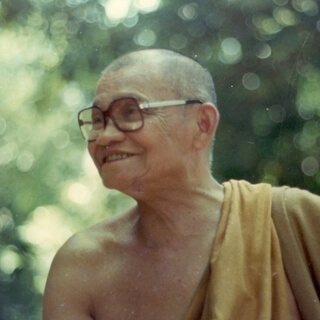
So it's the new moon day of the seventh lunar month,
And this rains retreat is halfway done already.
There's just one and a half months left until we reach the end of the period which we had determined to spend in retreat.
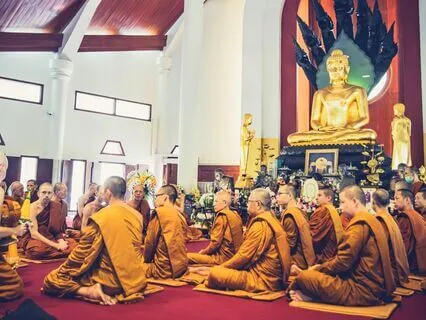
So with us setting our hearts on coming to take the higher ordination in the Buddhist religion,
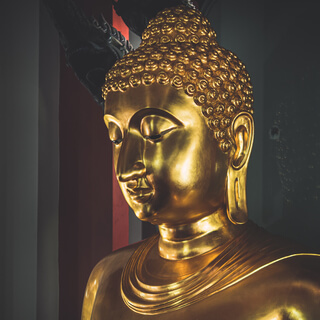
We have this respect for the Buddha.
He was a fully awakened being,
Awakened through his own efforts.
We have this respect towards the Buddha,
The Dhamma,
The Sangha as our sarana,
As our refuge.
We don't have any other refuge.
The Buddha,
The Dhamma,
The Sangha are my highest refuges.
So the Buddha is my excellent refuge.
So in previous times,
All one had to do was recite Bhuttam Saranam Gacchami,
Dhammam Saranam Gacchami,
Sangham Saranam Gacchami.
I take the Buddha as my refuge,
The Dhamma as my refuge,
The Sangha as my refuge,
And for a second time and a third time and one would be a monk within the Buddha Sāsana.
So this is something that we can use to chant,
That we can use to recite,
And that's in order to make this very firm within our hearts,
That we have this respect for the Buddha,
The Dhamma,
The Sangha.
We don't have any other refuge.
Natti me saranam varam,
Bhutto dhammo sangho,
That we have no other refuge than the Buddha,
The Dhamma,
The Sangha,
That these are our highest refuges,
Our most excellent refuge.
So this vara,
It means that which is excellent,
That which is the highest.
So we see that when we have this respect and take the Buddha,
The Dhamma,
The Sangha as a refuge,
And we're firm in that,
Then we walk the path following the Buddha,
The perfectly self-awakened one,
Following his Dhamma,
His teachings,
And the Sangha,
Those which have practiced those teachings already,
Those which have gained knowledge and insight into those teachings already.
So the Dhamma that we study comes from Venerable Ajahn Chah,
Who in turn learnt this Dhamma from Lumpur Ginniri and Lumpur Tongrap,
And they learnt that Dhamma from Lumpur Mun,
Ajahn Mun,
Who was the founder of this tradition,
And a very important person in this world.
And he taught us for us to practice strictly in the Vinaya,
The Padimokkha,
The rules inside and outside the Padimokkha.
This is the path that leads us to the end of suffering.
And also within our meditation practice as well.
And he taught for us to study about rupa and nama,
So materiality and mentality.
So we should observe that all the methods that we use in meditation are means to bring our minds to peace.
And we can contemplate in order to bring the mind to peace.
We can be reciting meditation words to bring the mind to peace.
But we have this acceptance first,
An openness first.
And what's that openness towards?
It's to the Buddha as our refuge.
That we accept him,
Receive him as our refuge.
And then we can recite that taking refuge as a means of practice as well.
And we can move to the body,
For instance.
The other's body,
Which we attach to,
Brings our mind suffering.
So then we find a path out of that suffering.
And we have this samadhiti,
This right view,
As a means to gain freedom from suffering.
So we study these noble truths.
So there's this noble truth of suffering,
Its origin and its cessation,
The path leading to that cessation.
This is something that we have understood to a degree already,
What they're like.
And then we try to put them into practice in order to seek that freedom from suffering.
So this is about the four noble truths.
These truths which we have studied,
Which we've got to know already.
So there was one time that there were some monks from overseas,
From Korea,
Who came to pay respects to Ajahn Chah.
And I just happened to be attending to him at that time.
And they asked him about the path of practice.
They asked him about dukkha,
The stress or suffering,
Its cause,
Its cessation,
The path leading to that cessation.
And with Dhammocha's answer,
He didn't answer,
Explain anything following the scriptures or the theory.
And there are some questions that should be answered with another question.
So to ask back to the questioner,
There are some questions which should be answered in short,
Some which should be given a long explanation,
And some which should be met with stillness.
So he was not answering that question.
But in this case,
Dhammocha,
He decided to ask back.
So he asked these monks,
Why do you eat?
What do you eat for?
Why do you eat?
And how do you eat?
And when you've eaten,
What's the result of that?
And so they understood this answer.
These monks,
They retained in Korea and were wearing the gray robes of a Korean monk.
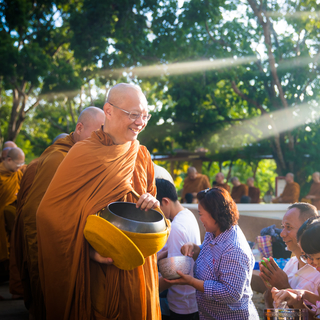
And he told the laypeople that you should bow to them because they are monks.
And the laypeople,
They were just familiar with monks wearing brown robes.
These monks had gray robes.
They had a shaven head as well.
But the laity didn't know that they were monks.
It's just like when we go outside of Thailand,
Then people don't quite know what we are either.
They don't know why we're wearing these kind of robes.
So we should study,
Study this right view,
To be reciting that as well as to be studying chanting in the Dhamma.
In what we study,
What we chant,
It's all about this body and mind.
It's materiality and mentality.
And so there is this physical form.
And then there are feelings.
There's memory and perception.
There's mental formation.
There's consciousness.
And this is nama and rupa.
And the reason that we experience stress is because we attach to this physicality,
Mentality,
As being,
As self.
That's the case,
Isn't it?
So we should then ask,
Well what is this physicality?
And what is mentality?
This is something that we've studied from the basic level of the Dhamma examinations that we study for.
And these bodies are a collection of elements of earth,
Water,
Fire and air.
This is a part of the four foundations of mindfulness.
It's foundations which comprise the body and feelings,
The mind and the Dhamma.
So the breath,
That's a part of the body,
This air element.
And then we have the other elements of water,
Earth and fire.
And all these come together to form this physical body.
But we can separate that out as well,
As being four different heaps of elements.
We can contemplate these as the four elements,
Or just one of those,
Picking up just one element.
We can contemplate that as well,
And that's fine.
We carry on doing that until we see clearly,
Until we gain an understanding.
And so this is the way of using contemplation as a means to bring about inner peace,
To bring about inner stillness.
And even though it's contemplation,
This is still Samatha Kamatthana,
So a meditation object to bring the mind to tranquility.
You can also be reciting mantras,
Meditation words,
Like butto,
Dhammo,
Sankho,
Or buttaṃ saranaṃ gacchāmi,
Dhammaṃ saranaṃ gacchāmi,
Sankhaṃ saranaṃ gacchāmi,
Or buttoṃ mi saranaṃ varaṃ,
Dhammoṃ mi saranaṃ varaṃ,
Sankhoṃ mi saranaṃ varaṃ.
Or we can pick up another chant and recite that,
Or go through the 32 parts of the body,
Hair of the head,
Hair of the body,
Nails,
Teeth and skin,
And go through that back and forth,
Back and forth.
These are all means to bring our hearts to a state of stillness and peace.
And when they're still and peaceful already,
Then these meditation mantras,
They disappear just by themselves.
The heart is settled into that stillness.
And so all of this is Samatha,
It's tranquility meditation.
So what then do we do to give rise to Vipassana,
To insight?
Because this wisdom is something that's important,
Isn't it?
In order to be freed from suffering,
We need to have wisdom first.
So if we practice just using tranquility,
That's the means of practice of a rishi,
Of a hermit,
That they're just seeking out just peace of mind,
Just the samādhi.
But what we're practicing,
It's samma-samādhi,
It's right samādhi,
And that requires mindfulness,
Which is based in one of the four foundations of mindfulness.
So it's a samādhi which has wisdom to it as well,
That it has all the factors of the Eightfold Path,
That there's right view,
There's right intention there too.
We can't just separate all of these out.
So may you really practice in order to bring your mind to peace and have a lot of mindfulness,
Be recollecting within this body to bring the mind to peace.
And stillness.
Because Vipassana,
Insight,
It arises from a calm mind.
We contemplate looking into the body,
Like the hair of the head,
Hair of the body now is teeth and skin.
We see the body changing all the time,
See the elements break apart and disappear.
So like when the body dies,
It's the air leaves the body first.
And we see how this is something which is unreliable,
That it's inconstant.
And then the water,
The liquids of the body,
They leave,
The heat leaves.
And then what's left is the earth,
And then that slowly breaks down and turns back into soil.
And as we see that process happening,
We see that the body isn't really there,
That it's emptiness.
So now minds see this way,
They see emptiness.
They see that this is not me.
And then this rapture appears from the peaceful heart.
There's wisdom there as well.
And this is for the qualities of the bojangas,
The factors for enlightenment,
Coming together.
And so we practice in the way,
In this way.
So bring the mind to peace,
Looking at the elements,
Separating them out,
Using this body as our main foundation,
As our mainstay in our meditation.
If any vedana feelings come up,
Then we can observe those feelings.
If there are moods coming up within the mind,
Causing the mind to proliferate,
Then we can observe the mind.
And all of this comes together in the mind,
Which is a part of the Dhamma as well.
So when the mind is not attached to the body,
To feelings,
To memory,
To mental proliferations,
And to sense consciousness,
To physicality and mentality,
Then this is a matter of Dhamma.
This arising,
Persisting,
Ceasing,
Seeing arising and ceasing.
This is within all things.
But in the beginning,
Peace is insufficient to be able to practice in this way,
To be seeing that.
And so we need to use the kind of wisdom that we're able to use first.
This wisdom that comes from listening and from thinking.
And so we bring up these perceptions and memories first.
It's like when we sit in meditation,
Then we recollect the triple gem,
And how that is our highest refuge,
And have our hearts firmly established in these refuges.
And we can develop loving-kindness,
And really bring the mind to a state of firmness with the Buddha,
The Dhamma,
The Sangha being our most excellent refuge.
And we come to contemplate the body using memory and perception.
In the beginning we have to use this.
So we contemplate how the body,
When it doesn't have any breath left,
Then it just breaks apart.
The fire element leaves,
And it becomes cool.
And then it starts bloating and splitting,
And then becomes filled with maggots and worms.
And if we can see like this,
Then we see that it's not a beautiful thing.
And so this is us using the Supakamattana meditation methods on the unattractive aspect of the body,
And there are ten of them.
If we separate the body out,
Then that is us using the elements as a means for meditation.
So seeing the earth element break apart and break down into the dirt of this world,
And then the liquids all leave.
And so this is using the elements.
So what do we do that for?
Well it's to bring the mind into peace,
To bring it to a state of samadhi.
And so we bring up and use what works for us,
And we carry on doing that until we're skilled with it.
So some people like to contemplate the elements,
And other people like to contemplate a subha.
And then when they do that,
They can come back into the elements,
And just carry on doing this until you're skilled at it.
And you contemplate the elements,
And then if a liking towards bodies comes up again,
Then contemplate a subha again,
And then bring it back.
And then if that liking comes up again,
Contemplate a subha again.
We keep on doing this using perception and memory,
Trying to bring the mind to peace through using our thinking.
And there may be a small amount of calm that arises,
Where the body and the mind feel calm and at ease.
And we just carry on doing this frequently,
Do this each and every day.
We do it in the morning,
In the afternoon,
At night,
Whenever we have the opportunity to meditate.
So when we have the time,
Then we should be contemplating a lot.
Contemplating using our thoughts in order to bring about peace of heart.
And then what we do next is we use that energy that we've gained inside ourselves in order to gain insight.
But here this doesn't happen through thinking,
But rather it's a genuine knowledge that appears.
A knowledge into dukkha,
Its origin,
Its cessation and the path leading to that cessation.
Through what we've studied,
We contemplate in line with that until this wisdom arises through bhavana,
Through mental cultivation.
And so when the heart is at peace,
Then it's possible to get there.
And it may happen when we're listening to a dhamma talk,
That that is possible.
And for this great clarity and knowledge to arise,
For us to gain insight and see how really this physicality and mentality,
It's not truly there.
And see into the nature of conventions.
And see that clearly,
Then we see emptiness.
And here the mind,
It knows reality.
And piti,
Rapture arises.
Wisdom comes up.
Experience,
The vipassana jhanas.
So these knowledges of insight,
And there are nine of them.
So seeing sankharas,
Conditions arise and cease.
Or just seeing them cease and cease and cease.
And seeing how all beings are destined for death.
And how the body is a nest of illnesses.
It's a heap of suffering.
And through this,
We can extract the liking delight that we have towards it.
And see that it's something that needs to break apart.
And what is there to have lust towards.
And yet the mind doesn't want anything from this world anymore.
Because there's this inner contentment and rapture within it,
That lasts for three days and three nights.
And we don't sleep during that time.
That the mind is awakened.
Even within rest,
The mind is still in an awakened state.
And we feel like we're not sleeping at all.
That we're always awake.
That there's no drowsiness present.
And so this is what happens when this dhamma of piti,
Of rapture arises.
And this is an important quality.
There's also this contentment and a happiness of heart.
And so what's this the result of then?
Where does this come from?
It comes from asila.
So keeping the five precepts,
The eight precepts in the beginning.
And maintaining our mindfulness.
Recollecting.
Having this awareness.
Bringing the mind to peace so that wisdom arises.
Putting in our efforts,
Being really firm in our practice.
And having this faith.
And as we carry on with that,
Then this faith grows,
Then wisdom arises.
This comes from the respect,
The devotion that we have.
That the Buddha is our most excellent refuge.
That we don't have any other refuge.
And when we recite this,
We do so with a heart which is firm in that,
That's not wavering.
As we recite that frequently,
Frequently,
Then hearts become more and more firm.
But initially this is just faith.
But when we actually see the true nature of the dhamma appear for us,
When wisdom arises,
Then this faith becomes solid.
Because we have seen the truth.
We've seen the dhamma,
The teachings of the Buddha.
That all materiality,
Mentality is inconstant,
Stressful,
And not self.
And that the truth is like this.
And we know that because we've seen it clearly.
And here our faith,
Within us,
Is firm.
And it's firm through wisdom.
So this comes from us making our body and our speech,
Our mind,
Our thoughts,
Our speech,
Firm in our devotion towards the Buddha.
And then bringing this respect into our hearts towards the Buddha,
The dhamma,
The sangha,
Which is there in our hearts,
Inside of us.
So when wisdom arises,
It comes from a mind which is peaceful and gathered together.
And at that point there isn't thinking going on.
So we humble and bow our hearts to be listening to the dhamma.
And then when we receive that sound,
Wisdom can come up within our hearts if they're in a peaceful state.
And so this is correct for us to be doing it like this.
We have this samadhi already and this leads on to wisdom.
And wisdom then leads on to a clear and correct understanding.
But in the beginning we use our thinking to contemplate first.
And we should do this a lot to bring the mind to peace.
But if that gets excessive and the mind starts becoming restless,
Then we bring our minds back to stillness through watching the breath,
For instance.
And then we go back and forth,
Back and forth between these.
And so you should practice like this and the results will appear for you.
So when we bring our hearts to bow and be humble to the dhamma,
We bring our hearts to humble to be seeking out the Buddha,
The dhamma,
The sangha.
That we need to be doing that,
To be humbling our hearts towards the Buddha,
The dhamma,
The sangha,
To have an open and respectful heart.
This is something that Ajahn Chah said,
That we need to be humbling our hearts to meet with the Buddha,
The dhamma,
The sangha.
That we don't get the Buddha to come and meet us,
But we need to be seeking out the Buddha with an open and respectful heart.
It's like the five ascetics,
When they listened to the dhamma,
They needed a humble and open heart.
And so initially it was just Ajahn Kuntanya who had that,
And the other four,
They hadn't yet humbled and opened their hearts.
But when they did so,
They were able to see the dhamma and accept the truth,
Accept how this mentality and physicality,
It really is changing all the time.
And dhamma appeared within them then.
And so this came from,
Initially from the faith that they had.
So for us we practice starting out with this foundation of faith,
Seeing dukkha,
The stress,
And then we come to find a path out of that.
In the beginning do we have respect?
Well we do have a kind of respect.
So we see monks and we bow to them following the customs and traditions we're used to.
But we don't practice following their teachings,
For example.
But when we try to practice in line with that,
We use our practice as our homage to the Buddha,
Dhamma,
The sangha.
And we sincerely do that,
We sincerely study,
We sincerely practice following the teachings of an awakened being.
Then we build up these qualities of generosity and of virtue,
And then we have this practice of inner cultivation as well.
We are mindful,
Mindful within our meditation words,
Mindful within our activity of contemplation,
And always maintaining this humble and respectful heart.
And a humble heart,
It allows us to grow in grace and beauty and brightness.
We grow in these qualities through sila,
Samadhi,
And panna,
Through virtue,
Collectedness,
And wisdom in this noble path.
And so we have this faith within that first,
And then we put that into practice,
Putting these methods that bring the mind to peace,
That bring up a buoyancy in body and in heart,
Through samadhi.
And so we can use means of contemplation to get there.
And then when we come out of samadhi,
Then we try to maintain our mindfulness,
Try to maintain a level of knowledge and understanding,
To carry on contemplating this body and mind.
And sometimes we're able to do that,
And sometimes we are not,
And we can't do it all the time,
But we carry on trying nonetheless.
In the end we will see that we'll remove our doubts.
So for us,
Having ordained as monks,
We should be training our minds a lot.
And today I'll speak just this much.
And then,
So just after the talk,
Silampova encouraged all of the monks to,
Those who have the energy,
Who are up to it,
To stay up practicing throughout the whole night.
He was also encouraging us to be careful that it's been raining a lot,
So the paths are quite slippery.
And he was relating how when he was attending on Ajahn Chah,
That when it was raining,
That Ajahn Chah would get him to shine the torch on the path ahead of him.
And Silampova was saying that he was confused as to why,
Because he was thinking kind of like a little child,
That he thought,
Well,
Ajahn Chah,
He knows everything already,
That he has all these special abilities,
And so surely he knows where it's slippery and where it's not slippery,
And that he has these special powers,
And that he's always using these powers all the time.
But he told me to light,
To shine the torch on the path.
And so I thought,
Well,
Ajahn Chah,
He was always in a state of samadhi,
That he always had this knowledge,
But this was taking things a bit too far.
And I had my belief and faith that was leading the way.