Welcome to another episode of Learn Buddhism.
I'm Alan Pedo.
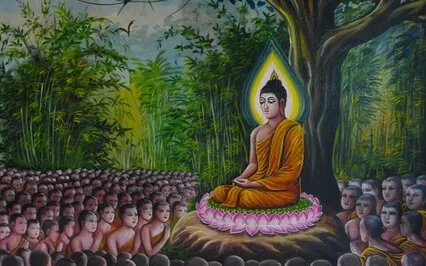
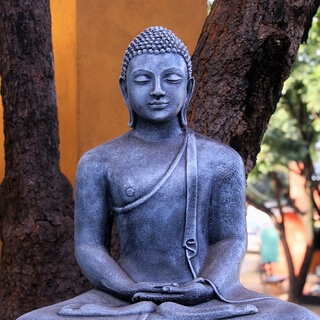
Did you know the Buddha was a leader?
And we talk a lot about leadership in our society and it's always good to look at people that we can see as true leaders and the Buddha was one.
So when I talk about leadership I usually have five qualities that I like to see in leaders and I'm going to talk in this episode about how the Buddha had every single one of these.
The first is to have a purpose.
This is essentially your why which tells what you're passionate about and attracts followers.
Two is to have a mission.
This is how you and your followers can achieve the purpose through a path.
Three is to have a vision.
This is what the end of the path looks like.
The mission,
If you will,
For you and your followers.
Four is setting the tone.
So a leader must be impeccable with their words,
Actions,
Trust,
Emancipation,
Which helps turn followers into leaders that want to achieve the mission.
And then finally,
Number five,
To be mindful.
This is where the leader is setting the tone where they practice everything such as emotional intelligence,
Paying attention,
Awareness,
Keeping focus,
Being self-aware,
Having empathy,
Reflecting daily.
Now the Buddha hit all of these and that's important because again when we want to become a leader ourselves or we want to identify what leadership is and what a leader is,
We want them to have these types of qualities and the Buddha did.
So when we look at the Buddha we can almost think of him as a focused entrepreneur,
If you will,
But of course in the religious context he was able to become enlightened through a long path,
A very long path through countless lifetimes which accumulated in the last lifetime where he was Siddhartha Gautama and then where he became enlightened and became the Buddha.
This was based on his continuous focused effort and in our world we can look at entrepreneurs who are just focused on achieving their goal,
Right?
And what the Buddha did was he was focused on the entrepreneurship of himself to become enlightened and he was focused on that.
So Siddhartha Gautama,
He was focused on that goal,
Became enlightened,
Became the Buddha.
When he became enlightened,
When he became the Buddha,
He went right into leadership mode and he had a point where he could have decided,
You know what,
I'm good just being enlightened.
I don't have to really lead anyone else.
I don't have to teach anyone else because a teacher is a leader and effective teachers are leaders.
So he was having to start everything from scratch.
Again if you want to look at a entrepreneurship model,
He was bare-bones.
There was nothing there.
He did not have any infrastructure.
He didn't even have anybody who even know what he had achieved.
In fact,
His five former disciples,
They recognized him not as the Buddha when they saw him but as someone who has abandoned them,
Who of course went off to become enlightened,
But they didn't know that.
So all they saw was someone who had left him.
He had to do his elevator pitch,
If you will,
Right away and that's what we have the very famous Four Noble Truths.
So it's almost like he was given a TED talk,
If you will,
In our modern society.
He had to give this TED talk,
This elevator pitch,
To his five former disciples which were not looking on him favorably and he had to convince them of this mission,
This vision that he has because this was going to be his path that he was to help liberate others,
To help them understand this truth so they can be free as well,
Realize nirvana.
And did he do it?
Absolutely.
So he was focused on this.
He was able to articulate and explain and convince his five former disciples became his new first disciples on this path.
And from there he had a lot of struggles.
So we often think of the Buddha as being,
Oh well,
He's the Buddha.
Everyone's gonna listen to him.
Everyone's gonna do what he says.
Didn't work that way.
He was an enlightened being but that doesn't mean that he could just snap his fingers and make everyone do what he wanted to do,
Nor would he.
So he had to do everything from organizing and managing communities of monks and nuns which ranged into thousands across great distances.
We usually just think,
Hey there's this like certain amount of monks that,
You know,
Followed him around.
No,
There eventually became other groups that were spread across distances where he also visited them.
So he had to organize and manage them.
His leadership and vision,
And this is key here,
His leadership and vision were filled with compassion,
Discipline,
And mindfulness.
In my opinion these are three things that every leader needs and he was showing it.
But here is a crucial part.
Even like the Four Noble Truths,
Even where he's organized and managing the monks and nuns,
He knew exactly what he wanted to do and where he wanted to go.
This allowed his followers to clearly understand his vision and the mission.
The mission here is to spread the Dharma,
The liberating teachings that frees us from the cycle of rebirth and constant dissatisfaction and suffering so we can free ourselves from samsara and realize nirvana.
And that's where we blow out the three fires of greed,
Anger,
And ignorance.
And that was the mission to help liberate all these sentient beings because that was the Buddha's decision.
Upon Siddhartha Gautama's enlightenment,
Where he became the Buddha,
He realized that all sentient beings have this innate capability to become enlightened,
Do the same thing he did.
And he had that choice going again where I could just be enlightened and go off on my own and enjoy this or start teaching,
Start leading.
And that was a monumental decision because you're listening to this podcast because of that right now.
We wouldn't even have Buddhism right now without that commitment,
Without that decision right there.
So understanding he knew what he wanted to do and where he wanted to go so clearly and was able to articulate that and show that and manage that.
That gave his followers,
His monastics,
The ability to follow him and understand where to go as well.
He understood the value of interpersonal relationships and this is so key about him because he could speak to the farmer or to a king and he was able to build relationships as a leader with both and all these different types of people.
And he was able to communicate with them in a way that they understood and could relate to.
But it was this capability he had as a leader where building relationships,
Which are key in leadership,
He was able to do that.
Maybe not always 100% successful,
But in the vast majority of circumstances he was.
And then he was able to solve problems.
And we wouldn't think about this because we had sometimes this very idealistic view of the Buddha and the life he led.
But he had problems.
There was some drastic problems that happened in the monastic community,
The Sangha and in the world.
There was everything from suicides to war and to famine and sickness.
All these different types of problems came up,
Which sometimes where we see very nice Buddha quotes we don't even think about all that.
But he,
As the leader,
Had to figure out how do I solve this?
What do I do?
And this is where you also see things such as the expansion of the precepts or the rules for monastics to help guide them in this right way.
You can almost think about in our modern world as policies and procedures,
But they're not meant to be restrictive in a way that's like punishing,
But in a way that helps get these people who want to be here on his team,
The Sangha,
To get to that goal.
They want to see that vision.
They want to accomplish that mission.
And the precepts help him get there.
So he had to solve a lot of problems.
He had to talk to a lot of people and intervene in different ways as a Buddha.
When he was dying,
He was on end of this life,
He was gonna go to what's called Parinirvāda,
Or final nirvāda.
His vision and mission was so clear that nobody had a single question or confusion about his teachings,
Because he asked them several times before he passed away in this body that he was in right now.
Does anybody have any questions for me?
Do you have any questions about the teachings?
What can I help you with?
Nobody asked.
Now of course we can think,
Well maybe they're just trying to be respectful and not trying to really,
You know,
He's dying we're not gonna really bother him with stuff.
But we can see 2,
600 years later we are seeing the continuous line from the time of the Buddha to now in many different schools of Buddhism where those teachings exist to continue on.
Well has there been challenges?
Has there been debates?
Has there been different things going on?
Of course.
But that vision was crystal clear to all of those monastics.
The mission was crystal clear.
The direction from the Buddha was crystal clear.
So while there may have been different ways that all these schools we see in our modern world and even in ancient India were exploring and practicing Buddhism,
We still saw all of them were on the same path.
Some of them may have went maybe more a little more to the center,
To the right,
Or left,
Or anywhere on this long road,
This path going there.
But they were all trying to achieve that same goal.
They all understood that clearly.
And he also had ensured succession planning.
So succession planning is when you are no longer the leader who takes over.
Does somebody brand-new come in?
Do they not understand how to accomplish that mission?
And we can see this in the military,
In business,
And everything else.
You need succession planning for those to be able to basically pick up that torch and continue on.
And he did that.
So he had organization inside a monastic community,
The Sangha,
To be able to succeed him.
And he realized that while he is the Buddha,
He is not going to be in this permanent manifested existence and form that we have him on this world.
So at some point in the future he will no longer exist.
The five aggregates are an impermanent temporary grouping of things.
And that's us.
So he understood if this is going to continue on,
If more people want to be liberated,
He has to have succession planning.
And this is something that may have been unheard of back in the day.
But we're in our modern world,
Especially in business and leadership.
This is something that leaders strive towards.
They want to find something to succeed them and be able to groom them in a way that they're understanding the mission,
The vision,
And everything in the practices,
And everything to be able to accomplish the mission after they leave.
So he was able to do this with the Sangha.
And this is where you had different roles in the Sangha.
So it's not like they were just all just monks or just nuns.
And that's all he did.
There were different leadership roles,
If you will,
Inside there.
Specialized roles that they had.
So that when he passed away into final Nirvana,
Pari Nirvana,
You saw where the monastics were able to come together.
And of course there may be a little struggles here and there,
But they were able to continue on.
That's why we still have Buddhism 2,
600 years later on.
So while the death,
The loss of your leader,
Your founder,
In this case Shakyamuni Buddha,
The Buddha of our era,
Was of course devastating.
They had that foundation,
That succession plan to continue on.
So let me talk to you about the Buddha's mission,
Purpose,
And vision.
So this is what every leader needs as well.
His purpose was to free sentient beings from dukkha.
Dukkha sometimes translated as suffering,
But it means everything from dissatisfaction to unsatisfactoriness.
This is the result of impermanence in this cycle of forced rebirth.
And this is what we're trying to end.
We're trying to end that.
So his purpose as a Buddha was to free sentient beings from that.
That gives rise to his mission.
His mission was to provide the conditions and teachings so those sentient beings could be free from dukkha.
And then finally that's his vision.
So what is his end state here?
I got my purpose.
I got my mission.
What's the vision?
His vision is a world where all sentient beings are awakened to their true nature,
Free from the three fires and three poisons of greed,
Anger,
And ignorance,
Which thus they are freed from dukkha.
Realized nirvana escaped that cycle of rebirth.
So he sees this vision where sentient beings can achieve the same as he can.
Does that mean that they're all going to be enlightened at the same time?
No.
But the vision is there.
That's the lighthouse you see all the way at the end,
Or the city lights all the way to end and you're on this really dark road.
You see the vision.
The purpose to get to there,
Right?
The mission,
Here's what I need to do to get to that particular location.
So purpose,
Mission,
And vision are so important and the Buddha understood that clearly.
He is building this foundation.
He is giving the structure and the teachings and the guidance and everything else and he's helping his followers.
The monastic community and even the laity to understand that vision so that they understood why the purpose and mission exists.
Because you can't explain that vision then the purpose and mission mean nothing.
As I talked about in the beginning of this episode,
When he tried to explain what he had learned of what he's now doing as the Buddha to his five former disciples,
He gave them the four noble truths.
I like to rephrase these as a four truths of leadership.
So when we look at these four noble truths,
We have here the truth of dukkha or suffering,
Which is life entails suffering.
Then we have the cause of suffering that's caused by delusion and attachment.
Then we have three,
The truth of the end of suffering.
This is the cure,
If you will.
Nirvana,
You can be cured of this.
And the fourth is the way to get there.
That's the path to freeze you from suffering,
The prescription if you will,
And has to follow the eightfold path that he had.
Now that is all so important because he was able to clearly give a cause and effect relationship.
He starts off just like he would with maybe a TED talk or a presentation.
He's letting you know what the problem is right away and that's talking about suffering.
He's telling you you're sick or here's the issue or here's the financials,
Whatever.
It's like here's where we're at because you're not seeing it.
I have to show you what it is.
And then as he explains that,
He has to tell you why we're in this predicament.
That's the second noble truth.
Explain why you're there.
So now you understand,
Oh wait,
I'm sick or I'm injured or whatever the cause might be in this analogy.
And then he has to explain why you got to that particular state so you understand these effect-cause relationship.
So he doesn't start with cause and effect.
He starts with effect and cause.
Next he goes into another effect.
So we have effect-cause.
You're suffering right now.
And then here's why.
Then he goes with the cure or the end state,
If you will.
So he's saying that you can be cured,
If you will,
Of this suffering.
And that's nirvana.
Nirvana is the vision.
That's the end state that we're trying to get to.
That's the effect.
So the suffering that I talked about in the first noble truth and the reason you're doing it in a second,
That goes away.
You can get to nirvana.
You can get rid of suffering.
And then he gives you the cause that gets you to the end of suffering.
And that is the eightfold path and the Buddhist practices that we have.
So a very skillful way of doing it,
Which I don't think a lot of us would even probably even think of,
But he came up with that method on the spot right away.
And that convinced his five former disciples.
So when we talk about those five qualities I was talking about,
Leaders should have.
Number one,
Have a purpose.
So the Buddha,
His purpose was super simple to liberate all sentient beings from suffering.
Now that purpose is so simple,
But that takes a lot of work.
So this is where he understood what his goal as a Buddha is.
And so Buddhas,
And the Buddhists we're talking about here,
The Buddhavar era,
Their goal is to provide the liberating teachings to others.
It's a leadership position.
Its purpose is to teach others.
We don't have right now,
But they are basically,
There are enlightened Buddhas that don't go on to teach me because they can't do that for whatever reason.
But the Buddha of an era,
They are setting force to teach others.
And that's what he did.
So his purpose was to liberate all sentient beings from suffering through his liberating teachings,
The Dharma.
What was his mission?
Well remember this is the how.
The first one was the why.
Why is he a leader?
Well his reason is a leader.
He wants to liberate all sentient beings from suffering.
That gives rise to the mission,
The how if you will.
How do we achieve that right?
So the Buddha was very clear-cut.
Remember the four noble truths?
The fourth one was a noble eightfold path.
All the Buddhist practices that we have in our world right now spring from that.
Whether you're following that directly or there's other ones like the six perfections in Mahayana for example,
We are all following this structure that gets us to that end state,
Right?
Gets us to that vision.
So that was his how and he was able to show where we are having this mission.
The mission here everyone is to get to Nirvana and the mission to get to Nirvana,
How we get there is the eightfold path.
If you want to think about it in a military context or in maybe like a emergency response like a search-and-rescue context,
We want to get to this end state maybe to that injured hiker or we want to get to this enemy's encampment or whatever the case may be.
The mission has a clear goal.
How do we get there?
That's all your tactics.
That's all the strategy.
It's all getting to that mission to get to that end.
And that leads up to the vision,
Right?
So we have at the very beginning we were talking about the purpose then we talked about the mission.
But the vision is what helps the followers understand,
Helps you and me understand where we need to go.
Because just saying,
Well here's what we're doing and here's how we're gonna do it.
Okay we need to have for us as sentient beings,
Human beings,
We really need to have that vision.
That helps us understand what the end looks like and he gave that to us.
So when he was talking about that he was very clear.
He said both formally now it is only suffering that I teach and the cessation of suffering.
How clear can you be?
That's it.
He's like this is my mission,
My path,
My vision is right here is the cessation of suffering and I'm gonna teach that to other people.
That's what he wanted to see.
Now all that's fine but he has to set the tone.
So as he is leading the monastic community,
As he is engaging with the lady and with kings and everybody else,
He has to set the tone.
He has to be a leader.
All the eyes are on him.
As an enlightened being,
Can you imagine if he had a bad day or he said a bad word or did something that someone didn't like?
Well the vision of him will change dramatically.
Should we trust this person?
Should we follow this person?
So that's why as an enlightened being and Buddha he was impeccable with his words,
Actions,
Trust and emancipation.
That's where he also was using that to help build other leaders for that succession planning because the mission was the goal.
It wasn't him.
It was the mission because even a Buddha said on his parinirvana,
His final nirvana,
On his deathbed as a physical being,
He said look to yourselves on this path.
You know your own safe harbor,
You are the ones you should be looking inside towards,
Not me.
He was trying to show them that the mission was there even when he wasn't there.
So that was so telling.
He was setting that tone all throughout his life,
The 40 years he was teaching,
Even up to just moments before his death.
He was so clear about that.
So he was able throughout his teaching life to give up control.
He was building leaders everywhere.
That's why we see so many different types of schools of Buddhism in our world today where we saw in his time there are many different monastic groups spread out.
It wasn't just the group that was with him.
It just spread out.
Even though he was in constant contact with them,
He had set the tone so well that they understood.
Then that leads us to the very last part,
Being mindful.
When we're being mindful,
We have a very secular world outlook on that,
But in the Buddhist context and in the leadership context,
It was so important because everything that he did was associated with him.
As I mentioned just a second ago,
What if he got angry with somebody or yelled at somebody,
Right?
No,
That's not gonna work as a leader or as a Buddha.
So he had to make sure that he was paying attention,
That he was keeping focus,
Self-aware,
Empathy,
Reflecting daily what you did through meditation and everything else,
And this emotional intelligence on a level we haven't seen before.
This is so important for a leader and for the Buddha.
So being mindful,
We're seeing sometimes he's talked about in different ways in Buddhism such as skillful means.
He was able to talk to people in many many different ways and explain things right,
But also where he was able to take the time to be with people.
So whether that was a Sikh monastic that everyone else wasn't taking care of,
He was there.
Or when his father was dying or sick,
This is where you see that things where we just look,
Leader,
Leader,
Leader,
That was the Buddha.
He was able to understand how people were feeling,
What they were thinking basically,
And what they needed in order to help them in ways that was conducive with the path towards enlightenment.
So his goal as a religious leader was this path towards enlightenment,
The Dharma,
But he wasn't there just to fulfill every wish,
Right?
He was there to help them understand.
So that means he had to be aware of what they were thinking and what they wanted and what they needed,
But he had to keep focused on what he was trying to do as a leader.
Remember that purpose,
Vision,
Mission,
All that?
He had to keep focused on that.
That was the goal.
And this is also where he had to be aware of himself,
Aware of what's going on.
If you're not self-aware,
If you can't see faults in yourself,
If you can't as a leader,
If you can't understand why some things happen this way because I said this,
You're not gonna be successful as a leader.
So even the Buddha had points where his teachings were misunderstood and where people just didn't understand what he was teaching,
And he had to be self-aware on that and reflect upon that and have empathy on that.
And he changed the way he talked about things and taught things so that those mistakes that other people understood about maybe his teachings or maybe didn't understand,
He was able to transform it away to prevent that from happening again.
That's being self-aware and not going,
Well they just didn't understand my teaching.
That's all that.
He took it into consideration deeply and he's like,
Is there a better way?
Is there a precept or is there a better way to explain it?
And he did.
And so that is what we are looking at with the leadership of the Buddha because famous quote,
A leader leads people not things.
So he was leading the monastic community,
The lady that came as well,
Lay followers,
And his interactions with leadership like kings and other political leaders.
This was important.
But the one thing that just sticks out to me all together was the Buddha was as a leader he made other leaders.
And that's not something you really think about was leadership,
But it is leadership.
A leader is there to really make other leaders and he did.
So we see in our world today,
2,
600 years later on,
We have lineages going all the way back to the time of Buddha.
You have monastics that can find their path,
Their lineage,
All the way back with all their teachers,
All the way back to the time of the Buddha.
So it's showing leader,
Leader,
Leader,
Leader.
We're seeing this path be developed.
We're seeing where these leaders being developed even to this day,
Even right now,
Even to this second.
They're being taught leadership skills as religious leaders in our religion.
But we can also look at it in our world.
What makes us a leader in our business,
In wherever you work,
Or society,
In your household,
It doesn't matter.
Leadership is so important and I look to the Buddha as a great example of a leader.
What do you think about the Buddha being a leader?
I'd like to hear back from you.
You can leave me a comment on social media,
Send a message on my website EllenPito.
Com,
And I look forward to talking with you in our next episode.
Thank you.