Namaste sannyasa family and everyone.
A very warm welcome to all of you in this daily live meditation session with me,
Dhyansa.
We are meditating on 112 meditation techniques of Vigyan Bhairav Tantra.
As you move along with these sessions,
As you move along with these teachings,
As you move along with me,
As you move along with Bhairava,
Or with any other tradition,
With any other teaching,
With any other stream,
Any other source of spirituality,
Of knowledge,
Of meditation,
A certain love arises in you for the teaching,
For the master,
For the knowledge,
For the meditation.
And this love is what takes you through the unknown.
It is what that gives you the courage to go through the unknown,
To take a step towards somewhere where you would have never taken that step.
So this love is very essential to go on this journey to have this love for the source,
Whatever your source of spirituality is,
Whatever your source of meditation is.
But along with this love,
Slowly from the back door also hate arises.
This love and hate,
They are always coming together,
Where love comes first,
And somewhere from the back door also hate starts to come.
Why is this hate also coming?
Do we realize that as the love comes,
Also the hate starts to arise?
This hate starts to arise somewhere deep down,
It remains in the potency if you have never yet experienced it,
But it is there somewhere hidden behind the curtain.
What is that hate?
That hate comes when the love becomes dependence.
When the love becomes some sort of dependence,
Where the freedom of love is now slowly becoming the dependence in love.
And this we see in our relationships with everybody else in this world,
Where the love that is there,
It also carries somewhere deep down hate with your lover,
Because you feel dependent on your lover.
You cannot forgive your lover,
You cannot forgive someone that you love,
Because deep down you have that dependence.
So as long as there is this dependence on what you love,
On the connection that you have with someone that you love,
Or with the source of your spirituality,
That dependence will create that hate.
That dependence will never let you forgive that source to keep you dependent.
So how to address this in this journey as you take along as the love arises?
Always bring freedom in.
Along with love,
Keep the freedom always in this equation of your love with anybody.
How do you do that in your relationships where along with love you keep the freedom,
You do not bring the dependence in?
This is a subject of a different discussion,
But how do you bring this freedom along with love in meditation,
In spirituality towards the source?
Towards your source of spirituality,
Your source of meditation?
How to build that is something to be understood.
How to have love along with freedom?
Let us understand this with an example from a question from a meditator in our community,
From our sannyasa family.
The meditator says,
I meditate twice or thrice every day.
At night,
The Vigyan Bhairav Tantra sessions serve me really well,
So I thought that I could try the Yoga Sutras of Patanjali from previous Dhyansay's live sessions for my morning meditations.
Since Dhyansay has been telling us about not mixing concepts or other practices,
I wonder if learning both Sutras and Tantra techniques at the same time will benefit me or if I should wait until we finish the Tantra sessions.
I am just curious.
Other than the obvious facet of this question,
What needs to be understood here in this source of silence,
In this source of meditation,
In this source of spirituality,
These sessions,
As you come across these sessions,
As you finally resonate to something that you had always wished for,
You would want more of it.
You would want to have more of this love,
And in this more,
Having more of this love,
Somewhere from somewhere,
A certain bondage,
A certain dependence may arise in this relationship between you and the source of spirituality.
And you have to keep that freedom in your practice.
You have to bring that freedom in your practice.
So to the question whether,
While you are going through Tantra sessions in the evening,
Should you bring the Patanjali's Yoga Sutras in your morning sessions?
There was once Moolishath flying in economy class,
And for some reason,
He was upgraded to the business class.
He was transferred from the economy class to the business class for the very first time.
And while Moolishath was enjoying this business class flight,
The lunch was about to be served,
The menu came,
The flight attendant came to explain the menu,
And said,
You will have this soup as your starter.
And for the main course,
You may choose between this fish and this meat.
And then later on,
We will have the dessert.
Mooli looked at the flight attendant,
He said,
Well,
Since you have prepared both the main courses for me,
Can I have the fish along with soup and meat in the main course afterwards?
These sessions,
The Vigyan Bhairav Tantra and Yoga Sutras of Patanjali's,
These are two main courses.
If you are hungry,
And you could be hungry for lifetimes,
You may go ahead and have these two main courses,
But I would suggest to take them one by one.
Have the main course of Tantra,
And leave these Yoga Sutras of Patanjali for another main course,
For some another time.
Then how to do your morning sessions,
Or your evening sessions,
Or your second or the third time in meditation,
Bring silence in.
Bring that freedom of silence in your meditation practice.
Sit in this silence all by yourself,
Without me,
Without these sessions,
Without any teachings,
Without any concepts.
Maybe with the technique,
Practice the technique that is given to you in this session,
Whether you are listening in the morning or in the evening,
Practice this next time you sit in meditation all by yourself,
Without using any form of leaning on any guidance,
On any guided meditations,
And move towards complete silence.
See that this journey with me,
With these sessions,
Will be done in three phases.
The discourse of these journeys,
This journey that we are taking with Tantra,
With Patanjali,
With all these traditions to come in these discourses,
This journey is divided into two parts.
One is the discourse,
The other is the guided meditation.
The discourse will remain for a long time in your life.
This will remain almost for a lifetime,
Because a lot has to be undone that you have done to yourself.
A lot has to be unwinded which you have winded in your life.
A lot has to be unfolded in you through these discourses,
Bit by bit,
Every day as we move along in this journey.
But the second part of it,
Which is the guided meditation,
This part of the guided meditation,
You begin with me,
You begin learning the technique in these sessions,
And as you move,
As you advance in your practice,
What you would do,
You would have a second session or a third session all by yourself,
Practicing these techniques on your own,
Exploring these techniques on your own,
Going into depths of yourself on your own.
And the third phase is where you even leave the technique.
All what you have learned as a technique,
You leave the technique and you will absolutely be in silence,
Be in awareness on your own.
This we bring also in every meditation that we do.
We begin with the technique,
We allow the technique to unfold in us,
For us to learn the technique,
And eventually we leave the technique.
So in this relationship between you and the source of this peace,
The source of this silence,
You have to move from the technique that is there in the sessions,
To practicing these techniques on your own,
And to moving into silence,
Into absolute silence all by yourself.
And all along the way,
These discourses will remain supporting to making this happen,
This slow unwinding,
Unfolding of your consciousness,
Liberation of your energies.
There's one more meditator who did these sessions,
The tantra sessions in the evening,
The sessions of Patanjali in the morning,
And there is no harm in that.
That meditator told me how much benefit he had from doing these two sessions,
From having the evening sessions,
Having the morning sessions also in place.
So I'm not suggesting you not to do it,
All I'm saying is there's enough to unfold,
There's enough to practice.
Take this main course slowly,
Eat this bit by bit,
Practice it,
And move towards your own silence.
Let us listen to the technique of today,
From Vigyan Bhairav Tantra,
Which Bhairava has given to us,
And sit in silence,
Practice this technique in silence,
In our own experience.
Bhairava says,
Eyes still without blinking,
Gaze at nothing and enter nothingness.
A very powerful technique,
Let me repeat.
Eyes still without blinking,
Gaze at nothing and enter nothingness.
This may be one of the slightly more difficult techniques,
But let us briefly understand the background of it,
Let us understand how to do this technique,
From a beginner to an advanced practitioner,
And then practice this in our own silence.
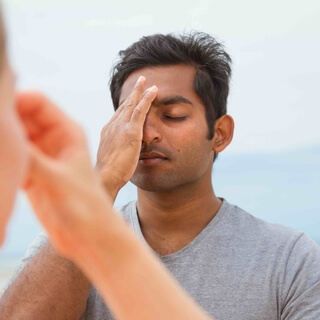
Eyes still without blinking,
Gazing into nothingness.
Our eyes are blinking as we blink,
Our mind moves along.
This blinking that we have,
This movement of our eyes,
Is directly related to the movement of our mind,
Is directly related to the movement of our thoughts.
So if you bring stillness to your eyes,
If you bring stillness to your eyes,
There is stillness in your mind.
If you do not blink,
Then this continuity,
This concentration of whatever you are focusing on,
It continues,
It remains.
The blink is the break in the continuity of your concentration,
Of your meditation,
Of your Samadhi.
So there are several masters who focused only on not blinking,
Only on maintaining this gaze without blinking as a meditation technique for themselves and for their disciples.
There have been numerous examples.
Gurjeev,
He was one of those who could not blink for minutes,
For hours,
And his gaze was so strong,
When he looked into the disciple,
He could see through the disciple without blinking for minutes,
Having that fierce gaze.
Osho was another meditation master who mastered this non-blinking to have this gaze so strong,
So deep that it could penetrate you as soon as you come across in this gaze.
But this was done by masters,
You could also use this as a meditation technique.
Bodhidharma,
He was one of the also most known meditation masters in the East.
Coming from the Buddhistic lineage,
One of the disciples of Buddha who took this art of meditation,
This art of Dhyana to China,
Which became Chan from Dhyana to Chan and eventually moved to Japan and became Zen.
So Bodhidharma,
That meditation master,
He practiced this non-blinking.
He was known as the wall-gazer.
He used to sit in silence,
Simply gazing the wall for hours,
And hours,
And hours without blinking.
The legend says that in order to avoid blinking,
He cut his eyelids and threw it on the ground.
That is of course a legend,
But what it says is that he practiced this throughout his life.
He made this as the main technique that he practiced for a very long time,
Until he reached to his enlightenment,
Until he reached to where he was belonging.
So you can practice this technique as well,
If this fascinates you,
If this brings something,
Some resonance to your ways of approaching meditation,
That you practice this non-blinking and gazing into the nothingness,
Gazing at nothing in particular.
As you have your eyes open,
As you have your eyes non-blinking,
You are gazing into nothingness,
At no object in particular.
As you gaze into nothingness,
Suddenly you are thrown into nothingness as well.
So how to do this as a beginner,
How to do this in not an extreme sense of cutting your eyelids,
Or having your,
Having practicing only this technique,
You can do this in three steps.
Step number one,
You will keep your eyes open,
And have few minutes,
Few seconds,
Few moments,
As long as it is comfortable for you of not gazing,
Establishing your,
For not blinking,
And establishing your gaze into nothingness.
As you look in the front,
You don't look at anything in particular,
You don't look at even the space,
You gaze into nothingness.
And then you will close your eyes,
Once you have done it for a few minutes,
A few seconds,
A few moments,
You close your eyes,
And with the eyes closed,
You will still continue to gaze in nothingness.
You will still continue not to blink.
You may notice that while you have your eyes closed,
You still blink on and off,
You still blink once in a while.
So as you have your eyes closed,
Keeping your eyes still,
And not blinking with your eyes closed,
And continue this gazing into nothingness.
Continue pouring in energy through your eyes into nothingness,
Into observing,
Becoming aware of this nothingness,
Until you're completely thrown into nothingness,
And you don't need the technique anymore,
And you move into silence as the third phase.
Let us practice this in the next minutes.
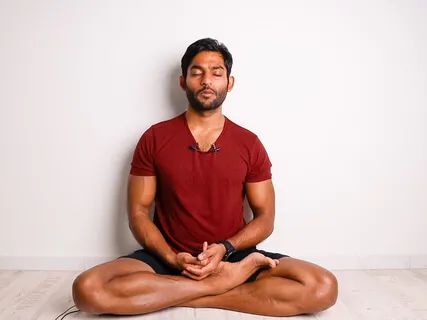
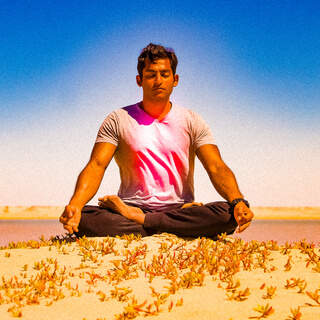
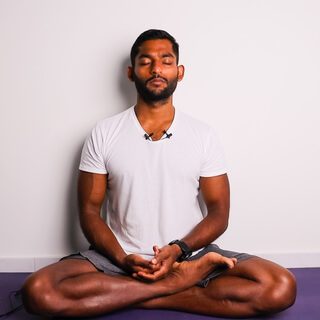
Please take a posture that is comfortable for you.
With your head,
Neck,
And back straight,
As the body finds a restful posture,
Close your eyes for a moment,
Allowing your body,
Your mind to settle.
And gently open your eyes,
Gazing into nothingness.
Holding this gaze into nothingness,
And closing your eyes,
Maintaining your gaze into nothingness.
In front of your closed eyes,
Keeping eyes still,
Relaxed,
Trying not to blink,
And maintaining your gaze into nothingness,
In front of your closed eyes.
Let us practice this in the next minutes.
Please take a posture that is comfortable for you.
Let us practice this in the next minutes.
Thank you.
.
Continuing to gaze in nothingness in front of your closed eyes.
.
.
.
.
.
.
.
.
.
.
.
.
.
.
.
.
.
.
We have formed a community of meditators and if you wish to be a part of that,
You can apply by writing an email to me with your introduction,
With your calling for this community and what can you give back to this community.
.
Thank you very much.
Namaste.