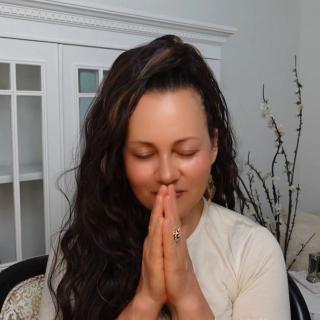
Once the senses are mastered through Pratyahara,
They can be restored to serve the realization of the Self,
Instead of being misguided in serving the ignorance projected by the ego.
Then the mind is ready for the next stage,
Interiorization of the mind.
Calmly focusing the full attention of the mind and consciousness on one point to the exclusion of everything else.
This is Dharana.
Dharana comes from the root word duri,
To hold firm.
In the Yoga Sutras of Patanjali,
Dharana is simply described in one sutra,
Chapter 3,
Verse 1.
Concentration is the binding of the mind's attention,
Or focused awareness,
To one particular point to the exclusion of everything else.
Think about a time in which you were totally immersed,
Focused in one activity.
It could have been something creative like painting or writing,
Or something physical like dance or yoga or running.
Your mind is still except for that one thing you were doing.
This kind of state of total focus is a peaceful feeling.
This is the essence of Dharana,
The total concentration of the mind.
Dharana is not a generalized attention where the mind is still engaged in thought processes,
But to the yoga technique of one-pointed,
Ekagrata concentration.
A continuous flow of concentration inwards,
Either on an internal object or an externalized object.
The internal objects refer to points within the body.
It could be your navel,
Your heart center,
The point between your eyebrows,
Particularly the higher chakras.
It can also be your breath.
The external object is typically an idea or image of an object that the mind's attention is calmly focused on from within.
We've all had glimpses and fleeting moments of Dharana.
Here I invite you to take up the practice of Dharana,
Focusing the mind in a more deliberate way.
In fact,
I invite you to make it a part of your meditation practice daily.
You can sit aside five minutes as we've done in previous episodes when discussing asana and pranayama breathing and pratyahara,
Where the focus has been five minutes,
Whether in a stillness of posture or on a breathing technique or on the ability to channel the mind and the senses inward.
What is attention?
It is the focusing of awareness upon a single object or idea to the exclusion of all else.
And here's something that's important.
Simple attention to your lack of awareness is actually an awakening of awareness,
Which means if you're in meditation practice,
For example,
And you recognize,
You become aware that your mind is somewhere else,
That's the first step to Dharana,
The awareness that you're not attentive.
And that's a helpful practice for anything in life.
Your kids are playing in front of you and you're scrolling through your phone.
The awareness of that helps you to put your phone down and focus on what is important in front of you.
Our concentration can either be focused or diffused.
If you focus the scattered rays of sunlight,
For example,
Onto a single beam through a magnifying glass,
They can burn a piece of paper,
Whereas the diffused rays cannot do this.
Similarly,
The mind's mental rays,
If you will,
Are usually dissipated on various objects and thoughts.
We still,
In modern society,
Somehow have got it in our minds that multitasking is a doable and productive option.
It's really not.
Research shows us that we cannot properly give our attention to two things at the same time.
One thing is always sacrificed.
However,
If the mind's mental rays are collected and brought into sharp focus and clarity,
Like a powerful laser beam of concentration,
Well,
It's also said that one can burn away all of the impurities or samskaras of the mind.
And I should also invite you to have a look at Steven Sturgis's book,
The Yoga Book.
It's a book that I'm quoting from directly and also referencing.
He writes beautifully and he takes us through this lovely journey of each of the limbs in the Yoga Sutras,
Together with many,
Many helpful practices.
It's really a one-stop,
All-inclusive deep dive into the Yoga Sutras.
I invite you to check it out and I will leave a link in the description for where you can find it.
And thank you,
Steven.
Concentration is necessary in all actions if we are to achieve anything successfully and safely.
Think about that for a moment.
Think about goals and self-discipline and perseverance.
We need concentration.
We need to be able to focus on our goals and also on the actions that will see us through to what we want to accomplish.
And similarly,
Dharana or concentration is a fundamental aspect of what we need every day to be able to do our tasks,
To carry on in our lives,
To create goals,
To realize goals,
Etc.
An interesting side note,
Concentration is often thought about with this essence of effort and tenseness and to possess or achieve something,
When in this case dharana is really about an effortless flow of willpower.
It's like you get into this beautiful groove of being present as you're walking in the forest or outside in nature and you're just aware of what's around you.
There's no real effort to focus on one thing.
You're able to take in different things and there's an ease and flow to which you are present.
You also find this in meditation practice.
The practices in which you have a far more enjoyable experience in meditation are those in which you allow your mind to be.
You notice when your mind is moved away from what you wish to focus upon and then you just gently bring your focus back.
There's not a hardened effort of concentration but rather the ease and flow of awareness and allowing and that's truly the essence of dharana.
In concentration,
Less effort is better.
In the sutras we read that pranayama qualifies or prepares the mind for concentration.
In pranayama,
We already have a glimpse of something beyond the self and so when it comes to concentration there is virtually no effort,
Especially when it is done after practicing pratyahara and so you see the progression of each of the limbs as leading us to where we are here in the sixth limb and almost into total absorption and bliss.
Sri Kriyananda writes in his 14 Steps to Joy,
When the will,
Instead of being focused on doing or accomplishing anything,
Is united inwardly to the purified intellect in a simple act of becoming,
Divine enlightenment ensues.
I think we can apply that to modern life when we think about how easy some things are when we just allow,
When we are aware and mindful and attentive and we are focused and yet we are not overburdening ourselves in an effortful practice that takes away the enjoyment of what we are doing.
And there's so many places in your life where you can practice an easy dharana.
Dharana is about fixing the mind to one specific point and again that one-pointedness is about holding our attention there.
This could be something internal,
The breath,
A part of the body,
Or external.
Something that we are looking at,
Gazing at.
The purpose really is about quieting the mind with total concentration.
And if you've been following my 30-day challenges,
The most recent one I've given to all of you is a five-minute practice of stillness.
And I encourage people to do this with their eyes closed to eliminate the distractions of what they are seeing around them and instead it's a practice of pratyahara which trains the mind to focus inward.
When we focus the mind intensely on one point,
The mind tends to quiet.
Think about something that you have recently given your total attention to and also remember how your mind begins to be absorbed in that.
It's like the mind and you become one with the focus of your concentration.
When we practice concentration like this,
There is less room for thoughts and memories and planning and other activities that the mind can become busy with.
And of course dharana is an important step on our way to the seventh limb of the sutras,
Dhyana,
And the last of the eightfold path,
Samadhi.
Begin with the whole or bliss as a total absorption of oneness.
I look forward to us getting to that point in the discussion on the sutras but for now I invite you to practice dharana.
Invite it in,
Make it a part of your daily life,
And then notice how it impacts and affects positively so much of your ability to enjoy the present moments of your life.
To integrate this practice into your life you can begin by concentrating on one thing at a time.
That could be what you eat,
Preparing your food,
It could be washing your dishes,
It could be going out for a walk,
Any of these things but done in significance of just that thing.
So a walk without being on your phone,
Or eating without reading or scrolling through your tablet,
Or preparing food lovingly and just being mindful of this task of being able to have this beautiful abundance of food at your fingertips.
And then you can slowly move towards more focused concentration and towards meditation and eventually these beautiful glimpses of unity with the whole,
Samadhi,
Which is where we feel this essence of inner peace and joy and a oneness with all things.
I'm sure some of you have experienced this in your meditation practice up to now.
I'm saying that we can make this a conscious experience,
A choice.
And so how do we achieve dharana?
Well a few different ways.
First by relaxing the mind and body.
The less tension that there is in the mind and body,
The easier it is for the mind to focus its attention.
Relaxing the body in the correct posture is necessary for concentration because it allows the energies in the spine to flow upward to the higher brain cells.
And relaxation is the gate to openness and receptivity,
Which helps to counteract the contractive force of the self-limiting ego.
Secondly,
We can achieve dharana with stillness,
The practice I just mentioned.
Steadiness of mind and body.
You can practice a steady pose which gives concentration of the mind.
You've experienced this in a yoga practice when you've been able to settle into a pose and hold it.
And then notice if you are holding it for a time that the mind begins to quiet.
All remains still.
The practice of five minutes of stillness in an asana posture will enable you to regain steadiness of the body and mind,
And to practice this without distraction,
And to practice focusing your attention on a single object or point within.
A third way to achieve dharana is by calming the breath.
If you pay attention to your breathing,
You will come to know the degree of distractedness of the mind.
The less distracted the mind is,
The calmer the breath.
The practice of pranayama brings calmness and equilibrium to the mind,
Enabling it to concentrate with less distraction.
And I invite you to go back and listen to any of the episodes on the previous limbs of the sutras.
We did so much on each of asana,
Pranayama,
And pratyahara.
The fourth way to achieve dharana is to cultivate willingness.
To remember that dharana has nothing to do with achieving,
And there is no practical immediacy for it,
No deadline,
No effort needed,
Rather a willingness toward wanting to be able to pursue focus and concentration.
And fifth,
You achieve dharana with cultivating interest and attention.
We have to create interest to induce attention,
Because the mind sometimes finds it difficult to focus on an uninteresting object.
And so by focusing on something of interest to you,
Something of meaning,
A candle flame,
An asana posture you are holding in yoga,
Perhaps being still and feeling at peace,
This is how the mind is more easily able to hold attention.
And finally,
How do we know when the mind is concentrated?
Well it happens when there is no sense of time.
That flow we were speaking about,
That feeling of being in the zone where there's no time and space,
In fact we lose sense of time.
When we are in deep concentration,
Time passes unnoticed.
We've all had this experience where we are reading a book or watching a show or hanging out with friends in great conversation and all of a sudden you notice the time and you wonder where did that time go?
You are enjoying the present moment,
And you are focused on what it was that you placed your attention onto.
Here's an interesting statement found in the yogic scripture of Karma Purana.
If the mind is focused on something for 12 seconds,
It is Dharana.
12 Dharanas make a Dhyana,
That is,
Meditation.
And 12 Dhyanas will be a Samadhi,
Super consciousness.
I invite you to listen on to the next episode where I dive into some specific practices for you to achieve Dharana.
And I invite you to continue with me on the journey,
We're almost near the end.
The Yoga Sutras has been such a delight and a wonder and a beautiful sharing of wisdom.
Wisdom that's truly been passed down from masters and teachers over time.
I am honored to be sharing this wisdom with you.
I send you great love and I encourage you to practice Dharana,
To enjoy the practice of focused concentration.
Sending you great love,
This is Dorothy Sanori Juno.
Namaste.
I hope you enjoyed this video.
I hope you found it helpful.
I hope you found it helpful.
I hope you found it helpful.
I hope you found it helpful.
I hope you found it helpful.
I hope you found it helpful.
I hope you found it helpful.
I hope you found it helpful.
I hope you found it helpful.
I hope you found it helpful.
I hope you found it helpful.
I hope you found it helpful.
I hope you found it helpful.
I hope you found it helpful.
I hope you found it helpful.
I hope you found it helpful.
I hope you found it helpful.
I hope you found it helpful.
I hope you found it helpful.
I hope you found it helpful.
I hope you found it helpful.
I hope you found it helpful.
I hope you found it helpful.
Awaken your authentic power.
Live your truth and be loved.
Namaste.