Welcome to episode 7 of my Tiny Talks focusing on MCI and dementia.
Today I will talk about implicit memory.
Our memory consists of a short-term or working memory and a long-term memory.
Short-term memory is often impacted in dementia,
So new and old procedures should be stored into long-term memory to be retrieved.
Long-term memory can be divided in again two subtypes,
One explicit memory,
Which includes episodic memory and semantic memory,
Like remembering people's and objects' names,
And recent events,
Again a type of memory that we recognize as being severely impacted by dementia.
The good news is long-term memory also has a section implicit memory,
Which includes priming and procedural memory.
It is called implicit because it does not require conscious thinking.
Priming is a learning technique that uses repeated exposure and an association between a stimuli and a response,
For example,
Encouragement or compliments.
Priming results in learned sequences of events,
And once it is in place,
It actually takes quite a while to vanish when the response is removed.
Procedural memory is of the most significance for people who have dementia and those around them.
Procedural memory works on the level of muscle memory,
As well as habits.
An example.
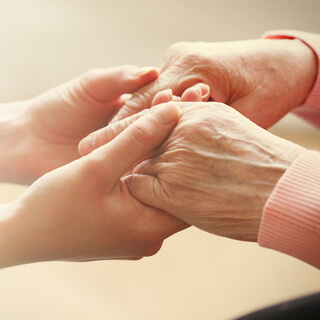
One learned habit is that when somebody tries to hand you something,
We will almost automatically reach out and take it.
Think about all those times when you were walking along the street and somebody tries to hand you a flyer.
Even though you know it's probably not of interest to you,
Before you have thought about it,
If you wanted the flyer or not,
You find yourself already holding it.
As annoying as that may be,
This is a great automated process to work with people who have dementia.
I have seen people with advanced dementia just take a hold of a flower that I was offering and then smelling it,
Because that is what you do with a flower.
Another example I use is,
Being Dutch,
I know that when I'm old and forgetful,
If you would hand me a bicycle,
I would just hop on and cycle away.
I may not be able to tell you how I cycle,
But my body,
My muscles just remember.