Hello and welcome.
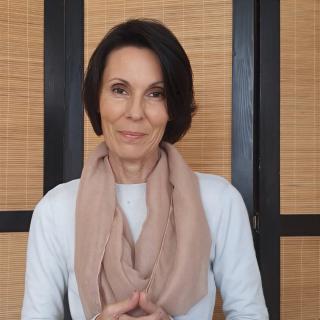
I'm Helen,
A kinesiologist and wellness practitioner.
I've been in mind-body practice for more than two decades and during this time I have presented at many corporate wellness days and school conferences.
Today I'm going to share with you a recording from a workshop I gave at the annual South African Montessori Association in 2019.
Here I share some foundational wellness principles that have helped many stressed people I have treated over the years.
Do join in with the exercises and I hope you will benefit from these.
Wow,
What a turnout at SOMA 2019.
So we're going to be talking about wellness and of course with wellness we need to consider stress.
So can you please all look at your lives at the moment as a whole and out of a scale of ten,
With ten being really near death and zero being no stress at all,
What is your current stress level?
If you're looking across the board just think of a number.
Okay,
I'm going to ask for a show of hands please.
Anybody under five,
Can you raise your hands?
Thank you.
One,
Two,
Three,
Four,
Five,
Six,
Seven,
Eight and how many are we in the room here?
Would you say 200?
Okay,
So we're looking at about ten out of 200.
How many people were between five,
Six or seven?
Okay,
So a large amount,
What maybe half?
You can put your hands down and eight,
Nine?
Okay,
Anybody on ten?
Well,
I'm glad you're here,
You're in the right place.
Okay,
So just take a moment now to check in with your body.
Where are you feeling the stress in your physical body?
Just go through the different areas,
Just become aware.
And even if you're feeling one percent of a slight twinge,
It's still something.
I still want you to count that.
So we often get so used to our stresses or our aches or our pains that they don't bother us anymore.
So I want you to consider those that don't bother you anymore.
So go to those places in your body where you're feeling them,
Acknowledge them.
Okay?
Now,
Can you link an emotion that is connected with the stress in that particular place in your body that you went to?
So if you're feeling this twinge in your shoulders or your neck,
Do you know where that's coming from?
Do you notice that there are certain times where that is heightened?
And when that is heightened,
What is the emotion that is traveling through your body?
What's going through your mind?
Is it irritation?
Is it frustration?
Is it anger?
Is it sadness?
Is it hopelessness?
Maybe there are more than one emotion because,
Of course,
We are interesting human beings and there's always this hue of colors in and around us.
So take stock of that as well if there's more than one.
And you might have a multitude of different aches or pains or stresses in the body with different emotional connections to that.
So if you just completed this exercise,
Congratulate yourself for making a mind-body connection.
That's what you have just done.
And often our body struggles to heal or do what we want it to do or we find ourselves repeating certain patterns in our life because this mind-body connection,
The communication has broken down.
So just by starting with that awareness,
You are already strengthening that connection and you are able now to invite the solution into your being.
So I'm going to show you one technique that is going to improve to balance what you have just assessed as a stress.
So I'd like you all to take one hand,
Please,
And place it very lightly on your forehead.
So you want to almost be able to fit a feather between your hand and your forehead.
And what's happening now is your hand is acting as a magnet.
It's drawing blood to your prefrontal cortex.
And when we are functioning with our conscious brain,
We are much more alert.
We have clarity.
We have awareness.
So I want you to bring to the foreground now of your thinking the emotion that you were previously thinking of or emotions.
You're not trying to solve anything.
You're not trying to make it go away.
I want you to be aware of it.
Acknowledge it completely.
Because what you are doing by holding this point on your forehead and bringing that acknowledgement to your emotion,
You are allowing the different hemispheres in your brain,
Particularly subconscious and conscious,
To balance that emotion.
Take a deep breath in here.
Now with your other hand,
Place this hand on the area of pain that you were thinking of or stress or tension in the body.
And if there was absolutely no area,
You place it over your heart.
So then you are doing a clearing purely that is emotional or you're doing a mind-body clearing.
This is a very,
Very powerful connection that you have made here.
It's known as the self-healing connection.
And in kinesiology,
My sessions with clients,
More than 90% this shows up in just about every session as a healing technique.
So take a deep breath in here.
And you can relax your hand to the side.
Thank you.
How often when people are in a space of,
I don't know what to do,
You just naturally put your hand to your forehead.
So it's an automatic technique that we use without even thinking about it.
But knowing that when we hold it there for that little bit longer,
Knowing that when you add the breath and knowing that when you connect a point of stress in the body,
It's going to amplify that power and create that mind-body connection and the mind-body release as well.
So something else that crops up,
I would again say in more than 95% of the sessions is people are stressed.
Just the life that we lead today,
Everybody's stressed about something or other.
And when I listen to the way that people talk,
It is a very clear indication where part of the stress is coming from.
Yes,
Of course,
We're all going to have challenges in life.
And we're never going to be able to have a completely challenge-free life.
But how are we going to deal with that?
And one very crucial way is our language.
What comes out of our mouth and what do we think?
So you can start by observing yourself.
How do I talk?
Do I talk more in the negative?
Am I more answering about things that are problematic,
Things that are negative,
Things that are causing me stress?
Often when I ask people,
So how are you?
It's a download of what is going wrong in their life and the way that,
How terrible that they're feeling right now.
Very few people authentically besides,
And I'm not talking about the phrase of,
Oh,
I'm fine,
But authentically can answer with looking at the good and being grateful for what is.
So we might know these things,
But do we put it into practice?
So I encourage you to have a journal.
Have a journal of your speech,
Of your language.
How are you talking outwardly to people?
Is there a lot of moaning?
Because remember,
The more that we focus on a particular problem,
The more we help it to reoccur.
And I'm not at all saying that we must not be realistic,
But we must be realistic and optimistic at the same time.
So yes,
We have a challenge,
But now let's work with this from a solution base.
And there's a lovely little exercise that I would love to share with you that many of my clients have used,
And I've shared this in many other teacher wellness workshops,
And feedback afterwards,
This has been really successful.
So when you get home today,
Please find a little bag or a container,
A box or something,
Where you are going to store your worries.
And then you're going to write down on a piece of paper,
A phrase or a word that is representative of each worry of yours.
So not the whole story,
Just one or two points.
And you cut that strip of paper off,
And you might have a few strips of paper.
Then you fold them up,
And you put them in your container.
Then you go to your diary,
And you make an appointment with yourself of when you are going to be having a meeting with your worry box.
And at that date and time,
You stick to that,
And you treat it as a meeting with anybody else that you would.
So you switch off your phone,
You are focused,
Let's say you've dedicated 20 minutes,
And you can do it in a variety of ways.
You can choose one paper randomly,
Or you can go to a specific area,
A specific worry or problem that you actually need to focus on now.
And you spend that time being action-based,
Being solution-based,
Writing down,
Creating brain maps.
If you need to start with venting,
Then do that.
If you need to let out those emotions first,
Because they are just all encompassing in your mind,
Do that on paper,
Because it's an act of releasing.
And when the brain sees that you are writing that down,
It is easier for it to let go of that emotion.
And once you've vented,
Then you can move into,
Okay,
What can I do?
If you feel that,
Oh,
I don't know what to do,
Start with ideas that even seem over the top that would never happen.
What you are doing here is you are inviting the right side of your brain to become active and to start thinking of solutions.
And the act of writing is another invitation for the right brain to be active.
And then when your 20 minutes is up,
You pack everything away and you carry on with your day.
Now,
If those worries that are in the box want to come back into your mind again,
You tell them,
And you might need to actually verbalize this sometimes,
Because the brain is very powerful,
But you say to them,
I have got an appointment with you on Tuesday at 2 o'clock.
So I know that you are there,
And I will talk to you on Tuesday at 2 o'clock.
But for now,
I need to focus on something else.
So if you have concerns that you need to have a meeting twice a day,
Then do that.
You will know where you are with your situations.
So try this.
Especially if your brain is saying,
Hmm,
I don't know if that's really going to work.
Our brain is a wonderful activator for keeping us in our comfort zones,
Even when our comfort zones are not beneficial to us.
And it's this game that it plays,
Because it's been designed for us to use as little energy of the brain as possible.
So it's doing what it is designed to do,
Which is wonderful.
So you need to know beforehand that your brain will come in with excuses of why you can't keep the meeting,
Or why I can't make the worry box,
Or why I can't continue with a certain solution-based program.
But know that this is part of the program that the brain has been used to.
And if it's been used to functioning in a certain way,
It's going to take some training,
Like with anything else.
Learning something,
A new skill,
A new language,
It is training.
And that's literally what we're training the brain to do,
A new language,
A new language,
Solution-based language.
And when you start really engaging with this,
And this starts to become a part of your way of being,
A part of your way of thinking,
A part of your way of talking,
You will start to see the changes take place in people around you,
In the situations around you,
In the way that you are managing and handling things.
It's very simple,
But it's very powerful.