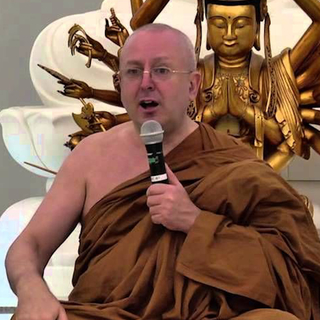
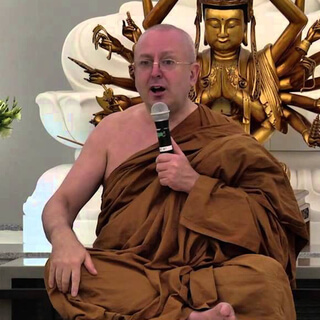
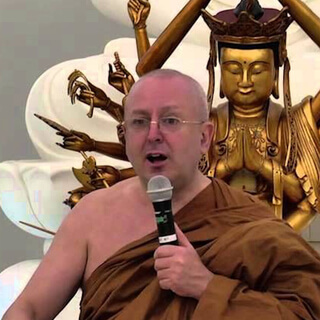
So welcome to another session of the meditation class on a Saturday afternoon.
And it's a nice place to come and chill out at the Buddhist center because it's very cold.
I just come back from Thailand just on Thursday so I haven't accustomed myself to this weather.
It's a stupid thing to do.
But nevertheless,
Now is the time for some meditation and I always have to announce that anybody coming to the introduction to meditation class,
That is being held in the room to my right.
This is the ongoing class and I do apologize but there is a lack of chairs because we're having a big function tonight at another place and I do believe that's where all the chairs have gone to.
But there's still one or two chairs available if anyone.
It's a bit difficult sitting on the ground.
So still some chairs over the front over here if you really need it.
But first of all,
Welcome again in this meditation class.
If you come for the introduction,
It's in the room to my right.
This is the ongoing class.
I always talk a little bit about basic meditation and sometimes I make it up as I go along as I'm doing today.
If you are feeling a little bit uncomfortable with the body,
Sometimes you can only do so much and once the body is reasonably comfortable,
It's good not to keep on thinking about it.
I remember in the hot days,
I tried to encourage the monks staying in the monastery,
The least you can do is not to keep complaining and say,
Oh it's hot,
Oh it's hot,
Oh it's hot.
Because once you start saying it's hot,
Then it actually becomes hotter.
It's the same if it's cold.
If you keep on saying,
Oh it's cold today,
It's cold today,
Then it actually gets colder which actually starts to show the power of this mind,
The perceptions which it has.
So when we are meditating,
You get our body in the most comfortable position you can and then you stop instead of saying,
Oh it hurts here,
Oh it aches there.
The more you talk about it,
The more you think about it,
The more that perception grows in the mind and the more it grows,
The more of a problem it is.
So just like in life we teach people to look at the positive perceptions,
The same in the body,
You look at the positive perceptions in the body in order to calm down and become peaceful.
So a lot of times,
I tell people who are suffering from some disease or some pain somewhere,
Yeah you may have like a sprained ankle but you have the rest of your body as well.
How about looking at the rest of the body,
How that's going on?
Why is it we have an ache,
We have a sore throat,
We have a sort of pain in our tummy,
That's all we look at.
So by looking at the other part of your body,
Not just the painful part,
You find that when your attention is away from the pain,
It lessens and it also tends to relax.
It's one of those things in meditation that what you pay attention to,
You actually disturb.
So by paying attention to the cold,
It gets colder.
By paying attention to the ache,
It hurts more.
And by paying attention to trying to be peaceful in meditation,
It gets worse.
So in other words,
We have this beautiful skill of meditation,
Is being able to look at things in a positive way,
In a way which does not interfere with things and to try and look at the positive part of the mind as well.
An example of that is when we,
In meditation,
The biggest problem for people when they try to meditate is the thinking mind,
Never being able to be quiet,
Never being able to be still.
And one of the reasons is we pay attention to those thoughts rather than paying attention to what was there before the thought began.
And what is left once the thought finishes?
The other part of the mind.
And it's not a hard thing for people to see once it's pointed out to them that there are spaces between your thoughts just as there are spaces between my words.
Now once you notice not just the thoughts but actually what was before the thought,
What was after the thought,
The space in between,
Then you pay attention to that rather than the thoughts and the thoughts disappear.
Or another thing which happens in meditation,
People sort of,
They cough,
They sneeze,
They get up,
They go down,
They make noises when you're meditating.
And a lot of times when they make a noise when you're meditating,
That destroys your whole meditation because it's a noise which we focus on which is the reason why,
You know that great teaching of my master Ajahn Chah,
He said it's a noise,
Noise doesn't disturb you,
You keep disturbing the noise.
In other words,
You disturb the noise by paying attention to it,
Over-emphasizing it,
Putting your whole mind on the noise rather than everything else which is happening apart from the noise.
So when you're meditating,
It's not just thoughts happening in your mind,
There's much else happening as well.
Pay attention to that.
Pay attention to what's before and after.
The simile which might help which I found very useful is the simile of the TV screen.
Try to,
It's amazing,
This simile,
The TV screen,
It wasn't invented by the Buddha because there was no TV screens in those days.
But I remember watching the TV and we used to have these really small sets in the old days,
The black and white ones and it always would have something on top of the TV set because it was a big box,
Not like the thin ones I have these days.
This big box would have a photo on the top or a flower pot or something and usually some sort of magazine rack underneath.
But I remember as soon as you turned the TV on,
The flower pot on top vanished and the magazine rack underneath disappeared.
And after a few seconds,
You couldn't even see the edges of the screen.
It had all disappeared and all you saw was the centre of the screen.
You couldn't even see the edges.
Because that's what you're focusing on,
Everything else disappeared.
And I've used that simile for people who when you are meditating,
There is a noise,
There is a distraction,
There is some sort of thought going on in the head when you're trying to be peaceful.
Stop paying attention to the noise.
Pay attention to everything else which is going on,
The peace,
The silence,
There's something going on there as well as the noise.
Because what you're doing,
If you focus on the noise,
If you focus on the ache,
If you focus on the cold,
That takes centre screen.
The cold is in the centre of your TV screen and soon everything else disappears except the feeling of cold which is why it becomes a problem.
If the sound is the problem,
Then that takes centre screen and everything else disappears.
The peace,
The calm,
The breath,
Whatever you're watching,
That disappears.
You find whatever you put in the centre of your screen,
After a while that stays and everything else vanishes.
Understanding that which is the basic rule of focusing on something,
You understand if you are meditating and there's noise outside,
Please never draw that into the centre of the screen of your attention.
Keep it on the edge.
You can hear the noise but it's over there somewhere,
To your left or your right.
Here you can feel the ache or the pain but it's way over there somewhere.
Here you can feel the cold but that's sort of around you,
It's not in the centre of you.
And if you can do that,
Don't put the problem in the centre.
Then you find after a while it just vanishes,
It disappears.
You just don't feel the cold anymore.
You don't hear the sounds.
You don't experience the ache or the pain in the body.
Just like the flower pot on top of the TV set,
It disappears,
It's gone,
It's vanished.
So the point is,
You look at something which isn't really a big problem.
You focus on the spaces between the thoughts.
You focus on the part of the body which is not aching.
You focus on some silence,
Some happiness,
Some positive part of the mind rather than a difficult part.
Because you focus on that part,
That is what remains and everything else falls off the screen of your attention.
Trouble is when we do have a problem,
We just want to fix it.
We try to fix it by focusing on the problem rather than focusing on the other part of life.
This follows on from the talk I gave yesterday,
The great story I mentioned yesterday.
The head of the schizophrenia unit in Singapore said to me he doesn't treat schizophrenia in his department.
He treats the other part of the patient.
Brilliant teaching,
All coming from the same idea.
If you focus on the schizophrenia,
Put that centre stage,
That grows,
Grows,
Grows.
If you focus on the other part of the patient,
The schizophrenia falls off the screen.
What's left is something much nicer.
So whatever problems and difficulties you have in this meditation,
Please don't put them in the centre of the screen.
If you're cold,
Don't make that the centre.
If you got restless,
Don't make that centre.
If there's a noise,
A sound outside,
Someone mowing or the dog's barking,
Don't bring that into the centre of your screen.
Keep it on the edges.
Focus on the other part.
You find even in the city,
These quiet parts,
Focus on that and the noise of the city falls off the screen and you're peaceful again.
You may be sick,
You may have a pain.
Don't focus on that.
Focus on another part of the body,
A healthy part and a painful part falls off your screen.
A great way of understanding how perception works,
Especially in meditation.
So that's an interesting stuff to start off with.
So now,
Thank you for the dog for barking.
So don't put the dog in the centre of the screen.
Now is the time to do the meditation.
So if you'd like to get yourselves comfortable,
If you're not comfortable yet,
Please do so.
Again,
Anyone coming for the first time,
The Introduction to Meditation class,
The course of four lessons for people starting off is in the room to my right.
This is the ongoing class where we meditate for about 45 minutes.
So off we go.
If you'd like to get yourselves comfortable.
Open the eyes.
One less sensory input to disturb the peace.
The scene.
Experiencing the body.
And as you experience of your body starts to get clearer and clearer,
Anything which you can do to make your body more comfortable within reason,
Then do so.
Adjust the legs,
Adjust the waist,
Move the bottom especially if it's on a chair so it doesn't get too sore after 45 minutes.
Make sure the hands are comfortable.
They're the ones which fidget the most because it's hard to find a comfortable position for your hands.
Don't underestimate the importance of even little things like the fingers.
Many people get aches in the neck,
The shoulders because their head is not comfortably positioned on top of the neck.
So just find out how you can get your head in the most comfortable position.
Never be perfect,
But the best position.
And last but not least,
Relax the muscles in your face.
The eyes should never be screwed down tight.
The mouth should not be clenched.
But everything nice and loose,
Closed but lightly closed.
So your whole body is relaxed and comfortable,
Able to give you minimum trouble for the next 45 minutes.
Once you've looked after your body,
Then you put it away.
You pack it away like you pack things away in a drawer somewhere.
Take them out later,
They'll be safe.
But now this is not your concern.
Your concern is your mental world.
To learn about it,
To bring it to a state of peace and comfort,
Understand what those words mean,
Especially the word freedom.
Freedom from desires.
So you can imagine your mind just sinking into a soft cushion.
You don't have to pull it or push it.
No tightness.
It's like a Sunday afternoon when you can just relax and do nothing.
So during the meditation don't give yourself a list of things to do.
This is rest,
Relaxation,
Peace time.
And see if you can gently bring your mind into the present moment.
This amazing place where life is actually happening.
It's not an image of life,
It's a real thing.
Looking at the past is like looking at your face in the mirror.
It's not real,
It's just the reflection,
It's not the real thing.
Looking at the future is like looking at a television show.
It's just how you interpret things or how these directors interpret life.
Real life is only that which is happening now.
But don't be scared of the present moment.
Be curious about what it feels to be alive.
The next scene,
Be kind to this moment.
Not controlling it but being warm to whatever you're feeling now.
Not complaining but embracing.
Whenever I'm kind to someone they're kind back to me.
Whenever I show compassion they tend to stick around.
You want the present moment to stay with you,
Show kindness to it.
It won't go anywhere.
Modernizing.
Modernizing.
.
.
.
.
.
.
.
.
.
.
.
.
.
.
.
.
.
.
.
.
.
.
.
.
.
.
.
.
.
.
.
.
.
.
.
.
.
.
.
.
.
.
.
.
.
.
.
.
.
.
.
.
.
.
.
.
.
.
.
.
.
.
.
.
.
.
.
.
.
.
.
.
.
.
.
.
.
Getting close to the end of the meditation session,
How do you feel?
This is the last one or two minutes where we reflect and are mindful on how far this meditation has taken us.
In any peace,
We know what that peace feels like.
We go to experience rather than ideas.
We feel the freedom,
The freedom from desires just being content.
Then that happiness called peace of mind.
We also know where this comes from as we learn what meditation brings us and how.
.
.
.
.
.
.
.
.
.
.
.
.
.
I'm now going to ring the gong three times.
Please listen to every sound of the gong.
When it finishes resounding for the third time,
It's a signal to come out from your meditation.
.
.
.
.
.
.
Very good.
So now we can sit comfortably again.
We have a few questions and the first question again this session is streamed live throughout the world.
So we have one question from Sri Lanka,
One from Indonesia and one from Adelaide.
First of all,
Indira from Sri Lanka,
A hindrance to my meditation is the feeling that I'm not doing anything.
There's an inner feeling doing nothing would not take me to liberation.
It has to be more difficult.
You can mess around like that with trial and error and every time that you do something,
You find that the mind never settles down,
It never gets peaceful.
And when you do let go,
When you are peaceful,
When you don't do anything,
Then the meditation gets very peaceful.
This is one of the reasons why at the end of every meditation I encourage people to reflect on how they feel and why they feel that way.
And soon you'll connect the cause with the effect.
The effect of stillness only comes about by doing nothing,
Which is a very difficult thing to do,
To let things be,
To be content,
To just be still.
That's the only way this can happen.
Just coming back from Thailand and teaching retreats,
Again I made a very strong point that the meaning of what we're doing here is not concentration but stillness.
The very fact that that word samadhi,
The word for meditation,
Was translated as concentration was a very unfortunate mistake which meant that people tried to meditate.
When you understand that this meditation is about stillness and peace and freedom from desires,
Freedom from wanting,
Freedom from control,
Then it becomes very,
Very clear that every time you do something you just stir up the mind,
You create waves,
You create that restlessness and that goes in the opposite direction.
So sooner or later more people will understand that this inner feeling,
Doing nothing,
Will not take me to liberation.
That is called delusion.
That is why people don't get liberated,
They try to make liberation happen.
When you can just learn how to let go and be still,
The liberation comes to you.
So many great teachers would say that.
I mentioned Ajahn Chah's simile of sitting under the mango tree.
I mentioned that last night.
If you sit under a mango tree,
The mango tree is planted by the Buddha.
And if you shake that tree,
If you throw a stick up at the tree,
If you climb that tree you'll never get a mango.
And the mango tree is planted by the Buddha,
This is a simile.
All you do is sit underneath it,
Open the door of your heart,
Open up your hand and a mango falls into it.
And that is an accurate description,
That's what Ajahn Chah said and that's actually how it happens.
The more you do,
The more restlessness,
The weaker your mindfulness,
The further away from stillness.
You neither get insight nor peace.
So it is experiment,
Trial and error.
Do something and then stop doing things,
See what happens.
You will find that the doing nothing causes stillness,
Stillness causes peace.
You see things as they truly are,
You get liberated,
You understand.
It has to be more difficult,
She added in the end.
That is very difficult to do nothing,
The most difficult thing a person can do.
In order to do nothing you have to abandon your sense of self.
When you do something,
You're there.
When you do nothing,
As if your identity vanishes.
We measure ourselves by what we do.
I'm a monk because that's what I do.
I'm a doctor because that's what I do.
I'm a housewife because that's what I do.
So much of our identity is caught up with what we do.
When you do nothing,
You disappear.
That's why the Buddha taught Anutan on Self and how it said in the Oisudhi Magga,
The path is but no traveller on it is seen.
I'll change that a little bit.
The path is but no doer on it is seen.
When you do something,
The path disappears.
John from Indonesia,
What type of meditation is suitable for a cancer patient?
What object to use?
Also what to do if I hear music in my mind when meditating?
All these meditations are useful for cancer simply because much cancers are stress related illnesses.
So if you can just learn how to relax and be still,
And especially if you can get into the very deep meditations when the body disappears,
When the mind becomes very bright,
That is really helpful.
I know that there's supposed to be so many different types of meditation but all the meditations are the same.
This is on the video.
You hold up a cup,
You hold it,
Putting it down,
That's called meditation,
You let it go,
Leave it alone.
When you hold the water,
The water is never still.
When you put it down,
It becomes still all by itself.
All meditation is about letting things go,
Putting them down,
Freeing yourself.
You can do that,
That's brilliant for being a cancer patient.
You can also do,
In order to be still,
You can reflect on what I was teaching today,
Which is when you're focusing,
Focus on something other than the cancer because sometimes when you've got a cancer that fills up your whole screen,
Your whole life is about the cancer,
Of course it's really important.
But how about looking at the other part of you which hasn't got cancer,
The other part of the life which is different than that.
If you don't focus on it,
You focus on something else,
It disappears,
It falls off your screen.
So you're not worrying about it so much.
Also there's great meditation,
So once you are still,
Once you develop the basics of meditation,
The mind is very peaceful,
Very calm and very powerful,
Then you can focus on that area of your body which is sick and just give it just good energy.
You have to have energy first before you can give it energy.
And this basic meditation of stillness arouses mental energy and then you can focus it.
I know that some people imagine white lights,
Golden lights,
Bathing with all sorts of things,
But that only has power when the mind has power.
To get the mind to have power,
Develop this type of stillness.
Now what to do if I hear music in my mind when meditating?
It depends what type of music.
I remember some years ago when I went to a fundraiser,
They put me on the spot and asked me to sing a song.
And so,
Very smart,
I said,
Okay,
When I was young,
One of my favorite groups was Simon and Garfunkel.
So I sang the song,
The Sound of Silence.
In other words,
I shut up.
It's one way of getting out of a sticky situation.
So if you're hearing the music,
The Sound of Silence,
Then that's brilliant.
But if you're hearing a song,
Sometimes those songs,
They just hang into the mind,
You can't get them out.
So what the Buddha said,
Use some substitution.
Instead of listening to the song,
Do a little mantra to yourself,
Some words you say to yourself over and over and over and over again.
So don't try and just go from hearing this music to hearing nothing at all.
Put something in between,
The stepping stone,
As they say,
Allowing you to cross a big river.
So stone in the middle of the stream,
You can step onto that,
From that stone to the further back.
So a little mantra which you can say to yourself,
Like because you're from Indonesia,
You can do Namo Buddhaya.
That's a very common greeting to Buddhists in Indonesia.
To keep on saying Namo Buddhaya,
Or in the in-breath,
Namo out-breath Buddhaya.
In-breath,
Namo out-breath Buddhaya,
Namo Buddhaya.
And by putting something in instead of the music,
It blocks it out.
And once you've been with Namo Buddhaya with the breath for long enough,
Then you can let the Namo Buddhaya go and then there'll be no sound left.
Lastly,
Now from Adelaide,
Will meditation help with bipolar in illness,
Manic depression?
Will it relieve aggressiveness symptoms?
Of course it does.
If you can develop that meditation,
It will bring back a greater sense of mindfulness and awareness of the activities of the mind,
Which means you can notice ideas which you can give less importance to.
Once you notice what's going on,
Then it's not that hard to understand how to deal with it.
A lot of times if there's something wrong with the car,
Even something wrong with your physical body,
As soon as you find out what the problem is,
You're aware of the problem,
Then the solution becomes pretty obvious.
So what meditation does do,
It brings up the power of the mind so the mindfulness is stronger and that you can see some of the problems which happen in your mental world.
And if you can do that,
Much of the mania gets less,
The depression gets less,
You find a middle way.
It also should not be done by yourself.
Keep with the psychologist or psychiatrist,
The doctors,
Whoever is treating you and use this as a complementary therapy.
It may be the most powerful part of the therapy,
The one which works more than anything else,
But sometimes people don't have enough skill in meditation to be able to use it properly so it's best to have the doctors on site as well.
But it does relieve all sorts of things,
Especially aggressive symptoms,
Aggressiveness symptoms,
Sometimes people get so frustrated,
Which is one of the reasons why they get aggressive,
A little bit of meditation,
It does allow yourself to let it be,
To relax the body,
To relax the mind,
So the aggressiveness,
Which is often a reaction just to the frustrations inside,
You're much more tolerant,
Much more resilient,
So yes it can work.
So those are some questions from overseas,
I suppose Adelaide is overseas,
It's over the bike to get to Adelaide.
So are there any questions from the floor here?
Oh yes,
There is a sutta class tomorrow,
That's actually for our locals over here,
Actually on the internet as well,
That's usually broadcast,
It's number 12,
The Mahasi Hanada Sutta,
The great discourse of the Lions' War,
That's tomorrow at 3pm.
So that wasn't announced on Friday,
Should it be?
Sutta class on Sunday.
Okay,
We'll finish off now because we have a big function this evening we have to go to,
So thanks again for listening everybody and see you again next week.