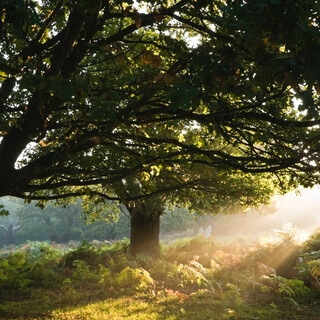
This is a story titled The Man Who Planted Trees by Jean Guionot.
In this wonderful story of a man named Elzard Bouffier,
An imaginary yet wholly believable shepherd,
Jean Guionot perhaps hoped to inspire a reforestation program that would renew the whole earth.
It shows us all that is best in man's relationship with nature and with his fellow man.
For Guionot,
Nature is a living force in which man can rediscover the depth and harmony he has lost in urban life.
Jean Guionot is among the most distinguished of French writers.
He wrote more than 30 novels as well as many short stories,
Plays,
Poetry,
Essays and film scripts.
Many of his books have been translated into English and this is one of them.
So make yourself comfortable and listen to this wonderful story now.
For a human character to reveal truly exceptional qualities,
One must have the good fortune to be able to observe its performance over many years.
If this performance is devoid of all egoism,
If its guiding motive is unparalleled generosity,
If it's absolutely certain that there is no thought of recompense and that in addition it has left its visible mark upon the earth,
Then there can be no mistake.
About 40 years ago I was taking a long trip on foot over mountain heights quite unknown to tourists in that ancient region where the Alps thrust down into Provence.
All this at the time I embarked upon my long walk through these deserted regions was barren and colourless land.
Nothing grew there but wild lavender.
I was crossing the area at its widest point and after three days walking found myself in the midst of unparalleled desolation.
I camped near the vestiges of an abandoned village.
I had run out of water the day before and had to find some.
These clustered houses although in ruins like an old wasps nest suggested that there must once have been a spring or a well here.
There was indeed a spring but it was dry.
The five or six houses roofless gnarled by wind and rain,
The tiny chapel with its crumbling steeple stood about like the houses and chapels in living villages but all life had vanished.
It was a fine June day brilliant with sunlight and over this unsheltered land high in the sky the wind blew with unendurable ferocity.
It growled over the carcasses of the houses like a lion disturbed at its meal.
I had to move my camp.
After five hours walking I had still not found water and there was nothing to give me any hope of finding any.
All about me was the same dryness the same coarse grasses.
I thought I glimpsed in the distance a small black silhouette upright and took it for the trunk of a solitary tree.
In any case I started toward it.
It was a shepherd.
30 sheep were lying about him on the baking earth.
He gave me a drink from his water gourd and a little later took me to his cottage in a fold of the plain.
He drew his water excellent water from a very deep natural well above which he had constructed a primitive winch.
The man spoke little.
This is the way of those who live alone but one felt that he was sure of himself and confident in his assurance.
That was unexpected in this barren country.
He lived not in a cabin but in a real house built of stone that bore plain evidence of how his own efforts had reclaimed the ruin he had found there on his arrival.
His roof was strong and sound.
The wind on the tiles made the sound of the sea upon its shores.
The place was in order.
The dishes washed,
The floor swept,
His rifle oiled.
His soup was boiling over the fire.
I noticed then that he was cleanly shaved,
That all his buttons were firmly sewn on,
That his clothing had been mended with the meticulous care that makes the mending invisible.
I shared his soup with him and afterwards when I offered my tobacco pouch he told me that he did not smoke.
His dog,
As silent as himself,
Was friendly without being so vile.
It was understood from the first that I should spend the night there.
The nearest village was still more than a day and a half away and besides I was perfectly familiar with the nature of the rare villages in that region.
There were four or five of them scattered well apart from each other on these mountain slopes among white oak thickets at the extreme end of the wagon roads.
They were inhabited by charcoal burners and the living was bad.
Families crowded together in a climate that is excessively harsh both in winter and summer found no escape from the unceasing conflict of personalities.
Irrational ambition reached inordinate proportions in the continual desire for escape.
The men took their wagon loads of charcoal to the town then returned.
The soundest characters broke under the perpetual grind.
The women nursed their grievances.
There was rivalry in everything over the price of charcoal as over a pew in the church.
Over warring virtues as over warring vices as well as over the ceaseless combat between virtue and vice.
And overall there was the wind also ceaseless to rasp upon the nerves.
There were epidemics of suicide and frequent cases of insanity usually homicidal.
The shepherd went to fetch a small sack and poured out a heap of acorns on the table.
He began to inspect them one by one with great concentration separating the good from the bad.
I smoked my pipe.
I did offer to help him.
He told me that it was his job and in fact seeing the care he devoted to the task I did not insist.
That was the whole of our conversation.
When he had set aside a large enough pile of good acorns he counted them out by tens meanwhile eliminating the small ones or those which were slightly cracked for now he examined them more closely.
When he had thus selected 100 perfect acorns he stopped and we went to bed.
There was peace in being with this man.
The next day I asked if I could rest here for a day.
He found it quite normal or to be exact he gave me the impression that nothing could startle him.
The rest was not absolutely necessary but I was interested and wished to know more about him.
He opened the pen and led his flocked pasture.
Before leaving he plunged his sack of carefully selected and counted acorns into a pail of water.
I noticed that he carried for a stick an iron rod as thick as my thumb and about a yard and a half long resting myself by walking I followed the path parallel to his.
His pasture was in a valley.
He left the dog in charge of the little flock and climbed toward where I stood.
I was afraid that he was about to rebuke me for my indiscretion but it was not that at all.
This was the way he was going and he invited me to go along if I had nothing better to do.
He climbed up to the top of the ridge about a hundred yards away.
There he began thrusting his iron rod into the earth making a hole in which he planted an acorn.
Then he refilled the hole.
He was planting oak trees.
I asked him if the land belonged to him.
He answered no.
Did he know whose it was?
He did not.
He supposed it was community property or perhaps belonged to people who cared nothing about it.
He was not interested in finding out whose it was.
He planted his hundred acorns with the greatest care.
After the midday meal he resumed his planting.
I suppose I must have been fairly insistent in my questioning for he answered me.
For three years he had been planting trees in this wilderness.
He had planted 100,
000.
Of the 100,
000,
20,
000 had sprouted.
Of the 20,
000 he still expected to lose about half to rodents or to the unpredictable designs of Providence.
There remained 10,
000 oak trees to grow when nothing had grown before.
That was when I began to wonder about the age of this man.
He was obviously over 50.
55 he told me.
His name was Elziad Boufier.
He had once had a farm in the lowlands.
There he had had his life.
He had lost his only son,
Then his wife.
He had withdrawn into this solitude where his pleasure was to live leisurely with his lambs and his dog.
It was his opinion that this land was dying for want of trees.
He added that having no very pressing business of his own he had resolved to remedy this state of affairs.
Since I was at that time in spite of my youth leading a solitary life I understood how to deal gently with solitary spirits.
But my very youth forced me to consider the future in relation to myself and to a certain quest for happiness.
I told him that in 30 years his 10,
000 oaks would be magnificent.
He answered quite simply that if God granted him life in 30 years he would have planted so many more that these 10,
000 would be like a drop of water in the ocean.
Besides he was now studying the reproduction of beech trees and had a nursery of seedlings grown from beech nuts near his cottage.
The seedlings which he had protected from his sheep with a wire fence were very beautiful.
He was also considering birches for the valleys where he told me there was a certain amount of moisture a few yards below the surface of the soil.
The next day we parted.
The following year came the war of 1914 in which I was involved for the next five years.
An infantryman hardly had time for reflecting upon trees.
To tell the truth the thing itself had made no impression upon me.
I had considered it as a hobby,
A stamp collection and forgotten it.
The war was over.
I found myself possessed of a tiny demobilization bonus and a huge desire to breathe fresh air for a while.
It was with no other objective that I again took the road to the barren lands.
The countryside had not changed.
However beyond the deserted village I glimpsed in the distance a sort of greyish mist that covered the mountain tops like a carpet.
Since the day before I had begun to think again of the shepherd tree planter.
Ten thousand oaks I reflected.
Really take up quite a lot of space.
I had seen too many men die during those five years not to imagine easily that Elzeard Bouffier was dead.
Especially since at 20 one regards men of 50 as old men with nothing left to do but die.
He was not dead.
As a matter of fact he was extremely spry.
He had changed jobs.
Now he had only four sheep but instead a hundred beehives.
He had got rid of the sheep because they threatened his young trees.
For he told me and I saw for myself the war had disturbed him not at all.
He had imperturbably continued to plant.
The oaks of 1910 were then 10 years old and taller than either of us.
It was an impressive spectacle.
I was literally speechless and as he did not talk we spent the whole day walking in silence through his forest.
In three sections it measured 11 kilometers in length and three kilometers at its greatest width.
When you remembered that all this had sprung from the hands and the soul of this one man without technical resources you understand that men could be as effectual as God in other realms than that of destruction.
He had pursued his plan and beech trees as high as my shoulder spreading out as far as the eye could reach confirmed it.
He showed me handsome clumps of birch planted five years before.
That is in 1915 when I had been fighting in Verdun.
He had set them out in all the valleys where he had guessed and rightly that there was moisture almost at the surface of the ground.
They were as delicate as young girls and very well established.
Creation seemed to come about in a sort of chain reaction.
He did not worry about it.
He was determinedly pursuing his task in all its simplicity.
But as we went back towards the village I saw water flowing in brooks that had been dry since the memory of man.
This was the most impressive result of chain reaction that I had seen.
These dry streams had once long ago run with water.
Some of the dreary villages I mentioned before had been built on the sites of ancient Roman settlements,
Traces of which still remained.
And archaeologists exploring there had found fish hooks where in the 20th century cisterns were needed to assure a small supply of water.
The wind too scattered seeds.
As the water reappeared so there reappeared willows,
Rushes,
Meadows,
Gardens,
Flowers and a certain purpose in being alive.
But the transformation took place so gradually that it became part of the pattern without causing any astonishment.
Hunters climbing into the wilderness in pursuit of hares or wild boars had of course noticed the sudden growth of little trees but had attributed it to some natural caprice of the earth.
That is why no one meddled with Elzeard Buffier's work.
If he had been detected he would have had opposition.
He was undetectable.
Who in the villages or in the administration could have dreamed of such a perseverance in a magnificent generosity?
To have anything like a precise idea of this exceptional character one must not forget that he worked in total solitude.
So total that toward the end of his life he lost the habit of speech.
Or perhaps it was that he saw no need for it.
In 1933 he received a visit from a forest ranger who notified him of an order against lighting fires out of doors for fear of endangering the growth of this natural forest.
It was the first time the man told him naively that he had ever heard of a forest growing of its own accord.
At that time Buffier was about to plant beaches at a spot some 12 kilometres from his cottage.
In order to avoid travelling back and forth,
For he was then 75,
He planned to build a stone cabin right at the plantation.
The next year he did so.
In 1935 a whole delegation came from the government to examine the natural forest.
There was a high official from the forest service,
A deputy,
Technicians.
There was a great deal of ineffectual talk.
It was decided that something must be done and fortunately nothing was done except the only helpful thing.
The whole forest was placed under the protection of the state and charcoal burning prohibited.
For it was impossible not to be captivated by the beauty of those young trees in the fullness of health and they cast their spell over the deputy himself.
A friend of mine was among the forestry officers of the delegation.
To him I explained the mystery.
One day the following week we went together to see Elzeard Buffier.
We found him hard at work,
Some 10 kilometres from the spot where the inspection had taken place.
This forester was not my friend for nothing.
He was aware of values.
He knew how to keep silent.
I delivered the eggs I had bought as a present.
We shared our lunch among the three of us and spent several hours in wordless contemplation of the countryside.
In the direction from which we had come the slopes were covered with trees 20 to 25 feet tall.
I remembered how the land had looked in 1913.
A desert,
Peaceful,
Regular toil,
The vigorous mountain air,
Frugality and above all serenity of spirit had endowed this old man with awe-inspiring health.
He was one of God's athletes.
I wondered how many more acres he was going to cover with trees.
Before leaving my friends simply made a brief suggestion about certain species of trees that the soil here seemed particularly suited to.
He did not force the point.
For the very good reason that he told me later that Buffier knows more about it than I do.
At the end of an hour's walking,
Having turned it over in my mind,
He added,
He knows a lot more about it than anyone.
He's discovered a wonderful way to be happy.
It was thanks to this officer that not only the forest but also the happiness of the man was protected.
He delegated three ranges to the task and so terrorized them that they remained proof against all the bottles of wine the charcoal burners could offer.
The only serious danger to the work occurred during the war of 1939.
As cars were being run on gasoline,
Wood-burning generators,
There was never enough wood.
Cutting was started among the oaks of 1910,
But the area was so far from any railroads that the enterprise turned out to be financially unsound.
It was abandoned.
The shepherd had seen nothing of it.
He was 30 kilometres away peacefully continuing his work,
Ignoring the war of 39 as he had ignored that of 14.
I saw Elciard Buffier for the last time in June of 1945.
He was then 87.
I had started back along the route through the wastelands,
But now in spite of the disorder in which the war had left the country,
There was a bus running between the Durants Valley and the mountain.
I attributed the fact that I no longer recognized the scenes of my earlier journeys to this relatively speedy transportation.
It seemed to me,
Too,
That the route took me through new territory.
It took the name of a village to convince me that I was actually in that region that had been all ruins and desolation.
The bus put me down at Vergones.
In 1913,
This hamlet of 10 or 12 houses had three inhabitants.
They had been savage creatures hating one another,
Living by trapping game,
Little removed,
Both physically and morally,
From the conditions of prehistoric man.
All about them nettles were feeding upon the remains of abandoned houses.
Their condition had been beyond hope.
For them,
Nothing but to await death,
A situation which rarely predisposes to virtue.
Everything was changed,
Even the air.
Instead of the harsh,
Dry winds that used to attack me,
A gentle breeze was blowing,
Laden with scent.
A sound like water came from the mountains.
It was the wind in the forest.
Most amazing of all,
I heard the actual sound of water falling into a pool.
I saw that a fountain had been built,
That it flowed freely,
And what touched me most,
That someone had planted a linden beside it,
A linden that must have been four years old,
Already in full leaf,
The incontestable symbol of resurrection.
Besides,
Vergones bore evidence of labour at the sort of undertaking for which hope is required.
Hope,
Then,
Had returned.
Ruins had been cleared away.
Dilapidated walls torn down,
And five houses restored.
Now there were twenty eight inhabitants,
Four of them young married couples.
The new houses,
Freshly plastered,
Were surrounded by gardens,
Where vegetables and flowers grew in orderly confusion,
Cabbages and roses,
Leeks and snapdragons,
Celery and anemones.
It was now a village where one would like to live.
From that point on,
I went on foot.
The war just finished,
Had not yet allowed the full blooming of life,
But Lazarus was out of the tomb.
On the lower slopes of the mountain I saw little fields of barley and of rye.
Deep in the narrow valleys the meadows were turning green.
It had taken only the eight years since then for the whole countryside to glow with health and prosperity.
On the site of ruins,
A had seen in 1913,
Now stand neat farms,
Cleanly plastered,
Testifying a happy and comfortable life.
The old streams fed by the rains and snows that the forest conserves are flowing again.
Their waters have been channelled.
On each farm,
In groves of maples,
Fountain pools overflow onto carpets of fresh mint.
Little by little the villages have been rebuilt.
People from the plains,
Where land is costly,
Have settled here,
Bringing youth,
Motion,
The spirit of adventure.
Along with roads you meet hearty men and women,
Boys and girls,
Who understand laughter and have recovered a taste for picnics.
Counting the former population,
Unrecognizable now that they live in comfort,
More than 10,
000 people owe their happiness to Elzeard Bouffier.
When I reflect that one man armed only with his own physical and moral resources was able to cause this land of Canaan to spring from the wasteland,
I am convinced that in spite of everything,
Humanity is admirable.
But when I compute the unfailing greatness of spirit and the tenacity of benevolence that it must have taken to achieve this result,
I am taken with an immense respect for that old and unlearned peasant who was able to complete a work worthy of God.
Elzeard Bouffier died peacefully in 1947 at the hospice in Benon.
And so the story ends.
There is a chapter on afterwards in relation to this book,
Which I will get to next time.
I hope you've enjoyed this beautiful story.