So I'd like to begin with an excerpt from Nelson Mandela's book,
A Long Walk to Freedom.
After becoming president of South Africa,
I asked one of my bodyguards to go with me for a walk in town.
Then we went for lunch at a local restaurant.
The waiter brought our menus and right at that moment I noticed there was a single man in front of us waiting to be served.
While he was served,
I asked my bodyguard to go and ask the man to join us.
The soldier went and transmitted the information.
The man stood up and took his plate and sat down next to me.
While eating,
His hands were constantly shaking and he didn't lift his head from the food.
When he was finished,
He waved at me,
Not looking directly in my eyes,
And I shook his hand and he got up and walked away.
One of my guards said,
That man must be very sick.
His hands wouldn't stop shaking as he was eating.
Not at all,
I replied.
The reason for the tremor is another.
The man was guarding the jail I was locked up in.
Often after torture,
After the torture I was subjected to,
I screamed and cried for water and he came and humiliated me.
He laughed at me and instead of giving me water,
He urinated on my head.
He wasn't sick.
He was scared,
Maybe fearing that I,
Now the president of the country,
Would send him to jail or do the same thing that he did to me,
Torture and humiliating him.
But that is not me.
That behavior is not part of my character,
Nor my ethics.
Minds that seek revenge destroy states and humans.
While those who seek reconciliation build nations and well-being.
So this message that Nelson Mandela is offering is reminding us that this is possible.
That what love looks like when we're not afraid.
And that's courage.
That's courage.
The physiological effects of fear are kind of extraordinary.
The potency of fear really has a lot of motivation on how people make life decisions.
Fear can keep us awake at night as worry.
Some people are resoundingly engaged in saying,
Well I'm not afraid.
That's what they're telling us,
But yet they won't engage.
Some people,
They'll stay really tight in their routine because engagement actually has a level of fear.
Kind of an unwillingness to participate is motivated by fear and self-interest.
Some people are entirely unaware of being afraid of their fears,
And they spend their whole life not engaging at all.
Fear has us coming up with all kinds of excuses and all kinds of reasons for not participating.
Many practitioners in this room even are starting to experience medical issues,
With aging.
It comes with aging,
Medical problems.
And the more mysterious the ailment,
The more we complicate it with fear of the unknown.
So in my role as a teacher and spiritual guide,
I often hold space for people when they're facing uncertainty with their health.
And what I've noticed is that most people that have a daily meditation practice,
When faced with uncertain medical issues,
Are able to meet what's happening for them with a lot more ease and a lot more balance than they even thought was possible.
It's really kind of surprising for people.
And it's one of those,
I find it's kind of delightful for me to see this as a teacher,
Because I see that the capacity of practice really is building.
And it's really the way that practice shows up.
It's kind of the fruit of practice to be able to meet uncertainty with a lot more ease and grace.
And I've also noticed that people who dabble in the practice,
You know,
Come when it's convenient.
When something goes down medically,
Or something goes down politically,
Or in our culture,
Fear takes over.
And what happens is reactivity is there,
Story is there,
Doubting is there,
All kinds of emotions are sort of running the show,
And mindfulness practice completely decreases.
And I share this because it's happened enough times now,
That I think it's important to give voice to,
Right?
The power of daily practice is really,
It can be transformational.
And transforming fear is not easy.
It's not an easy feat.
At some point in our lives,
I'm certain that it has been a fundamental basis of how we've made decisions.
You know,
All of us.
At some point,
We're all influenced by fear.
And how we see the world,
And how we see ourselves,
And how we choose to live,
Can sometimes be a result,
Like we'll see the results of that in our life.
On kind of the mundane level,
Not trying new things is,
Can be like,
Fear based.
For example,
I say that I'm not really good at technology,
That I'm a Luddite.
I actually gave myself the title of Luddite.
And that stance that I take is based on fear of not looking good,
Of looking stupid,
Or incompetent.
And somehow,
Like there's this other generation that is smarter than me.
So if I just stay and I'm a Luddite,
Then I don't have to look foolish.
You know,
The reality is,
I could probably figure this stuff out,
Right?
Even if I feel incompetent at the time of trying to figure it out.
But I stay away because I'm lazy.
And I don't want to look ignorant.
And that's the reality.
And that's the truth.
So that's a subtle way that fear is operating in the background of actions,
Or inactions,
For that matter.
So a really important aspect of our Dharma practice is to understand fear.
And be willing to not only understand it,
But also to respect it.
Like I have,
I understand that this is my motivation around technology.
And I respect that it's there.
It's okay.
I think fear should be respected.
And respected doesn't mean that we give in to it.
Or we give it authority.
But respecting it means we take a second look.
You know,
That there's something to be learned in our fear.
Whenever there's fear,
Whenever there's fear,
There's a message.
And that's an indication that something needs to be seen,
Or it needs to be given our attention,
Given our attention.
And that's where courage comes in.
Because that takes courage to look.
There is an American painter.
Her name is Agnes Martin.
And her work is considered,
Like,
Minimal and internal.
And she wrote this essay called,
What We Do Not See If We Do Not See.
And she wrote,
We all believe in life.
We feel a certain devotion.
We feel called upon to live a good life,
As good a life as we can.
Yet,
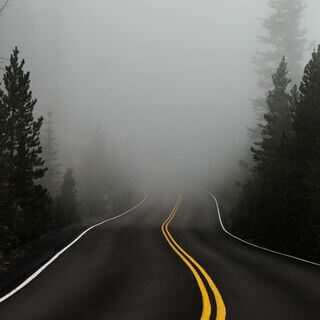
We feel we are in the dark.
And that even in darkness,
We must struggle to know what is best to do.
We feel we should not live in the same way as our ancestors.
We feel that we should take a step forward.
And we know that this step will be in the dark,
And will require courage.
I really love this.
We're called upon to live as good a life as we can.
And that's faith right there.
But we feel that we're in the dark.
There's not knowing,
Right?
And even in the darkness,
We struggle to know what is best to do.
That darkness is uncertainty.
It's confusion,
It's doubt.
We don't want to repeat what our ancestors have done in the past.
We need,
We feel we need to step forward.
But stepping forward in our own step,
Well,
And not doing what's been repeated in the past,
That requires some courage.
So courage is this intersection of faith coming together with doubt.
And the confidence of faith coupled with uncertainty.
It kind of brings together these two strands that create courage for ourselves.
And courage actually,
It's the driver of the practice that we do.
It takes courage to sit with this mind,
Have you noticed?
Because the mind has no shame.
It will go everywhere.
And the story that I shared from Nelson Mandela,
You know,
That takes that's a story of moral courage.
And he brought forward a vision that people weren't quite ready to see they weren't able to see right away.
And Martin Luther King Jr.
Also,
You know,
He's an exemplar of moral courage,
The courage to act in a deeply loving way,
In the face of opposition.
You know,
He endured so much trouble.
In his last speech,
The day before he died,
The day that before he was assassinated.
He said,
I don't know what will happen now.
We've got some difficult days ahead.
But it really doesn't matter.
Because I've been to the mountaintop.
And I don't mind,
Like anybody,
I would like to live a long life,
Longevity has its place.
But I'm not concerned about that now.
I just want to do God's will.
I've seen the promised land,
I might not get there with you.
But I want you to know tonight that we will,
As a people,
We will get to the promised land.
So this is the courage of standing in our principles.
If I take a stand for my principles,
It may cost me some of my money,
My wealth.
But yet,
If I feel so strongly about my principles,
Whatever happens,
I'm not going to betray my principles.
Like that's where we are right now as a nation,
In a way.
And that can be an incredibly lonely stand.
And I'd say we're a pretty good company,
Right?
So I imagine that both of these men that I'm speaking of,
Experienced fear at some point in their journey.
Fear comes with the territory of being a human being,
It just does.
And sometimes it's really intense,
As I've said,
And sometimes it's really mild.
And what's so interesting about fear is it's it lives more in the imagination.
And our predictions of the future,
It's kind of a constructed idea of what could be,
Or what should be,
Or what will be.
It's not happening right now.
It's an expectation.
And we talked about expectations before I left on vacation.
The problem with fear is not the fear itself,
But how we behave because of it.
Some people get afraid,
And they attack.
We've seen this,
The highest level of the land,
Right?
Some people,
When they're afraid,
They collapse.
Some people run away.
Some people put their head in the sand.
So what do we do with fear?
This is what our inquiry is about today.
Take a moment to consider what you're afraid of,
Or the last time you were afraid.
What's your response to that fear?
Just notice.
I'd like to explore in conversation the ways in which you are aware that fear is operating in you.
It's so helpful to give voice to it,
And this takes some courage.
It does.
To see and understand your own fear and respond in a different way takes some willingness and some strength.
Even to say it out loud takes some vulnerability,
And it's a little uncomfortable.
That's why we have this safe space.
But when we do examine our motivations and we talk about them,
It weakens the hold.
It weakens the hold of fear in our life.
When we understand our attitude towards fear,
It weakens the hold of how it runs.
So I'd like to open this up and talk about it.
What's your attitude towards fear?
Do you get angry?
Do you deny it?
And how are you developing courage in the face of fear?
How are you developing courage in the face of fear?
Thank you for your consideration.