Thank you for your practice.
So we are reflecting on a particular teaching this week called the Marana Sati and what that Pali word means is mindfulness of death.
And it's a Buddhist meditation practice of remembering frequently that death can strike at any time.
So this is our topic for the remainder of this week and next.
And just to say that it may be a little uncomfortable and my hope is that you'll turn towards it not away from it.
You'll turn towards it.
The reflection or the cultivation of death awareness is said to be really helpful for developing a sense of spiritual urgency.
Not like rushing around urgency but rather where you're putting your effort.
Where you're putting your energy.
What is it like looking at your aspirations.
To kind of get everything really clear while you're alive so that when death comes you can die well.
And in this practice in this teaching what happens at the moment of death is thought to be very important.
So how we meet these last moments you know the understanding is in the center of the text and the Theravada Buddhist practice doesn't talk about death and dying as much as the Tibetan teachings do.
And I'm not a scholar of Tibetan teachings but I can just pull from what I understand my understanding.
And the theory in the Tibetan teachings are that how you meet these last moments in your life the energy that's out there call it spirit call it God call it soul call it earth whatever that energy will take the state of your soul the state of your mind and create a new reality.
So if you meet death afraid and in terror then the theory is your next incarnation may not be an easy one.
So what we're doing here is exploring you know how we meet endings how we meet death.
And as you know this practice is really deeply rooted in mindfulness doing things consciously and to be mindful of the process of dying is and preparing for it is something that we're kind of doing.
Really one could say that all of spiritual practice is in a sense preparing ourselves to die to die well.
So for modern culture to reconcile its fear of death.
It requires a kind of a deep reorientation around the individual within the universe or in the world.
If I am a solitary subject in a world of the objects that I'm trying to possess and call mine and I'm confronted with the reality that I'm going to die and I can't take anything with me then this I-ness this individual being this ego that I consider the apex of creation the most important thing of the universe that it's going to die then death holds like the most horrible prospect in the world.
But if that's not what I am like like what if I is not actually what I am you know the the ego the built up self if I'm a continuation of ancestry then what actually dies if this body is woven of stardust and vines and mineral salts and goes back to being them again you know in the idea of ashes to ashes as the saying goes then what actually dies.
This is from the poet Mary Elizabeth Fry.
Do not stand at my grave and weep.
I am not there.
I do not sleep.
I am a thousand winds that blow.
I am the diamond glints on snow.
I am the sunlight on ripened grain.
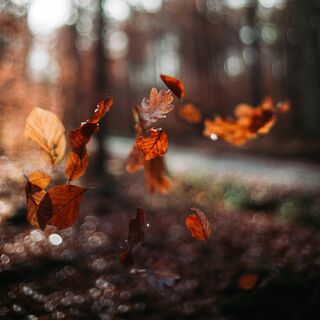
I am the gentle autumn rain.
When you awaken in the morning's hush I am the swift uplifting rush of quiet birds in circled flight.
I am the soft stars that shine at night.
Do not stand at my grave and cry.
I am not there.
I did not die.
So what actually dies?
According to biology the moment of death is actually teeming with life.
Your atoms they say don't die.
They never were according to science.
Your molecules don't die they just reform and they repurpose.
So then it begs the question does anything in nature actually die?
Nature just seems to be this eternal shape shifter and what we call this self,
I,
Is shifting back into this eternal body of vibration.
For several years I've been sharing,
Not only around the holidays,
I share this story.
It's a Plains Indian story of Jumping Mouse and as the story goes Jumping Mouse sets out on his great quest to know and to see and eventually he has this great moment of transformative initiation and what is this great moment for Jumping Mouse?
He's picked up and he's devoured by an eagle and as the land and the water below him recede into the distance we could say that you know it's easy to think that this is the end for Jumping Mouse,
The end of Jumping Mouse's story but then his friend Frog shouts from below now you have a new name.
Now they will call you Eagle.
Was he a mouse?
Was he an eagle?
Who are you?
Who are you separate from the waters that comprise your body?
Who are you?
This question brings us to that Buddhist teaching of Anata.
Anata means not self and we've looked at this before and it can be a confusing teaching for some.
If there's no self then who is it that's making effort?
Who is it that experiences anger or who is it that falls in love?
What does it mean to say there is no I?
And as mindfulness grows stronger we begin to understand that we are not this body.
Some of you have been practicing together for a while now.
We understand that we're not these thoughts that arise.
We're not these emotions that are felt.
We begin to really see and experience in our practice the idea of self is a mental construct.
It's a mental fabrication.
We are making up this idea of self and understanding this is really important.
As we explore death what dies are these mental constructs and fabrications and they can die before we die.
As we deepen mindfulness practice maybe we don't discard everything that we might call self our preferences our identity but we learn to hold it more wisely.
Not me not mine just a role right now.
Maybe we're not operating from a self that's devoted to clinging to this is me.
And what's interesting as we explore this topic of death and dying people tend to hold onto life tighter when they're very identified with the construction that is their self.
That the self that holds so tightly onto this what is really the egoic construction of me and the ego doesn't want to die.
But if we can practice letting the ego die before we die then when our time comes to enter into that cottage of darkness as the poet Mary Oliver beautifully states maybe our vision of death won't be so frightening.
So in yesterday's practice group I pointed out that this reflection on death it bumps into notions that you might have about living and dying.
So the question that I asked and maybe those of you who were in practice yesterday may be more prepared to speak to it today but I want to ask you to reflect on this.
What is your notion about a complete life a fulfilling life?
Is a complete life that you live to be 85 or 95?
Is that what makes life fulfilling?
That you get to be that old means you've had a fulfilling life?
Or is life about accumulating as many experiences as you can before you die?
As many peak experiences or pleasant experiences or spiritual experiences does that make life fulfilling?
Does that make life complete?
And it's not an evaluative question.
It's not like one is better and one is worse.
The reflection is to look seriously at the question what makes your life complete?
What brings fulfillment?
What notion do we have about living and dying that are deeply unconscious?
That's why I want to name it because often our notions of living and dying are so deeply unconscious we've never even considered what makes life fulfilling what makes life complete.
That's why I want to name this.
So I'll close today with a poem from the poet Rainer Wilke.
I love the dark hours of my being.
My mind deepens into them.
There I can find as in old letters the days of my life already lived and held like a legend and understood.
Then the knowing comes.
I can open to another life that's wide and timeless.
So I am something like a tree rustling over a gravesite and making real the dream of the one.
Its living roots embrace.
A dream once lost among sorrows and songs.
I love the dark hours of my being.
So thank you for your kind attention this morning.